


Skip to content
  • Facebook
  • X
  • Linkedin
  • WhatsApp
  • YouTube
  • Associate Journalism
  • About Us
  • Privacy Policy
  • 033-46046046
  • editor@artifex.news
Artifex.News

Artifex.News

Stay Connected. Stay Informed.

  • Breaking News
  • World
  • Nation
  • Sports
  • Business
  • Science
  • Entertainment
  • Lifestyle
  • Toggle search form
  • Mentally Disturbed Boy Allegedly Kills His Grandparents With Axe In UP
    Mentally Disturbed Boy Allegedly Kills His Grandparents With Axe In UP Nation
  • Gurugram Woman Dies After Mentally-Ill Son Stabs Her, Sets House On Fire
    Gurugram Woman Dies After Mentally-Ill Son Stabs Her, Sets House On Fire Nation
  • Vaccine for dengue may be available commercially by mid-2026 
    Vaccine for dengue may be available commercially by mid-2026  Science
  • Real Madrid Eagerly Await Kylian Mbappe After PSG Exit Confirmed
    Real Madrid Eagerly Await Kylian Mbappe After PSG Exit Confirmed Sports
  • Travis Head’s ‘Obscene’ Finger Celebration Explained After Social Media Furore During MCG Test
    Travis Head’s ‘Obscene’ Finger Celebration Explained After Social Media Furore During MCG Test Sports
  • Wayanad debris slip: Accurate weather forecasting still elusive in Wayanad
    Wayanad debris slip: Accurate weather forecasting still elusive in Wayanad Nation
  • Viral! Video Clip Showing WWE Superstar Talking About MS Dhoni Takes Internet By Storm
    Viral! Video Clip Showing WWE Superstar Talking About MS Dhoni Takes Internet By Storm Sports
  • Access Denied Sports
How magnetic levitation lifts and propels high-speed maglev trains

How magnetic levitation lifts and propels high-speed maglev trains

Posted on July 20, 2026 By admin


‘Maglev’ is a portmanteau of ‘magnetic levitation’. Instead of running on wheels, maglev technology uses strong magnetic fields to lift the train and move it forward. Since the train floats above the track, there is no rolling friction during normal operations, nor are operations affected by inclement weather, like rain or snow. The result: the train can move at extremely high speed, topping 400 km/hr, while also giving passengers a smooth ride.

How is a train lifted?

Nature has four fundamental forces: the two nuclear forces, the electromagnetic force, and gravity. Of them, gravity is the weakest by far — around 1039 times weaker than the electromagnetic force. This is why a small magnet can stay stuck to your fridge despite having the entire gravitational force of the earth pulling it down. The same idea applies to lifting a train weighing somewhere from 150 to 500 tonnes.

Engineers get the train to float above the tracks using electromagnetic suspension (EMS). The train has two ‘arms’ that wrap around the guideway over which it runs. Strong electromagnets on these arms point magnetic fields up towards the protruding parts of the guideway. Say you are lifting a bag with your hand. Your fingers wrap around the bag’s strap. The train’s arms do something like this — they wrap only just halfway, and from the bottom part, i.e., where the tip of your finger would be, exert a magnetic field into the underside of the strap. When these electromagnets are turned on, they exert a magnetic field that attracts them towards the guideway, i.e., your fingers would be attracted towards the strap. As a result, the train is pushed upwards. The train is fit with sensors that help it float around 10 mm above the guideway at all times.

In a closely related technology called electrodynamic suspension (EDS), there are superconducting magnets on the train that are cooled to a very low temperature. When the train moves, the magnets that move with it induce an electric current in coils built into the sides of the tracks. (The phenomenon is called electromagnetic induction.) The result is a repulsive force that pushes the train up. Since the magnets have to move to induce the current, the train often needs to be travelling at around 100 km/hr before the effect can kick in, and until then it uses wheels. The train also hovers higher above the track, at around 100 mm.

But in exchange for requiring wheels, EDS can support higher speeds. EMS systems operate at around or under 500 km/hr whereas the SCMAGLEV EDS system in Japan achieved 603 km/hr during testing in 2015.

How does the train move forward?

The walls of the guideway are lined with coils that carry an alternating current (AC). This current creates a magnetic field that constantly shifts its poles (north to south) along the track. The magnets on the train are attracted to the ‘opposite’ pole ahead and repelled by the ‘like’ pole behind. As a result, the train is simultaneously pulled forward from the front and pushed forward from the back. And to make the train go faster, engineers just need to increase the frequency of the AC.

Similarly, the current is used to switch the direction of the magnetic field to slow the train or altogether stop it. This process may also use regenerative braking to divert the energy ‘saved’ by braking to the electric grid.

If a fast-moving maglev train starts to drift, there are magnets on the sides that repel/attract accordingly to ensure it stays centered. For emergencies or when the magnetic braking fails, the system is also fit with friction brakes. They come in two forms, although there are other technologies as well. One: the maglev train is also fit with ‘regular’ auxiliary wheels, and these wheels have a braking system akin to those in other trains and cars. Two: braking pads between the guideway and the train apply friction to further slow it down.

What are the downsides of maglev?

The maglev system including the guideway cannot reuse existing guideways and stations vis-à-vis non-maglev trains. It needs its own. And this infrastructure is very expensive as the guideway needs to have magnets and coils with precision engineering.

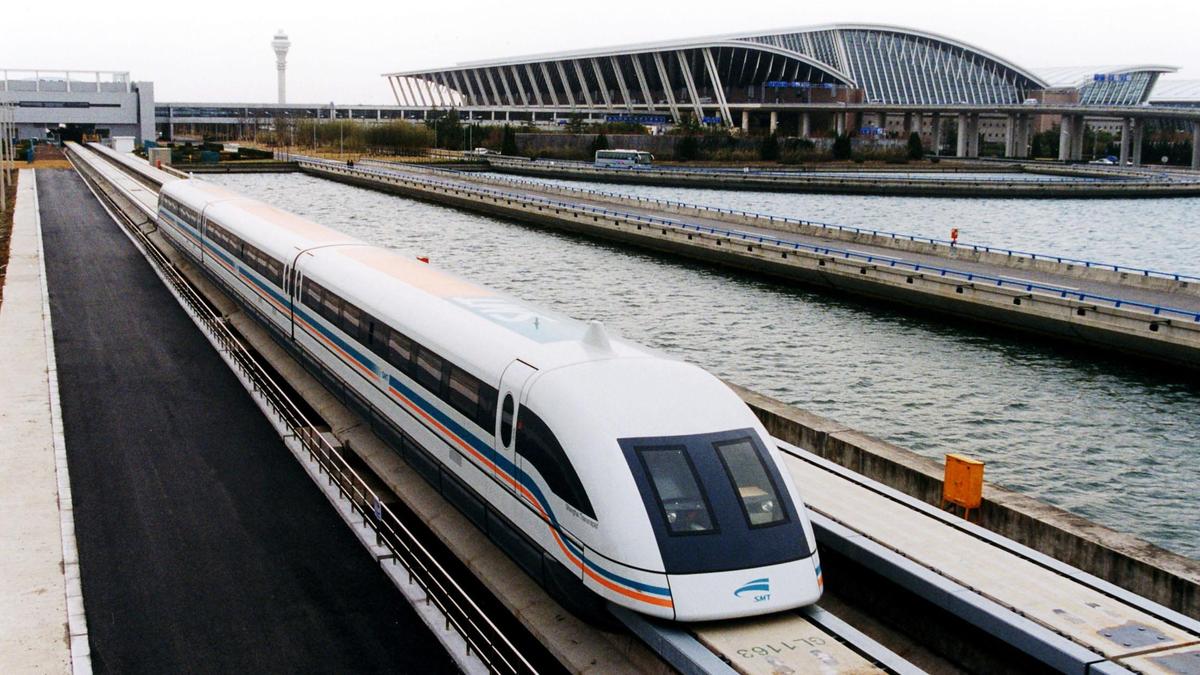
The Shanghai Maglev, which was completed in 2004, cost ₹580 crore to ₹720 crore per kilometre (adjusted for inflation). This is excluding the cost of preparing the local terrain first — and operational costs like maintenance. Ergo, there needs to be very high and consistent passenger demand. Otherwise, the economics won’t work out.

On the engineering front, while there is no rolling friction, a train moving very fast — especially over 300 km/hr — experiences aerodynamic resistance due to the flow of air around the train’s body. This is why maglev trains have aerodynamic designs (which can add to the cost), including a front portion that resembles a bird’s beak.

Is maglev technology used elsewhere?

Maglev is essential about using magnetic fields to support or move objects — a use-case that arises in many enterprises. High-speed turbines and compressors suspend their rotating shafts in a magnetic field instead of conventional bearings, minimising mechanical contact and allowing the blades to turn faster. Similarly, modern aircraft carriers use the linear motor technology that pushes maglev trains forward to accelerate aircraft on the vessels’ runways.

Factory automation systems also use it to achieve the rapid, precise motion crucial in semiconductor manufacturing, food and medicine packaging, CNC machining, inspection cameras involving lasers or X-rays, and DNA sequencing, among others.

Scientists have also used magnetic fields to levitate biological samples, liquid droplets, molten metals, and even small animals for experiments. Following a suggestion by his wife, the British physicists Andre Geim and Michael Berry used a magnetic field to levitate a frog in 1997. This was possible because a form of magnetism called diamagnetism gives all materials a very weak magnetic field. The duo had to work out the strength of the field required to ‘cancel out’ the gravitational force exerted on the frog by the earth. Thus, they were able to get the frog to float using a 10-tesla magnet.

For this work the duo won an Ig Nobel Prize in 2000. Today, Geim remains the only scientist to have won both an Ig Nobel Prize and a Nobel Prize. Berry is also a noted physicist, known for his work on semi-classical physics.

Published – July 21, 2026 09:15 am IST



Source link

Science

Post navigation

Previous Post: Philippines accuses Chinese coast guard of injuring Filipino sailor in disputed shoal
Next Post: It was a rewarding experience as a captain: Shubhang

Related Posts

  • IIT Guwahati team finds blue-green algae can remove lead from water
    IIT Guwahati team finds blue-green algae can remove lead from water Science
  • Food systems largest violators of planetary limits: 2025 EAT-Lancet Commission
    Food systems largest violators of planetary limits: 2025 EAT-Lancet Commission Science
  • Carrot extract can make fake ghee dodge quality test: study
    Carrot extract can make fake ghee dodge quality test: study Science
  • Euclid space telescope discovers new ‘Einstein ring’ in nearby galaxy
    Euclid space telescope discovers new ‘Einstein ring’ in nearby galaxy Science
  • Watch: What is ammonia poisoning?
    Watch: What is ammonia poisoning? Science
  • 13 new amphibians recorded from northeast
    13 new amphibians recorded from northeast Science

More Related Articles

ISRO successfully launches PSLV-C59 rocket with European Space Agency’s Proba-3 satellites ISRO successfully launches PSLV-C59 rocket with European Space Agency’s Proba-3 satellites Science
Forgotten but not gone: Covid keeps killing, five years on Forgotten but not gone: Covid keeps killing, five years on Science
India and the second Space Age India and the second Space Age Science
Polar geoengineering projects could cause severe harm, scientists say Polar geoengineering projects could cause severe harm, scientists say Science
IMF chief warns global monetary system not ready for AI cyber threats IMF chief warns global monetary system not ready for AI cyber threats Science
Anticyclones, hanging even now over India, link warming to heat | Explained Anticyclones, hanging even now over India, link warming to heat | Explained Science
SiteLock

Archives

  • July 2026
  • June 2026
  • May 2026
  • April 2026
  • March 2026
  • February 2026
  • January 2026
  • December 2025
  • November 2025
  • October 2025
  • September 2025
  • August 2025
  • July 2025
  • June 2025
  • May 2025
  • April 2025
  • March 2025
  • February 2025
  • January 2025
  • December 2024
  • November 2024
  • October 2024
  • September 2024
  • August 2024
  • July 2024
  • June 2024
  • May 2024
  • April 2024
  • March 2024
  • February 2024
  • January 2024
  • December 2023
  • November 2023
  • October 2023
  • September 2023
  • August 2023
  • July 2023
  • June 2023
  • May 2023
  • April 2023
  • March 2023
  • February 2023
  • January 2023
  • December 2022
  • November 2022
  • October 2022
  • September 2022
  • August 2022
  • July 2022
  • June 2022
  • May 2022

Categories

  • Business
  • Nation
  • Science
  • Sports
  • World

Recent Posts

  • Adult unmarried daughter can claim financial support for education from father under DV Act: Karnataka High Court
  • China summons Philippine Ambassador over South China Sea encounter
  • ASEAN’s top diplomats meet in shadow of U.S.-Iran conflict
  • July 21, 1993 Kolkata police firing: What does the Commission of Inquiry report reveal? | Explained
  • India name 20-member squad for Hockey World Cup, Harmanpreet Singh to lead

Recent Comments

  1. ThurmanWency on UP Teacher Who Asked Students To Slap Muslim Classmate
  2. Davidpsymn on UP Teacher Who Asked Students To Slap Muslim Classmate
  3. Robertmoina on UP Teacher Who Asked Students To Slap Muslim Classmate
  4. Martysek on UP Teacher Who Asked Students To Slap Muslim Classmate
  5. Shanealand on UP Teacher Who Asked Students To Slap Muslim Classmate
  • EV prices to match that of petrol vehicles in 4-6 months: Gadkari
    EV prices to match that of petrol vehicles in 4-6 months: Gadkari Business
  • Rupee settles flat at 83.13 against U.S. dollar
    Rupee settles flat at 83.13 against U.S. dollar Business
  • Access Denied
    Access Denied Nation
  • FIFA World Cup 2026, New Zealand vs Belgium LIVE updates: de Bruyne makes it 3-0
    FIFA World Cup 2026, New Zealand vs Belgium LIVE updates: de Bruyne makes it 3-0 Sports
  • Access Denied World
  • India will support any feasible, mutually acceptable solution: Ministry of External Affairs on Russia-Ukraine conflict
    India will support any feasible, mutually acceptable solution: Ministry of External Affairs on Russia-Ukraine conflict World
  • ‘Partnering with top Indian institutes on decarbonisation R&D’
    ‘Partnering with top Indian institutes on decarbonisation R&D’ Business
  • Gautam Gambhir appointed India men’s cricket head coach
    Gautam Gambhir appointed India men’s cricket head coach Sports

Editor-in-Chief:
Mohammad Ariff,
MSW, MAJMC, BSW, DTL, CTS, CNM, CCR, CAL, RSL, ASOC.
editor@artifex.news

Associate Editors:
1. Zenellis R. Tuba,
zenelis@artifex.news
2. Haris Daniyel
daniyel@artifex.news

Photograher:
Rohan Das
rohan@artifex.news

Artifex.News offers Online Paid Internships to college students from India and Abroad. Interns will get a PRESS CARD and other online offers.
Send your CV (Subjectline: Paid Internship) to internship@artifex.news

Links:
Associate Journalism
About Us
Privacy Policy

News Links:
Breaking News
World
Nation
Sports
Business
Entertainment
Lifestyle

Registered Office:
72/A, Elliot Road, Kolkata - 700016
Tel: 033-22277777, 033-22172217
Email: office@artifex.news

Editorial Office / News Desk:
No. 13, Mezzanine Floor, Esplanade Metro Rail Station,
12 J. L. Nehru Road, Kolkata - 700069.
(Entry from Gate No. 5)
Tel: 033-46011099, 033-46046046
Email: editor@artifex.news

Copyright © 2023 Artifex.News Newsportal designed by Artifex Infotech.