



Skip to content
  • Facebook
  • X
  • Linkedin
  • WhatsApp
  • YouTube
  • Associate Journalism
  • About Us
  • Privacy Policy
  • 033-46046046
  • editor@artifex.news
Artifex.News

Artifex.News

Stay Connected. Stay Informed.

  • Breaking News
  • World
  • Nation
  • Sports
  • Business
  • Science
  • Entertainment
  • Lifestyle
  • Toggle search form
  • 2 Arrested Over Indore Temple Tragedy That Killed 36 In March Last Year
    2 Arrested Over Indore Temple Tragedy That Killed 36 In March Last Year Nation
  • Birubala Rabha, Padma Shri Winner Who Helped Pass Assam’s Anti-Witch Hunting Law, Dies
    Birubala Rabha, Padma Shri Winner Who Helped Pass Assam’s Anti-Witch Hunting Law, Dies Nation
  • What Experts Say About The Disease
    What Experts Say About The Disease World
  • Access Denied
    Access Denied Nation
  • No proposal since April 1 to increase price of petrol: Petroleum Ministry official
    No proposal since April 1 to increase price of petrol: Petroleum Ministry official Business
  • Historic Move From Old To New Parliament Today: 10 Facts
    Historic Move From Old To New Parliament Today: 10 Facts Nation
  • Dr Reddy’s, FDC recall products in U.S. for manufacturing issues
    Dr Reddy’s, FDC recall products in U.S. for manufacturing issues World
  • ‘That’s It For Me As A Coach’ Says Ex-Liverpool Manager Jurgen Klopp
    ‘That’s It For Me As A Coach’ Says Ex-Liverpool Manager Jurgen Klopp Sports
Indian lab designs quantum algorithm to beat classical computers

Indian lab designs quantum algorithm to beat classical computers

Posted on July 8, 2026 By admin


Ask Indrakshi Raychowdhury what a quantum computer is bad at, and she points to arithmetic.

“If you try to add two numbers, a classical calculator does it easily, whereas doing it on a quantum computer is incredibly difficult,” she said in a conversation with The Hindu. “But simulating a highly complex, interacting quantum system (where particles mutually influence each other) is relatively easy for a quantum computer. That is highly counterintuitive, but it is where quantum advantage lies.”

“Understanding exactly where quantum computers can provide this advantage is currently the biggest challenge, and it is why governments and companies are investing heavily in this space,” Dr. Raychowdhury, an associate professor in the physics department at BITS Pilani (Goa campus), added.

High bar

The problem her team solved a few weeks ago is of the useful kind. According to one expert assessment, it is only one of three problems that are incredibly useful to physicists and also impervious (so far) to the muscle of classical computers. In other words, it demonstrates ‘quantum advantage’.

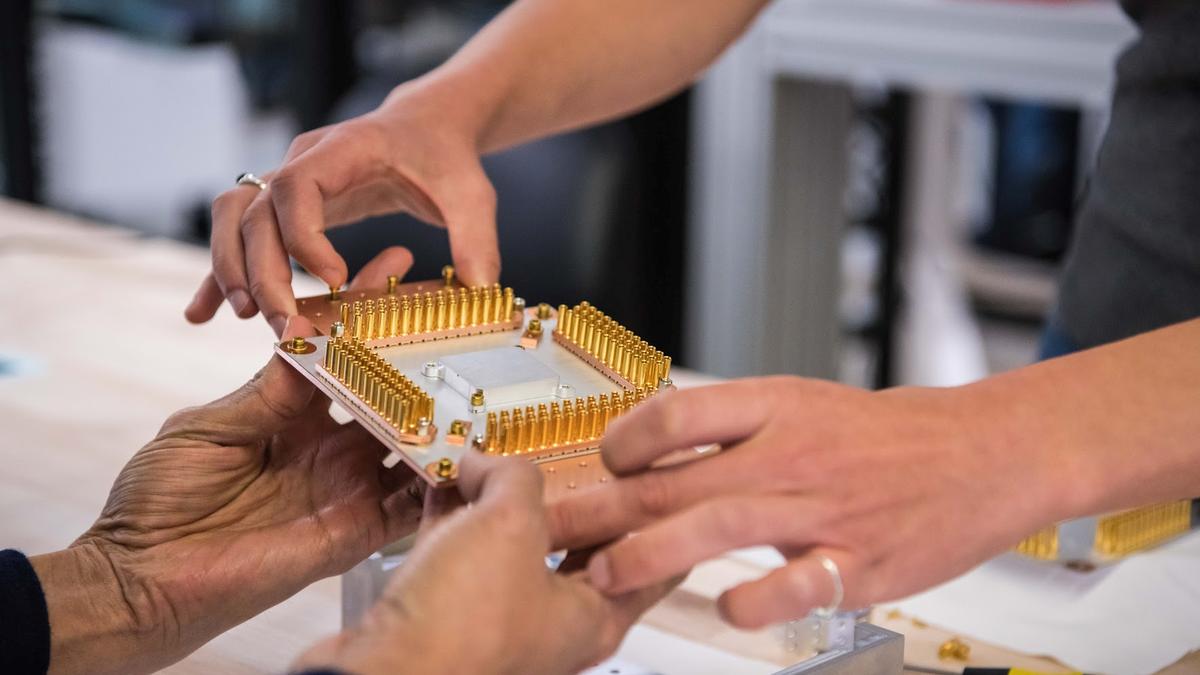
Working with scientists from IBM Quantum, Dr. Raychowdhury and her colleagues simulated the behaviour of subatomic particles on 120 qubits — qubits being the computing currency of quantum computers — of an IBM processor. The calculation took the quantum machine 20 seconds and a classical computer two hours.

The Quantum Advantage Tracker (QAT), the expert assessor, exists to police that claim. Launched in November 2025 by IBM, with the Flatiron Institute, the startups BlueQubit and Algorithmiq, and a widening cast of academic reviewers, QAT is a kind of live peer review where a researcher submits a result and a committee reproduces it — on both classical and quantum machines — before letting it stand. The bar is high. Of some 220 items logged on its GitHub page, only around a dozen have been accepted, and just a handful survive as ‘active’ claims.

The Quantum Advantage Tracker homepage.

The Quantum Advantage Tracker homepage.
| Photo Credit:
Quantum Advantage Tracker

“It is more thorough than a standard academic journal,” Dr. Raychowdhury said. It is here that her group’s entry now sits, marked ‘active’ — the first such from an Indian laboratory. Were the problem to be solvable by a classical machine, it would be considered ‘superseded’. How long their solution stays ‘active’ is an open challenge: since May, they haven’t been superseded.

Looking for the right problem

For all the money and noise around quantum computing, the machines have yet to solve a genuinely useful problem faster than an ordinary computer. The best-known demonstrations have been contrived. When Google reported in 2019 that its processor had finished in minutes a task a supercomputer would need 10,000 years to match, the task had no practical use and was chosen precisely because it suited quantum hardware. (To be sure, the QAT has a space for those too.)

Breaking modern encryption or simulating a large molecule from scratch remains years away. So the field has begun to chase a narrower prize: “useful” advantage, a quantum win on a real problem whose answer can be independently checked.

Dr. Raychowdhury’s problem of choice lies at the foundations of physics. The quarks inside a proton, and the gluons that bind them, are governed by the strong nuclear force, and working out how they move and rearrange in real time is among the toughest problems in the field. Classical methods are good at snapshots — they can pin down a proton’s mass with great accuracy — but watching the particles evolve, frame by frame, is “exponentially hard to calculate classically,” she said. A quantum computer, being itself made of quantum parts, can instead be coaxed into imitating the system directly: a still photograph replaced by a film.

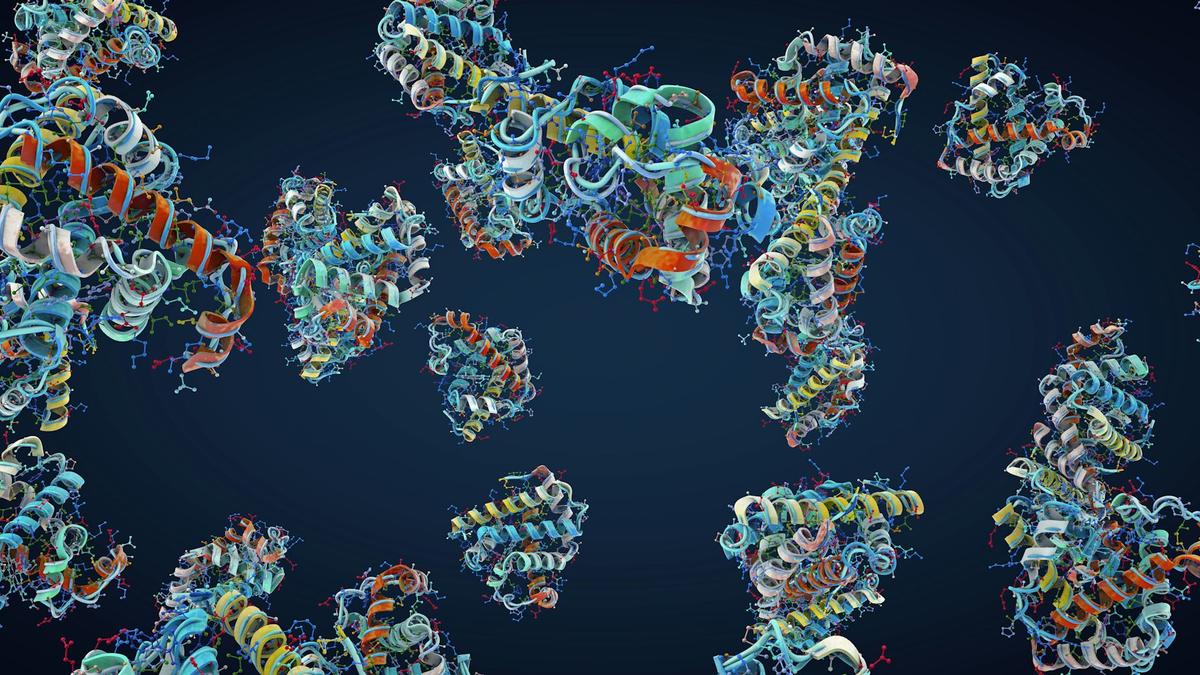
The quarks inside a proton and the gluons that bind them are governed by nature’s strongest force.

The quarks inside a proton and the gluons that bind them are governed by nature’s strongest force.
| Photo Credit:
Image created with AI

“I am actually visiting CERN (Switzerland) next month,” she said, where the world’s most powerful particle smasher pulverises protons to physically trace how the simplest particles may evolve into weightier, more complicated ones. CERN researchers, hemmed in by the limits of classical methods, have invited her, she said, to know whether her approach can carry their simulations further.

‘Without algorithms, hardware is useless’

The model her team used was a simplified stand-in for the full theory of the strong force, which is nature’s most powerful force. While no new particle has emerged from it, the novelty lies in the method. Her group’s encoding stripped away mathematical redundancy so the simulation could scale; a task others had run on at most 27 qubits was pushed to 120. “If someone gave me a 1,000-qubit computer today, our algorithm would scale to it seamlessly,” she reckoned.

Just as portable, she believes, is the trick her team used to beat the noise that plagues fragile quantum hardware: run the experiment twice — once with the particle, once without — within fractions of a second, then subtract one measurement from the other, so that the near-identical errors cancel out. “It is an inexpensive way of mitigating noise,” she said, and colleagues have already begun applying it to other problems. None of it required her to leave her desk. IBM’s machines are reached over the cloud, programmed in Python through a toolkit called Qiskit, and most of her runs finished in minutes. “While the media often highlights quantum applications in drug discovery or material science, those fields are at a much more primitive stage computationally than high-energy physics.”

India is only beginning to build towards this. Its National Quantum Mission, the ₹6,003-crore programme approved in 2023, is funding quantum algorithms and runs a computing hub in Bengaluru, but the country has no high-end quantum hardware of its own, and researchers here lean on machines abroad.

“Without algorithms, the hardware is useless; you can’t just sit in front of a quantum computer and get an answer,” she said.

jacob.koshy@thehindu.co.in

Published – July 09, 2026 09:00 am IST



Source link

Science

Post navigation

Previous Post: I am a coach for moments like this, says Argentina’s Lionel Scaloni
Next Post: Wimbledon 2026 | Of longevity and supreme fitness: Djokovic keeps redefining his career graph

Related Posts

  • Advances in cardiac care and the challenge of accessibility in India
    Advances in cardiac care and the challenge of accessibility in India Science
  • Russia reports coolant leak in backup line at space station and says crew not in danger
    Russia reports coolant leak in backup line at space station and says crew not in danger Science
  • Jabarkhet: can private reserves restore wildlife and keep tourism gentle?
    Jabarkhet: can private reserves restore wildlife and keep tourism gentle? Science
  • Not your everyday forecast: Odd weather you won’t believe is real
    Not your everyday forecast: Odd weather you won’t believe is real Science
  • Sahara space rock 4.5 billion years old upends assumptions about the early Solar System
    Sahara space rock 4.5 billion years old upends assumptions about the early Solar System Science
  • Sci-Five | The Hindu Science Quiz: On Autism
    Sci-Five | The Hindu Science Quiz: On Autism Science

More Related Articles

New theory of general relativity casts doubt on dark matter New theory of general relativity casts doubt on dark matter Science
Asteroid named after Bengaluru Professor Asteroid named after Bengaluru Professor Science
Phase of matter where order, disorder coexist in time found Phase of matter where order, disorder coexist in time found Science
Balancing two forms of SNCA protein could help manage Parkinson’s, study finds Balancing two forms of SNCA protein could help manage Parkinson’s, study finds Science
Science Quiz on rivers and cities Science Quiz on rivers and cities Science
Why do microwave ovens sometimes overheat water? Why do microwave ovens sometimes overheat water? Science
SiteLock

Archives

  • July 2026
  • June 2026
  • May 2026
  • April 2026
  • March 2026
  • February 2026
  • January 2026
  • December 2025
  • November 2025
  • October 2025
  • September 2025
  • August 2025
  • July 2025
  • June 2025
  • May 2025
  • April 2025
  • March 2025
  • February 2025
  • January 2025
  • December 2024
  • November 2024
  • October 2024
  • September 2024
  • August 2024
  • July 2024
  • June 2024
  • May 2024
  • April 2024
  • March 2024
  • February 2024
  • January 2024
  • December 2023
  • November 2023
  • October 2023
  • September 2023
  • August 2023
  • July 2023
  • June 2023
  • May 2023
  • April 2023
  • March 2023
  • February 2023
  • January 2023
  • December 2022
  • November 2022
  • October 2022
  • September 2022
  • August 2022
  • July 2022
  • June 2022
  • May 2022

Categories

  • Business
  • Nation
  • Science
  • Sports
  • World

Recent Posts

  • Oilseeds cultivation to be promoted on 2,100 hectares in Tiruchi district this year
  • Eye on Indo-Pacific: India and Australia deepen ties across nuclear, maritime and mineral sectors
  • Majesticus and Lucky Diamond show out
  • Tamil Nadu CM Vijay to distribute govt. job appointment orders to kin of 32 Karur stampede victims
  • Ensure 100% spending of ₹20,643-crore SC Sub-Plan by January: Minister Dola Sree Bala

Recent Comments

  1. Matthewben on UP Teacher Who Asked Students To Slap Muslim Classmate
  2. Matthewben on UP Teacher Who Asked Students To Slap Muslim Classmate
  3. Matthewben on UP Teacher Who Asked Students To Slap Muslim Classmate
  4. Matthewben on UP Teacher Who Asked Students To Slap Muslim Classmate
  5. Matthewben on UP Teacher Who Asked Students To Slap Muslim Classmate
  • Access Denied Sports
  • PM Narendra Modi Modi In New York
    PM Narendra Modi Modi In New York Nation
  • Access Denied Business
  • Access Denied Sports
  • Access Denied
    Access Denied Nation
  • Bus carrying Indian pilgrims in Nepal plunges down slope killing seven
    Bus carrying Indian pilgrims in Nepal plunges down slope killing seven World
  • Proving Me Guilty By Media Trial Wrong
    Proving Me Guilty By Media Trial Wrong Nation
  • Access Denied
    Access Denied Nation

Editor-in-Chief:
Mohammad Ariff,
MSW, MAJMC, BSW, DTL, CTS, CNM, CCR, CAL, RSL, ASOC.
editor@artifex.news

Associate Editors:
1. Zenellis R. Tuba,
zenelis@artifex.news
2. Haris Daniyel
daniyel@artifex.news

Photograher:
Rohan Das
rohan@artifex.news

Artifex.News offers Online Paid Internships to college students from India and Abroad. Interns will get a PRESS CARD and other online offers.
Send your CV (Subjectline: Paid Internship) to internship@artifex.news

Links:
Associate Journalism
About Us
Privacy Policy

News Links:
Breaking News
World
Nation
Sports
Business
Entertainment
Lifestyle

Registered Office:
72/A, Elliot Road, Kolkata - 700016
Tel: 033-22277777, 033-22172217
Email: office@artifex.news

Editorial Office / News Desk:
No. 13, Mezzanine Floor, Esplanade Metro Rail Station,
12 J. L. Nehru Road, Kolkata - 700069.
(Entry from Gate No. 5)
Tel: 033-46011099, 033-46046046
Email: editor@artifex.news

Copyright © 2023 Artifex.News Newsportal designed by Artifex Infotech.