


Skip to content
  • Facebook
  • X
  • Linkedin
  • WhatsApp
  • YouTube
  • Associate Journalism
  • About Us
  • Privacy Policy
  • 033-46046046
  • editor@artifex.news
Artifex.News

Artifex.News

Stay Connected. Stay Informed.

  • Breaking News
  • World
  • Nation
  • Sports
  • Business
  • Science
  • Entertainment
  • Lifestyle
  • Toggle search form
  • Congress Claims Mallikarjun Kharge’s Helicopter Checked In Bihar
    Congress Claims Mallikarjun Kharge’s Helicopter Checked In Bihar Nation
  • Minor Performs Dangerous Scooter Stunt On Road, Bengaluru Police Reacts
    Minor Performs Dangerous Scooter Stunt On Road, Bengaluru Police Reacts Nation
  • Access Denied World
  • Asian Games 2023 Comes To An End With Massive Closing Ceremony – See Pics
    Asian Games 2023 Comes To An End With Massive Closing Ceremony – See Pics Sports
  • Naagam app to list 100 snake rescuers; more to be trained in handling reptiles
    Naagam app to list 100 snake rescuers; more to be trained in handling reptiles Nation
  • Science for all newsletter Are ants in groups smarter than humans in groups?
    Science for all newsletter Are ants in groups smarter than humans in groups? Science
  • India’s Economy To Grow By 6.7% In Next Two Fiscal Years: World Bank
    India’s Economy To Grow By 6.7% In Next Two Fiscal Years: World Bank Nation
  • Access Denied Business
A new era? The 2024 Nobel Prizes and the power of machine learning

A new era? The 2024 Nobel Prizes and the power of machine learning

Posted on October 11, 2024 By admin


The 2024 Nobel Prize in chemistry recognized Demis Hassabis, John Jumper and David Baker for using machine learning to tackle one of biology’s biggest challenges: predicting the 3D shape of proteins and designing them from scratch.

This year’s award stood out because it honored research that originated at a tech company: DeepMind, an AI research startup that was acquired by Google in 2014. Most previous chemistry Nobel Prizes have gone to researchers in academia. Many laureates went on to form startup companies to further expand and commercialize their groundbreaking work – for instance, CRISPR gene-editing technology and quantum dots – but the research, from start to end, wasn’t done in the commercial sphere.

Although the Nobel Prizes in physics and chemistry are awarded separately, there is a fascinating connection between the winning research in those fields in 2024. The physics award went to two computer scientists who laid the foundations for machine learning, while the chemistry laureates were rewarded for their use of machine learning to tackle one of biology’s biggest mysteries: how proteins fold.

The 2024 Nobel Prizes underscore both the importance of this kind of artificial intelligence and how science today often crosses traditional boundaries, blending different fields to achieve groundbreaking results.

The challenge of protein folding

Proteins are the molecular machines of life. They make up a significant portion of our bodies, including muscles, enzymes, hormones, blood, hair and cartilage.

Understanding proteins’ structures is essential because their shapes determine their functions. Back in 1972, Christian Anfinsen won the Nobel Prize in chemistry for showing that the sequence of a protein’s amino acid building blocks dictates the protein’s shape, which, in turn, influences its function. If a protein folds incorrectly, it may not work properly and could lead to diseases such as Alzheimer’s, cystic fibrosis or diabetes.

A protein’s overall shape depends on the tiny interactions, the attractions and repulsions, between all the atoms in the amino acids its made of. Some want to be together, some don’t. The protein twists and folds itself into a final shape based on many thousands of these chemical interactions.

For decades, one of biology’s greatest challenges was predicting a protein’s shape based solely on its amino acid sequence. Although researchers can now predict the shape, we still don’t understand how the proteins maneuver into their specific shapes and minimize the repulsions of all the interatomic interactions in a few microseconds.

To understand how proteins work and to prevent misfolding, scientists needed a way to predict the way proteins fold, but solving this puzzle was no easy task.

In 2003, University of Washington biochemist David Baker wrote Rosetta, a computer program for designing proteins. With it he showed it was possible to reverse the protein-folding problem by designing a protein shape and then predicting the amino acid sequence needed to create it.

It was a phenomenal jump forward, but the shape chosen for the calculation was simple, and the calculations were complex. A major paradigm shift was required to routinely design novel proteins with desired structures.

A new era of machine learning

Machine learning is a type of AI where computers learn to solve problems by analyzing vast amounts of data. It’s been used in various fields, from game-playing and speech recognition to autonomous vehicles and scientific research. The idea behind machine learning is to use hidden patterns in data to answer complex questions.

This approach made a huge leap in 2010 when Demis Hassabis co-founded DeepMind, a company aiming to combine neuroscience with AI to solve real-world problems.

Hassabis, a chess prodigy at age 4, quickly made headlines with AlphaZero, an AI that taught itself to play chess at a superhuman level. In 2017, AlphaZero thoroughly beat the world’s top computer chess program, Stockfish-8. The AI’s ability to learn from its own gameplay, rather than relying on preprogrammed strategies, marked a turning point in the AI world.

Soon after, DeepMind applied similar techniques to Go, an ancient board game known for its immense complexity. In 2016, its AI program AlphaGo defeated one of the world’s top players, Lee Sedol, in a widely watched match that stunned millions.

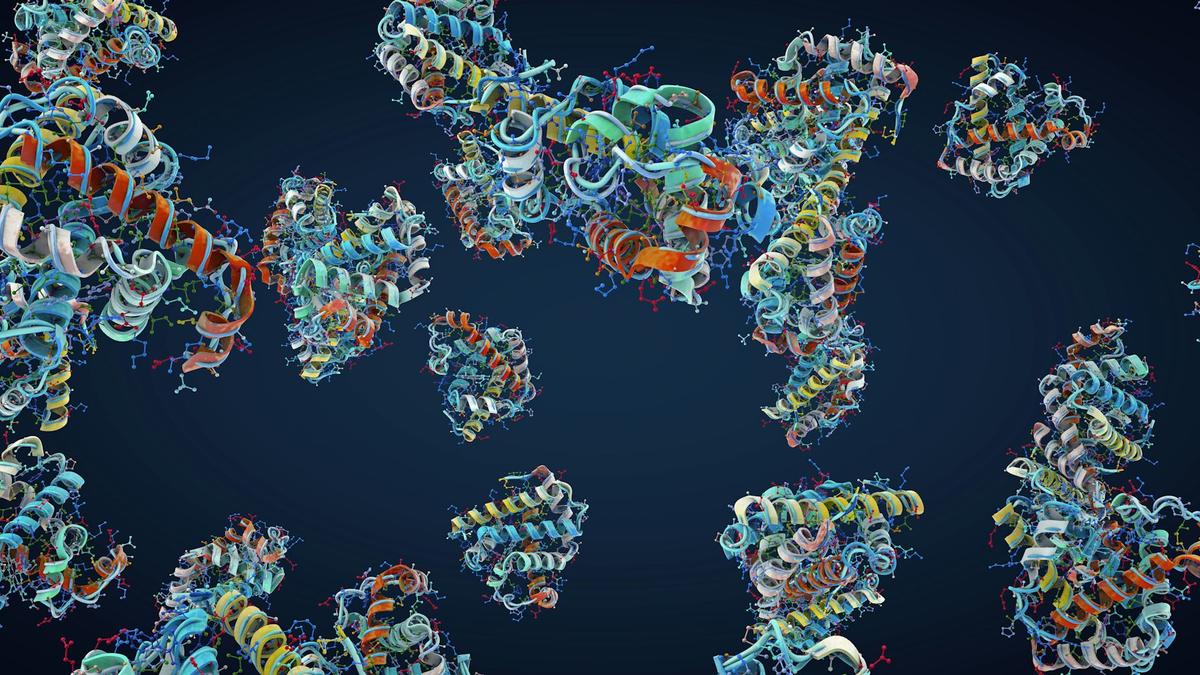
In 2016, Hassabis shifted DeepMind’s focus to a new challenge: the protein-folding problem. Under the leadership of John Jumper, a chemist with a background in protein science, the AlphaFold project began. The team used a large database of experimentally determined protein structures to train the AI, which allowed it to learn the principles of protein folding. The result was AlphaFold2, an AI that could predict the 3D structure of proteins from their amino acid sequences with remarkable accuracy.

This was a significant scientific breakthrough. AlphaFold has since predicted the structures of over 200 million proteins – essentially all the proteins that scientists have sequenced to date. This massive database of protein structures is now freely available, accelerating research in biology, medicine and drug development.

Designer proteins to fight disease

Understanding how proteins fold and function is crucial for designing new drugs. Enzymes, a type of protein, act as catalysts in biochemical reactions and can speed up or regulate these processes. To treat diseases such as cancer or diabetes, researchers often target specific enzymes involved in disease pathways. By predicting the shape of a protein, scientists can figure out where small molecules – potential drug candidates – might bind to it, which is the first step in designing new medicines.

In 2024, DeepMind launched AlphaFold3, an upgraded version of the AlphaFold program that not only predicts protein shapes but also identifies potential binding sites for small molecules. This advance makes it easier for researchers to design drugs that precisely target the right proteins.

Google bought Deepmind for reportedly around half a billion dollars in 2014. Google DeepMind has now started a new venture, Isomorphic Labs, to collaborate with pharmaceutical companies on real-world drug development using these AlphaFold3 predictions.

For his part, David Baker has continued to make significant contributions to protein science. His team at the University of Washington developed an AI-based method called “family-wide hallucination,” which they used to design entirely new proteins from scratch. Hallucinations are new patterns – in this case, proteins – that are plausible, meaning they are a good fit with patterns in the AI’s training data. These new proteins included a light-emitting enzyme, demonstrating that machine learning can help create novel synthetic proteins. These AI tools offer new ways to design functional enzymes and other proteins that never could have evolved naturally.

AI will enable research’s next chapter

The Nobel-worthy achievements of Hassabis, Jumper and Baker show that machine learning isn’t just a tool for computer scientists – it’s now an essential part of the future of biology and medicine.

By tackling one of the toughest problems in biology, the winners of the 2024 prize have opened up new possibilities in drug discovery, personalized medicine and even our understanding of the chemistry of life itself.

Marc Zimmer is professor of chemistry, Connecticut College. This article is republished from The Conversation.

Published – October 11, 2024 05:00 pm IST


Source link

Science Tags:2024 Nobel Prize in Chemistry, 2024 nobel prizes, 2024 Nobel Prizes and machine learning, science news, who won this year’s nobel prizes

Post navigation

Previous Post: Daily Quiz | On Saturday Night Live
Next Post: PAK vs ENG first Test: Jack Leach leads England’s rout of Pakistan

Related Posts

  • NASA’s Perseverance rover on Mars begins steep climb to rim of a crater
    NASA’s Perseverance rover on Mars begins steep climb to rim of a crater Science
  • Tetrapod-shaped nanoparticles could make plastics easier to process, finds IIT study
    Tetrapod-shaped nanoparticles could make plastics easier to process, finds IIT study Science
  • Indian Immunologicals Ltd develops needle-free COVID-19 intranasal booster vaccine in collaboration with Australian university
    Indian Immunologicals Ltd develops needle-free COVID-19 intranasal booster vaccine in collaboration with Australian university Science
  • NASA Artemis II launch: Astronauts reach orbit on historic mission to moon and back
    NASA Artemis II launch: Astronauts reach orbit on historic mission to moon and back Science
  • Small animals acquire genes from bacteria that can produce antibiotics
    Small animals acquire genes from bacteria that can produce antibiotics Science
  • ISRO ties up with European Space Agency for Gaganyaan missions
    ISRO ties up with European Space Agency for Gaganyaan missions Science

More Related Articles

NASA blows up another inflatable space station structure after exceeding the recommended safety levels  NASA blows up another inflatable space station structure after exceeding the recommended safety levels  Science
The Science Quiz | Twilight time – the world between worlds The Science Quiz | Twilight time – the world between worlds Science
Where does ‘us versus them’ bias in the brain come from? Where does ‘us versus them’ bias in the brain come from? Science
Dutch airport Schiphol capped at 478,000 flights per year to reduce noise Dutch airport Schiphol capped at 478,000 flights per year to reduce noise Science
What is the HbA1C test and why is it used to check for diabetes? | Explained What is the HbA1C test and why is it used to check for diabetes? | Explained Science
Scientist bottles smell of bones to help solve cold cases Scientist bottles smell of bones to help solve cold cases Science
SiteLock

Archives

  • May 2026
  • April 2026
  • March 2026
  • February 2026
  • January 2026
  • December 2025
  • November 2025
  • October 2025
  • September 2025
  • August 2025
  • July 2025
  • June 2025
  • May 2025
  • April 2025
  • March 2025
  • February 2025
  • January 2025
  • December 2024
  • November 2024
  • October 2024
  • September 2024
  • August 2024
  • July 2024
  • June 2024
  • May 2024
  • April 2024
  • March 2024
  • February 2024
  • January 2024
  • December 2023
  • November 2023
  • October 2023
  • September 2023
  • August 2023
  • July 2023
  • June 2023
  • May 2023
  • April 2023
  • March 2023
  • February 2023
  • January 2023
  • December 2022
  • November 2022
  • October 2022
  • September 2022
  • August 2022
  • July 2022
  • June 2022
  • May 2022

Categories

  • Business
  • Nation
  • Science
  • Sports
  • World

Recent Posts

  • Visakhapatnam Collector calls for inter-departmental synergy to boost investments
  • Kohli’s masterful knock powers Royal Challengers to the top
  • Vijay Narayan earns rare distinction of being Advocate General under two different governments
  • Learn from Sri Lanka’s experience on impact of fertilizer supply chains: experts
  • Sewage pollution of Cooum, groundwater depletion raise alarm

Recent Comments

  1. Leonardren on UP Teacher Who Asked Students To Slap Muslim Classmate
  2. NathanQuins on UP Teacher Who Asked Students To Slap Muslim Classmate
  3. Davidgof on UP Teacher Who Asked Students To Slap Muslim Classmate
  4. NathanJobre on UP Teacher Who Asked Students To Slap Muslim Classmate
  5. Davidcag on UP Teacher Who Asked Students To Slap Muslim Classmate
  • Man Shot Dead In Manipur’s Amid Tension Over Killing Of Women, Children
    Man Shot Dead In Manipur’s Amid Tension Over Killing Of Women, Children Nation
  • Israel FM Smotrich seeks annexation of West Bank during Trump presidency
    Israel FM Smotrich seeks annexation of West Bank during Trump presidency World
  • Access Denied Sports
  • Access Denied World
  • Watch: Global oil crisis: Why is India’s transport sector far more exposed than China’s?
    Watch: Global oil crisis: Why is India’s transport sector far more exposed than China’s? World
  • US Teacher, 26, Arrested For Sexually Abusing Teenager She Met In Church
    US Teacher, 26, Arrested For Sexually Abusing Teenager She Met In Church World
  • Supreme Court’s Demolition Verdict Will Help Curb Organised Crime: UP
    Supreme Court’s Demolition Verdict Will Help Curb Organised Crime: UP Nation
  • Serbia’s Prime Minister Milos Vucevic resigns and appeals for peace as anti-corruption protests grow
    Serbia’s Prime Minister Milos Vucevic resigns and appeals for peace as anti-corruption protests grow World

Editor-in-Chief:
Mohammad Ariff,
MSW, MAJMC, BSW, DTL, CTS, CNM, CCR, CAL, RSL, ASOC.
editor@artifex.news

Associate Editors:
1. Zenellis R. Tuba,
zenelis@artifex.news
2. Haris Daniyel
daniyel@artifex.news

Photograher:
Rohan Das
rohan@artifex.news

Artifex.News offers Online Paid Internships to college students from India and Abroad. Interns will get a PRESS CARD and other online offers.
Send your CV (Subjectline: Paid Internship) to internship@artifex.news

Links:
Associate Journalism
About Us
Privacy Policy

News Links:
Breaking News
World
Nation
Sports
Business
Entertainment
Lifestyle

Registered Office:
72/A, Elliot Road, Kolkata - 700016
Tel: 033-22277777, 033-22172217
Email: office@artifex.news

Editorial Office / News Desk:
No. 13, Mezzanine Floor, Esplanade Metro Rail Station,
12 J. L. Nehru Road, Kolkata - 700069.
(Entry from Gate No. 5)
Tel: 033-46011099, 033-46046046
Email: editor@artifex.news

Copyright © 2023 Artifex.News Newsportal designed by Artifex Infotech.