


Skip to content
  • Facebook
  • X
  • Linkedin
  • WhatsApp
  • YouTube
  • Associate Journalism
  • About Us
  • Privacy Policy
  • 033-46046046
  • editor@artifex.news
Artifex.News

Artifex.News

Stay Connected. Stay Informed.

  • Breaking News
  • World
  • Nation
  • Sports
  • Business
  • Science
  • Entertainment
  • Lifestyle
  • Toggle search form
  • Five Years On, WHO Urges China To Share Data On Covid Origins
    Five Years On, WHO Urges China To Share Data On Covid Origins World
  • Budget 2023 | Brilliant balancing act between growth, fiscal consolidation: Sanjiv Bajaj
    Budget 2023 | Brilliant balancing act between growth, fiscal consolidation: Sanjiv Bajaj Business
  • Japan Recalls One Lakh Bread Packs After Rat Remains Found In Some
    Japan Recalls One Lakh Bread Packs After Rat Remains Found In Some World
  • Access Denied Sports
  • China’s Wang Yi warns U.S. official over Philippines support
    China’s Wang Yi warns U.S. official over Philippines support World
  • Google Android Told by EU To Open Up To Rival AI Systems Business
  • Stock markets decline amid unabated foreign fund outflows, weak global trends
    Stock markets decline amid unabated foreign fund outflows, weak global trends Business
  • Access Denied Business
The perfect flaw: how a diamond defect is changing quantum physics

The perfect flaw: how a diamond defect is changing quantum physics

Posted on January 7, 2026 By admin


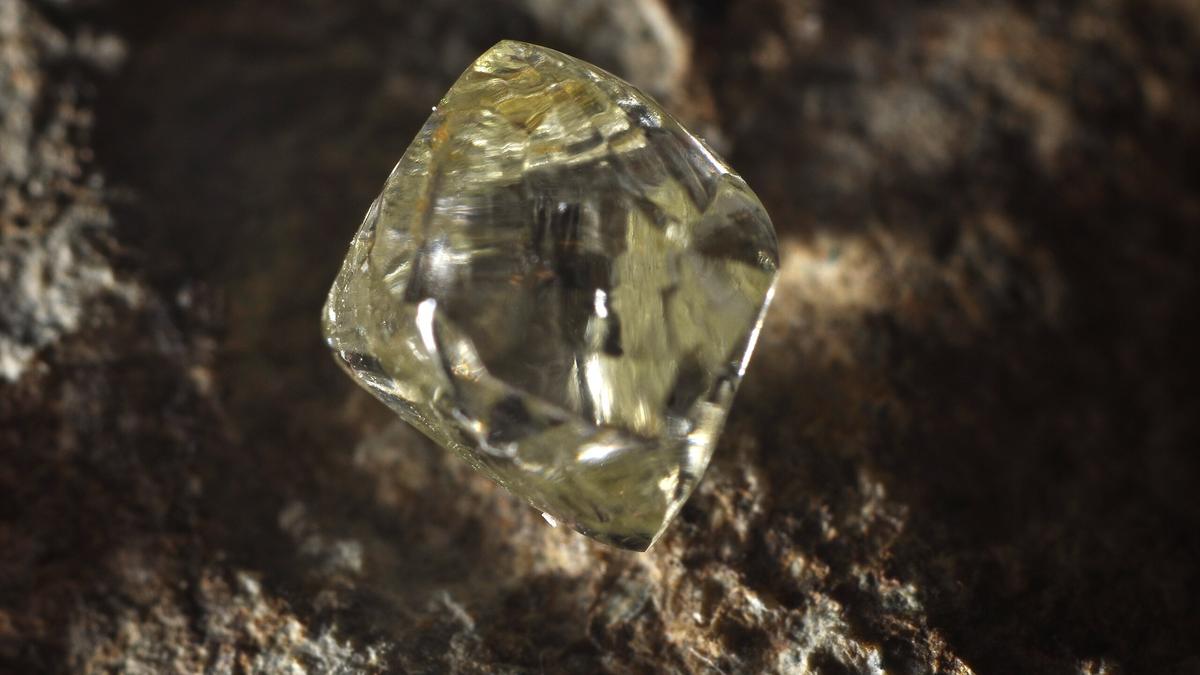
Imagine a diamond.

You probably thought of a clear and flawless gemstone used in jewellery. But to a physicist, a perfect diamond might actually be quite boring. Something magical happens when the diamond is just a little broken.

For decades, scientists have been fascinated by a specific type of defect in the diamond crystal lattice called the nitrogen-vacancy (NV) centre. All diamonds are made of a rigid grid of carbon atoms. An NV centre occurs when one carbon atom is replaced by a nitrogen atom, and the spot next to it is left empty.

This seeming blemish turns the diamond into a powerhouse for quantum technologies.

Magnetic arrows

The NV centre is often called a ‘perfect defect’ because it behaves like a single atom trapped in a solid cage. This structure gives it some remarkable abilities that hold great potential to transform how we think about computers and sensors.

The NV centre has a property called spin. Think of it as a small magnetic arrow. Because the NV centre is trapped inside the diamond structure, it’s shielded from much of the noise that would otherwise scramble its spin. This helps the spin stay coherent, or quantummy, for longer.

This is useful because scientists can then measure how the spin’s internal energy levels respond to the environment, including very weak magnetic or electric fields.

This is why NV centres are some of the world’s smallest and most precise sensors. And scientists have been using them to map the magnetic fields associated with brain activity and to detect microscopic cracks in metals.

Most quantum experiments require large, heavy, and expensive refrigerators to cool atoms down to near absolute zero (-273 ºC). If an environment becomes too warm, the quantum effects disappear in a chaotic mess because they’re sensitive to stray amounts of energy.

But NV centres are special because their rigid diamond cage protects them. They can hold onto their quantum state even at room temperature. This makes them much more practical for real-world devices, like portable medical scanners and navigation systems that don’t need GPS.

Trillions of centres

One of the most useful traits of the NV centre is the way it interacts with light.

If you shine a green laser on it, the centre will glow red. The brightness of the red glow will change depending on the state of its spin. This allows scientists to ‘read’ the quantum information stored in the diamond just by looking at how much light it emits. It’s a bridge between the invisible world of quantum mechanics and the visible world we live in.

While NV centres are amazing on their own, matters become complicated when you pack millions of them together. Usually, when these quantum spins are too close to one another, they start interacting in messy ways. They push and pull on each other, creating noise that destroys the quantum signal. This is generally seen as a problem to be fixed.

However, a study published in Nature Physics on January 2 has turned this problem on its head. A team of researchers from Austria and Japan has reported a way to use these messy interactions to create a powerful and continuous beam of microwave light.

A diamond maser

The researchers took a diamond packed with about 9 trillion NV centres and placed it inside a superconducting microwave cavity — a device that traps microwaves so they can bounce back and forth and build up, like sound echoing in a room.

Then they used a microwave pulse to energise, or invert, the spins of the NV centres. In a standard experiment, the NV centers would release this energy as a quick, bright burst of microwave light called superradiance and then stop.

After the initial burst, however, the system didn’t stop in the experiment. Instead, it started pulsing again, eventually settling into a continuous, steady emission of microwave light for up to one millisecond. In the world of quantum physics, a millisecond is a very long time.

The team had effectively created a maser. You’ve probably heard of a laser, an acronym for ‘light amplification by stimulated emission of radiation’. A maser is the same thing but for microwave radiation instead of visible light.

Bucket brigade

The researchers discovered that the very thing usually considered a nuisance, the interaction between the spins, was actually powering this maser.

“This discovery changes how we think about the quantum world,” Okinawa Institute’s director of the Center for Quantum Technologies and study coauthor Kae Nemoto said in a statement. “We’ve shown that the very interactions once thought to disrupt quantum behavior can instead be harnessed to create it. That shift opens entirely new directions for quantum technologies.”

When the first group of NV centers released their energy into the cavity, they became de-excited, or tired. Usually, that would be the end of the show. But because the diamond was so dense, these tired spins were surrounded by other energetic spins that weren’t quite tuned to the cavity’s frequency.

Through magnetic dipole-dipole interactions, essentially magnets pushing on magnets, the energetic spins passed their energy to the tired spins. This process re-filled the energy hole left behind by the first burst.

It was like the bucket brigade firefighting technique, where neighbouring spins handed off their energy to the spins that could release it as light.

Potential benefits

The finding could lead to the development of highly stable superradiant masers with a very narrow linewidth, meaning the frequency of the light is extremely pure.

“The principles we observe here could also enhance quantum sensors capable of detecting minute changes in magnetic or electric fields,” Jörg Schmiedmayer of the Vienna Center for Quantum Science and Technology, TU Wien, and study coauthor said in the release.

“Such advances could benefit medical imaging, materials science, and environmental monitoring.”

mukunth.v@thehindu.co.in

Published – January 07, 2026 09:00 am IST



Source link

Science

Post navigation

Previous Post: Access Denied
Next Post: Elon Musk’s Grok AI faces backlash from UK, EU, India, and Malaysia over sexualised deepfakes

Related Posts

  • Suriname pledges to shield 90% of forests, far beyond global conservation goal
    Suriname pledges to shield 90% of forests, far beyond global conservation goal Science
  • In an electric vehicle, what is regenerative braking? | Explained
    In an electric vehicle, what is regenerative braking? | Explained Science
  • Can datacentres in orbit solve for AI models’ soaring energy demand?
    Can datacentres in orbit solve for AI models’ soaring energy demand? Science
  • The Science Quiz: 370 years since the ‘problem of points’…
    The Science Quiz: 370 years since the ‘problem of points’… Science
  • Harris or Trump? How US space policy will change under a new president
    Harris or Trump? How US space policy will change under a new president Science
  • What are Monte Carlo methods?
    What are Monte Carlo methods? Science

More Related Articles

Nobel laureate supports India’s pursuit for a neutrino lab Nobel laureate supports India’s pursuit for a neutrino lab Science
The bacteria that write new genes to cope with infections The bacteria that write new genes to cope with infections Science
Are jellyfish randomly moving organisms? Are jellyfish randomly moving organisms? Science
Small animals acquire genes from bacteria that can produce antibiotics Small animals acquire genes from bacteria that can produce antibiotics Science
Sci-Five | The Hindu Science Quiz: on semi-conductors Sci-Five | The Hindu Science Quiz: on semi-conductors Science
Climate change reshaping disease patterns, straining health systems, finds report Climate change reshaping disease patterns, straining health systems, finds report Science
SiteLock

Archives

  • May 2026
  • April 2026
  • March 2026
  • February 2026
  • January 2026
  • December 2025
  • November 2025
  • October 2025
  • September 2025
  • August 2025
  • July 2025
  • June 2025
  • May 2025
  • April 2025
  • March 2025
  • February 2025
  • January 2025
  • December 2024
  • November 2024
  • October 2024
  • September 2024
  • August 2024
  • July 2024
  • June 2024
  • May 2024
  • April 2024
  • March 2024
  • February 2024
  • January 2024
  • December 2023
  • November 2023
  • October 2023
  • September 2023
  • August 2023
  • July 2023
  • June 2023
  • May 2023
  • April 2023
  • March 2023
  • February 2023
  • January 2023
  • December 2022
  • November 2022
  • October 2022
  • September 2022
  • August 2022
  • July 2022
  • June 2022
  • May 2022

Categories

  • Business
  • Nation
  • Science
  • Sports
  • World

Recent Posts

  • Jockeying for the KPCC president’s post gains momentum, even as uncertainty looms over the party’s Chief Minister choice
  • China, U.S. jointly crack down on transnational drug smuggling ring ahead of Trump’s visit
  • Greatest setback for workers’ rights since Independence: Congress on new labour codes
  • West Bengal Secretariat moving back to Writers’ Buildings; small traders hope for revival of businesses
  • IT industry body NITES seeks official advisory for Work from Home measures amid rising oil prices 

Recent Comments

  1. Andrewfoods on UP Teacher Who Asked Students To Slap Muslim Classmate
  2. JamesTruff on UP Teacher Who Asked Students To Slap Muslim Classmate
  3. EnriqueExins on UP Teacher Who Asked Students To Slap Muslim Classmate
  4. CliftonInese on UP Teacher Who Asked Students To Slap Muslim Classmate
  5. JamesTruff on UP Teacher Who Asked Students To Slap Muslim Classmate
  • Unprecedented Rainfall Paralyses Life In Puducherry
    Unprecedented Rainfall Paralyses Life In Puducherry Nation
  • Bangladesh gears up to host Russia’s Lavrov and French President Macron as Sheikh Hasina plans G-20 participation
    Bangladesh gears up to host Russia’s Lavrov and French President Macron as Sheikh Hasina plans G-20 participation World
  • Claims of chemical weapon use in Ukraine ‘insufficiently substantiated’: watchdog
    Claims of chemical weapon use in Ukraine ‘insufficiently substantiated’: watchdog World
  • The Hindu Morning Digest, October 30, 2024
    The Hindu Morning Digest, October 30, 2024 Nation
  • K Kavitha’s Judicial Custody Extended Till May 20 In Delhi Excise Policy Case
    K Kavitha’s Judicial Custody Extended Till May 20 In Delhi Excise Policy Case Nation
  • Shreyas Iyer Sets Expectations Clear From Under-Fire Prithvi Shaw: “Everything Else Will…”
    Shreyas Iyer Sets Expectations Clear From Under-Fire Prithvi Shaw: “Everything Else Will…” Sports
  • Life insurers’ new premium slump second month in a row, down 22% in December to ₹30,218.71 crore
    Life insurers’ new premium slump second month in a row, down 22% in December to ₹30,218.71 crore Business
  • Train Hits Road Near Station In Madhya Pradesh, Railway Cops Launch Probe
    Train Hits Road Near Station In Madhya Pradesh, Railway Cops Launch Probe Nation

Editor-in-Chief:
Mohammad Ariff,
MSW, MAJMC, BSW, DTL, CTS, CNM, CCR, CAL, RSL, ASOC.
editor@artifex.news

Associate Editors:
1. Zenellis R. Tuba,
zenelis@artifex.news
2. Haris Daniyel
daniyel@artifex.news

Photograher:
Rohan Das
rohan@artifex.news

Artifex.News offers Online Paid Internships to college students from India and Abroad. Interns will get a PRESS CARD and other online offers.
Send your CV (Subjectline: Paid Internship) to internship@artifex.news

Links:
Associate Journalism
About Us
Privacy Policy

News Links:
Breaking News
World
Nation
Sports
Business
Entertainment
Lifestyle

Registered Office:
72/A, Elliot Road, Kolkata - 700016
Tel: 033-22277777, 033-22172217
Email: office@artifex.news

Editorial Office / News Desk:
No. 13, Mezzanine Floor, Esplanade Metro Rail Station,
12 J. L. Nehru Road, Kolkata - 700069.
(Entry from Gate No. 5)
Tel: 033-46011099, 033-46046046
Email: editor@artifex.news

Copyright © 2023 Artifex.News Newsportal designed by Artifex Infotech.