




Skip to content
  • Facebook
  • X
  • Linkedin
  • WhatsApp
  • YouTube
  • Associate Journalism
  • About Us
  • Privacy Policy
  • 033-46046046
  • editor@artifex.news
Artifex.News

Artifex.News

Stay Connected. Stay Informed.

  • Breaking News
  • World
  • Nation
  • Sports
  • Business
  • Science
  • Entertainment
  • Lifestyle
  • Toggle search form
  • Chandrayaan-4 to launch in 2027: Jitendra Singh
    Chandrayaan-4 to launch in 2027: Jitendra Singh Science
  • Euro 2024: Qualification Scenarios For Knockout Stage Heading Into Final Matchweek
    Euro 2024: Qualification Scenarios For Knockout Stage Heading Into Final Matchweek Sports
  • Biden On Reports That Xi May Skip India G20 Summit
    Biden On Reports That Xi May Skip India G20 Summit World
  • Access Denied World
  • Request To Sort Mutually, Fake PMO Official Threatens CEO Of Dr Agarwal Eye Hospital
    Request To Sort Mutually, Fake PMO Official Threatens CEO Of Dr Agarwal Eye Hospital Nation
  • Access Denied Business
  • Access Denied Sports
  • Access Denied Sports
Why did metal-organic frameworks win the 2025 chemistry Nobel?

Why did metal-organic frameworks win the 2025 chemistry Nobel?

Posted on October 8, 2025 By admin


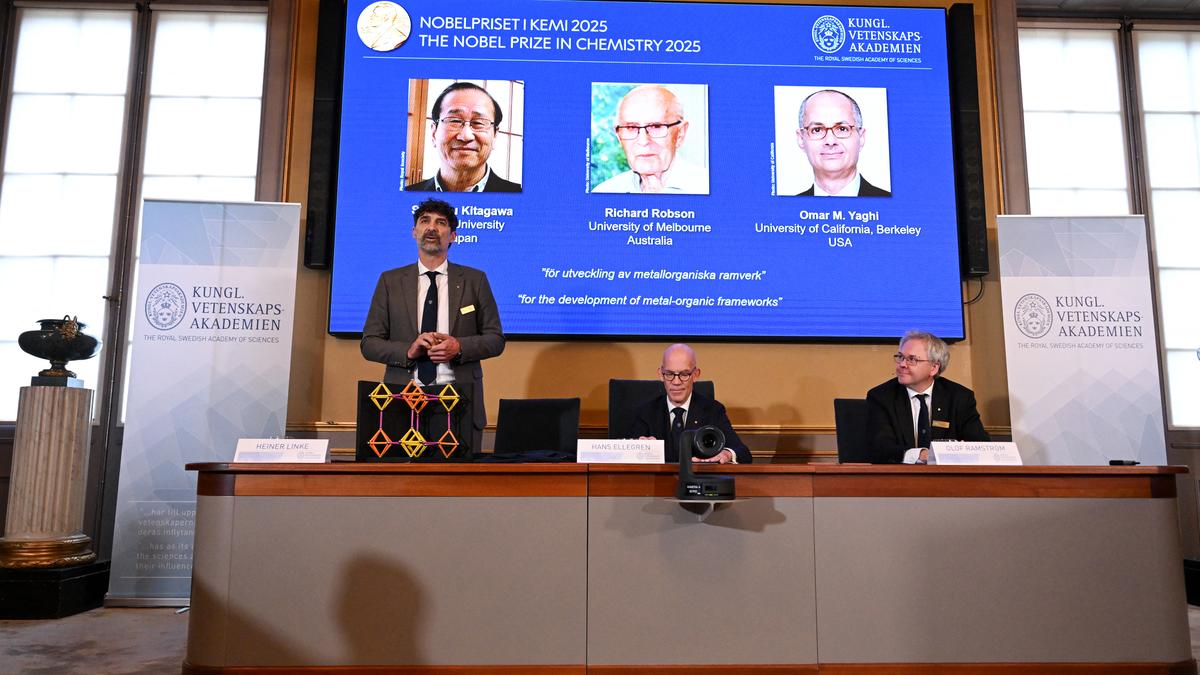
Heiner Linke (left), Chair of the Nobel Committee for Chemistry, explains a model as Hans Ellegren (centre), Secretary General of The Royal Swedish Academy of Sciences, and Olof Ramstroem, Member of the Nobel Committee for Chemistry, listen during a press conference on the announcement of the winners of the 2025 Nobel Prize in Chemistry at the Royal Swedish Academy of Sciences in Stockholm, Sweden, on October 8, 2025. Japan’s Susumu Kitagawa, UK-born Richard Robson and American-Jordanian Omar M. Yaghi won the Nobel Prize in Chemistry for developing so-called metalorganic frameworks, the Nobel jury said on October 8, 2025.
| Photo Credit: AFP

The story so far: For centuries, chemistry’s main terrain was to craft ever more complex molecules but it soon became clear to scientists that they were all confined to their own boundaries. The Nobel Prize in Chemistry 2025 honours three scientists who expanded that horizon into a whole new dimension. Susumu Kitagawa, Richard Robson and Omar Yaghi have been feted for developing metal-organic frameworks (MOFs), little molecular scaffolds with vast internal spaces where other atoms and molecules can move, react or stay.

What is a MOF?

MOFs are crystalline structures in which metal ions serve as nodes and organic molecules as connectors. The resulting structure can have enormous internal surface areas — thousands of square metres per gram — and their pores can be customised to attract or hold specific molecules.

Chemists classify MOFs as part of a larger family called coordination networks but their hallmark is tuneable porosity. By carefully choosing the building blocks, researchers can control the size and shape of the cavities and the chemical environment within. As a result, MOFs are among the most versatile materials ever created.

What did Robson and Kitagawa do?

In the 1970s, Richard Robson at the University of Melbourne was preparing ball-and-stick models to show students how atoms connect. He realised that the positions of the holes drilled into each atom contained all the information needed to determine the molecule’s shape. If that logic worked for small molecules, he wondered, could it be scaled up?

A decade later, Robson combined copper ions, which like to bond in a tetrahedral arrangement, with an organic molecule bearing four arms ending in nitrile groups. To everyone’s surprise, instead of a messy tangle, the components self-assembled into a diamond-like crystal. This lattice wasn’t dense like diamond but full of empty cavities, each capable of hosting other molecules. Robson predicted that such “frameworks” could be tailored to trap ions, catalyse reactions and sieve molecules by size.

However, Robson’s early crystals were fragile. Susumu Kitagawa in Japan made them stable and functional. Guided by his philosophy of finding “usefulness in the useless”, Kitagawa pursued porous materials even when they seemed too delicate to matter. In 1997, he used cobalt, nickel or zinc ions linked by a bridging molecule called 4,4’-bipyridine to build a true three-dimensional MOF. When the material was dried and refilled, gases such as methane, nitrogen, and oxygen could flow in and out without damaging the structure.

Kitagawa also recognised that MOFs could be soft rather than rigid, with flexible molecular joints allowing them to expand, contract or bend around depending on temperature, pressure, and the molecules inside.

What was Yaghi’s contribution?

Omar Yaghi in the U.S. gave MOFs their structural strength and reproducibility. Having grown up in modest circumstances in Jordan, Yaghi was fascinated by chemistry’s ability to create new forms of order. At Arizona State University in the 1990s, he sought a way to build extended materials by design, not by chance, using metal ions as joints and organic molecules as struts.

In 1995, he made the first two-dimensional frameworks linked by cobalt or copper ions that could host other molecules without collapsing. Four years later, he achieved a landmark with MOF-5, a robust three-dimensional lattice made from zinc ions and benzene-dicarboxylate linkers. MOF-5 was strong and, notably, just a few grams had an internal surface area comparable to a football field. It was also intact when heated to 300°C and emptied of all ‘guest’ molecules.

By the early 2000s, his team had built entire families of MOFs with the same underlying geometry but different pore sizes and functions.

Why do MOFs matter?

Say you have a tennis ball with a surface area of X. Say its outer shell is 5 mm thick. What will the total surface area be when you cut open the ball? It will be 2.2-times X (proof available on request) — which is a little illustration of the ‘magic’ of surface areas. The same ball yielded some surface area first, then with a single modification that didn’t add any new material yielded 2.2X! This fact explains one half of the allure of MOFs. The other half has to do with how easily chemists can make them for different applications.

A MOF called CALF-20 can efficiently capture carbon dioxide from factory exhaust and is already being tested in industrial plants. MOF-303 can harvest drinking water from arid desert air by absorbing vapour at night and releasing it in sunlight. UiO-67 can remove persistent forever chemicals (PFAS) from water. MIL-101 and ZIF-8 can speed up the breakdown of pollutants and recover rare-earth metals from wastewater.

In the energy sector, NU-1501 and MOF-177 can store hydrogen or methane safely at moderate pressure, a crucial step toward clean-fuel vehicles. Others serve as containers for toxic gases in semiconductor manufacturing and as drug-delivery capsules that release medicines in response to biological cues.

Published – October 08, 2025 06:51 pm IST


Source link

Science Tags:Chemistry Nobel Prize 2025, metal organic frameworks, nobel prize in chemistry 2025, Omar Yaghi, Richard Robson, Susumu Kitagawa

Post navigation

Previous Post: Access Denied
Next Post: Access Denied

Related Posts

  • As Trump floats buying Greenland, Arctic island still holds toxic US waste
    As Trump floats buying Greenland, Arctic island still holds toxic US waste Science
  • Global ocean model affirms Fukushima wastewater release is safe
    Global ocean model affirms Fukushima wastewater release is safe Science
  • When did an uptick in dental cavities in humans begin?
    When did an uptick in dental cavities in humans begin? Science
  • Researchers uncover remains of Ice Age mastodons in Peru 
    Researchers uncover remains of Ice Age mastodons in Peru  Science
  • Watch | How climate change is affecting monsoon forecast and disaster management
    Watch | How climate change is affecting monsoon forecast and disaster management Science
  • Pollen in pee: fossilised urine from a small African mammal helps us understand past environments
    Pollen in pee: fossilised urine from a small African mammal helps us understand past environments Science

More Related Articles

New sedimentary rock made from slag is a carbon-trapping champ New sedimentary rock made from slag is a carbon-trapping champ Science
Could rewiring macrophage metabolism make TB treatments shorter? Could rewiring macrophage metabolism make TB treatments shorter? Science
Unwrapping India’s plastic packaging problem: from boom to crisis Unwrapping India’s plastic packaging problem: from boom to crisis Science
IAU approves ‘Statio Shiv Shakti’ as name for Chandrayaan-3 landing site IAU approves ‘Statio Shiv Shakti’ as name for Chandrayaan-3 landing site Science
The mystery of Déjà vu The mystery of Déjà vu Science
A decade among the stars: India’s first space observatory AstroSat completes 10 years A decade among the stars: India’s first space observatory AstroSat completes 10 years Science
SiteLock

Archives

  • May 2026
  • April 2026
  • March 2026
  • February 2026
  • January 2026
  • December 2025
  • November 2025
  • October 2025
  • September 2025
  • August 2025
  • July 2025
  • June 2025
  • May 2025
  • April 2025
  • March 2025
  • February 2025
  • January 2025
  • December 2024
  • November 2024
  • October 2024
  • September 2024
  • August 2024
  • July 2024
  • June 2024
  • May 2024
  • April 2024
  • March 2024
  • February 2024
  • January 2024
  • December 2023
  • November 2023
  • October 2023
  • September 2023
  • August 2023
  • July 2023
  • June 2023
  • May 2023
  • April 2023
  • March 2023
  • February 2023
  • January 2023
  • December 2022
  • November 2022
  • October 2022
  • September 2022
  • August 2022
  • July 2022
  • June 2022
  • May 2022

Categories

  • Business
  • Nation
  • Science
  • Sports
  • World

Recent Posts

  • Israel-Iran war LIVE: Iran working on Hormuz ‘protocol’ to cover ‘costs’, says Dy FM Gharibabadi
  • Russia to fulfil all agreements on energy supply to India: FM Lavrov
  • Maruti Suzuki crosses 3 million vehicle dispatches through railways, eyes 35% share by rail
  • Delhi High Court rejects plea against tax exemption for agricultural income in Capital
  • Delhi High Court refuses to entertain PIL to prevent suicides

Recent Comments

  1. Jeffreyroure on UP Teacher Who Asked Students To Slap Muslim Classmate
  2. Stevemonge on UP Teacher Who Asked Students To Slap Muslim Classmate
  3. RichardClage on UP Teacher Who Asked Students To Slap Muslim Classmate
  4. StevenLek on UP Teacher Who Asked Students To Slap Muslim Classmate
  5. Leonardren on UP Teacher Who Asked Students To Slap Muslim Classmate
  • Supreme Court On Uttarakhand Appointment
    Supreme Court On Uttarakhand Appointment Nation
  • Twenty20 World Cup countdown: South Africa has the firepower to pass the Group D test
    Twenty20 World Cup countdown: South Africa has the firepower to pass the Group D test Sports
  • Access Denied
    Access Denied Nation
  • Activist Sonam Wangchuk, Other Ladakhis Taken To Rajghat By Police
    Activist Sonam Wangchuk, Other Ladakhis Taken To Rajghat By Police Nation
  • Karnataka Seeks Rs 17,901 Crore Drought Relief Funds From Centre
    Karnataka Seeks Rs 17,901 Crore Drought Relief Funds From Centre Nation
  • Access Denied
    Access Denied Nation
  • Sri Lanka vs Australia, 1st Test Day 4 LIVE Scorecard Updates
    Sri Lanka vs Australia, 1st Test Day 4 LIVE Scorecard Updates Sports
  • Access Denied
    Access Denied Business

Editor-in-Chief:
Mohammad Ariff,
MSW, MAJMC, BSW, DTL, CTS, CNM, CCR, CAL, RSL, ASOC.
editor@artifex.news

Associate Editors:
1. Zenellis R. Tuba,
zenelis@artifex.news
2. Haris Daniyel
daniyel@artifex.news

Photograher:
Rohan Das
rohan@artifex.news

Artifex.News offers Online Paid Internships to college students from India and Abroad. Interns will get a PRESS CARD and other online offers.
Send your CV (Subjectline: Paid Internship) to internship@artifex.news

Links:
Associate Journalism
About Us
Privacy Policy

News Links:
Breaking News
World
Nation
Sports
Business
Entertainment
Lifestyle

Registered Office:
72/A, Elliot Road, Kolkata - 700016
Tel: 033-22277777, 033-22172217
Email: office@artifex.news

Editorial Office / News Desk:
No. 13, Mezzanine Floor, Esplanade Metro Rail Station,
12 J. L. Nehru Road, Kolkata - 700069.
(Entry from Gate No. 5)
Tel: 033-46011099, 033-46046046
Email: editor@artifex.news

Copyright © 2023 Artifex.News Newsportal designed by Artifex Infotech.