



A canvas of stars
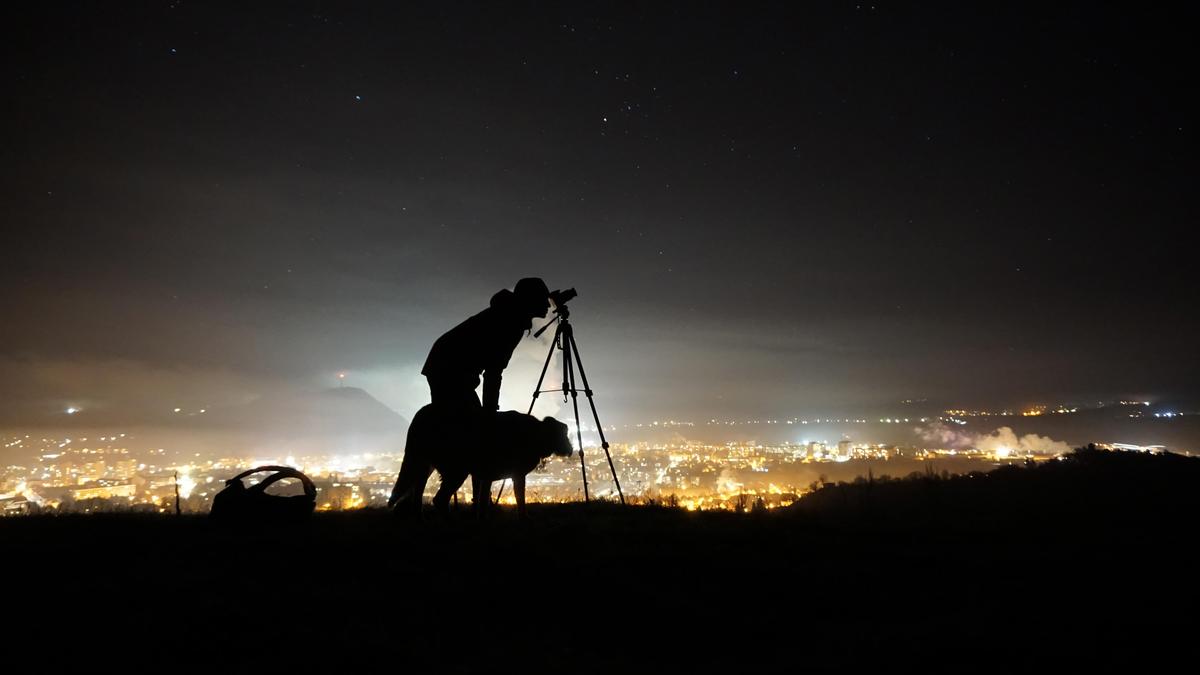
Some of the greatest works of art can be found in museums and galleries. But little do many know, the greatest piece of artwork can be found on the universe’s largest canvas: The night sky! It can be collectively agreed upon that the night sky is a mere window to the vast magnificence of space! Some people see space as a mystery waiting to be solved; others see it as a land yet to be explored. Then there are those who admire it for its beauty and vastness.
This file photo obtained from NASA shows the official crew portrait of the Apollo 11 astronauts taken at the Kennedy Space Center on March 30, 1969, of(L-R) Neil A. Armstrong, Commander; Michael Collins, Module Pilot; and Edwin E. “Buzz” Aldrin, Lunar Module Pilot.
| Photo Credit:
AFP
First steps of space legends
If one were to ask you to name a famous personality (it doesn’t only have to be an astronaut) in the field of space, there’s a good chance you would have an answer prepared. It could be Neil Alden Armstrong, the first man to walk on the moon; or even Neil deGrasse Tyson, the famed astrophysicist whose voice of knowledge can send a listener to the vast expanse of the universe.
But what’s important to understand is that they and many more started their journey on Earth. For example, Neil Armstrong, the Ice Commander himself, displayed an interest in flying at the young age of two, when his father had taken him to the National Air Races in Cleveland, Ohio. This interest only grew when he travelled on an aeroplane for the first time at the age of six. Neil deGrasse Tyson discovered his interest in astronomy at the age of nine, following a visit to the sky theatre at the Hayden Planetarium in New York.
Coming from India, Kalpana Chawla, the first woman of Indian origin to fly to space, developed a keen interest in flying and space at a young age. She held a strong desire to pursue aerospace engineering despite the dissuasion she faced from many around her. Just like how it was for these incredible achievers, the path to a historical landmark always started with a single step of interest, or a curious eye.
The spark of curiosity
Speaking of a ‘curious eye’, there is one important factor that comes with an interest in space, whether it be in astronomy or exploration, and that is curiosity. When it comes to pondering astronomy and space, many topics and questions can arise for discussion. But one would need to find a group or a place where these questions can be addressed, and their fascination can be cherished. One popular answer to this situation would be to join an astronomy club, where your curiosity only grows with every answer you receive and activity you take part in. When you’re in a club, your passion for the field and the knowledge you gain go beyond what you learn in textbooks at school. We interviewed members from four high-notable Astronomy Clubs who provided their insights on the unique aspects of their clubs and how they nurture the curiosity within their members.

Interaction between school students and members of Singularity (from IISER Kolkata), a founding club of ISAAC, which took place during an outreach event
| Photo Credit:
SPECIAL ARRANGEMENT
Cherishing it early: One’s passion for space could start with the simple act of looking at the starry sky and asking whatever questions come to mind. Don’t hold yourself back from asking questions, no matter how silly they may seem. “If you are curious,” Ruturaj Kulkarni, the co-founder of The Indian Synergy of Astronomy and Astrophysics Clubs (ISAAC), stated, “and develop a natural interest and are dedicated, then you would automatically push yourself towards learning more about that particular field.” If you gain this curiosity in school, it is important to cherish it and keep its flame going strong. It is during this time that joining a club would be best. “In outreach sessions,” Ruturaj said, “we carry it forward much more for the school students, because at that level, it (astronomy) is much more inspiring and wondrous,” but he also went on to explain how during college, this same curiosity tends to “die down, since our inner child might fade away.”

People gathered for an event held at Koratagere by Banglore Astronomical Society.
| Photo Credit:
SPECIAL ARRANGEMENT
Before the rocket: For an astronomer, the curiosity gained from asking questions leads to further research, major contributions, and even a new discovery made in the galaxy! When it comes to space explorers, the journey of an astronaut begins long before the launch of the rocket, or the moment they step into the rocket, as stated by Vishwanath S K, a volunteer from Bangalore Astronomical Society, where children, including those from rural areas who hold great interest in space but don’t have access to equipment like telescopes, are encouraged to be inquisitive. “These people have a lot of curiosity in their lives,” he said, and explained that this curiosity serves as an important addition to their academic inclination towards the subject.
No boundaries: One of the wonderful things about studying space is that its vastness ensures that there is no end to the curiosity over mysteries. “One of the most beautiful things about astronomy is that you do not need a laboratory; you are living in a laboratory!” said Neelesh Rana, one of the founding members at OVSRCSC’s Big Bang Astronomy Club, which was established in 2003. Only, this is a laboratory where there are no walls or boundaries, similar to the circle of possibilities surrounding the field of space where the horizons of your mind don’t stay in one place. “It is basic human curiosity that wants to expand our horizons,” he stated.

Children looking through a telescope at Jyotirvidya Parisanstha’s sky-gazing programme at Chandigarh.
| Photo Credit:
SPECIAL ARRANGEMENT
From caves to planets: The power of the need to learn more should never be underestimated, as its importance lies in the fact that it is one of the factors that have pushed humankind to evolve through discoveries and inventions. “We went from caves to boats and planes,” said Aniruddha Deshpande, the Vice President of Jyotirvidya Parisanstha, one of the oldest associations of amateur astronomers in India. “And now we’re eyeing Mars and the Moon. We will find planets in the Goldilocks zone someday. That itch to see what’s over the horizon is hardwired in us.”
Beyond the lesson
What happens when you turn to the last page of an astronomy lesson in your textbook? Let’s say you read a line about the red spot of Jupiter and learn that it is a spot of continuous high pressure with the largest anticyclonic storm. Do you stop yourself with that information? Or start thinking further? Does the red spot of Jupiter have animals biologically conditioned to survive in the storm-filled conditions? Do questions like this pop up in your mind?
More than the pages: One of the steps that can be taken to nurture curiosity within the classroom is “giving students opportunities to ask questions beyond the curriculum,” Ruturaj Kulkarni explained. Don’t stop yourself from asking your teacher any questions that arise in your mind and go beyond what is taught. “One lesson we’ve learnt,” he added, regarding his club’s activities, “from working with so many astronomy clubs, is that exposure matters tremendously.” He further advised that one step institutes can take is “encourage interest by creating astronomy clubs within the school itself. Organising observation sessions and inviting speakers.” Those working in the field would be more than happy to encourage young minds to step into these fields. “Some of the most successful outreach activities can begin with students simply learning to identify constellations, or observing the moon. The goal is just to create opportunities so that curiosity grows more.”
Observation and timing: Neelesh Rana emphasised the importance of schools taking the active step to focus on “observation, rather than just textbook astronomy.” One unique point he provided was that when a chapter on astronomy was taken in a classroom, “it should be at a time that the observation season is just right.” Sadly, it is not every day that you will get the chance to look at the stars in the sky, commonly due to clouds and weather conditions. “So, one thing that schools can do,” he advised, “is have the chapter be taken in months when the conditions are perfect for observation.”
Pictures vs passion: Vishwanath S K narrated the story of when his interest and passion in space first lit a spark. “When I was a kid, I was very curious. I would break electronics and take them apart. But during my college days, there was a professor.” This professor had shown him the live image of Saturn through a telescope for the first time. Before this, he had only seen the planet in 2-D pictures in books. “But the moment you see that through your eyes through a telescope, it looks like a jewel in the night sky.” This experience had first ignited the spark within him, and to this day, he still cannot forget the magnificent sight and continues to protect his passion for astronomy.
The career factor
Has space been in the field of vision for your dream career?

An Astrophotography workshop conducted by the Big Bang Astronomy Club during their Gir Star Party event.
| Photo Credit:
SPECIAL ARRANGEMENT
Astronomy & space science: Many magnificent careers in space begin with an interest in either flying or the stars. “I think it often begins with a simple moment of curiosity.” Ruturaj stated, “It could be seeing the moon through a telescope for the first time, or watching a rocket launch on television.” These simple actions driven by a curious mind could very well be a person’s first step into a space-related career. However, it must first be understood that the paths to becoming either an astronomer or an astronaut are different. To understand this, one must first identify the differences between astronomy and space science. “Astronomy is the study of outer space, its objects, as well as the phenomena that govern the systems.” Neelesh Rana clarified. “Whereas space science is to do with acts like launching satellites into space, or missions to nearby planets or the moon.”

An event held by Bangalore Astronomical Society
| Photo Credit:
SPECIAL ARRANGEMENT
The lack of telescopes: For every profession, there is a path one must walk. And a majority of these paths will involve academic excellence in one or more subjects. In astronomy, two of the main subjects constantly involved are maths and physics. Believe it or not, astronomers of today spend surprisingly less time looking through telescopes, about only a few weeks a year. Even though the telescope is one of the most popular instruments associated with space and astronomy, Aniruddha Deshpande revealed that an astronomer “needs to spend most of the time looking at code, spreadsheets, and graphs rather than actual telescope eyepieces.” Programming is also a major skill to study and understand to enter fields like astrophysics. “Nowadays whenever you have to do any observation or analytics,” said Ruturaj Kulkarni, “programming does help a lot.”

A Water Rocketry Workshop held by Singularity (from IISER Kolkata), a founding club of ISAAC.
| Photo Credit:
SPECIAL ARRANGEMENT
Multiple careers: There may be those whose interest in space does not match their interest in mathematics or physics. “However, space careers are not only for astronomers.” Ruturaj said, “They include scientists, engineers, data analysts, communicators, and educators as well. The space ecosystem is quite broad and seen through various clubs.” There are many fields and subfields to choose from in space-related studies, such as cosmology, astrobiology, space weather research, etc. If you wish to turn your passion for space into a career, the first thing you need to do is explore and select which path would align with your interest the most. You may never truly know where the horizon in your mind is taking you. Just like how space seems to have no boundary, neither does human potential. Whether you wish to pursue a career in astronomy or space science, or stay in the field purely for the fascination you find, be sure to ask a lot of questions, because one of them could be answered in the future as a solution to save humankind!
Bonds of fun and knowledge
We’ve seen space as a canvas for magnificent art, a chest of mysteries, and a blueprint of science. But it can also be seen as a link to bring friends and family together. Whether it involves sitting on your terrace to look at stars or joining the same club, you will be building more than just your knowledge and interest.

The Messier Marathon is an overnight stargazing challenge. Amateur astronomers try to find 110 deep-sky objects from the catalogue of French astronomer Charles Messier. This year, during the Big Bang Astronomy Club’s 20th attempt, four individuals completed the marathon. Two of whom (left to right) Deeva M. Raichura (14), and Shaurya N. Rana (15) became the youngest amateurs in the world to have accomplished this.
| Photo Credit:
SPECIAL ARRANGEMENT
The bond and shared mindset between parents and their children could be seen in The Big Bang Astronomy Club, which was first founded in 2003. In the beginning, they only had public outreach sessions and open telescope nights every month. “We put 2 to 3 telescopes out on the sidewalk, and people would just come and look at the sky,” said Neelesh Rana. This programme is still going on and brings in people in very large numbers. When members began coming into the club, the cutoff age had been 16. The reason for this was “when we go out for full-night observations,” Neelesh Rana explained, “it is usually a place which is near to a forest or uninhabited place.” This served as a safety risk for young children. However, this soon changed when parents requested a solution that would allow their children access. “So we started taking parents as members.” The children could then accompany them and be a part of the sessions. The inclusion of the younger minds soon involved many new ideas, one of which was a small 15-day camp for children aged 7 to 12. This came to be known as ‘Cosmic Kids’, which was started in 2016. “We have completed about 20 batches and have trained about 750 children of this age.” In this camp, everything involves hands-on experience, where the kids can make astronomy models and learn how to use a telescope.

Students taking part in an art activity held by Bangalore Astronomical Society
| Photo Credit:
SPECIAL ARRANGEMENT
Bonds are formed amongst members in the Bangalore Astronomical Society through fun activities like drawing, telescope building, and creating simulations of the night sky on their phones. “What we try to achieve,” Vishwanath stated, “is to inculcate curiosity and scientific thinking towards the younger generation. “We conduct outreach programmes for the school kids. And nowadays we target all rural schools in the area, where they will not have this kind of opportunity. They will have very good skies, but none would have been able to see it through a telescope.” The Society would bring telescopes for these children to use to look at celestial objects they never would have seen up close before! “We hope that this is what inculcates the spark of curiosity within them so that they can go beyond and explore.”

Children lining up at an event held by Jyotirvidya Parisanstha
| Photo Credit:
SPECIAL ARRANGEMENT
Jyotirvidya Parisanstha, or JVP, is a non-profit voluntary organisation. Its main goal involves spreading knowledge of astronomy to the general public. One of the many activities it conducts involves observational and experiential knowledge, where members will be taken on “Study tours to professional observatories throughout India, which include a dark sky reserve at Hanley.” Aniruddha Deshpande stated. For students and amateur astronomers with a dedicated interest in projects in the field, the club has “an automated observatory named Kesariwada Jyotirvidya Observatory.” It is also known for its telescope library from where members can borrow small telescopes for when they can’t afford its purchase. The club also reaches out to local schools to create a spark of interest within the students by “offering experiential, project-based activities.” These fun activities open young minds to the various aspects of space. “Students make hands-on models in exhibitions, live stargazing events, and direct interactions with national and international lecturers and space experts; schools transform abstract concepts into tangible, exciting career paths.

Event conducted during IISER Kolkata’s outreach session on National Science Day, via members of Singularity, a founding club of ISAAC.
| Photo Credit:
SPECIAL ARRANGEMENT
ISAAC, according to Ruturaj, is less a club and more of a platform, and a “collection of multiple astronomy and astrophysics clubs” at the university level. When the founders and early members of ISAAC realised the potential and magnificence of many other astronomy clubs across India, they also noticed the lack of communication between them. “ISAAC’s main goal is to encourage collaboration of different clubs for the purpose of sharing knowledge, resources, and equipment so that members can pursue their passion much more efficiently.” Many of the college clubs within ISAAC carry out outreaches within schools to spread and promote interest in astronomy. “In outreach sessions, we carry it out much more for the school students.” Ruturaj said, “because at that level it is much more inspiring and wondrous.”
The field of space is incredibly vast with no boundaries, but that only makes the journey to uncover its secrets far more interesting and fun. You may make a discovery or figure out the answer to one of your questions today, but there will always be another question itching to be spoken out in the future. And your pursuit of its answer will be a whole other incredible journey. For those who wonder about the mysteries of space and wish to join clubs, know that you are building something incredibly valuable for a life of adventure.
In the words of financier Bernard Baruch, “Millions saw the apple fall, but Newton asked why.”