
Skip to content
  • Facebook
  • X
  • Linkedin
  • WhatsApp
  • YouTube
  • Associate Journalism
  • About Us
  • Privacy Policy
  • 033-46046046
  • editor@artifex.news
Artifex.News

Artifex.News

Stay Connected. Stay Informed.

  • Breaking News
  • World
  • Nation
  • Sports
  • Business
  • Science
  • Entertainment
  • Lifestyle
  • Toggle search form
  • Chanting ‘Jai Shri Ram’ In Mosque Doesn’t Hurt Religious Feelings: Karnataka High Court
    Chanting ‘Jai Shri Ram’ In Mosque Doesn’t Hurt Religious Feelings: Karnataka High Court Nation
  • Woman In Madhya Pradesh Gives Birth On Handcart, Newborn Dies
    Woman In Madhya Pradesh Gives Birth On Handcart, Newborn Dies Nation
  • Access Denied Business
  • Access Denied
    Access Denied Nation
  • Access Denied World
  • Access Denied Business
  • China says it will ‘resolutely support’ Cuba against U.S. pressure
    China says it will ‘resolutely support’ Cuba against U.S. pressure World
  • Riyan Parag Tries Controversial Action, Ends Up Bowling Rare No-Ball In India vs Bangladesh 2nd T20I. Watch
    Riyan Parag Tries Controversial Action, Ends Up Bowling Rare No-Ball In India vs Bangladesh 2nd T20I. Watch Sports
Why India’s ‘leaky pipeline’ in research is unlike the rest of the world

Why India’s ‘leaky pipeline’ in research is unlike the rest of the world

Posted on March 5, 2026 By admin


Girls and women represent half the population of the world yet their participation in scientific research is lagging. In many countries, this disparate contribution starts as early as school. In the U.S., for example, girls are less likely to take advanced calculus, physics, mathematics, and biology at high school level.

In many other countries, the number of girls opting to major in a science, technology, engineering or mathematics (STEM) subject is significantly lower than that of boys. Women constitute only 35% of STEM graduates across the world and earn only 40% of STEM PhDs. Further, based on data from 146 nations, women scientists comprise only 30% of the STEM workforce, which includes academic jobs and faculty positions. This systematic loss of women at various stages of STEM education and careers is commonly called the ‘leaky pipeline’. 

And at first glance, India appears to be an exception.

Where are the ‘leaks’?

At the school level, nearly all students have ‘science’ as a mandatory subject and (at least anecdotally) girls participate in science quizzes, Olympiads, summer schools, hackathons, and hands-on tinkering challenges. After class X, the enrolment of girls in the ‘science’ stream can be as high as 60%, with girls making up 46% of all class XII science pass-outs. In 2025 the Ministry of Education reported that for the first time in over a decade, more girls had cleared their Class XII examination in science than in the arts stream. This indicated a significant increase in the participation of girls in science education: according to data from 2014, 7.5 lakh more girls graduated from the arts stream than science. As a result, India boasts of the highest percentage of female STEM graduates worldwide, with 43% women science graduates at the bachelor’s level and nearly 50% at the masters and doctoral levels.

But beyond the encouraging statistics, India does have a leaky pipeline for women in STEM — except that it looks different from the rest of the world.

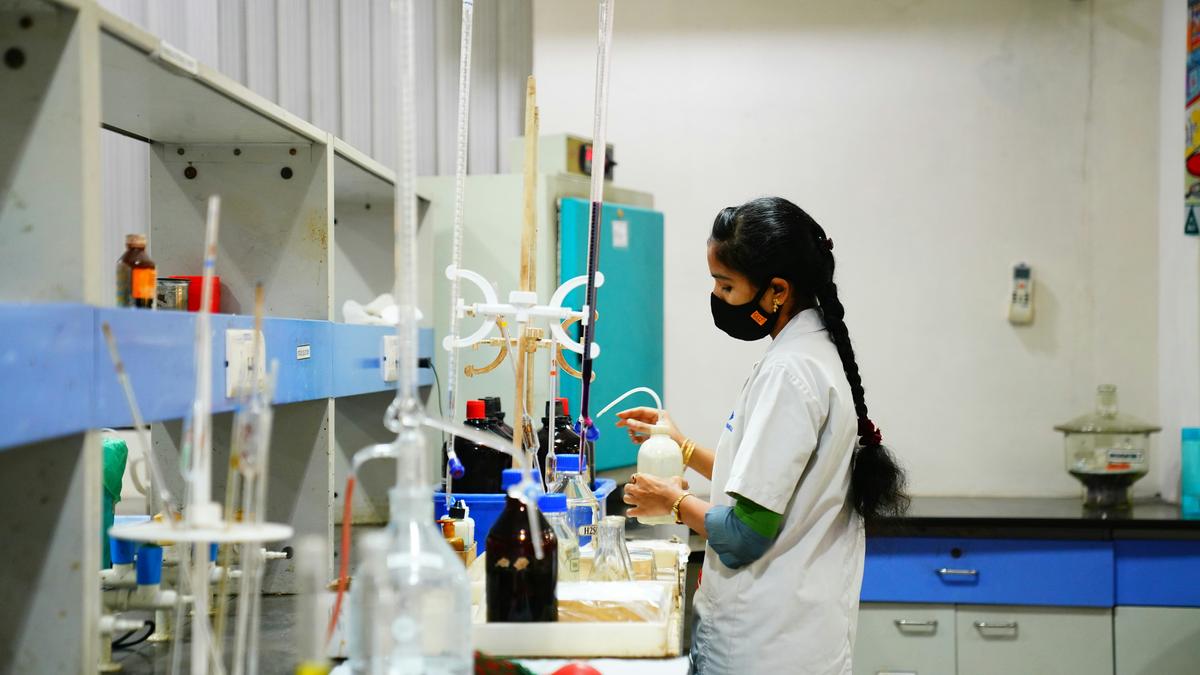
In spite of producing the highest number of female STEM graduates, women constitute only 18% of the research and development workforce in the country. A Department of Science and Technology report reveals that women constituted less than 30% of scientists in India’s national research agencies; the highest representation was in the Indian Council of Medical Research at 29% and the lowest in the Defence Research and Development Organisation at 14%. Women also make up only 8% of faculty at the Indian Institute of Science Bangalore and 11-13% of scientists at the IITs. While university settings, both government and private, report higher representation, the figures are still lower than 30%.

The typical Indian milieu

What this means is that while women in India enter STEM education in large numbers, they are under-represented in scientific research jobs. This ‘leaky pipeline’ persists due to a combination of social, structural, and systemic challenges.

In schools, girls in India are often encouraged to pursue science and those interested in science are considered to be ‘good’ or ‘smart’ girls, with ‘wanting to become a scientist’ looked upon favourably by teachers, peers, and parents. Yet as women advance in their science education — the pursuit of which can require several years of training and commitment — social expectations pose barriers to their career plans. Completing a PhD often coincides with the search for a research job as well asfamilial directives to ‘settle down’, bear children, and ‘focus’ on the household. In India’s typical socio-cultural milieu, women often relocate to their husband’s place of living, adjust to a new family structure, and handle the larger share of childcare and household responsibilities, all of which pose significant challenges to seeking lucrative scientific research jobs and positions.

Scientific recruitment across government research organisations have strict age cut-offs, especially at entry-level positions, in addition to erratic hiring practices, a dearth of positions, and specific mandates for certain fields of research. For women, given geographic constraints and familial responsibilities, accessing these long-term jobs means doing so within the age eligibility and in a defined location, factors that result in a limited pool of options. Academic jobs also don’t allow for remote work; while certain roles may allow for flexible and hybrid work models, they typically don’t directly involve research or teaching.

Position gap

At the level of the research ecosystem, some of these social and structural challenges are being addressed via special recruitment drives and funding schemes for women scientists. In spite of these measures, institutions lag in ensuring gender parity at the time of recruitment, and gender equity initiatives have either been limited to pilot projects, are not appropriately incentivised, or are associated with minimal accountability. 

Consequently, the majority of women PhD holders in STEM in India find themselves unable to access long-term, lucrative and prestigious research jobs. This results in a position gap, where women scientists often have to contend with short-term, contractual, precarious, and unstable positions, such as those found in quasi-academic initiatives, entities funded on grants, fellowships, or ‘soft money’, positions without full-spectrum benefits, promotions or increments, and roles with limited career advancement. 

The big ‘leak’ in India’s STEM pipeline, as seen by the sharp loss of women scientists during the transition from science education to the research workforce, is a consequence of social, structural, and systemic challenges — and is reflected in the position gap that precludes the majority of trained women scientists from long-term and sustained participation in scientific research. 

Karishma S Kaushik is a physician-scientist and scientific consultant. She has recently published a book for girls and women seeking to pursue STEM education and careers.

Published – March 08, 2026 08:00 am IST


Source link

Science

Post navigation

Previous Post: Raisina Dialogue 2026: U.S. foreign policy is to advance our national interests, says Christopher Landau
Next Post: Patriarchy, the Matilda effect, and the erasure of women in STEM

Related Posts

  • Union Budget 2026: push for technology, planetary science in space programme
    Union Budget 2026: push for technology, planetary science in space programme Science
  • IIT-Bombay, TCS to build India’s first Quantum Diamond Microchip Imager
    IIT-Bombay, TCS to build India’s first Quantum Diamond Microchip Imager Science
  • As India’s summer begins, understanding the heat and health conundrum
    As India’s summer begins, understanding the heat and health conundrum Science
  • India’s fossil fuel capacity grows 2.44% in FY24; non fossil-fuel rises 11%: Government data
    India’s fossil fuel capacity grows 2.44% in FY24; non fossil-fuel rises 11%: Government data Science
  • IISc researchers devise a new language for ML models
    IISc researchers devise a new language for ML models Science
  • Sky Teamwork: Why do birds fly in V formation?
    Sky Teamwork: Why do birds fly in V formation? Science

More Related Articles

Major climate change-GDP study under review after facing challenge Major climate change-GDP study under review after facing challenge Science
Scans of seemingly empty space reveal black holes not far from earth Scans of seemingly empty space reveal black holes not far from earth Science
The “biggest blunder” of Einstein’s life The “biggest blunder” of Einstein’s life Science
Chandrayaan’s Pragyan rover offers evidence of magma ocean on young moon Science
China scientists rush to climate-proof potatoes China scientists rush to climate-proof potatoes Science
How the deadliest virus in human history paved the way for new cures How the deadliest virus in human history paved the way for new cures Science
SiteLock

Archives

  • May 2026
  • April 2026
  • March 2026
  • February 2026
  • January 2026
  • December 2025
  • November 2025
  • October 2025
  • September 2025
  • August 2025
  • July 2025
  • June 2025
  • May 2025
  • April 2025
  • March 2025
  • February 2025
  • January 2025
  • December 2024
  • November 2024
  • October 2024
  • September 2024
  • August 2024
  • July 2024
  • June 2024
  • May 2024
  • April 2024
  • March 2024
  • February 2024
  • January 2024
  • December 2023
  • November 2023
  • October 2023
  • September 2023
  • August 2023
  • July 2023
  • June 2023
  • May 2023
  • April 2023
  • March 2023
  • February 2023
  • January 2023
  • December 2022
  • November 2022
  • October 2022
  • September 2022
  • August 2022
  • July 2022
  • June 2022
  • May 2022

Categories

  • Business
  • Nation
  • Science
  • Sports
  • World

Recent Posts

  • Husband held for alleged dowry harassment in Visakhapatnam; wife dies 45 days after marriage
  • Scientists trigger ‘controlled’ earthquakes under Swiss Alps
  • Bandi Bhagirath’s case takes serious turn with Telangana CM ordering special team for comprehensive probe
  • Asian shares mixed, oil jumps 4% after Donald Trump rejects Iran’s response to ceasefire proposal
  • Velachery school kids steer road users towards safety

Recent Comments

  1. JamesTruff on UP Teacher Who Asked Students To Slap Muslim Classmate
  2. CliftonInese on UP Teacher Who Asked Students To Slap Muslim Classmate
  3. DonaldStype on UP Teacher Who Asked Students To Slap Muslim Classmate
  4. EnriqueExins on UP Teacher Who Asked Students To Slap Muslim Classmate
  5. EnriqueExins on UP Teacher Who Asked Students To Slap Muslim Classmate
  • How Ismail Haniyeh Rose From Being Activist To Chief Of Hamas
    How Ismail Haniyeh Rose From Being Activist To Chief Of Hamas World
  • Sri Lanka vs New Zealand LIVE Streaming 1st Test LIVE Telecast: When And Where To Watch
    Sri Lanka vs New Zealand LIVE Streaming 1st Test LIVE Telecast: When And Where To Watch Sports
  • Typhoon Bebinca, the strongest storm to hit Shanghai since 1949, shuts down megacity
    Typhoon Bebinca, the strongest storm to hit Shanghai since 1949, shuts down megacity World
  • Union Finance Minister Nirmala Sitharaman confident of India Inc aligning to country’s developmental goals
    Union Finance Minister Nirmala Sitharaman confident of India Inc aligning to country’s developmental goals Business
  • Net direct tax collections slow down marginally to touch 15.88%
    Net direct tax collections slow down marginally to touch 15.88% Business
  • Access Denied Sports
  • Smriti Mandhana Gifts Wheelchair-Bound Girl Mobile Phone After India Match In Asia Cup
    Smriti Mandhana Gifts Wheelchair-Bound Girl Mobile Phone After India Match In Asia Cup Sports
  • U.S. Democrats, Trump set to face off in budget battle that could trigger government shutdown
    U.S. Democrats, Trump set to face off in budget battle that could trigger government shutdown World

Editor-in-Chief:
Mohammad Ariff,
MSW, MAJMC, BSW, DTL, CTS, CNM, CCR, CAL, RSL, ASOC.
editor@artifex.news

Associate Editors:
1. Zenellis R. Tuba,
zenelis@artifex.news
2. Haris Daniyel
daniyel@artifex.news

Photograher:
Rohan Das
rohan@artifex.news

Artifex.News offers Online Paid Internships to college students from India and Abroad. Interns will get a PRESS CARD and other online offers.
Send your CV (Subjectline: Paid Internship) to internship@artifex.news

Links:
Associate Journalism
About Us
Privacy Policy

News Links:
Breaking News
World
Nation
Sports
Business
Entertainment
Lifestyle

Registered Office:
72/A, Elliot Road, Kolkata - 700016
Tel: 033-22277777, 033-22172217
Email: office@artifex.news

Editorial Office / News Desk:
No. 13, Mezzanine Floor, Esplanade Metro Rail Station,
12 J. L. Nehru Road, Kolkata - 700069.
(Entry from Gate No. 5)
Tel: 033-46011099, 033-46046046
Email: editor@artifex.news

Copyright © 2023 Artifex.News Newsportal designed by Artifex Infotech.