


Skip to content
  • Facebook
  • X
  • Linkedin
  • WhatsApp
  • YouTube
  • Associate Journalism
  • About Us
  • Privacy Policy
  • 033-46046046
  • editor@artifex.news
Artifex.News

Artifex.News

Stay Connected. Stay Informed.

  • Breaking News
  • World
  • Nation
  • Sports
  • Business
  • Science
  • Entertainment
  • Lifestyle
  • Toggle search form
  • Tamil Nadu government provides interest subsidy to modernise textile mills
    Tamil Nadu government provides interest subsidy to modernise textile mills Business
  • Important for India, China to work together to bring stability to world economic order: PM
    Important for India, China to work together to bring stability to world economic order: PM World
  • Access Denied World
  • ​Moving on: On India’s Consumer Price Index and a new base year
    ​Moving on: On India’s Consumer Price Index and a new base year Business
  • Access Denied Sports
  • Trump posts image of himself with Jesus as administration’s Pope criticism continues
    Trump posts image of himself with Jesus as administration’s Pope criticism continues World
  • At least 18 have died after a tanker carrying gasoline exploded in southern Nigeria
    At least 18 have died after a tanker carrying gasoline exploded in southern Nigeria World
  • Access Denied Sports
New infectious diseases among bees threaten world’s economies

New infectious diseases among bees threaten world’s economies

Posted on November 18, 2024 By admin


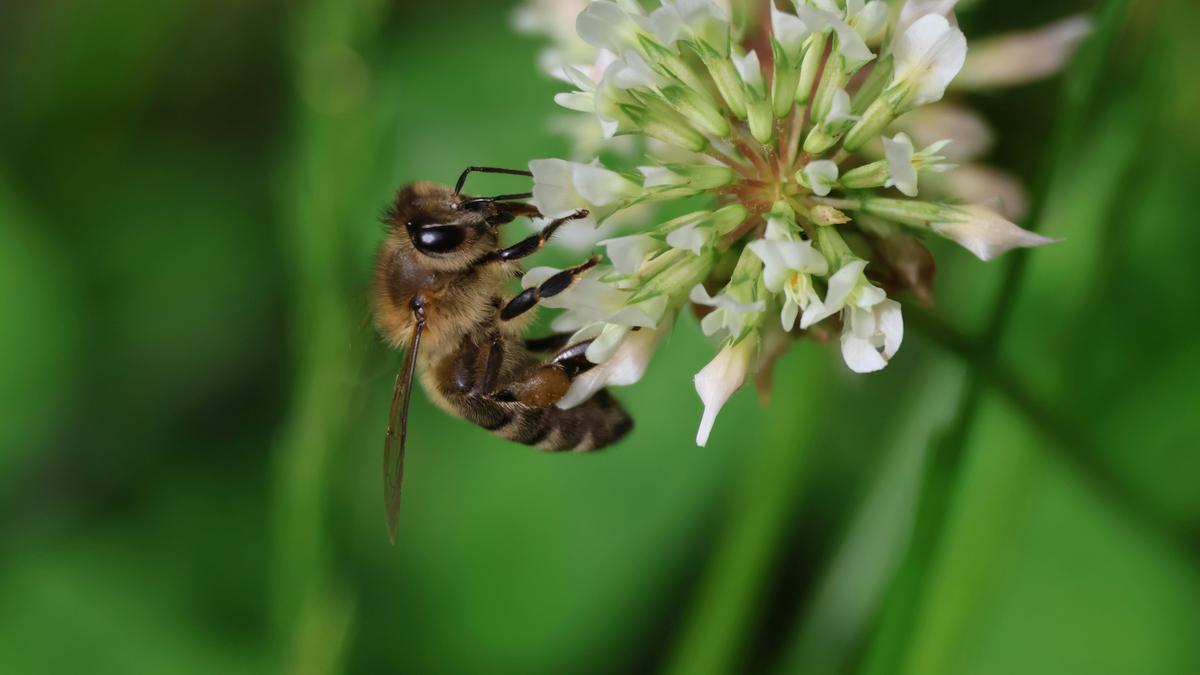
A significant chunk of the world’s agricultural productivity and nutritional security relies on small insect pollinators. More than 75% of food crops, fruits, and flowering plants need bees, wasps, beetles, flies, moths, and butterflies to yield successful harvests.

This is why threats to insect pollinators, including pesticides, pollution, and climate change, endanger the economies of entire countries. A new actor on this list is infectious diseases made worse by habitat loss.

While the declining populations of pollinators, particularly bees, has been well-documented in Europe and North America, data from biodiversity-rich regions like the Indian subcontinent are scarce. In fact, most of what scientists know about bees comes from research on managed western honey bees (Apis mellifera).

Diversity is better, again

“In many cases, wild bees are more efficient pollinators than the western honey bees. It is essential to study wild bee communities and look at their state of health,” Corina Maurer, a postdoctoral researcher at ETH Zürich, wrote in an email to this reporter.

Research has uncovered the transmission of pathogens between managed honey bees and wild pollinators, a process called pathogen spillover and spillback. Western honey bees are often viral reservoirs and can infect wild species when they share habitats. These emerging infectious diseases also threaten the wider pollinator community.

Maurer and her team recently published a paper in Nature Ecology and Evolution exploring the presence of deformed wing virus and black queen virus in 19 wild bee and hoverfly species across different landscapes in Switzerland. They found higher loads of these pathogens in wild pollinators that used floral resources the honey bees accessed as well. The loads were 10-times higher among the wild pollinators in these shared habitats.

Based on these findings, the researchers suggested that diverse pollinator-friendly habitats with more floral resources lowered the chance of pathogens being transmitted between wild pollinators and managed western honey bees. Habitat loss, on the other hand, could force pollinators into smaller suitable habitats and increase the risk of disease transmission.

“We cannot exclude the possibility of spillover if wild species are forced to share spaces due to loss of habitat or if managed species are transported into new habitats,” Axel Brockmann, a retired professor who studied honey bee behaviour at the National Centre for Biological Sciences, Bengaluru, said.

Habitat overlap and native bees

India hosts more than 700 bee species, including four indigenous honey bees: Asiatic honey bee (Apis cerana indica), giant rock bee (Apis dorsata), dwarf honey bee (Apis florea), and the stingless bee (sp. Trigona). Western honey bees were introduced in India in 1983 to increase the country’s honey yield.

In 1991-1992, a Thai sacbrood virus outbreak devastated around 90% of Asiatic honey bee colonies in South India and reemerged in 2021 in Telangana. The virus has been reported from other parts of the world, including China and Vietnam.

The Thai sacbrood virus is one of the greatest threats facing the Asiatic honey bee. The disease caused by the virus’s infection kills the bees’ larvae. The particular viral strain that attacks western honey bees is less virulent.

Importantly, researchers don’t know how the virus is transmitted between bee populations.

“Transmission of viruses from a managed species, such as the honeybee, to wild pollinators could be a problem for the honeybee and wild pollinators,” Maurer said. “The viruses spilling over from honeybees to wild pollinators could mutate in the wild pollinators and then spill back to honeybees in a more virulent form, … being more detrimental to honeybees. In the case of wild pollinators, diseases which are not naturally occurring in wild pollinators but spill over from the managed honeybee may severely affect their health.”

When bees migrate

“Since 2009, we have been surveying different states such as Gujarat, Madhya Pradesh and Maharashtra. In some of these areas, local bee populations are absent probably because they are on the migratory route of managed western honeybees,” Sujana Krishnamoorthy, executive director of Under the Mango Tree Society, a non-profit organisation that trains small farmers to work with native honey bees, said.

When managed honey bees migrate, beekeepers carry their bee boxes along a specific route where there are more bee flora. In North India, for example, they move through the mustard or sunflower fields of Uttar Pradesh and Madhya Pradesh. In Jammu and Kashmir, the bees migrate from plains to apple orchards, where bumble bees live.

A study published in Scientific Reports in February estimated that 40% of bumblebee species in the Indian Himalaya could lose more than 90% of their habitat by 2050, raising concerns about the competition for resources with western honey bees.

“During our surveys in Kolhapur in Maharashtra many years ago, conversations with local beekeepers and experts informed us that after a few western honey bee colonies were brought in, some disease completely decimated the indigenous pollinator populations,” Krishnamoorthy said. “Kolhapur used to produce eight to 10 tonnes of forest honey but it struggled to produce even a tonne after that.”

“There is no discussion about what these diseases could be.”

Need for focused research

Experts agree that more research and surveillance are required to monitor emerging diseases in bees and other pollinators.

“Surveying wild pollinators is probably difficult and a huge effort, as there are so many species,” Maurer said. “A better approach is to survey the managed honeybee colonies and control their diseases to minimise transmission to wild pollinators.”

Dedicated research on viral threats like the Thai sacbrood virus is crucial for protecting the health of pollinators because it can pave the way for early warnings and help researchers and policymakers devise prevention strategies.

“Understanding the basic ecology of pollinators is key to conservation-oriented studies of how they will respond to threats such as climate change, habitat loss or infectious diseases,” Brockmann said.

Rupsy Khurana is Science Communication and Outreach Lead at the National Centre for Biological Sciences, Bengaluru.

Published – November 18, 2024 05:30 am IST



Source link

Science

Post navigation

Previous Post: India in close consultation with Arab countries as West Asian conflict drags on
Next Post: PM Modi Arrives In Brazil To Attend G20 Summit After Nigeria Visit

Related Posts

  • Grew up shy, didn’t think will fly to space: Astronaut Shubhanshu Shukla
    Grew up shy, didn’t think will fly to space: Astronaut Shubhanshu Shukla Science
  • Sci-Five | The Hindu Science Quiz: On Astronomical Instruments
    Sci-Five | The Hindu Science Quiz: On Astronomical Instruments Science
  • ISRO’s 100th launch from Sriharikota scheduled for January-end
    ISRO’s 100th launch from Sriharikota scheduled for January-end Science
  • The Science Quiz | On Spine
    The Science Quiz | On Spine Science
  • The first man to experience jet streams
    The first man to experience jet streams Science
  • NASA report recalls dysfunction, heated emotions during Boeing’s botched Starliner flight
    NASA report recalls dysfunction, heated emotions during Boeing’s botched Starliner flight Science

More Related Articles

In snake genes, study finds they evolved 3x faster than other reptiles In snake genes, study finds they evolved 3x faster than other reptiles Science
Aerobic exercise creates a muscle protein that boosts mouse memory Aerobic exercise creates a muscle protein that boosts mouse memory Science
Data | India tops AI projects in GitHub Data | India tops AI projects in GitHub Science
Mumbai-led team helps reveal mysterious twin rings around galaxy Mumbai-led team helps reveal mysterious twin rings around galaxy Science
Like India’s PRATUSH, astronomers want to put telescopes on, around the moon Like India’s PRATUSH, astronomers want to put telescopes on, around the moon Science
Will the baby be a boy or a girl? SRY gene claims to have the answer Will the baby be a boy or a girl? SRY gene claims to have the answer Science
SiteLock

Archives

  • May 2026
  • April 2026
  • March 2026
  • February 2026
  • January 2026
  • December 2025
  • November 2025
  • October 2025
  • September 2025
  • August 2025
  • July 2025
  • June 2025
  • May 2025
  • April 2025
  • March 2025
  • February 2025
  • January 2025
  • December 2024
  • November 2024
  • October 2024
  • September 2024
  • August 2024
  • July 2024
  • June 2024
  • May 2024
  • April 2024
  • March 2024
  • February 2024
  • January 2024
  • December 2023
  • November 2023
  • October 2023
  • September 2023
  • August 2023
  • July 2023
  • June 2023
  • May 2023
  • April 2023
  • March 2023
  • February 2023
  • January 2023
  • December 2022
  • November 2022
  • October 2022
  • September 2022
  • August 2022
  • July 2022
  • June 2022
  • May 2022

Categories

  • Business
  • Nation
  • Science
  • Sports
  • World

Recent Posts

  • Somnath Amrut Mahotsav: PM Modi performs ‘Maha Pooja’, witnesses air show
  • At least six people found dead in boxcar in Laredo, Texas, police say
  • Asia braces for second wave of energy shocks from Iran war
  • Queer dance-theatre production SAM;AAJ, helmed by choreographer Jainil Mehta in Hyderabad blends dance, poetry and music
  • Krunal credits DK for RCB batters’ improved performance this season

Recent Comments

  1. EnriqueExins on UP Teacher Who Asked Students To Slap Muslim Classmate
  2. EnriqueExins on UP Teacher Who Asked Students To Slap Muslim Classmate
  3. Robertnof on UP Teacher Who Asked Students To Slap Muslim Classmate
  4. GarlandLex on UP Teacher Who Asked Students To Slap Muslim Classmate
  5. Williamdox on UP Teacher Who Asked Students To Slap Muslim Classmate
  • 22 Nepal prisoners escape amid unrest, nabbed at U.P. border
    22 Nepal prisoners escape amid unrest, nabbed at U.P. border World
  • Actor Urvashi Rautela Faces Awkward ‘Marriage’ Question On Rishabh Pant. Says This
    Actor Urvashi Rautela Faces Awkward ‘Marriage’ Question On Rishabh Pant. Says This Sports
  • Pakistan Squad, Amid Severe Criticism, Calls Up 37-Year-Old Spinner For 1st England Test
    Pakistan Squad, Amid Severe Criticism, Calls Up 37-Year-Old Spinner For 1st England Test Sports
  • Mahatma Gandhi’s Statue Removed In Assam, Chief Minister Says “Not Aware”
    Mahatma Gandhi’s Statue Removed In Assam, Chief Minister Says “Not Aware” Nation
  • India To Face Major ‘Bowling’ Crisis In Near Future? Report Makes Grim Claim
    India To Face Major ‘Bowling’ Crisis In Near Future? Report Makes Grim Claim Sports
  • “Daughter’s Biggest Concern…”: Anushka Sharma’s Heartfelt Post For Virat Kohli And Team India
    “Daughter’s Biggest Concern…”: Anushka Sharma’s Heartfelt Post For Virat Kohli And Team India Sports
  • Opposition Members Take Oath As MLAs In Maharashtra Assembly
    Opposition Members Take Oath As MLAs In Maharashtra Assembly Nation
  • Antony Blinken Announces  Billion In Ukraine Military Aid In Kyiv
    Antony Blinken Announces $2 Billion In Ukraine Military Aid In Kyiv World

Editor-in-Chief:
Mohammad Ariff,
MSW, MAJMC, BSW, DTL, CTS, CNM, CCR, CAL, RSL, ASOC.
editor@artifex.news

Associate Editors:
1. Zenellis R. Tuba,
zenelis@artifex.news
2. Haris Daniyel
daniyel@artifex.news

Photograher:
Rohan Das
rohan@artifex.news

Artifex.News offers Online Paid Internships to college students from India and Abroad. Interns will get a PRESS CARD and other online offers.
Send your CV (Subjectline: Paid Internship) to internship@artifex.news

Links:
Associate Journalism
About Us
Privacy Policy

News Links:
Breaking News
World
Nation
Sports
Business
Entertainment
Lifestyle

Registered Office:
72/A, Elliot Road, Kolkata - 700016
Tel: 033-22277777, 033-22172217
Email: office@artifex.news

Editorial Office / News Desk:
No. 13, Mezzanine Floor, Esplanade Metro Rail Station,
12 J. L. Nehru Road, Kolkata - 700069.
(Entry from Gate No. 5)
Tel: 033-46011099, 033-46046046
Email: editor@artifex.news

Copyright © 2023 Artifex.News Newsportal designed by Artifex Infotech.