





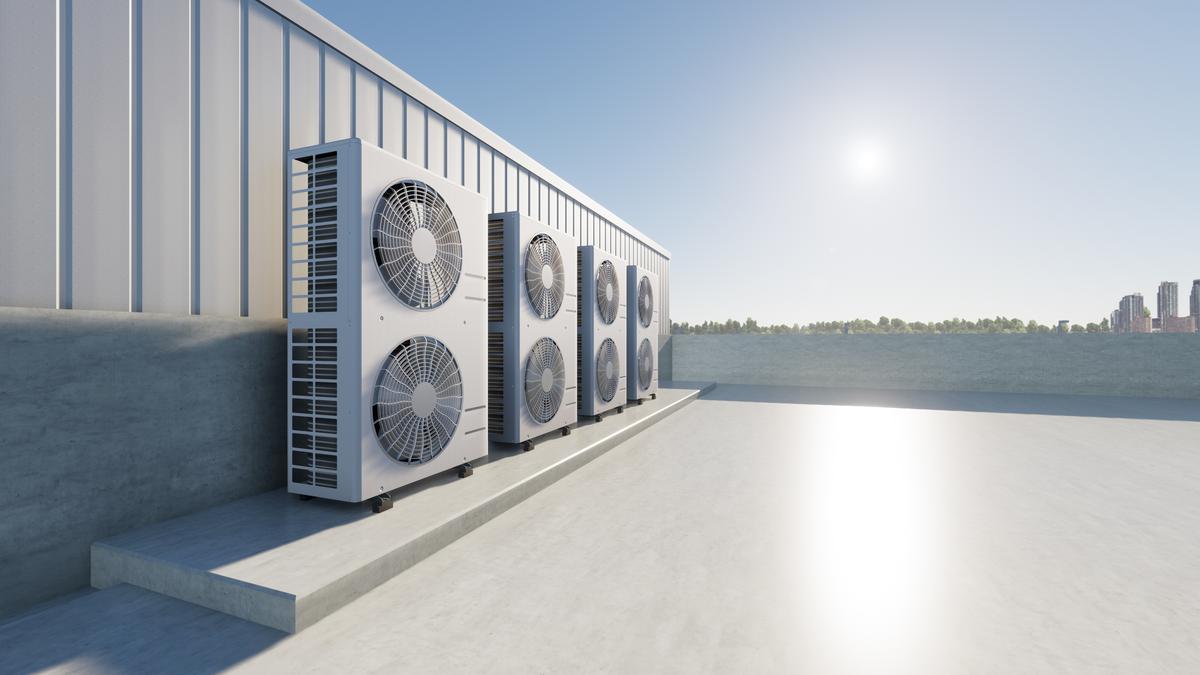
With rising temperatures, longer heatwaves, and a rapidly growing urban economy, cooling in India is rapidly shifting from a lifestyle choice to a basic need, driving up air-conditioner use in homes and workplaces. This surge is now a major part of cities’ power demand, in turn raising concerns about blackouts and higher emissions and about keeping urban areas livable. In this context, planners and experts are looking at district cooling as a way to keep people comfortable while using less electricity and emitting less carbon.
A central cooler
District cooling is a centralised system that supplies air-conditioning to a cluster of buildings, like a shared air-conditioner for an entire neighbourhood or campus. Instead of every building running its own chillers or rooftop units, one large plant makes chilled water and sends it through insulated underground pipes to many buildings, much like a public utility such as piped natural gas or electricity.
Inside each building, this water passes through heat exchangers, cools the indoor air by absorbing heat, then returns slightly warmer to the central plant, where it’s cooled again and sent back into the network. Buildings therefore don’t need to install or operate large cooling systems. They simply draw ‘cooling as a service’ from the network.
Like other utilities, district cooling usually follows a multi-part tariff: a one-time connection charge to join the network, a fixed demand charge based on the maximum cooling capacity, and a consumption charge based on actual cooling energy used.
Efficiency gains
District cooling plants use large, high-efficiency chillers and cooling towers to deliver more cooling from each unit of electricity than individual building systems. They typically supply chilled water at about 6-7°C and receive it back at around 12-14°C, after it has absorbed heat. Many systems use thermal storage so that 20-40% of the cooling can be produced at night, when demand and tariffs are lower.
Together, these choices allow well-run systems to operate roughly twice as efficiently as many stand-alone building chillers, cutting electricity use for cooling by 30-50% and reducing peak demand on the grid by 20-30%. These efficiency gains translate into important environmental benefits. Lower electricity use means greenhouse gas emissions can fall by roughly 15-40% while concentrating equipment in a one unified plant can cut refrigerant volumes in buildings by up to 80%, reducing leak risks. At the street level, fewer small outdoor units spewing hot air outside can also mitigate the urban heat-island effect.Some districts abroad have already reported local temperature drops of 1-2°C where such systems operate.
Water use is often raised as a concern, especially in water-stressed cities. In district cooling systems, the chilled water circulating between the plant and buildings runs in a closed loop and consumes very little water. A district cooling plant of about 10,000 tonnes of capacity typically requires a little over one kilolitre of make-up water during cooling tower operation. Because these systems are built at scale and centrally managed, they can also be designed to use treated sewage or wastewater.
Making sense
All of this connects directly to India’s National Cooling Action Plan. Using less power for cooling and shifting part of the load to the night eases pressure on the grid, improving energy security and reducing the risk of outages during heatwaves, when people most need cooling.
Lower emissions and easier use of low/zero global warming potential refrigerants in central plants support India’s climate goals and its Kigali commitments to phase down hydrofluorocarbons while reliable, high-quality cooling underpins the growth of services, IT, hospitals and data centres in dense urban areas. By freeing up rooftops and indoor space otherwise taken up by cooling equipment, district cooling can also help cities use urban land better, making it a tool of comfort as much as climate action and smarter urbanisation.
District cooling works best where cooling demand is high, dense, and predictable. This makes it suitable for commercial districts, transit-oriented corridors, airports and aerocities, hospitals, universities, and IT parks. In India, Navi Mumbai, Hyderabad’s financial districts, Ahmedabad’s GIFT City, and parts of Bengaluru are often cited as strong candidates because they combine new development, dense commercial loads, and planned infrastructure.
Business case
For operators, district cooling is a utility-style business with revenue typically coming from a one-time connection charge, a fixed demand charge, and a variable consumption charge. The model can be financially attractive if there are enough long-term customers and city planning offers certainty about future demand.
For customers, cooling can account for 30-50% of electricity use in many commercial buildings, and by using energy more efficiently and sharing infrastructure, district cooling can cut operating costs by about 20-40% over the life of a project.
Not having to install separate chillers and cooling towers in each building can also save developers 5-10% of project cost and unlock 1-2% extra usable or saleable space. Utility-grade reliability (often above 99.9%) is also a major plus for hospitals and data centres.
The main concern is the fixed demand charge: customers pay for reserved capacity even if the building is partly empty.
If they over-estimate their needs or have inefficient internal systems that waste chilled water, bills can feel high, making good building design and right-sizing of contracts crucial.
For electricity utilities, the primary benefit is lower peak load from air-conditioning during hot afternoons. District systems use large, efficient chillers, benefit from diversity where different buildings peak at different times, and often include thermal storage to shift 20-40% of cooling production to the night, helping flatten daytime peaks. This allows utilities to avoid or defer new peak load plants and reduce purchases of expensive peak power.
Economy of scale
To move to a real network of district cooling systems, many players need to work together. Urban authorities should demarcate district cooling zones in master plans, set aside land for plants and pipe corridors, and coordinate underground utilities.
Municipal bodies need to be empowered and strengthened to introduce clear concession rules, service standards, and long-term frameworks so private players know how they will recover investments.
Likewise, state electricity regulators and DISCOMs can consider shifting loads from day to night as a formal demand-side resource, link it to tariff design, and recognise the value of avoided peak capacity. Central agencies can also issue standard technical guidelines and model PPP contracts while developers design new buildings with ready connection points and compatible internal piping.
GIFT City in Gujarat has already demonstrated district cooling. Studies here have suggested full deployment could reduce power demand by around 6,100 MW, save about 7,850 GWh annually, and avoid roughly 6.6 million tonnes of CO2 emissions each year.
With effective coordination and clear governance frameworks, Indian cities can replicate and expand such examples, transforming cooling from a climate vulnerability into a cornerstone of sustainable, resilient urban infrastructure.
Prasad Vaidya is Advisor, Indian Institute for Human Settlements (IIHS). Manish Dubey is Chief-Practice, IIHS.