


Skip to content
  • Facebook
  • X
  • Linkedin
  • WhatsApp
  • YouTube
  • Associate Journalism
  • About Us
  • Privacy Policy
  • 033-46046046
  • editor@artifex.news
Artifex.News

Artifex.News

Stay Connected. Stay Informed.

  • Breaking News
  • World
  • Nation
  • Sports
  • Business
  • Science
  • Entertainment
  • Lifestyle
  • Toggle search form
  • Access Denied Sports
  • Hardeep Puri vs Shashi Tharoor Over 2009 Dinner With George Soros In US
    Hardeep Puri vs Shashi Tharoor Over 2009 Dinner With George Soros In US Nation
  • Access Denied Sports
  • Access Denied Sports
  • Kylian Mbappe ‘Can Do Better’ As Troubled Real Madrid Visit Atalanta
    Kylian Mbappe ‘Can Do Better’ As Troubled Real Madrid Visit Atalanta Sports
  • Mother, Daughter Electrocuted In Kota, Family Alleges Negligence
    Mother, Daughter Electrocuted In Kota, Family Alleges Negligence Nation
  • ‘I had God on my side’: Trump describes assassination attempt in personal detail as he accepts Republican nomination
    ‘I had God on my side’: Trump describes assassination attempt in personal detail as he accepts Republican nomination World
  • French left to name PM candidate this week
    French left to name PM candidate this week World
Astronomers puzzle over ‘inside out’ planetary system

Astronomers puzzle over ‘inside out’ planetary system

Posted on February 15, 2026 By admin


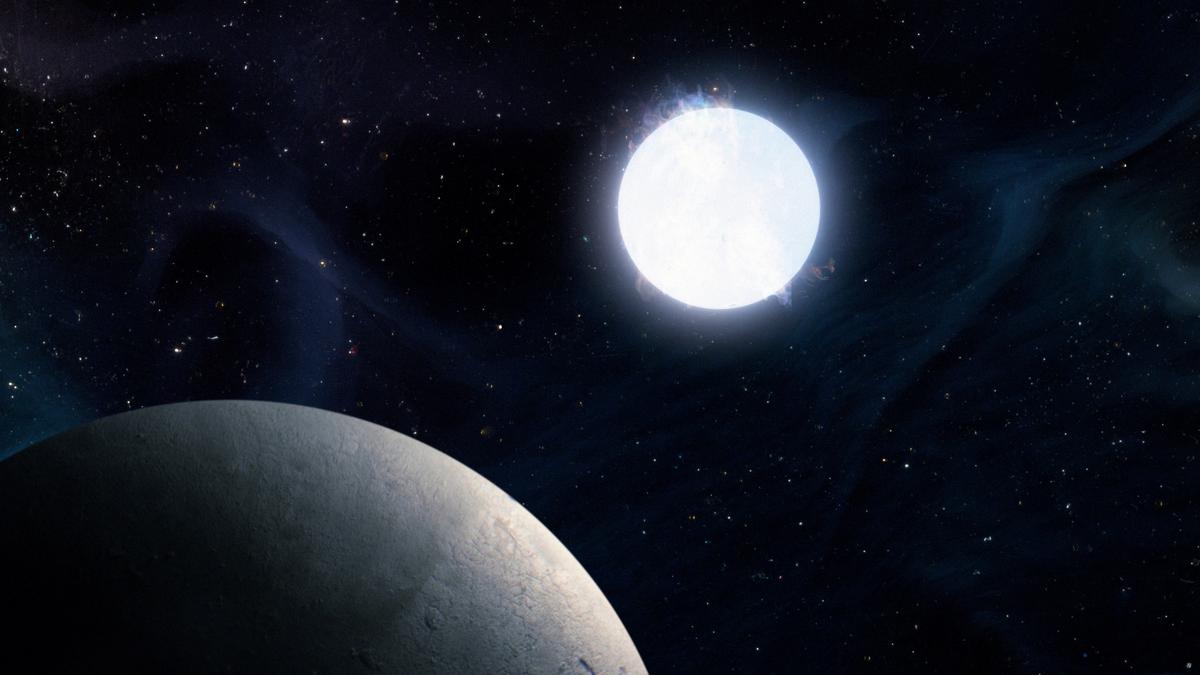
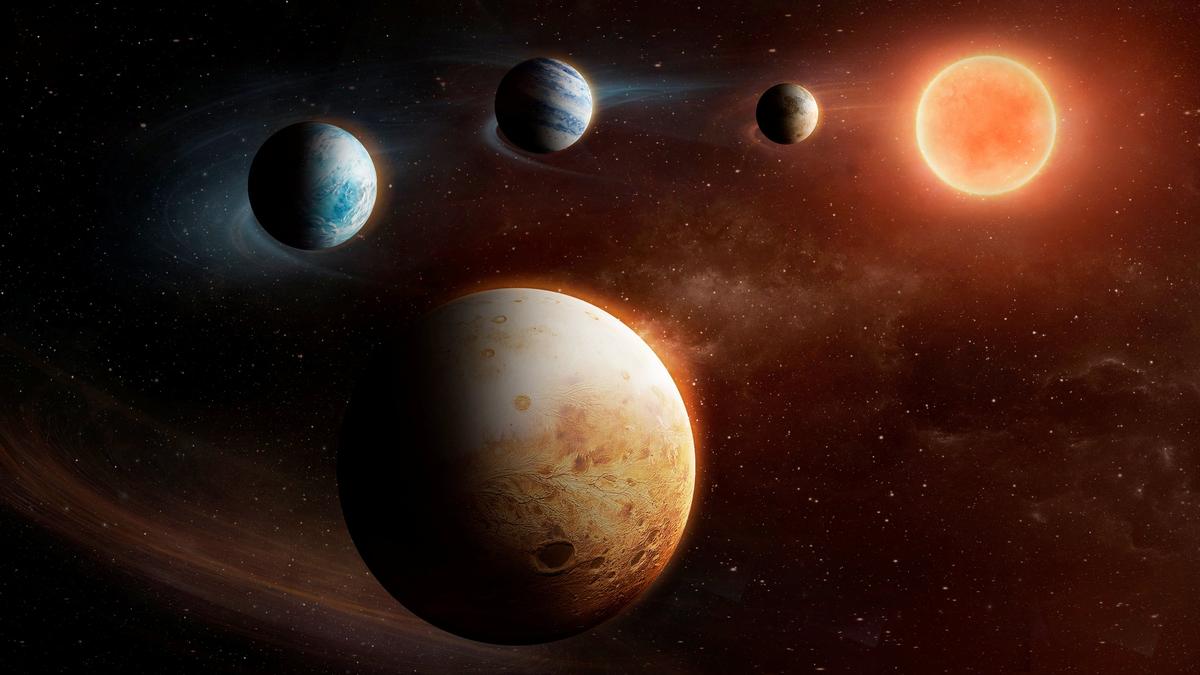
An artist’s impression of the LHS 1903 planetary system.
| Photo Credit: Reuters

Astronomers have observed a planetary system that challenges current planet formation theories, with a rocky planet that formed beyond the orbits of its gaseous neighbors, possibly after much of the planet-forming material had been used up.

The system, observed using the European Space Agency’s Cheops space telescope, consists of four planets – two rocky and two gaseous – orbiting a relatively small and dim star called a red dwarf about 117 light-years from Earth in the direction of the Lynx constellation. A light-year is the distance light travels in a year, 9.5 trillion km.

The star, named LHS 1903, is about 50% as massive and 5% as luminous as our sun.

The order of the planets is what caught the attention of scientists. The innermost planet is rocky, the next two are gaseous and the fourth one, which current planetary formation theory suggests should be gaseous, instead is rocky.

“The planet-formation paradigm states that planets close to their host star should form small and rocky, with little-to-no gas or ice,” said astronomer Thomas Wilson of the University of Warwick in England, lead author of the study published in the journal Science.

“This is because this environment is too hot to maintain substantial gas or ice, and any atmospheres that do form are likely removed via irradiation from their host star. Conversely, planets at larger separations are thought to be built in colder regions with a lot of gas and ice that would create gas-rich worlds with large atmospheres. This system challenges that by giving us a rocky planet outside of gas-rich planets,” Wilson said.

Wilson called it “a system built inside-out.”

In our solar system, the four inner planets are rocky and the four outer planets are gaseous. The rocky dwarf planets like Pluto that orbit beyond the gas planets are much smaller than any of the solar system’s planets.

Astronomers have detected about 6,100 planets beyond our solar system, called exoplanets, since the 1990s.

All four in the newly observed system orbit closer to the star than our solar system’s innermost planet Mercury orbits the sun. In fact, the outermost planet orbits at only about 40% of the orbital distance between Mercury and the sun. This is typical for planets orbiting red dwarf stars that are so much less powerful than the sun.

The two rocky planets are categorized as super-Earths, meaning rocky like Earth but two to 10 times more massive. The two gas planets are categorized as mini-Neptunes, meaning gaseous and smaller than our solar system’s smallest gas planet Neptune but larger than Earth.

The researchers suspect that rather than forming all at once in a large disk of gas and dust swirling around their host star, this system’s planets formed sequentially, with gas that otherwise would have made up the atmosphere of the fourth planet being used up by its sibling planets before it coalesced.

Wilson said the fourth planet most likely was a “late bloomer.”

“It formed later than the other planets in a gas-poor environment. There was actually not so much material to build this planet,” Wilson said.

Another possibility is that it was born with a large gas atmosphere that later was lost in a calamity, leaving behind just the rocky planetary core.

“Did (the fourth planet) arrive coincidentally just as the gas ran out? Or did it suffer a collision with another body which stripped its atmosphere away? The latter sounds fanciful until you remember that the Earth-moon system appears to be a product of just such a collision,” astronomer and study co-author Andrew Cameron of the University of St Andrews in Scotland said.

This fourth planet also is interesting because of its potential habitability. Its mass is 5.8 times that of Earth and it is about 60 degrees C.

“A temperature of 60 degrees C is very similar to the hottest temperature recorded on Earth, 57 degrees Celsius (135 degrees Fahrenheit), so it’s definitely possible that this planet is habitable. Future James Webb Space Telescope observations could reveal the conditions of this planet and help us understand how habitable it might be,” Wilson said.

Published – February 15, 2026 03:38 pm IST



Source link

Science

Post navigation

Previous Post: Israeli airstrikes kill nine in Gaza, including tent camp, Palestinian officials say
Next Post: Access Denied

Related Posts

  • New portable atomic clock offers very accurate timekeeping at sea
    New portable atomic clock offers very accurate timekeeping at sea Science
  • The Science Quiz | Remembering a star that was briefly the brightest…
    The Science Quiz | Remembering a star that was briefly the brightest… Science
  • Scientists are working on a way to detect cancer with ultrasound waves
    Scientists are working on a way to detect cancer with ultrasound waves Science
  • Why we can’t tickle ourselves
    Why we can’t tickle ourselves Science
  • ISRO satellites tracking cyclone Dana since October 20
    ISRO satellites tracking cyclone Dana since October 20 Science
  • Bottleneck in human evolution explained using a novel genomic analysis technique
    Bottleneck in human evolution explained using a novel genomic analysis technique Science

More Related Articles

Sci-Five | The Hindu Science Quiz: On Planetary Nebula Sci-Five | The Hindu Science Quiz: On Planetary Nebula Science
Why do cyclones move towards land? | Explained Why do cyclones move towards land? | Explained Science
Could a telescope ever see the beginning of time? Could a telescope ever see the beginning of time? Science
New tool predicts how pollen travels through city air New tool predicts how pollen travels through city air Science
Babies in Nigeria being born with antibiotic resistant bacteria Babies in Nigeria being born with antibiotic resistant bacteria Science
Space-tech firm GalaxEye to launch world’s first multi-sensor EO satellite in 2026 Space-tech firm GalaxEye to launch world’s first multi-sensor EO satellite in 2026 Science
SiteLock

Archives

  • May 2026
  • April 2026
  • March 2026
  • February 2026
  • January 2026
  • December 2025
  • November 2025
  • October 2025
  • September 2025
  • August 2025
  • July 2025
  • June 2025
  • May 2025
  • April 2025
  • March 2025
  • February 2025
  • January 2025
  • December 2024
  • November 2024
  • October 2024
  • September 2024
  • August 2024
  • July 2024
  • June 2024
  • May 2024
  • April 2024
  • March 2024
  • February 2024
  • January 2024
  • December 2023
  • November 2023
  • October 2023
  • September 2023
  • August 2023
  • July 2023
  • June 2023
  • May 2023
  • April 2023
  • March 2023
  • February 2023
  • January 2023
  • December 2022
  • November 2022
  • October 2022
  • September 2022
  • August 2022
  • July 2022
  • June 2022
  • May 2022

Categories

  • Business
  • Nation
  • Science
  • Sports
  • World

Recent Posts

  • 15 security officials killed in militant attack in northwest Pakistan
  • As model code ends, wall posters make a comeback in Tiruchi
  • Explosion at coal mine in Colombia, at least four trapped
  • Telangana hotel association seek LPG relief, urge PM Modi for rationalisation
  • Air India has terminated over 1,000 staff in last 3 years for ethical breaches: CEO

Recent Comments

  1. EnriqueExins on UP Teacher Who Asked Students To Slap Muslim Classmate
  2. Andrewfoods on UP Teacher Who Asked Students To Slap Muslim Classmate
  3. DonaldStype on UP Teacher Who Asked Students To Slap Muslim Classmate
  4. RaymondMuh on UP Teacher Who Asked Students To Slap Muslim Classmate
  5. Williamdox on UP Teacher Who Asked Students To Slap Muslim Classmate
  • Asia Cup 2023: Pakistan Make Huge Changes To Playing XI Against Sri Lanka
    Asia Cup 2023: Pakistan Make Huge Changes To Playing XI Against Sri Lanka Sports
  • Access Denied
    Access Denied Nation
  • U.S., Singapore accounted for one-third of FDI during FY25: RBI census
    U.S., Singapore accounted for one-third of FDI during FY25: RBI census Business
  • Trump threatens Iran with power plant strikes over Hormuz blockade
    Trump threatens Iran with power plant strikes over Hormuz blockade World
  • Two senior media professionals arrested in Bangladesh
    Two senior media professionals arrested in Bangladesh World
  • Viral Picture: Shikhar Dhawan Stops His Interview To Share A Hug With Rishabh Pant During DPL 2024 Game
    Viral Picture: Shikhar Dhawan Stops His Interview To Share A Hug With Rishabh Pant During DPL 2024 Game Sports
  • Sensex, Nifty fall for 2nd day amid foreign fund exodus, muted corporate earnings
    Sensex, Nifty fall for 2nd day amid foreign fund exodus, muted corporate earnings Business
  • IPL 2024 Final: Some youngsters have won us games on their own. That’s been the story of our team: Cummins
    IPL 2024 Final: Some youngsters have won us games on their own. That’s been the story of our team: Cummins Sports

Editor-in-Chief:
Mohammad Ariff,
MSW, MAJMC, BSW, DTL, CTS, CNM, CCR, CAL, RSL, ASOC.
editor@artifex.news

Associate Editors:
1. Zenellis R. Tuba,
zenelis@artifex.news
2. Haris Daniyel
daniyel@artifex.news

Photograher:
Rohan Das
rohan@artifex.news

Artifex.News offers Online Paid Internships to college students from India and Abroad. Interns will get a PRESS CARD and other online offers.
Send your CV (Subjectline: Paid Internship) to internship@artifex.news

Links:
Associate Journalism
About Us
Privacy Policy

News Links:
Breaking News
World
Nation
Sports
Business
Entertainment
Lifestyle

Registered Office:
72/A, Elliot Road, Kolkata - 700016
Tel: 033-22277777, 033-22172217
Email: office@artifex.news

Editorial Office / News Desk:
No. 13, Mezzanine Floor, Esplanade Metro Rail Station,
12 J. L. Nehru Road, Kolkata - 700069.
(Entry from Gate No. 5)
Tel: 033-46011099, 033-46046046
Email: editor@artifex.news

Copyright © 2023 Artifex.News Newsportal designed by Artifex Infotech.