

Skip to content
  • Facebook
  • X
  • Linkedin
  • WhatsApp
  • YouTube
  • Associate Journalism
  • About Us
  • Privacy Policy
  • 033-46046046
  • editor@artifex.news
Artifex.News

Artifex.News

Stay Connected. Stay Informed.

  • Breaking News
  • World
  • Nation
  • Sports
  • Business
  • Science
  • Entertainment
  • Lifestyle
  • Toggle search form
  • Science Snapshots: April 19, 2026
    Science Snapshots: April 19, 2026 Science
  • Sharad Pawar’s Big Symbol Charge Against Ajit Pawar After Maharashtra Rout
    Sharad Pawar’s Big Symbol Charge Against Ajit Pawar After Maharashtra Rout Nation
  • Actor-politician Gautami Tadimalla quits BJP
    Actor-politician Gautami Tadimalla quits BJP Nation
  • IND vs NZ fourth T20I | Samson in focus as the action moves to the City of Destiny
    IND vs NZ fourth T20I | Samson in focus as the action moves to the City of Destiny Sports
  • Access Denied
    Access Denied Nation
  • Access Denied Sports
  • Kursk Residents Get Used To Life With Strikes, Sirens
    Kursk Residents Get Used To Life With Strikes, Sirens World
  • The Hindu Morning Digest, March 21, 2024
    The Hindu Morning Digest, March 21, 2024 World
Why do cyclones move towards land? | Explained

Why do cyclones move towards land? | Explained

Posted on October 28, 2025 By admin


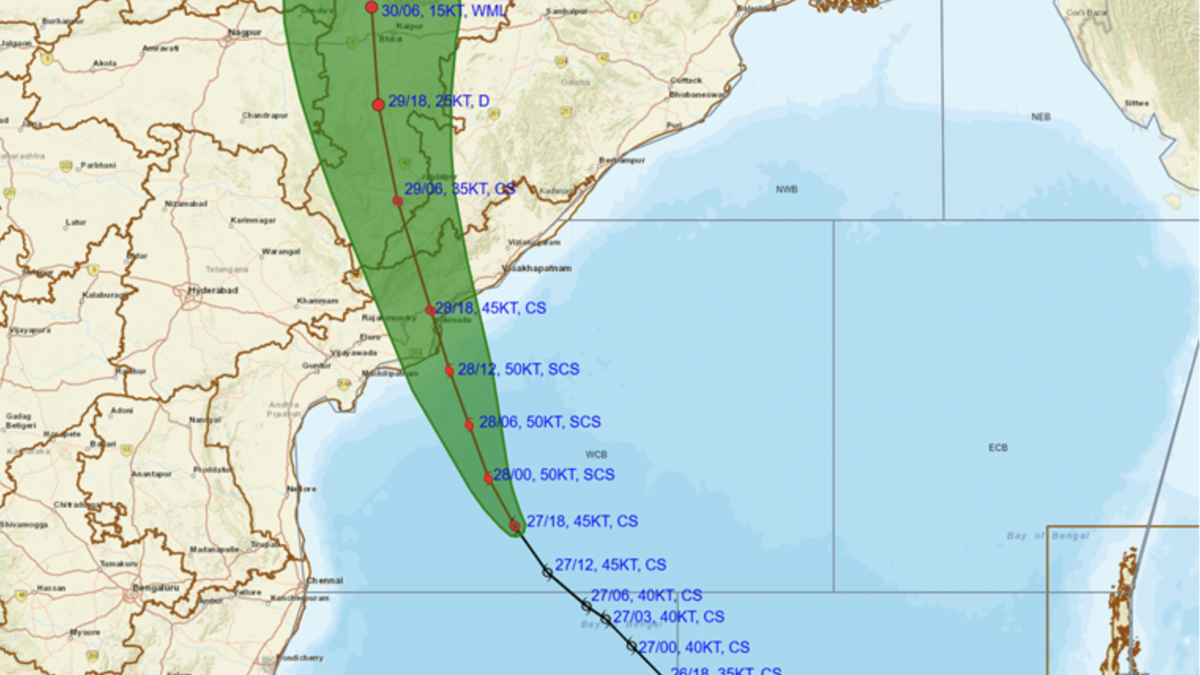
Observed (black line) and forecast track of Cyclone Montha at 11.30 pm hours on October 27, 2025. The green area depicts the cone of uncertainty.
| Photo Credit: India Meteorological Department

Tropical cyclones are carried by the large-scale wind patterns that govern the atmosphere. These storms form over warm ocean waters, where the sea surface temperature is about 26º C or more, providing the heat and moisture they need to grow. But once they have formed, the way they move depends entirely on the winds that surround them, much like a leaf swept along by a river.

The tropical areas where cyclones develop are roughly between 5º and 20º north and south (of the equator). Here the dominant winds are the trade winds, which blow from east to west throughout the year as part of the global Hadley circulation. This is a global convection pattern driven by the uneven heating of the earth: warm air rises near the equator, moves towards the poles, cools and sinks around the 30º latitude, and then flows back towards the equator at the surface. Because the earth rotates, the returning air is deflected towards the west by the Coriolis effect, creating the easterly trade winds.

These winds thus tend to push storms westward across the oceans, which is why tropical cyclones in the Bay of Bengal move towards India’s east coast. It’s also why tropical storms in the Atlantic Ocean move from the African coast towards the Caribbean and the Americas and why those in the Pacific Ocean often head towards Asia and Australia.

While tropical cyclones draw their energy from warm ocean waters and can thus become more intense as long as they remain offshore, the winds don’t give them a choice. And as the storm moves, it may also encounter other atmospheric systems, such as mid-latitude westerlies farther north, which can alter its course. Sometimes these changes steer a storm harmlessly into open water — but it’s often the case that the prevailing flow carries the storm over land.

In December 2023, because the steering winds over the Bay of Bengal were weak, Cyclone Michaung moved very slowly and lingered for many hours offshore before making landfall.

If the global geography were reversed or if the trade winds blew the other way, cyclones would instead be carried out over open water and rarely make landfall.

A question obviously arises here: why then would a cyclone in the Arabian Sea make landfall over the west coast of India? Shouldn’t it move towards the Arabian Peninsula or the Horn of Africa instead?

If the trade winds were the only influence, then yes, storms in the Arabian Sea should indeed drift towards the Arabian Peninsula or Africa. But in practice, they often move towards India instead because of the monsoons.

In the Atlantic and the Pacific Oceans, the trade winds blow consistently westwards, but in the Indian Ocean, the surface winds reverse directions with the monsoons. From around June to September, the southwest monsoon dominates: winds blow from the southwest towards the northeast. This means that during the monsoon and its onset and retreat phases, the low-level steering flow over the Arabian Sea often points towards India rather than away from it. Cyclones forming in this period thus are carried northeastward and make landfall along India’s western coast, particularly Gujarat, Maharashtra, and sometimes Kerala.

Outside the monsoon season, during winter and early spring, the circulation reverses: the northeast monsoon brings dry air from the Indian subcontinent towards the equator and Africa. So cyclones that form then are more likely to drift westwards towards the Arabian Peninsula or Somalia. However, a cyclone is also unlikely to form at this time because the waters are cooler and wind shear is stronger.

Published – October 28, 2025 09:00 am IST



Source link

Science

Post navigation

Previous Post: Access Denied
Next Post: Qualcomm shares soar 20% on new AI chip launch

Related Posts

  • Cost concerns delay safer building codes despite Himalayan threats
    Cost concerns delay safer building codes despite Himalayan threats Science
  • Scans of seemingly empty space reveal black holes not far from earth
    Scans of seemingly empty space reveal black holes not far from earth Science
  • Budget 2024: Urban, rural land reforms ‘welcome move’ by government
    Budget 2024: Urban, rural land reforms ‘welcome move’ by government Science
  • China’s Shenzhou-20 return mission delayed due to space debris impact
    China’s Shenzhou-20 return mission delayed due to space debris impact Science
  • How does a speed gun work?
    How does a speed gun work? Science
  • Rediscovering the virtues of bamboo, an ancient plant
    Rediscovering the virtues of bamboo, an ancient plant Science

More Related Articles

ISRO identifies site for Chandrayaan-4 lander ISRO identifies site for Chandrayaan-4 lander Science
Watch | Indians are buying land on the moon… but can one ‘own’ lunar land? Watch | Indians are buying land on the moon… but can one ‘own’ lunar land? Science
Can heavy snowfall and rain contribute to some earthquakes? Can heavy snowfall and rain contribute to some earthquakes? Science
Why does an elevator need three electrical phases to operate? Why does an elevator need three electrical phases to operate? Science
The mystery of Déjà vu The mystery of Déjà vu Science
IISc researchers develop novel method for mass production of recombinant proteins IISc researchers develop novel method for mass production of recombinant proteins Science
SiteLock

Archives

  • May 2026
  • April 2026
  • March 2026
  • February 2026
  • January 2026
  • December 2025
  • November 2025
  • October 2025
  • September 2025
  • August 2025
  • July 2025
  • June 2025
  • May 2025
  • April 2025
  • March 2025
  • February 2025
  • January 2025
  • December 2024
  • November 2024
  • October 2024
  • September 2024
  • August 2024
  • July 2024
  • June 2024
  • May 2024
  • April 2024
  • March 2024
  • February 2024
  • January 2024
  • December 2023
  • November 2023
  • October 2023
  • September 2023
  • August 2023
  • July 2023
  • June 2023
  • May 2023
  • April 2023
  • March 2023
  • February 2023
  • January 2023
  • December 2022
  • November 2022
  • October 2022
  • September 2022
  • August 2022
  • July 2022
  • June 2022
  • May 2022

Categories

  • Business
  • Nation
  • Science
  • Sports
  • World

Recent Posts

  • China, U.S. should be ‘partners not rivals’, says Xi Jinping after meeting Donald Trump
  • Iran working on Hormuz ‘protocol’ to cover ‘costs’, says Deputy Foreign Minister Gharibabadi
  • Zydus Lifesciences arm to acquire U.S. oncology firm Assertio for $166 million
  • Israel-Iran war LIVE: Iran working on Hormuz ‘protocol’ to cover ‘costs’, says Dy FM Gharibabadi
  • Russia to fulfil all agreements on energy supply to India: FM Lavrov

Recent Comments

  1. Jeffreyroure on UP Teacher Who Asked Students To Slap Muslim Classmate
  2. Stevemonge on UP Teacher Who Asked Students To Slap Muslim Classmate
  3. RichardClage on UP Teacher Who Asked Students To Slap Muslim Classmate
  4. StevenLek on UP Teacher Who Asked Students To Slap Muslim Classmate
  5. Leonardren on UP Teacher Who Asked Students To Slap Muslim Classmate
  • Access Denied Sports
  • Chinese military’s airspace violation is utterly unacceptable, says Japan
    Chinese military’s airspace violation is utterly unacceptable, says Japan World
  • Putin Calls For Closer Ties With North Korea “On All Fronts”: Kremlin
    Putin Calls For Closer Ties With North Korea “On All Fronts”: Kremlin World
  • TVS Emerald raises ₹425 crore equity from IFC for new housing projects
    TVS Emerald raises ₹425 crore equity from IFC for new housing projects Business
  • Access Denied
    Access Denied Nation
  • Poor Will Get Free Treatment Up To Rs 10 Lakh In Chhattisgarh: Rahul Gandhi
    Poor Will Get Free Treatment Up To Rs 10 Lakh In Chhattisgarh: Rahul Gandhi Nation
  • Access Denied Sports
  • Europe To Impose Sanctions Over Iranian Ballistic Missile Transfer To Russia
    Europe To Impose Sanctions Over Iranian Ballistic Missile Transfer To Russia World

Editor-in-Chief:
Mohammad Ariff,
MSW, MAJMC, BSW, DTL, CTS, CNM, CCR, CAL, RSL, ASOC.
editor@artifex.news

Associate Editors:
1. Zenellis R. Tuba,
zenelis@artifex.news
2. Haris Daniyel
daniyel@artifex.news

Photograher:
Rohan Das
rohan@artifex.news

Artifex.News offers Online Paid Internships to college students from India and Abroad. Interns will get a PRESS CARD and other online offers.
Send your CV (Subjectline: Paid Internship) to internship@artifex.news

Links:
Associate Journalism
About Us
Privacy Policy

News Links:
Breaking News
World
Nation
Sports
Business
Entertainment
Lifestyle

Registered Office:
72/A, Elliot Road, Kolkata - 700016
Tel: 033-22277777, 033-22172217
Email: office@artifex.news

Editorial Office / News Desk:
No. 13, Mezzanine Floor, Esplanade Metro Rail Station,
12 J. L. Nehru Road, Kolkata - 700069.
(Entry from Gate No. 5)
Tel: 033-46011099, 033-46046046
Email: editor@artifex.news

Copyright © 2023 Artifex.News Newsportal designed by Artifex Infotech.