





Atomic clocks are the backbone of the Global Positioning System (GPS), the network of satellites above the earth that we use every day to navigate cities, respond to emergencies, and organise military operations, among other things.
Despite being one of the most accurate timekeeping methods, however, there is still room for improvement. Scientists today are pushing the boundaries with a new technology called optical atomic clocks.
But for being such sophisticated instruments, both these clocks are also bulky, power-hungry, fragile, and expensive (see image below). As a result, their installation and operations are often restricted to big research facilities.
A study recently published in the journal Nature introduced a kind of portable optical atomic clock that can be used onboard ships. While these devices traded some accuracy for size and robustness, they were still more accurate than other vessel-borne timekeeping options.
According to the researchers, this is the most performant optical clock based at sea and represents a significant advancement in optical timekeeping.
The working of an atomic clock
Atomic clocks work by keeping time using atoms. One popular design uses atoms of an isotope of caesium, Cs-133. The International Committee for Weights and Measures first used it in 1967 to define the duration of one second. India also uses a Cs-133 atomic clock to define the second for timekeeping within its borders.
Cs-133 is a highly stable atom and is found naturally, which is why it is so commonly used in atomic clocks.
Atomic clocks exploit a fundamental property of all atoms: their ability to jump between different energy levels. Energy levels are like the steps of a ladder. An atom climbs up the ladder by absorbing energy, like electromagnetic radiation.
In a Cs atomic clock, the energy needed for the atom to jump to a higher energy level matches the frequency of microwave radiation. This frequency is related in some fully understood way to the duration of a second.
First, researchers keep the Cs atoms in a cavity, to which microwave radiation of a specific frequency is applied. When the frequency of this radiation matches the transition energy of the Cs atoms, the match-up is called a resonance.
The Cs-133 atoms absorb this radiation and jump to a higher energy level. This transition only happens when the frequency of the applied radiation is equal to 9,192,631,770 Hz.
Put another way, when the Cs-133 atom completes 9,192,631,770 oscillations between the two energy levels, one second will have passed.
The accuracy of atomic clocks comes from a feedback mechanism that detects any changes in the resonance frequency and adjusts the microwave radiation to maintain resonance.
Thus, a caesium atomic clock loses or gains a second every 1.4 million years.
How optical atomic clocks are different
Optical atomic clocks are even more accurate. While they have the same working principle, the resonance frequency here is in the optical range. Radiation in this range includes visible light (to humans) and ultraviolet and infrared radiation.
As part of an optical atomic clock, researchers use lasers to stimulate atomic transitions. The lasers’ light is highly coherent: the emitted light waves all have the same frequency and their wavelengths are related to each other in a way that doesn’t change. The result is light with more precise properties and great stability.
Optical atomic clocks use coherent light to achieve higher accuracy in two main ways.
The first is the higher operating frequency of atomic clocks. Say we have two clocks, A and B. A has a higher operating frequency than that of B — which means A will complete more oscillations than B in the same time.
As a result, A will be able measure smaller increments of time more accurately because it has more cycles to count within that time frame.
The second reason is that optical atomic clocks have much narrower linewidths. The linewidth is the range of frequencies over which the transition occurs. The narrower the linewidth, the easier it is to tune the frequency of the optical light that produces the resonance. This leads to higher accuracy because it enables more precise changes.
The most commonly used atom in optical atomic clocks is strontium (Sr): it has narrow linewidths and stable optical transitions.

Researchers at the Indian Institute of Science Education and Research, Pune, are working on a strontium optical atomic clock. Their peers at the Inter-University Centre for Astronomy and Astrophysics in the same city are developing a similar clock with ytterbium ions. These devices, once ready, will bring precision timekeeping in India to the optical regime.
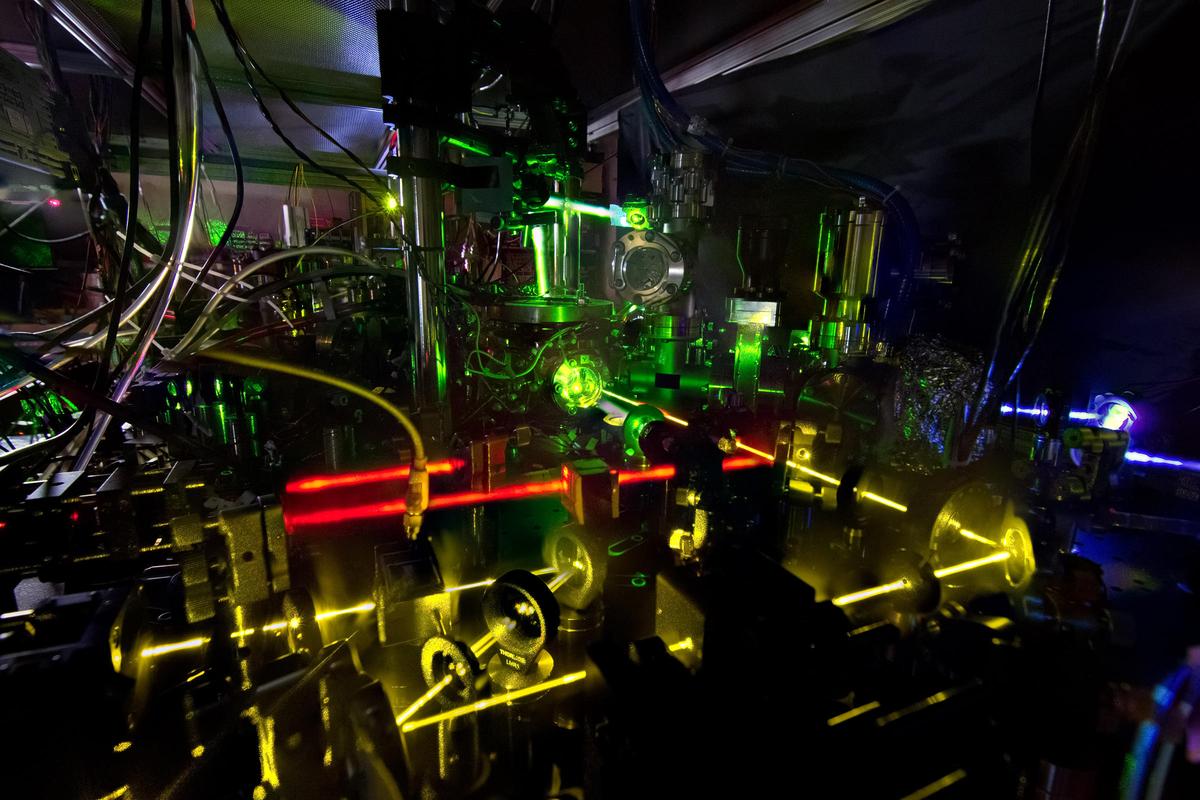
A general view of an ytterbium atomic clock at the U.S. National Institute of Standards and Technology, October 16, 2014.
| Photo Credit:
Public domain
Building a portable optical atomic clock
The researchers in the Nature study developed an optical atomic clock that uses molecular iodine as the frequency standard.
Traditional optical atomic clocks are large and not easy to transport. Scientists have previously attempted to make them portable. Those in the new study wished to fit them within a standardised rack, of the sort used in data centres, laboratories, and telecommunications facilities.
To do this, the team miniaturised the clock’s spectrometer, laser system, and frequency comb.
The spectrometer, used to measure the frequencies of transitions, was designed to have a volume of 2.5 litres. The laser system was built using optical fibres — slender, flexible, transparent cables made of glass or plastic and which can transmit light over long distances. The system thus had a volume of only 1 litre, and operated with light of wavelength 1,064 nm.
A frequency comb is a device that generates a series of equally spaced optical frequencies. This provides a stable and accurate reference for tracking the atomic transitions and generating precise optical frequencies. The frequency comb occupied a volume of 0.5 litres.
The researchers also equipped the clock with a software control system that could autonomously initialise the clock from an ‘off’ state to a fully operational state. It monitors temperature, identifies specific transitions, activates some components, and ensures the system stays stable by continuously checking for problems.
As a result, the final clock had a total volume of 35 litres — about the size of a large backpack. It weighed around 26 kg and consumed 85 W of power, which is just above the consumption of an incandescent light bulb.
Optical atomic clocks at sea
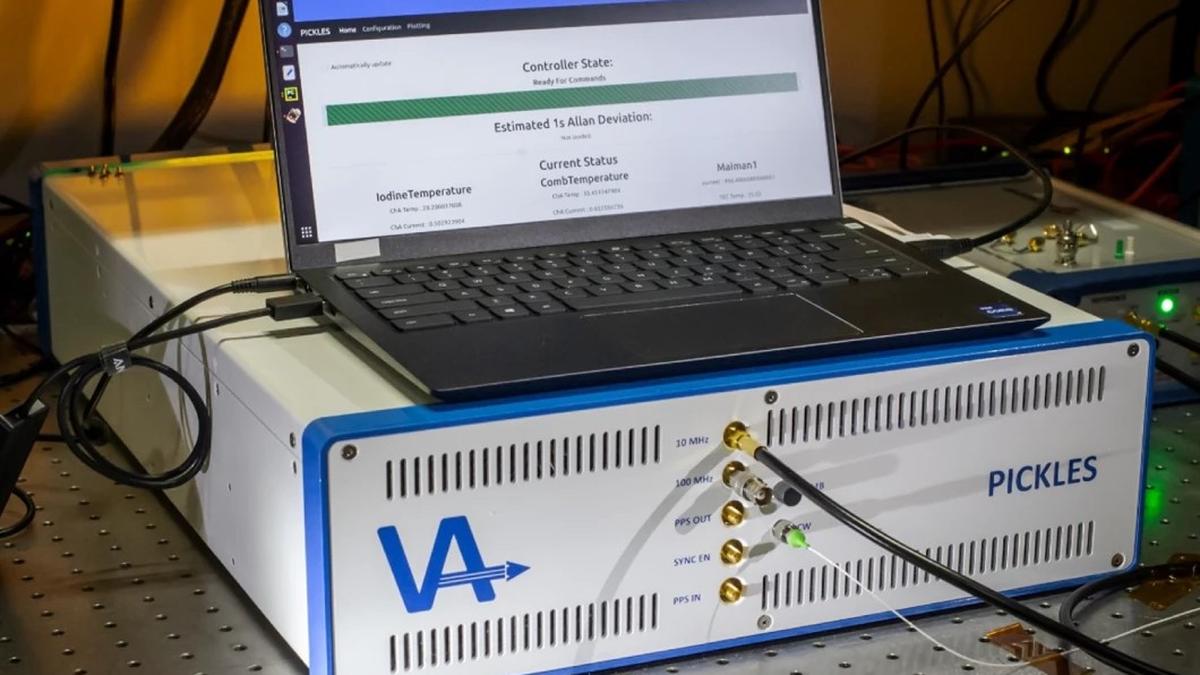
The researchers conducted initial tests at the U.S. National Institute of Standards and Technology (NIST) in April 2022. They operated two prototypes, called PICKLES and EPIC, autonomously for 34 days.
The optical atomic clocks’ accuracy fluctuated less over short periods, outperforming NIST’s hydrogen maser ST05, one of the world’s most accurate and stable atomic clocks, which is based on hydrogen atoms.

A server rack containing three independent optical clocks, a 1-U power supply, a control laptop for each clock, an uninterruptable power supply, and a measurement system were loaded in a total rack volume of 23 U. The cargo container housing the rack was craned onto the deck of the HMNZS Aotearoa, where it remained for a three-week naval exercise.
| Photo Credit:
Nature 628, pages 736–740 (2024)
The optical atomic clocks also had 10x lower long-term drift compared to rubidium atomic clocks. This means that over long periods, the rate at which the clock’s frequency changes is much lower compared to changes in rubidium atomic clocks. It is a sign of the compact clock’s high stability.
The researchers also deployed the two clocks plus another, called VIPER, on a boat at Pearl Harbor in Hawaii to test them at sea. VIPER was built with a smaller spectrometer and a more simplified laser design, according to the paper.
Despite the ship’s motion, a temperature fluctuation of 2-3 degrees C, and 4-5% changes in humidity, the clocks were nearly as stable as they were in laboratory conditions for up to 1,000 s at a time. When operated for more than a lakh seconds at a time, the clock was still highly stable but also more susceptible to being affected by temperature fluctuations.
Accuracy trade-offs and applications
Atomic clocks are prized for their accuracy, losing or gaining just one second over 300 million years. Optical atomic clocks only lose or gain a second over 300 billion years.
The new iodine clock isn’t as accurate as an optical atomic clock in the laboratory, trading it off for mobility and robustness. But it is still accurate enough to lose or gain a second only every 9.1 million years.
The development of such setups is a necessary first-step for their use for navigation, maritime communication, and scientific research. For example, they can now help monitor underwater seismic and volcanic activity with great precision.
Onboard spacecraft, they can help scientists conduct experiments that test the theories of relativity and potentially reduce the cost of satellite-based navigation.
Tejasri Gururaj is a freelance science writer and journalist with a master’s degree in physics.