




Skip to content
  • Facebook
  • X
  • Linkedin
  • WhatsApp
  • YouTube
  • Associate Journalism
  • About Us
  • Privacy Policy
  • 033-46046046
  • editor@artifex.news
Artifex.News

Artifex.News

Stay Connected. Stay Informed.

  • Breaking News
  • World
  • Nation
  • Sports
  • Business
  • Science
  • Entertainment
  • Lifestyle
  • Toggle search form
  • Puja Khedkar’s Mother Sent To 14 Days Judical Custody For Waving Gun At Farmers
    Puja Khedkar’s Mother Sent To 14 Days Judical Custody For Waving Gun At Farmers Nation
  • Stressed Chinese youngsters fuel wellness boom with a traditional twist
    Stressed Chinese youngsters fuel wellness boom with a traditional twist World
  • TAFE files contempt petition against AGCO over Massey Ferguson brand
    TAFE files contempt petition against AGCO over Massey Ferguson brand Business
  • Access Denied
    Access Denied Nation
  • Access Denied Sports
  • Mental Illness No Bar For Medical Degree, Medical Council Tells Court
    Mental Illness No Bar For Medical Degree, Medical Council Tells Court Nation
  • Access Denied World
  • Palestine state recognition ‘when not if’: Japan PM Shigeru Ishiba
    Palestine state recognition ‘when not if’: Japan PM Shigeru Ishiba World
Researchers use sound waves to detect elusive helium gas leaks

Researchers use sound waves to detect elusive helium gas leaks

Posted on January 28, 2026 By admin


A simple Kagome lattice. The name comes from the Japanese for “basket” and “eye”, referring to the pattern when woven with bamboo leaves.
| Photo Credit: N. Mori

Helium is famous for making balloons float, voices squeak, and as a critical resource for MRI machines and aerospace engineering. Helium is expensive and scarce, finding leaks quickly is essential, but that’s easier said than done because helium is also chemically inert and sensors, which usually rely on chemical reactors, have a tough time detecting it.

In a new study, researchers from Nanjing University in China have reported a sensor that uses sound waves instead of chemistry to ‘hear’ helium leaks. The study paper was published in the December 2025 issue of Applied Physics Letters.

Most gas sensors work like a sponge that reacts when it touches a particular liquid. They work by absorbing gas or using chemical reactions to change an electrical signal. Since helium is chemically stable, it doesn’t react with these sensitive coatings. And while existing methods like mass spectrometry can detect helium, they’re often bulky and expensive.

In the new study, the researchers took a different approach. They designed a sensor based on acoustic topological materials. These are structures that can trap sound using a particular geometric pattern called a Kagome lattice.

The Kagome lattice is made of interlaced triangles and hexagons. In their specific design, the researchers used rigid cylinders connected by small tubes, creating an effect called topological corner states. Essentially, sound waves introduced into the structure get trapped at the three corners of the triangle and are unable to escape into the middle or from the sides.
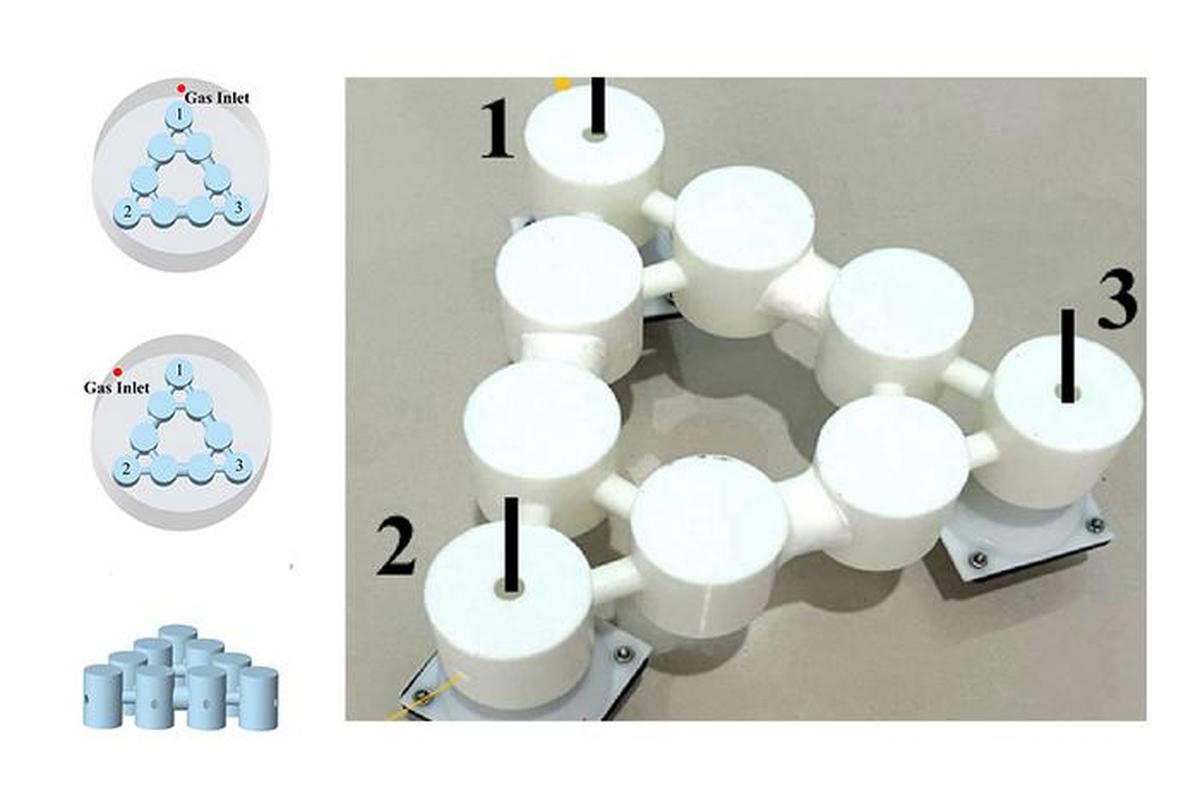
Helium detection device inspired by Kagome. Left: The device’s triangular structure helps determine the location of helium leaks in a 2D space.

Helium detection device inspired by Kagome. Left: The device’s triangular structure helps determine the location of helium leaks in a 2D space.
| Photo Credit:
Wang et al.

Sound travels at different speeds through different gases. When helium leaks into the sensor and mixes with the air inside, it changes the speed at which sound waves travel through the tubes. This change in speed changes the frequency (or pitch) of the trapped sound at the corners. So by measuring this shift in frequency, the sensor can instantly calculate the concentration of helium present.

The acoustic approach offers several advantages over traditional chemical sensors. Because it doesn’t rely on delicate chemical coatings, the sensor is incredibly tough. It works well in temperatures ranging from a comfortable 26º C to a freezing –34º C. It also ignores changes in humidity and thus doesn’t need to be constantly recalibrated like other sensors.

The topological nature of the sensor means its ability to trap sound is very stable. The researchers found that they could drill large holes in the sides of the cylinders to let gas in faster and the sound trap still worked well. This means the sensor can detect leaks rapidly as the gas doesn’t have to seep in slowly.

And because the sensor is a triangle with three distinct corners, it can do more than just say whether helium is present in the air. By comparing the timing of the signals at each of the three corners, the sensor can triangulate the direction the gas is coming from. If the frequency shifts at corner 1 before corner 3, for instance, it would mean the leak is closer to corner 1.

According to the research, this device could make it much easier and cheaper to protect valuable helium supplies in industries ranging from medicine to space exploration.

Published – January 28, 2026 12:40 pm IST



Source link

Science

Post navigation

Previous Post: Vishal Mega Mart Shares May Rally 40% Says ICICI Securities After Q3 Results — Check Target Price
Next Post: Access Denied

Related Posts

  • The Science Quiz | Exploring superfoods and beyond
    The Science Quiz | Exploring superfoods and beyond Science
  • How do airbags work? – The Hindu
    How do airbags work? – The Hindu Science
  • NASA capsule bearing asteroid sample in imminent return to Earth
    NASA capsule bearing asteroid sample in imminent return to Earth Science
  • Indigenously built stroke device approved on domestic trial data, launch set for February 2026
    Indigenously built stroke device approved on domestic trial data, launch set for February 2026 Science
  • High-energy cosmic neutrino detected under Mediterranean Sea
    High-energy cosmic neutrino detected under Mediterranean Sea Science
  • The science of plant communication
    The science of plant communication Science

More Related Articles

If antibiotics are becoming less effective, why not combine them? If antibiotics are becoming less effective, why not combine them? Science
LPG crisis: India needs to electrify heat and win thermal independence LPG crisis: India needs to electrify heat and win thermal independence Science
Agnikul eyes satellite launches by 2025: start-up CEO Ravichandran Agnikul eyes satellite launches by 2025: start-up CEO Ravichandran Science
Auction of world’s largest Mars meteorite sparks ownership debate Auction of world’s largest Mars meteorite sparks ownership debate Science
Small study hints that revving up immune cells might help fight HIV Small study hints that revving up immune cells might help fight HIV Science
On soaps and detergents: how they are made and manufactured On soaps and detergents: how they are made and manufactured Science
SiteLock

Archives

  • May 2026
  • April 2026
  • March 2026
  • February 2026
  • January 2026
  • December 2025
  • November 2025
  • October 2025
  • September 2025
  • August 2025
  • July 2025
  • June 2025
  • May 2025
  • April 2025
  • March 2025
  • February 2025
  • January 2025
  • December 2024
  • November 2024
  • October 2024
  • September 2024
  • August 2024
  • July 2024
  • June 2024
  • May 2024
  • April 2024
  • March 2024
  • February 2024
  • January 2024
  • December 2023
  • November 2023
  • October 2023
  • September 2023
  • August 2023
  • July 2023
  • June 2023
  • May 2023
  • April 2023
  • March 2023
  • February 2023
  • January 2023
  • December 2022
  • November 2022
  • October 2022
  • September 2022
  • August 2022
  • July 2022
  • June 2022
  • May 2022

Categories

  • Business
  • Nation
  • Science
  • Sports
  • World

Recent Posts

  • Gold ETF prices revive as investors flock on higher import duties on yellow metal
  • Assam ships first legal agarwood chips to West Asia
  • How the anti-defection law is going to operate in the AIADMK case?
  • ATS questions 57 in Maharashtra over alleged gangster network links
  • Nicobarese oppose proposal for three wildlife sanctuaries

Recent Comments

  1. Stevemonge on UP Teacher Who Asked Students To Slap Muslim Classmate
  2. RichardClage on UP Teacher Who Asked Students To Slap Muslim Classmate
  3. StevenLek on UP Teacher Who Asked Students To Slap Muslim Classmate
  4. Leonardren on UP Teacher Who Asked Students To Slap Muslim Classmate
  5. NathanQuins on UP Teacher Who Asked Students To Slap Muslim Classmate
  • Access Denied Business
  • “Not Very Happy. Lost Four Games…”: IPL 2024 Play-offs Chances Hit, Owner’s Blunt Take On Team
    “Not Very Happy. Lost Four Games…”: IPL 2024 Play-offs Chances Hit, Owner’s Blunt Take On Team Sports
  • Ram Nath Kovind Chairs First Meeting Of One Nation One Election Panel
    Ram Nath Kovind Chairs First Meeting Of One Nation One Election Panel Nation
  • Bus carrying Indian pilgrims in Nepal plunges down slope killing seven
    Bus carrying Indian pilgrims in Nepal plunges down slope killing seven World
  • “We Gave Him Clear Message”: Rohit Sharma Comments On KL Rahul’s India Chances
    “We Gave Him Clear Message”: Rohit Sharma Comments On KL Rahul’s India Chances Sports
  • “In An Election, Hands Off!” Supreme Court Adjourns Voter Turnout Data Plea
    “In An Election, Hands Off!” Supreme Court Adjourns Voter Turnout Data Plea Nation
  • Access Denied Business
  • 1st Test: Noman Ali And Sajid Khan Help Pakistan Dominate West Indies In Spin Battle
    1st Test: Noman Ali And Sajid Khan Help Pakistan Dominate West Indies In Spin Battle Sports

Editor-in-Chief:
Mohammad Ariff,
MSW, MAJMC, BSW, DTL, CTS, CNM, CCR, CAL, RSL, ASOC.
editor@artifex.news

Associate Editors:
1. Zenellis R. Tuba,
zenelis@artifex.news
2. Haris Daniyel
daniyel@artifex.news

Photograher:
Rohan Das
rohan@artifex.news

Artifex.News offers Online Paid Internships to college students from India and Abroad. Interns will get a PRESS CARD and other online offers.
Send your CV (Subjectline: Paid Internship) to internship@artifex.news

Links:
Associate Journalism
About Us
Privacy Policy

News Links:
Breaking News
World
Nation
Sports
Business
Entertainment
Lifestyle

Registered Office:
72/A, Elliot Road, Kolkata - 700016
Tel: 033-22277777, 033-22172217
Email: office@artifex.news

Editorial Office / News Desk:
No. 13, Mezzanine Floor, Esplanade Metro Rail Station,
12 J. L. Nehru Road, Kolkata - 700069.
(Entry from Gate No. 5)
Tel: 033-46011099, 033-46046046
Email: editor@artifex.news

Copyright © 2023 Artifex.News Newsportal designed by Artifex Infotech.