




Skip to content
  • Facebook
  • X
  • Linkedin
  • WhatsApp
  • YouTube
  • Associate Journalism
  • About Us
  • Privacy Policy
  • 033-46046046
  • editor@artifex.news
Artifex.News

Artifex.News

Stay Connected. Stay Informed.

  • Breaking News
  • World
  • Nation
  • Sports
  • Business
  • Science
  • Entertainment
  • Lifestyle
  • Toggle search form
  • Access Denied World
  • Cops In Closure Report, Clean Chit To All Accused
    Cops In Closure Report, Clean Chit To All Accused Nation
  • Helpline to be set up for people of Karnataka stuck in West Asian countries: CM
    Helpline to be set up for people of Karnataka stuck in West Asian countries: CM Nation
  • India to convey its plans to build a new research station in Antarctica at Antarctic Treaty Consultative Meeting
    India to convey its plans to build a new research station in Antarctica at Antarctic Treaty Consultative Meeting Science
  • Congress To Promise ‘Right To Employment’ To Youth In 2024 Lok Sabha Poll Manifesto
    Congress To Promise ‘Right To Employment’ To Youth In 2024 Lok Sabha Poll Manifesto Nation
  • Access Denied
    Access Denied Nation
  • Abhimanyu Mishra on becoming the youngest Grandmaster, beating Gukesh, the Global Chess League and more
    Abhimanyu Mishra on becoming the youngest Grandmaster, beating Gukesh, the Global Chess League and more Sports
  • ONGC appoints bp to stabilise production decline at Mumbai High field, boost output
    ONGC appoints bp to stabilise production decline at Mumbai High field, boost output Business
On soaps and detergents: how they are made and manufactured

On soaps and detergents: how they are made and manufactured

Posted on August 19, 2025 By admin


There is nothing like a refreshing bath after a sweaty workout or a hard day outside. The feeling of freshness and the pleasant odour after the bath is the contribution of the ubiquitous soap. In ancient India, soap nuts were crushed and used to clean, as were the bark of certain trees and specific flowers and leaves. The first use of soap has been traced back to 2800 BC in Mesopotamia. From there this little item later spread into Europe. During the Industrial Revolution, soaps started to be mass-produced. But even until the 19th century, soaps were treated as luxury items and taxed heavily in Europe.

What is soap?

Soap is essentially a sodium (Na) or potassium (K) salt of a fatty acid based on vegetable oil or animal fat. In chemistry parlance, soap is represented by the formula RCOONa or RCOOK, where R is an organic fatty acid chain and C and O are carbon and oxygen atoms, respectively.

For example, a fatty acid based on coconut oil contains lauric acid, which has the formula C₁₂H₂₄O₂. Similarly, a palm-based fatty acid will have palmitic acid, which is represented as C₁₆H₃₂O₂. The corresponding formula of soap with a lauric acid base will be C₁₁H₂₂COONa.

Solid soaps are generally sodium salts while liquid soaps are generally potassium salts, both of fatty acid chains.

How is soap made?

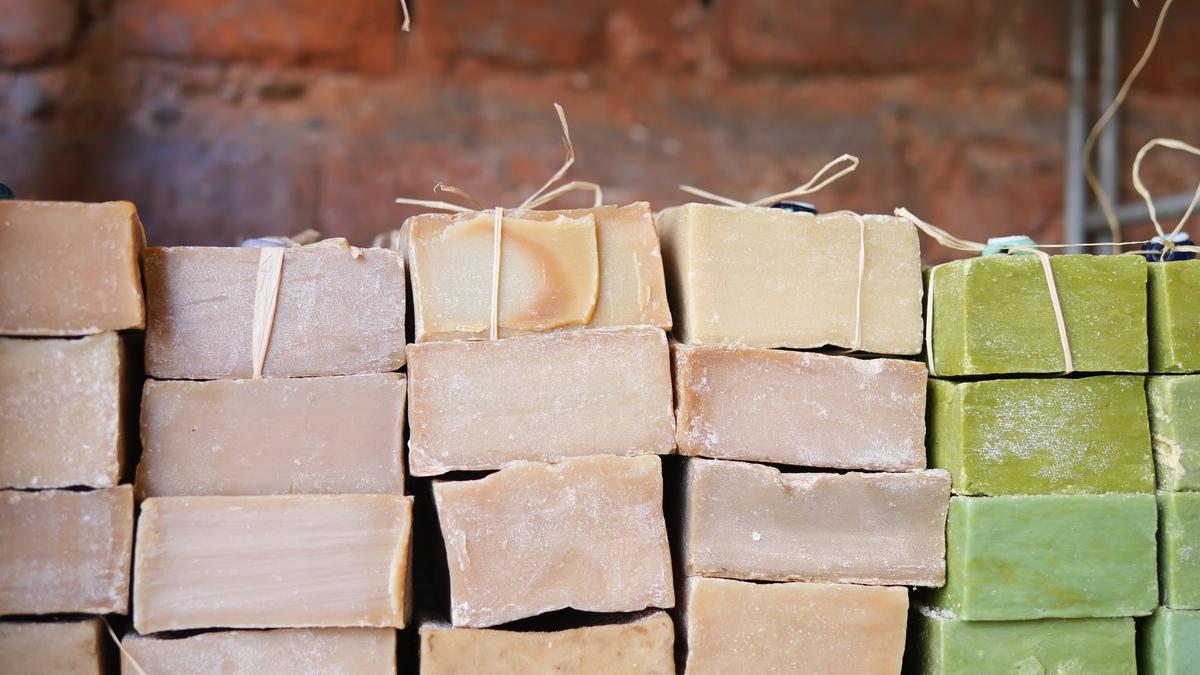
Traditionally, coconut or olive oil has been reacted with caustic soda (NaOH) to produce a crude form of soap. This process of soap-making was quite slow and producing it in large quantities was laborious.

The contemporary process to produce soap en masse is much faster. The process begins by converting the triglycerides in the vegetable oil base to a fatty acid. This process allows the manufacturer the flexibility to use different types of vegetable oils like soya, sunflower or palm, aside from the more conventional coconut or olive oil, to make soap. The fatty acid forms when the vegetable oil is treated with hot water at a very high temperature and pressure:

Triglyceride (vegetable oil) + water = fatty acid + glycerin

The glycerin is refined to remove moisture and other impurities and converted to industrial grade or pharmaceutical grade glycerin, according to demand. The fatty acid is then used to make soap by reacting it with caustic soda (NaOH) in a large vessel:

RCOOH (fatty acid) + NaOH = RCOONa (soap) + H₂O

The soap thus produced is extracted from the mix and dried to remove excess moisture using vacuum drying. The resulting mass is then extruded through a die to produce soap “noodles”. These strings are much thicker than the noodles we eat but are much shorter in length.

At this juncture, a critical element of soap is the total fatty matter (TFM): it is the percentage of natural oils and fat in the mass. The higher the TFM, the better the soap is in terms of its cleaning performance. At this stage, the moisture content in the noodles are controlled depending on the end use. Soap noodles destined for bathing should have less moisture content than those destined for laundering soaps.

The manufacturer moves the soap noodles into a blender, where they are mixed with additional ingredients to achieve the final product. To the fatty matter and moisture already present in the noodles, the manufacturer adds perfume, colour, filler material, and performance enhancers.

Some popular perfumes in India are sandal-wood oil, which is natural, or synthetic alternatives. Similarly, colours can be plant pigments or synthetic options like oxides. Soap fillers are generally talc (that is, magnesium silicate), sodium silicate or certain sulphates.

Surfactants also known as surface active agents, are added to reduce the surface tension of water and allow the soap to spread more easily when bathing. A common surfactant is sodium lauryl sulphate. Depending on the brand, some manufacturers also add antifungal, antibacterial (e.g. triclosan), and other medicinal additives (e.g. tea-tree oil or neem oil) to the soap.

Once the soap formulation is complete, the manufacturer extrudes the blended mixture to produce long soap bars, which are then stamped in a die into the desired shape, size, and weight as individual soap cakes. Finally, they are wrapped in a specifically designed wrapper and packed in cartons for shipment.

The technologies and automation in soap-making have advanced significantly over the years such that automatic production lines can deliver 600-700 soaps per minute (100 gm each) today.

Why do soaps clean?

A soap molecule has two ends: one end attracts water (that is, it’s hydrophilic) and the other end repels water (hydrophobic). Thanks to the presence of surfactants, soap also tends to reduce the surface tension of water, allowing it to spread more evenly.

During a cleaning activity, the hydrophobic end is attracted or embeds itself in grease or dirt while the hydrophilic end stays attached to water. The act of scrubbing and rinsing then dislodges the dirt, which flows out along with the water. The detergents used to wash clothes, utensils, various surfaces, etc. are also liquid soaps in a way — but their formulation consists of a large amount of surfactants along with additives like bleach, fragrances, and dyes.

During World War I, there was a shortage of natural oils and fats to make soaps, which spurred some industrialists to look for alternatives that could be synthesised chemically. Thus, the first commercial soap-like detergents emerged in the mid-1930s.

Depending on the formulation, detergents have the ability to soften hard water making the cleaning action more effective. However, their surfactants are known to be environmentally unfriendly. The use of phosphates has spurred concerns about nutrient pollution in the soil and some sulphonates have been known to linger in the environment for many years. In light of these concerns, chemical engineers are currently developing more biodegradable surfactants and enzymes that can replace phosphates.

Both soaps and detergents are a part of our everyday lives today, so any effort that makes them more ecofriendly should be welcome.

R. Vasudevan has a decade’s experience in the manufacture of soaps and fatty acids.

Published – August 19, 2025 08:30 am IST



Source link

Science

Post navigation

Previous Post: Access Denied
Next Post: Google announces Tennessee as site for small modular nuclear reactor

Related Posts

  • Scientists change how El Nino is labelled to keep up with temperature spikes
    Scientists change how El Nino is labelled to keep up with temperature spikes Science
  • Large Hadron Collider discovers a new particle
    Large Hadron Collider discovers a new particle Science
  • Dark matter could keep tiny black holes alive inside stars: study
    Dark matter could keep tiny black holes alive inside stars: study Science
  • Why do we feel the need to go to the bathroom when we’re nervous or scared?
    Why do we feel the need to go to the bathroom when we’re nervous or scared? Science
  • How an altered protein and fussy neurons conspire to cause microcephaly
    How an altered protein and fussy neurons conspire to cause microcephaly Science
  • Eye donation and corneal transplant
    Eye donation and corneal transplant Science

More Related Articles

The price of Kim Kardashian’s Met Gala corset look? Guts, lungs, heart The price of Kim Kardashian’s Met Gala corset look? Guts, lungs, heart Science
Biodiversity everywhere is ordered by a common ‘hidden’ pattern Biodiversity everywhere is ordered by a common ‘hidden’ pattern Science
The Science Quiz | SI-derived units The Science Quiz | SI-derived units Science
 Children at risk as new mpox variant hits Congo displacement camps  Children at risk as new mpox variant hits Congo displacement camps Science
2025 to be second or third-hottest year on record: EU scientists 2025 to be second or third-hottest year on record: EU scientists Science
The Science Quiz | Promethium bound… The Science Quiz | Promethium bound… Science
SiteLock

Archives

  • September 2026
  • August 2026
  • July 2026
  • June 2026
  • May 2026
  • April 2026
  • March 2026
  • February 2026
  • January 2026
  • December 2025
  • November 2025
  • October 2025
  • September 2025
  • August 2025
  • July 2025
  • June 2025
  • May 2025
  • April 2025
  • March 2025
  • February 2025
  • January 2025
  • December 2024
  • November 2024
  • October 2024
  • September 2024
  • August 2024
  • July 2024
  • June 2024
  • May 2024
  • April 2024
  • March 2024
  • February 2024
  • January 2024
  • December 2023
  • November 2023
  • October 2023
  • September 2023
  • August 2023
  • July 2023
  • June 2023
  • May 2023
  • April 2023
  • March 2023
  • February 2023
  • January 2023
  • December 2022
  • November 2022
  • October 2022
  • September 2022
  • August 2022
  • July 2022
  • June 2022
  • May 2022

Categories

  • Business
  • Nation
  • Science
  • Sports
  • World

Recent Posts

  • State owes sanctioned subsidies, incentives worth ₹2,880 crore to 3,716 industrial units: KASSIA
  • China expels generals accused of graft from Communist Party: state media
  • Andre Siddarth appointed Tamil Nadu vice-captain for Ranji Trophy
  • Supreme Court orders fresh probe into 2012 rape-murder near Dharmasthala in Karnataka
  • Whole of govt. approach being followed to address concerns of critical mineral recycling industry: G. Kishan Reddy

Recent Comments

  1. BrandonDib on UP Teacher Who Asked Students To Slap Muslim Classmate
  2. Daviddrire on UP Teacher Who Asked Students To Slap Muslim Classmate
  3. JesseHaf on UP Teacher Who Asked Students To Slap Muslim Classmate
  4. JustinPet on UP Teacher Who Asked Students To Slap Muslim Classmate
  5. Davidscush on UP Teacher Who Asked Students To Slap Muslim Classmate
  • Barack Obama’s Half-Sister Among Protesters Tear-Gassed In Kenya: Report
    Barack Obama’s Half-Sister Among Protesters Tear-Gassed In Kenya: Report World
  • Access Denied Sports
  • Texas City On Verge Of “Breaking Point” As Migrants Flood Border
    Texas City On Verge Of “Breaking Point” As Migrants Flood Border World
  • U.S. Fed cuts interest rates, nods to limits of data during shutdown; two policymakers dissent
    U.S. Fed cuts interest rates, nods to limits of data during shutdown; two policymakers dissent World
  • PM Modi To Address 104th Episode Of Mann Ki Baat Tomorrow
    PM Modi To Address 104th Episode Of Mann Ki Baat Tomorrow Nation
  • ITC Fined Rs 1 Lakh After Man Complains One Biscuit Missing In Sunfeast Marie Pack
    ITC Fined Rs 1 Lakh After Man Complains One Biscuit Missing In Sunfeast Marie Pack Nation
  • India vs Bangladesh: Asia Cup 2023 Live Cricket Score, Live Score Of Today's Match on NDTV Sports
    India vs Bangladesh: Asia Cup 2023 Live Cricket Score, Live Score Of Today's Match on NDTV Sports Sports
  • YouTuber Asks Students To Skip School To “Avoid Wasting Time”, Faces Action
    YouTuber Asks Students To Skip School To “Avoid Wasting Time”, Faces Action Nation

Editor-in-Chief:
Mohammad Ariff,
MSW, MAJMC, BSW, DTL, CTS, CNM, CCR, CAL, RSL, ASOC.
editor@artifex.news

Associate Editors:
1. Zenellis R. Tuba,
zenelis@artifex.news
2. Haris Daniyel
daniyel@artifex.news

Photograher:
Rohan Das
rohan@artifex.news

Artifex.News offers Online Paid Internships to college students from India and Abroad. Interns will get a PRESS CARD and other online offers.
Send your CV (Subjectline: Paid Internship) to internship@artifex.news

Links:
Associate Journalism
About Us
Privacy Policy

News Links:
Breaking News
World
Nation
Sports
Business
Entertainment
Lifestyle

Registered Office:
72/A, Elliot Road, Kolkata - 700016
Tel: 033-22277777, 033-22172217
Email: office@artifex.news

Editorial Office / News Desk:
No. 13, Mezzanine Floor, Esplanade Metro Rail Station,
12 J. L. Nehru Road, Kolkata - 700069.
(Entry from Gate No. 5)
Tel: 033-46011099, 033-46046046
Email: editor@artifex.news

Copyright © 2023 Artifex.News Newsportal designed by Artifex Infotech.