




Skip to content
  • Facebook
  • X
  • Linkedin
  • WhatsApp
  • YouTube
  • Associate Journalism
  • About Us
  • Privacy Policy
  • 033-46046046
  • editor@artifex.news
Artifex.News

Artifex.News

Stay Connected. Stay Informed.

  • Breaking News
  • World
  • Nation
  • Sports
  • Business
  • Science
  • Entertainment
  • Lifestyle
  • Toggle search form
  • 16 dead, 45 injured in two road accidents in Pakistan
    16 dead, 45 injured in two road accidents in Pakistan World
  • Taiwanese rocket startup may be early test of Japan’s space hub plans
    Taiwanese rocket startup may be early test of Japan’s space hub plans World
  • What is the B-52 bomber that crashed at a U.S. air base in California?
    What is the B-52 bomber that crashed at a U.S. air base in California? World
  • Rajasthan Urges Centre To Ask CBI To Appeal Acquittal Of Abdul Karim Tunda
    Rajasthan Urges Centre To Ask CBI To Appeal Acquittal Of Abdul Karim Tunda Nation
  • Declare Kumbh Mela area restricted zone for non-Hindus before 2027 Ardh Kumbh: Shri Ganga Sabha
    Declare Kumbh Mela area restricted zone for non-Hindus before 2027 Ardh Kumbh: Shri Ganga Sabha Nation
  • Morgan Stanley Says PM Gati Shakti Scheme Gives India An Edge Over China
    Morgan Stanley Says PM Gati Shakti Scheme Gives India An Edge Over China World
  • Access Denied
    Access Denied Nation
  • Family Refuses To Cremate UP Doctor Allegedly Beaten To Death
    Family Refuses To Cremate UP Doctor Allegedly Beaten To Death Nation
Nuclear study provides major update on plutonium isotope fission

Nuclear study provides major update on plutonium isotope fission

Posted on June 24, 2024 By admin


On March 4 this year, India stepped on the threshold of the second stage of its nuclear power programme when engineers started the core-loading process of the prototype fast breeder reactor (PFBR) at the Madras Atomic Power Station, Kalpakkam. While the first stage used uranium isotopes as nuclear fuel in pressurised heavy-water reactors to produce plutonium-239 (Pu-239) and energy, the second stage is more concerned with plutonium fission.

When a Pu-239 nucleus captures a neutron, it has a 27-38% chance of becoming Pu-240 instead of undergoing fission. It is thus present in many nuclear reactors and in the fallout of nuclear weapon tests. When Pu-240 captures a neutron, it most often turns into Pu-241. On the off chance it does undergo fission, however, there is a significant amount of uncertainty about the energy carried away by its fission products. Researchers currently use models that incorporate several complicated calculations based on theory to estimate the output.

Only the second time

A part of the fission energy carried away by neutrons is called the prompt fission neutron spectrum (PFNS). The ‘prompt’ stands for neutrons a Pu-240 nucleus might emit right after it has captured a neutron with enough energy to destabilise it, but before the nucleus has reached a stable (or equilibrium) state.

So far there has only been one study that attempted to study the PFNS of induced fission in Pu-240, where neutrons that bombarded the Pu-240 nuclei had an energy of 0.85 mega-electron-volt (MeV). Recently, researchers in the U.S. reported only the second attempt ever to measure the PFNS of induced fission in Pu-240, and the first to use neutrons of energy greater than 0.85 MeV.

Their findings, reported in the journal Physical Review C on June 13, note significant differences between the predicted and the measured PFNS after induced fission. This information will be useful for researchers in various fields, from reactor designers to practitioners of nuclear medicine.

“The PFBR uses plutonium recovered from CANDU spent fuel and so will contain ample quantities of Pu-240. And if the spent fuel arising from the PFBR is reprocessed, that too will contain Pu-240,” M.V. Ramana, a professor at the University of British Columbia, told The Hindu. “Therefore any new information about how Pu-240 behaves will be relevant.”

CANDU is a Canadian design for pressurised heavy-water reactors, such as those India uses for its first stage.

A profile of Pu-240

Pu-239 is produced when U-238 is exposed to neutrons of certain energy in a reactor. Because Pu-239 captures neutrons to become Pu-240 at a fixed rate, Pu-239 left in the reactor for a certain duration will accumulate a predictable quantity of Pu-240. The two isotopes are hard to separate, so as Pu-240 builds up, the spent fuel is pulled out.

Pu-240 undergoes spontaneous fission, i.e. without ‘external’ neutrons striking it first, and emits alpha particles. For these reasons, the isotope is considered a contaminant of weapons-grade plutonium, where its composition by weight is restricted to under 7%. There are some ways to use higher quantities of Pu-240 to build a nuclear weapon, however.

Generally, if a mass of plutonium contains more than 19% of Pu-240, it is considered to be reactor-grade rather than weapons-grade.

The test setup

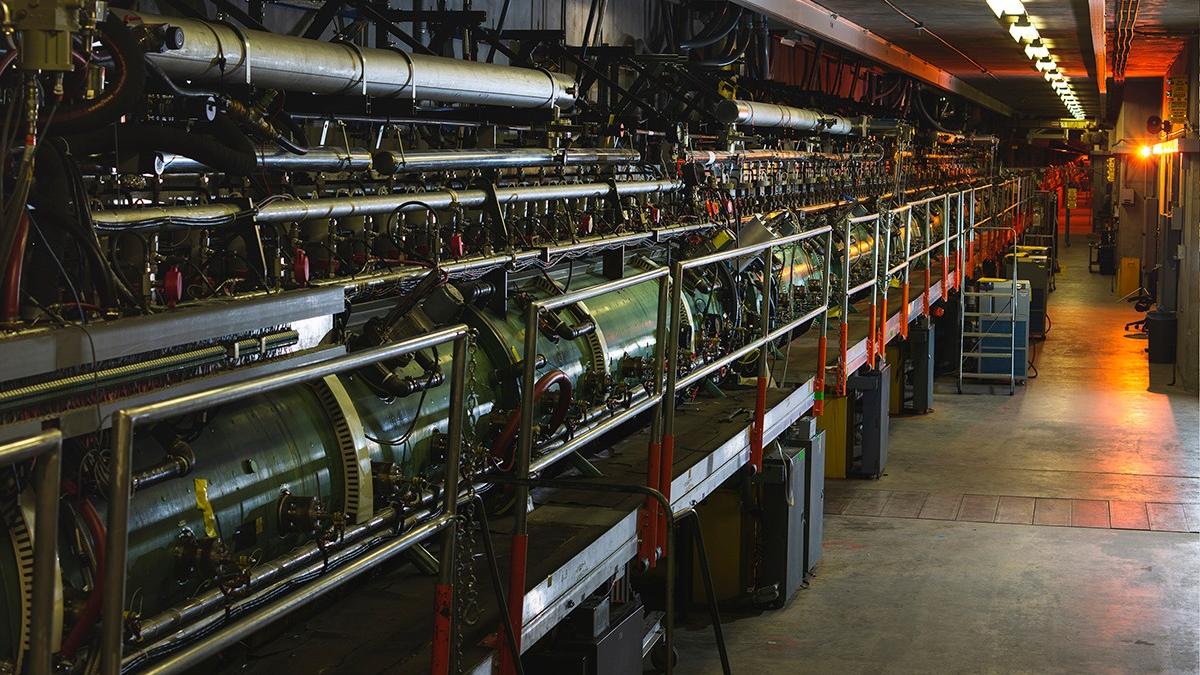
The new findings are based on a test conducted by researchers at the Los Alamos Neutron Science Centre (LANSCE) in the U.S. They struck a tungsten disc with pulses of protons, which produced neutrons of energy 0.01-800 MeV. Those neutrons moving 15 degrees to the left of the proton beam were redirected to a chamber containing 99.875% pure Pu-240.

An array of liquid scintillators — substances that emit flashes of light when struck by energetic particles — arranged around the Pu-240 sample tracked its output. The Pu-240 weighed all of 20 milligrams; the researchers wrote in their paper that they used such a small sample to minimise the amount of alpha particles emitted.
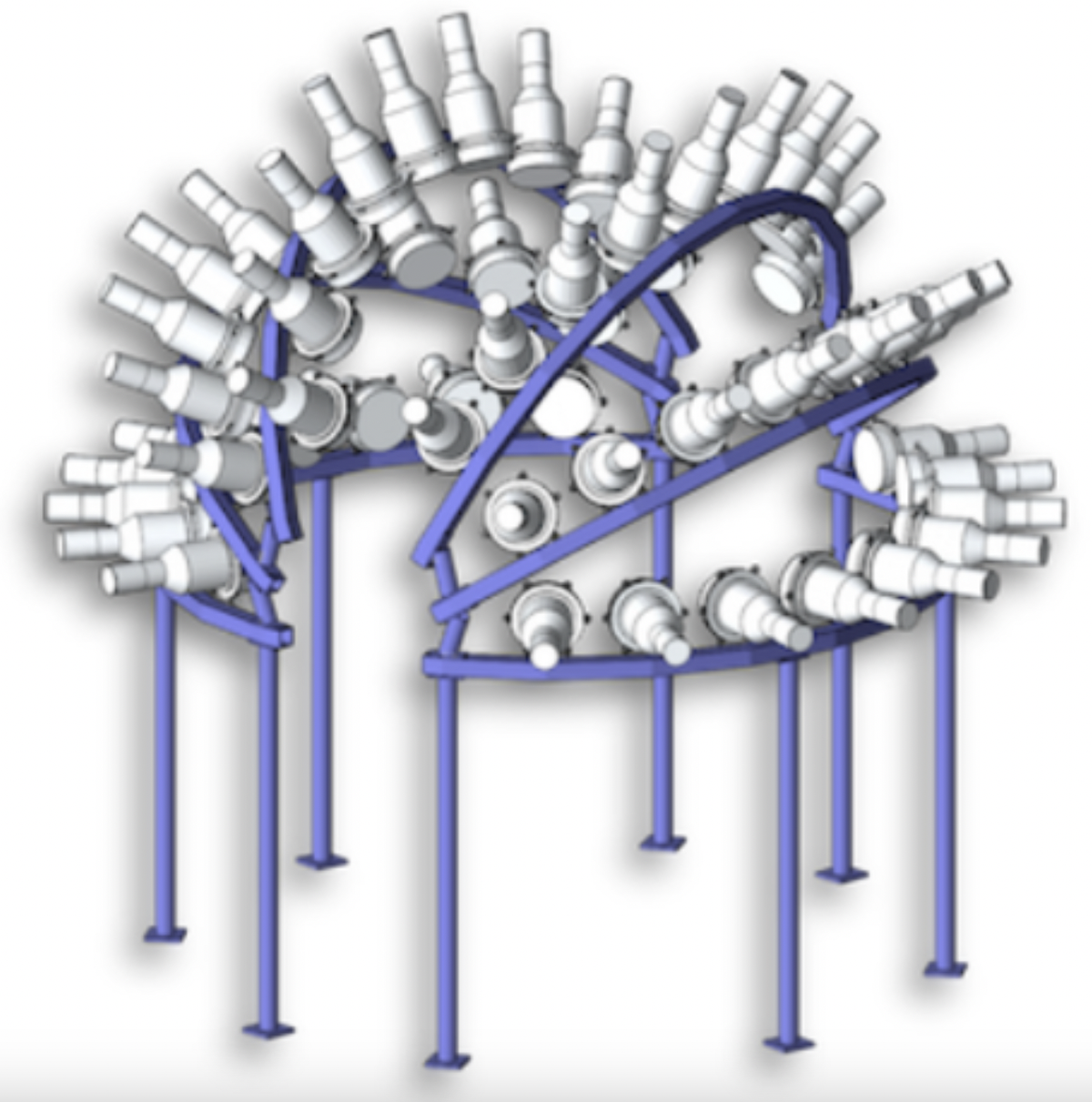
A computer-generated rendering of the liquid scintillator detector system at LANSCE. The Pu-240 sample is located at the centre and neutrons intended to bombard the sample enter from the bottom left side.

A computer-generated rendering of the liquid scintillator detector system at LANSCE. The Pu-240 sample is located at the centre and neutrons intended to bombard the sample enter from the bottom left side.
| Photo Credit:
U.S. Department of Energy

With this setup, the researchers measured the energies of the neutrons emitted by the sample as well as of other fission products.

Because they were interested in particles of a specific origin (neutron-induced fission), extracting the corresponding PFNS data from the overall data required the researchers to carefully subtract contributions from spontaneous fission, alpha particles, and other sources. After doing so, they reported their analysis for incident neutrons of energies 1-20 MeV.

Updating nuclear data libraries

In addition to deviations between PFNS predicted by models and those observed in the test, the researchers also reported a higher-than-expected rate of second-chance fission of Pu-240: when a nucleus isn’t fissionable but becomes so after losing a neutron. They also reported finding signs of “a smaller contribution from third-chance fission” but added that this “was difficult to observe in the data directly”.

Models that predict the outputs of nuclear reactions are based on data libraries pieced together from various experiments, reactor operation records, simulations, and other sources. For example, applications of the ENDF library prepared by the U.S. National Nuclear Data Centre include research on nuclear reactors, radiation shielding design, calculating radiation dose in nuclear medicine, investigating the trafficking of nuclear materials, and to understand the origins of elements in the universe. Other such libraries are JEFF-3.3, prepared by the OECD’s Nuclear Energy Agency, and JENDL-5.0, by the Japan Atomic Energy Agency.

The PFNS paper concluded that only the JENDL-5.0 library included “both multi-chance fission and pre-equilibrium neutron emission processes” and that the ENDF/B-VIII.0 and JEFF-3.3 libraries “contain multi-chance fission but not pre-equilibrium”. “However,” it continued, “there are also clear differences observed in the [energy levels] relating to the magnitude of second-chance fission in the data, as well as a possible energy shift in the thresholds relating to the pre-equilibrium neutron emission process preceding fission.”


Source link

Science Tags:nuclear fission, plutonium 238, plutonium 239, plutonium 240, plutonium 240 in nuclear power, prompt fission neutron spectrum, prototype fast breeder reactor, thorium fission

Post navigation

Previous Post: Israel PM says ‘intense’ phase of Gaza war nearing end
Next Post: Hungary Knock Scotland Out Of Euro 2024 After Barnabas Varga Injury Horror

Related Posts

  • ISRO issues memo to curb exodus of personnel from Gaganyaan, other key missions
    ISRO issues memo to curb exodus of personnel from Gaganyaan, other key missions Science
  • ICMR and Zydus Lifesciences initiate second phase proof-of-concept trial for Desidustat in patients with sickle cell disease
    ICMR and Zydus Lifesciences initiate second phase proof-of-concept trial for Desidustat in patients with sickle cell disease Science
  • Hyderabad hospital launches genetic test; claims it helps doctors know which medicines work for you
    Hyderabad hospital launches genetic test; claims it helps doctors know which medicines work for you Science
  • Watch: What is ammonia poisoning?
    Watch: What is ammonia poisoning? Science
  • Science Quiz | What computers need to compute: Logic gates
    Science Quiz | What computers need to compute: Logic gates Science
  • How Attenborough’s lush imagery hid a history of colonial harm
    How Attenborough’s lush imagery hid a history of colonial harm Science

More Related Articles

1998 Pokhran nuclear tests reflected India’s scientific excellence: PM on National Technology Day 1998 Pokhran nuclear tests reflected India’s scientific excellence: PM on National Technology Day Science
IISc launches product accelerator programme, Pravriddhi IISc launches product accelerator programme, Pravriddhi Science
Canadian climate lawsuit by young people could sway global cases Canadian climate lawsuit by young people could sway global cases Science
Rapa Nui genomes restore the real history of an old, troubled people Rapa Nui genomes restore the real history of an old, troubled people Science
World’s oldest cave painting in Indonesia shows a pig and people World’s oldest cave painting in Indonesia shows a pig and people Science
ISRO’s Gaganyaan mission: PM Modi announces Indian astronaut designates ISRO’s Gaganyaan mission: PM Modi announces Indian astronaut designates Science
SiteLock

Archives

  • September 2026
  • August 2026
  • July 2026
  • June 2026
  • May 2026
  • April 2026
  • March 2026
  • February 2026
  • January 2026
  • December 2025
  • November 2025
  • October 2025
  • September 2025
  • August 2025
  • July 2025
  • June 2025
  • May 2025
  • April 2025
  • March 2025
  • February 2025
  • January 2025
  • December 2024
  • November 2024
  • October 2024
  • September 2024
  • August 2024
  • July 2024
  • June 2024
  • May 2024
  • April 2024
  • March 2024
  • February 2024
  • January 2024
  • December 2023
  • November 2023
  • October 2023
  • September 2023
  • August 2023
  • July 2023
  • June 2023
  • May 2023
  • April 2023
  • March 2023
  • February 2023
  • January 2023
  • December 2022
  • November 2022
  • October 2022
  • September 2022
  • August 2022
  • July 2022
  • June 2022
  • May 2022

Categories

  • Business
  • Nation
  • Science
  • Sports
  • World

Recent Posts

  • Bihar announces OTS scheme for brick kilns, waives ₹90 crore interest on outstanding dues
  • North Korea says nuclear status ‘irreversible’ after UN atomic agency rebuke
  • Bombay High Court permits BMC to cut over 1,200 mangroves for Versova-Madh Island bridge
  • U.S. appeals court rejects Trump policy allowing swift deportations to third countries
  • Trump to meet with Venezuela’s interim President Rodriguez in New York on Sept. 22

Recent Comments

  1. AlvinNet on UP Teacher Who Asked Students To Slap Muslim Classmate
  2. Jamesslits on UP Teacher Who Asked Students To Slap Muslim Classmate
  3. MichaelClear on UP Teacher Who Asked Students To Slap Muslim Classmate
  4. Jamesslits on UP Teacher Who Asked Students To Slap Muslim Classmate
  5. Jamesslits on UP Teacher Who Asked Students To Slap Muslim Classmate
  • D’artagnan lives up to the favourite billing in the Zavaray S. Poonawalla Colts Championship Stakes
    D’artagnan lives up to the favourite billing in the Zavaray S. Poonawalla Colts Championship Stakes Sports
  • What are the U.S.’s latest allegations against India? | Explained
    What are the U.S.’s latest allegations against India? | Explained World
  • Access Denied Sports
  • Iran claims strike on U.S. ship in Hormuz but Washington denies it
    Iran claims strike on U.S. ship in Hormuz but Washington denies it World
  • Bangladesh’s Shakib booed by home fans on World Cup break
    Bangladesh’s Shakib booed by home fans on World Cup break Sports
  • Access Denied
    Access Denied Nation
  • Access Denied
    Access Denied Nation
  • Access Denied
    Access Denied Nation

Editor-in-Chief:
Mohammad Ariff,
MSW, MAJMC, BSW, DTL, CTS, CNM, CCR, CAL, RSL, ASOC.
editor@artifex.news

Associate Editors:
1. Zenellis R. Tuba,
zenelis@artifex.news
2. Haris Daniyel
daniyel@artifex.news

Photograher:
Rohan Das
rohan@artifex.news

Artifex.News offers Online Paid Internships to college students from India and Abroad. Interns will get a PRESS CARD and other online offers.
Send your CV (Subjectline: Paid Internship) to internship@artifex.news

Links:
Associate Journalism
About Us
Privacy Policy

News Links:
Breaking News
World
Nation
Sports
Business
Entertainment
Lifestyle

Registered Office:
72/A, Elliot Road, Kolkata - 700016
Tel: 033-22277777, 033-22172217
Email: office@artifex.news

Editorial Office / News Desk:
No. 13, Mezzanine Floor, Esplanade Metro Rail Station,
12 J. L. Nehru Road, Kolkata - 700069.
(Entry from Gate No. 5)
Tel: 033-46011099, 033-46046046
Email: editor@artifex.news

Copyright © 2023 Artifex.News Newsportal designed by Artifex Infotech.