

Skip to content
  • Facebook
  • X
  • Linkedin
  • WhatsApp
  • YouTube
  • Associate Journalism
  • About Us
  • Privacy Policy
  • 033-46046046
  • editor@artifex.news
Artifex.News

Artifex.News

Stay Connected. Stay Informed.

  • Breaking News
  • World
  • Nation
  • Sports
  • Business
  • Science
  • Entertainment
  • Lifestyle
  • Toggle search form
  • Access Denied Nation
  • End Of IPL Campaign For India’s 156.7 Kmph Pace Star Mayank Yadav? Report Claims…
    End Of IPL Campaign For India’s 156.7 Kmph Pace Star Mayank Yadav? Report Claims… Sports
  • U.S., Chinese officials to launch talks in Spain on trade irritants, TikTok deadline
    U.S., Chinese officials to launch talks in Spain on trade irritants, TikTok deadline World
  • Access Denied
    Access Denied Nation
  • Pak Leader On Manmohan Singh’s Dream
    Pak Leader On Manmohan Singh’s Dream World
  • Access Denied Sports
  • “Will Take Reservation Beyond 50%”: Rahul Gandhi Clarifies Comment
    “Will Take Reservation Beyond 50%”: Rahul Gandhi Clarifies Comment Nation
  • Is India Really At Risk Of A Monkeypox Outbreak?
    Is India Really At Risk Of A Monkeypox Outbreak? World
2025 physics Nobel Prize: the magic of quantum pervades all scales

2025 physics Nobel Prize: the magic of quantum pervades all scales

Posted on October 11, 2025 By admin


John Clarke (University of California, Berkeley), Michel H. Devoret (Yale University, Connecticut and University of California, Santa Barbara), and John M. Martinis (University of California, Santa Barbara) have shared the 2025 Nobel Prize in physics. The prize recognises their contributions to experimentally demonstrating the manifestation of quantum effects in macroscopic systems, confirming our faith that quantum theory works at all scales, small and large.

Their research contribution is a milestone. We develop our intuition based on our sensory perceptions, and the classical physics framework is an expression of that experience, mostly gleaned from observing macroscopic objects.

On the other hand, quantum theory, currently the best framework to understand nature, does not seem natural or obvious. While the behaviour of the microscopic objects, such as electrons, protons, nuclei, and atoms, is not understandable within the classical physics framework, quantum theory provides ways to compute experimental outcomes.

The marble and the ramp

One counterintuitive feature of quantum theory is quantum tunnelling.

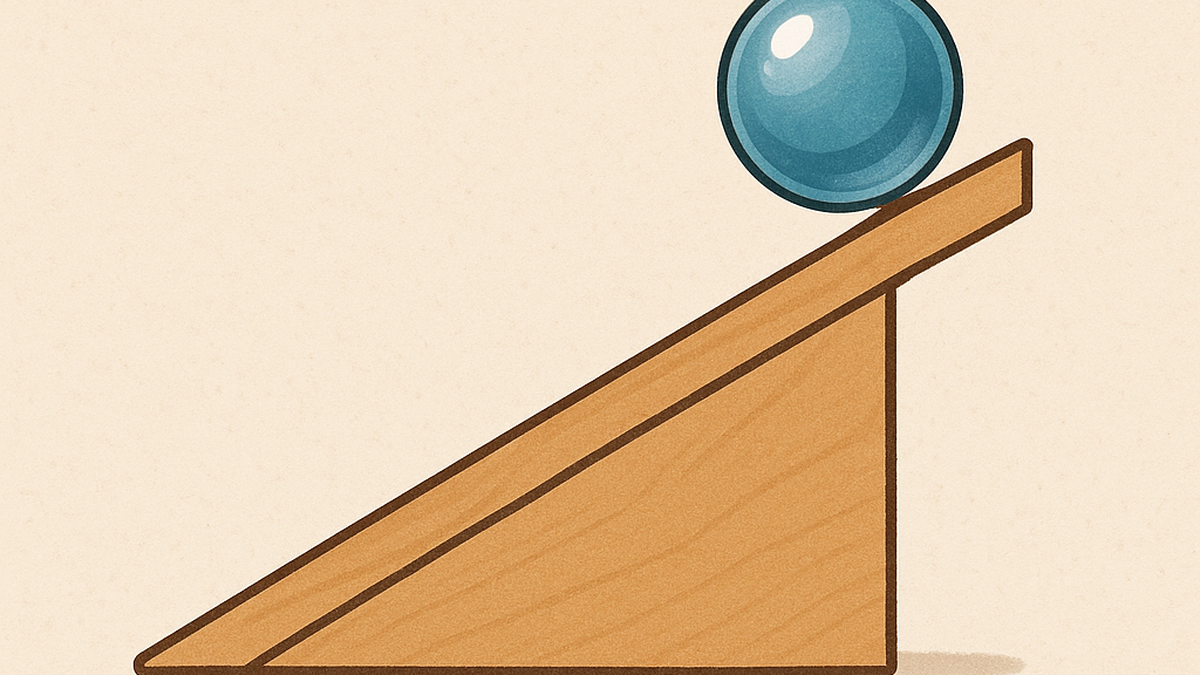
Imagine rolling a marble that encounters a ramp (slope). If the marble moves fast enough, it can roll over the ramp and reach the other side. A slowly moving marble can’t overcome the ramp, however. For such sluggish marbles, the locations on the other side of the ramp are forbidden in classical physics. But quantum theory has a different story to offer.

Suppose quantum theory applies to all situations. In this case, a marble starting on one side of a barrier can be located on the other, even if the marble does not have sufficient energy (as needed in classical physics). This possibility of finding objects in classically forbidden regions is called tunnelling, a feature recognised even in the early days of quantum theory.

For example, an alpha particle (two protons plus two neutrons) within a nucleus — even if it does not have enough energy to break away from the attraction of other protons and neutrons in the nucleus — can manage to exit the nucleus by tunnelling. This in fact explains the origin of the alpha decay of radioactive nuclei.

While tunnelling of microscopic species, such as an alpha particle, is in accordance with quantum mechanical predictions, we have never seen a slow marble crossing a ramp. Is tunnelling then a property of microscopic objects only? If so, is there a boundary that demarcates the quantum from the classical?

The condensates

One way to answer the first question is to demonstrate tunnelling in a macroscopic object. The three Nobel laureates worked as a team and demonstrated tunnelling and energy quantisation, yet another distinguishing feature of quantum systems, in a macroscopic system. A macroscopic object like a marble is composed of many atoms. The marble’s properties, which are intuitively obvious to us as they are classical, are the cumulative effects of the features of the atoms, which are microscopic. But it is possible to think of a system with a macroscopic degree of freedom that exhibits quantum features.

A superconductor offers no resistance to the flow of electricity. In a superconductor, electrons moving in opposite directions form pairs, called Cooper pairs, and their motion is correlated. The origin of this correlation is the lattice of atoms that make up the superconductor. At low temperatures, the vibrating atoms are not energetic enough to break the correlation between the paired electrons, which allows these pairs to move without resistance.

A thin insulating barrier sandwiched between two superconductors forms a Josephson junction. When the temperature is sufficiently low, Cooper pairs form and electrons move across the insulating barrier from one superconductor to another when the Josephson junction is part of a suitable electric circuit. The total current is due to the migration of billions of such pairs.

At a suitably low temperature, the large collection of pairs (called condensates) behaves as a single macroscopic object — in that all Cooper pairs are in the same state, exhibiting identical quantum features. This macroscopic object is characterised by a quantity called the phase difference and the number of Cooper pairs, which are macroscopic properties of the condensate.

The mathematical equation describing the circuit is similar to that describing a marble moving up a slope (though not a uniform slope). The phase difference and the barrier are analogous to the location of the marble and the ramp, respectively. The experiment by Clarke, Devoret, and Martinis showed this “phase difference” tunnelling across the Josephson junction in the circuit.

This observation, by analogy, is equivalent to the marble’s location shifting to the other side of the barrier, and is therefore a demonstration of tunnelling at macroscopic levels.

Ideas endure

The team also established energy quantisation, which means the total energy in the circuits can take only a specific set of values, to substantiate that the circuit containing the Josephson junction was manifestly quantum. This conclusively established that a non-classical feature like tunnelling is present even at the scale of billions of Cooper pairs.

The quantum-classical transition is still unsettled. However, there are reasons to believe that the interaction of macroscopic systems with their surroundings is a major reason why quantum effects are not manifest in big objects like a marble.

Though these experiments were conducted in the mid-1980s, the ideas continue to spur research activities in many domains. Most notably, quantum computing has immensely benefited from these ideas. The fundamental component of a quantum computer is a qubit (quantum bit) that holds information to be processed. A large array of qubits is required to perform quantum computations. Many physical systems are suitable for realising qubits, and superconducting qubits are circuits containing Josephson junctions, similar to the ones designed by the Nobel laureates.

The laureates’ work also points to the importance of basic research. Though the work’s original motivation was not quantum computing, its impact on the field amply demonstrates how basic research can foster technological innovations.

S. Srinivasan is a professor of physics at Krea University.

Published – October 11, 2025 06:00 am IST


Source link

Science

Post navigation

Previous Post: Even on ‘clear’ days, the air can be chemically toxic
Next Post: Access Denied

Related Posts

  • Endemic dengue may have helped stem severity of early COVID wave in India: study
    Endemic dengue may have helped stem severity of early COVID wave in India: study Science
  • 150% customs duty on lab chemicals alarms scientists
    150% customs duty on lab chemicals alarms scientists Science
  • New study finds different roots for early and late autism diagnoses
    New study finds different roots for early and late autism diagnoses Science
  • Study finds the Ganga river is drying faster than in 1,300 years
    Study finds the Ganga river is drying faster than in 1,300 years Science
  • Action-packed September – The Hindu
    Action-packed September – The Hindu Science
  • Astronomers just found complex carbon molecules in space – a step closer to deciphering the origins of life
    Astronomers just found complex carbon molecules in space – a step closer to deciphering the origins of life Science

More Related Articles

India among four nations driving most global pesticide toxicity: study India among four nations driving most global pesticide toxicity: study Science
ISRO successfully launches INSAT-3DS meteorological satellite ISRO successfully launches INSAT-3DS meteorological satellite Science
SpaceX successfully launches 10th Starship test flight SpaceX successfully launches 10th Starship test flight Science
Leaders hail work of visionary scientist M.S. Swaminathan Leaders hail work of visionary scientist M.S. Swaminathan Science
ISRO invites proposals from Indian scientists to analyse data from Aditya-L1 mission ISRO invites proposals from Indian scientists to analyse data from Aditya-L1 mission Science
Cherry blossoms fade in Japan with climate change Cherry blossoms fade in Japan with climate change Science
SiteLock

Archives

  • May 2026
  • April 2026
  • March 2026
  • February 2026
  • January 2026
  • December 2025
  • November 2025
  • October 2025
  • September 2025
  • August 2025
  • July 2025
  • June 2025
  • May 2025
  • April 2025
  • March 2025
  • February 2025
  • January 2025
  • December 2024
  • November 2024
  • October 2024
  • September 2024
  • August 2024
  • July 2024
  • June 2024
  • May 2024
  • April 2024
  • March 2024
  • February 2024
  • January 2024
  • December 2023
  • November 2023
  • October 2023
  • September 2023
  • August 2023
  • July 2023
  • June 2023
  • May 2023
  • April 2023
  • March 2023
  • February 2023
  • January 2023
  • December 2022
  • November 2022
  • October 2022
  • September 2022
  • August 2022
  • July 2022
  • June 2022
  • May 2022

Categories

  • Business
  • Nation
  • Science
  • Sports
  • World

Recent Posts

  • China, U.S. should be ‘partners not rivals’, says Xi Jinping after meeting Donald Trump
  • Iran working on Hormuz ‘protocol’ to cover ‘costs’, says Deputy Foreign Minister Gharibabadi
  • Zydus Lifesciences arm to acquire U.S. oncology firm Assertio for $166 million
  • Israel-Iran war LIVE: Iran working on Hormuz ‘protocol’ to cover ‘costs’, says Dy FM Gharibabadi
  • Russia to fulfil all agreements on energy supply to India: FM Lavrov

Recent Comments

  1. OrvalMaync on UP Teacher Who Asked Students To Slap Muslim Classmate
  2. Jeffreyroure on UP Teacher Who Asked Students To Slap Muslim Classmate
  3. Stevemonge on UP Teacher Who Asked Students To Slap Muslim Classmate
  4. RichardClage on UP Teacher Who Asked Students To Slap Muslim Classmate
  5. StevenLek on UP Teacher Who Asked Students To Slap Muslim Classmate
  • Access Denied World
  • Access Denied
    Access Denied Nation
  • Cracking the mystery of how proteins found their shapes
    Cracking the mystery of how proteins found their shapes Science
  • Thai king cuts ex-PM Thaksin’s jail term to one year
    Thai king cuts ex-PM Thaksin’s jail term to one year World
  • NFL Star George Kittle Confirms Featuring In Wrestlemania 41
    NFL Star George Kittle Confirms Featuring In Wrestlemania 41 Sports
  • Vadodara Animal Rescuers Tripling On Scooter — With A Crocodile
    Vadodara Animal Rescuers Tripling On Scooter — With A Crocodile Nation
  • Access Denied Business
  • Access Denied Business

Editor-in-Chief:
Mohammad Ariff,
MSW, MAJMC, BSW, DTL, CTS, CNM, CCR, CAL, RSL, ASOC.
editor@artifex.news

Associate Editors:
1. Zenellis R. Tuba,
zenelis@artifex.news
2. Haris Daniyel
daniyel@artifex.news

Photograher:
Rohan Das
rohan@artifex.news

Artifex.News offers Online Paid Internships to college students from India and Abroad. Interns will get a PRESS CARD and other online offers.
Send your CV (Subjectline: Paid Internship) to internship@artifex.news

Links:
Associate Journalism
About Us
Privacy Policy

News Links:
Breaking News
World
Nation
Sports
Business
Entertainment
Lifestyle

Registered Office:
72/A, Elliot Road, Kolkata - 700016
Tel: 033-22277777, 033-22172217
Email: office@artifex.news

Editorial Office / News Desk:
No. 13, Mezzanine Floor, Esplanade Metro Rail Station,
12 J. L. Nehru Road, Kolkata - 700069.
(Entry from Gate No. 5)
Tel: 033-46011099, 033-46046046
Email: editor@artifex.news

Copyright © 2023 Artifex.News Newsportal designed by Artifex Infotech.