





Skip to content
  • Facebook
  • X
  • Linkedin
  • WhatsApp
  • YouTube
  • Associate Journalism
  • About Us
  • Privacy Policy
  • 033-46046046
  • editor@artifex.news
Artifex.News

Artifex.News

Stay Connected. Stay Informed.

  • Breaking News
  • World
  • Nation
  • Sports
  • Business
  • Science
  • Entertainment
  • Lifestyle
  • Toggle search form
  • “Test Cricket Summed Up”: England Great Gives Verdict On Reality Of Test Cricket
    “Test Cricket Summed Up”: England Great Gives Verdict On Reality Of Test Cricket Sports
  • ChatGPT blamed by parents for teenaged son’s death
    ChatGPT blamed by parents for teenaged son’s death World
  • After Indecent Reel, Strict Norms For Videography, Photography In Gwalior
    After Indecent Reel, Strict Norms For Videography, Photography In Gwalior Nation
  • Access Denied World
  • Access Denied
    Access Denied Nation
  • PM Modi Pays Tributes To Rabindranath Tagore On His Birth Anniversary
    PM Modi Pays Tributes To Rabindranath Tagore On His Birth Anniversary Nation
  • IPL 2024 | Porel’s blitzkrieg against Punjab big positive for DC, says assistant coach Amre
    IPL 2024 | Porel’s blitzkrieg against Punjab big positive for DC, says assistant coach Amre Sports
  • Philippine officials say two Americans among suspected communist rebels killed in clash with troops
    Philippine officials say two Americans among suspected communist rebels killed in clash with troops World
Astronomers just found complex carbon molecules in space – a step closer to deciphering the origins of life

Astronomers just found complex carbon molecules in space – a step closer to deciphering the origins of life

Posted on October 30, 2024 By admin


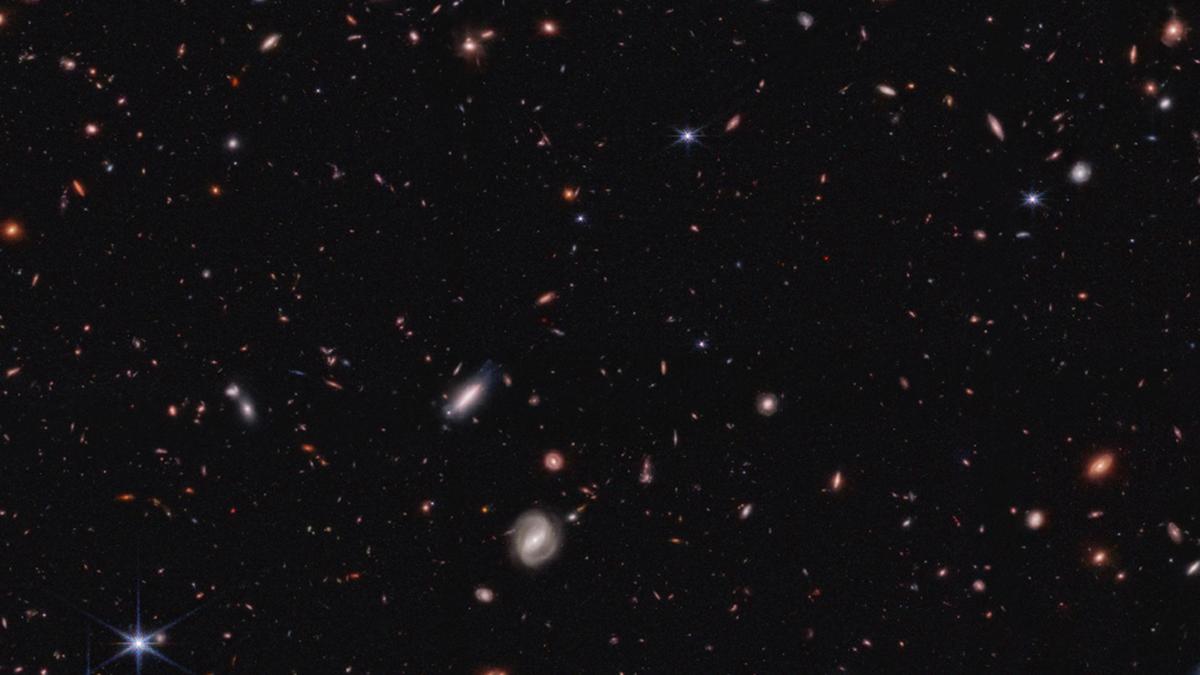
A team led by researchers at MIT in the United States has discovered large molecules containing carbon in a distant interstellar cloud of gas and dust.
| Photo Credit: Space Telescope Science Institute Office of Public Outreach

A team led by researchers at MIT in the United States has discovered large molecules containing carbon in a distant interstellar cloud of gas and dust.

This is exciting for those of us who keep lists of known interstellar molecules in the hope that we might work out how life arose in the universe.

But it’s more than just another molecule for the collection. The result, reported today in the journal Science, shows that complex organic molecules (with carbon and hydrogen) likely existed in the cold, dark gas cloud that gave rise to our Solar System.

Furthermore, the molecules held together until after the formation of Earth. This is important for our understanding of the early origins of life on our planet.

Difficult to destroy, hard to detect

The molecule in question is called pyrene, a polycyclic aromatic hydrocarbon or PAH for short. The complicated-sounding name tells us these molecules are made of rings of carbon atoms.

Carbon chemistry is the backbone of life on Earth. PAHs have long been known to be abundant in the interstellar medium, so they feature prominently in theories of how carbon-based life on Earth came to be.

We know there are many large PAHs in space because astrophysicists have detected signs of them in visible and infrared light. But we didn’t know which PAHs they might be in particular.

Pyrene is now the largest PAH detected in space, although it’s what is known as a “small” or simple PAH, with 26 atoms. It was long thought such molecules could not survive the harsh environment of star formation when everything is bathed in radiation from the newborn suns, destroying complex molecules.

In fact, it was once thought molecules of more than two atoms could not exist in space for this reason, until they were actually found. Also, chemical models show pyrene is very difficult to destroy once formed.

Last year, scientists reported they found large amounts of pyrene in samples from the asteroid Ryugu in our own Solar System. They argued at least some of it must have come from the cold interstellar cloud that predated our Solar System.

So why not look at another cold interstellar cloud to find some? The problem for astrophysicists is that we don’t have the tools to detect pyrene directly – it’s invisible to radio telescopes.

Using a tracer

The molecule the team has detected is called 1-cyanopyrene, what we call a “tracer” for pyrene. It is formed from pyrene interacting with cyanide, which is common in interstellar space.

The researchers used the Green Bank Telescope in West Virginia to look at the Taurus molecular cloud or TMC-1, in the Taurus constellation. Unlike pyrene itself, 1-cyanopyrene can be detected by radio telescopes. This is because 1-cyanopyrene molecules act as small radio-wave emitters – tiny versions of earthly radio stations.

As scientists know the proportions of 1-cyanopyrene compared to pyrene, they can then estimate the amount of pyrene in the interstellar cloud.

The amount of pyrene they found was significant. Importantly, this discovery in the Taurus molecular cloud suggests a lot of pyrene exists in the cold, dark molecular clouds that go on to form stars and solar systems.

The complex birth of life

We are gradually building a picture of how life on Earth evolved. This picture tells us that life came from space – well, at least the complex organic, pre-biological molecules needed to form life did.

That pyrene survives the harsh conditions associated with the birth of stars, as shown by the findings from Ryugu, is an important part of this story.

Simple life – consisting of a single cell – appeared in Earth’s fossil record almost immediately (in geological and astronomical terms) after the planet’s surface had cooled enough to not vaporise complex molecules. This happened more than 3.7 billion years ago in Earth’s approximately 4.5 billion history.

For simple organisms to then appear so quickly in the fossil record, there’s just not enough time for chemistry to start with mere simple molecules of two or three atoms.

The new discovery of 1-cyanopyrene in the Taurus molecular cloud shows complex molecules could indeed survive the harsh conditions of our Solar System’s formation. As a result, pyrene was available to form the backbone of carbon-based life when it emerged on the early Earth some 3.7 billion years ago.

This discovery also links to another important finding of the last decade – the first chiral molecule in the interstellar medium, propylene oxide. We need chiral molecules to make the evolution of simple lifeforms work on the surface of the early Earth.

So far, our theories that molecules for early life on Earth came from space are looking good.

This article is republished from The Conversation under a Creative Commons license. Read the original article here.

Published – October 30, 2024 03:59 pm IST


Source link

Science Tags:astronomy news, carbon molecules in space, complex carbon molecules found in space, science news

Post navigation

Previous Post: Paul Scholes Warns Manchester United Not To Rush Into Ruben Amorim Appointment
Next Post: U.S. says it welcomes any reduction in tension along India-China border

Related Posts

  • Female right whales may never breed after entanglement in fishing gear: study
    Female right whales may never breed after entanglement in fishing gear: study Science
  • Pipeline work leads to vast megalithic site in Kerala
    Pipeline work leads to vast megalithic site in Kerala Science
  • MACE in Ladakh opens its one-of-a-kind eye to cosmic gamma rays
    MACE in Ladakh opens its one-of-a-kind eye to cosmic gamma rays Science
  • Quiz | Easy like Sunday morning: Know your flora and fauna
    Quiz | Easy like Sunday morning: Know your flora and fauna Science
  • Could ‘marine cloud brightening’ reduce coral bleaching on the Great Barrier Reef?
    Could ‘marine cloud brightening’ reduce coral bleaching on the Great Barrier Reef? Science
  • Why is a blood moon called so?
    Why is a blood moon called so? Science

More Related Articles

How linguists figured Hindi, Greek, English all come from a single ancient language How linguists figured Hindi, Greek, English all come from a single ancient language Science
Earth Observation Satellite EOS-08 slated for launch: ISRO Earth Observation Satellite EOS-08 slated for launch: ISRO Science
Researchers identify key genetic factors causing oral cancer early among Indian tobacco chewers Researchers identify key genetic factors causing oral cancer early among Indian tobacco chewers Science
Ketamine pill offers hope, and risks, for treatment-resistant depression Ketamine pill offers hope, and risks, for treatment-resistant depression Science
Archaeologists unearth 3,000-year-old priestly tomb in northern Peru Archaeologists unearth 3,000-year-old priestly tomb in northern Peru Science
Scientists warn Centre against accepting ‘compromise formula’ at plant treaty meet in Peru Scientists warn Centre against accepting ‘compromise formula’ at plant treaty meet in Peru Science
SiteLock

Archives

  • May 2026
  • April 2026
  • March 2026
  • February 2026
  • January 2026
  • December 2025
  • November 2025
  • October 2025
  • September 2025
  • August 2025
  • July 2025
  • June 2025
  • May 2025
  • April 2025
  • March 2025
  • February 2025
  • January 2025
  • December 2024
  • November 2024
  • October 2024
  • September 2024
  • August 2024
  • July 2024
  • June 2024
  • May 2024
  • April 2024
  • March 2024
  • February 2024
  • January 2024
  • December 2023
  • November 2023
  • October 2023
  • September 2023
  • August 2023
  • July 2023
  • June 2023
  • May 2023
  • April 2023
  • March 2023
  • February 2023
  • January 2023
  • December 2022
  • November 2022
  • October 2022
  • September 2022
  • August 2022
  • July 2022
  • June 2022
  • May 2022

Categories

  • Business
  • Nation
  • Science
  • Sports
  • World

Recent Posts

  • Congress MLA-elects make a beeline for Indira Bhavan as AICC inches closer to announcing its Chief Minister pick for Kerala
  • Woman gang-raped in sleeper bus in New Delhi
  • Lebanon, Israel to hold new talks in U.S. as ceasefire nears end
  • Lionel Messi has two goals and an assist as Inter Miami rallies for 5-3 victory over Cincinnati
  • Cuba has run out of diesel and fuel oil amid U.S. oil blockade

Recent Comments

  1. Davidcag on UP Teacher Who Asked Students To Slap Muslim Classmate
  2. OrvalMaync on UP Teacher Who Asked Students To Slap Muslim Classmate
  3. Jeffreyroure on UP Teacher Who Asked Students To Slap Muslim Classmate
  4. Stevemonge on UP Teacher Who Asked Students To Slap Muslim Classmate
  5. RichardClage on UP Teacher Who Asked Students To Slap Muslim Classmate
  • Lebanon to disarm Hezbollah near Israel border within three months: Minister
    Lebanon to disarm Hezbollah near Israel border within three months: Minister World
  • IMF gives India a ‘C’ on its GDP and other national accounts data, the second-lowest grade
    IMF gives India a ‘C’ on its GDP and other national accounts data, the second-lowest grade Business
  • Advocates Can’t be Held Liable For Deficiency In Service: Supreme Court
    Advocates Can’t be Held Liable For Deficiency In Service: Supreme Court Nation
  • Access Denied World
  • Boy, 16, Kills Father For “Thrashing” Mother During Quarrel In Delhi: Cops
    Boy, 16, Kills Father For “Thrashing” Mother During Quarrel In Delhi: Cops Nation
  • First Time Since 1877: Joe Root, Harry Brook Tear Apart Pakistan To Script World Record
    First Time Since 1877: Joe Root, Harry Brook Tear Apart Pakistan To Script World Record Sports
  • The Seven States That Will Decide The US Presidency
    The Seven States That Will Decide The US Presidency World
  • Access Denied Sports

Editor-in-Chief:
Mohammad Ariff,
MSW, MAJMC, BSW, DTL, CTS, CNM, CCR, CAL, RSL, ASOC.
editor@artifex.news

Associate Editors:
1. Zenellis R. Tuba,
zenelis@artifex.news
2. Haris Daniyel
daniyel@artifex.news

Photograher:
Rohan Das
rohan@artifex.news

Artifex.News offers Online Paid Internships to college students from India and Abroad. Interns will get a PRESS CARD and other online offers.
Send your CV (Subjectline: Paid Internship) to internship@artifex.news

Links:
Associate Journalism
About Us
Privacy Policy

News Links:
Breaking News
World
Nation
Sports
Business
Entertainment
Lifestyle

Registered Office:
72/A, Elliot Road, Kolkata - 700016
Tel: 033-22277777, 033-22172217
Email: office@artifex.news

Editorial Office / News Desk:
No. 13, Mezzanine Floor, Esplanade Metro Rail Station,
12 J. L. Nehru Road, Kolkata - 700069.
(Entry from Gate No. 5)
Tel: 033-46011099, 033-46046046
Email: editor@artifex.news

Copyright © 2023 Artifex.News Newsportal designed by Artifex Infotech.