




In science and technology, as is the case in many other fields, progress often isn’t accomplished by one person acting in isolation. Renowned English polymath Isaac Newton probably summed this idea best in a letter to fellow scientist Robert Hooke in 1675, when he stated that “If I have seen further [than others], it is by standing upon the shoulders of giants.” When it comes to credit and attribution, however, it isn’t that easy.
For instance, who invented the digital computer? It seems like a simple, straightforward question that probably begs an equally simple answer. But the answer might likely be debated for a long time, for there are different answers based on whom you are talking to. One of the answers is John Vincent Atanasoff (JVA).
Born in 1903, JVA was the son of John Atanasoff (you read that right, father and son share the same name) and Iva Lucena Purdy. Bright from the start, JVA attended grade school at a two room schoolhouse in what was then a newly established town called Brewster. JVA’s middle and high school studies took place at an accelerated pace, so much so that he graduated with his high school diploma by the age of 15.
Early encouragement
Both his parents encouraged him to pursue a wide variety of interests and it contributed to his inventive personality. If his father was responsible for his fascination with calculating devices (he gifted JVA a slide rule with which JVA started solving maths problems), his mother made sure he understood number bases other than base-10 (and hence early initiation into base-2 or binary mathematics). These early exposures later played an important role in JVA inventing an electronic digital computer.
After obtaining a Bachelor of Science degree in electrical engineering from the University of Florida in 1925, he accepted a teaching fellowship from Iowa State College, despite having plenty of offers, including one from Harvard. The reason for this choice was both the institution’s reputation in engineering and sciences, and the fact that it was the first offer that he had received.
JVA received his master’s degree from Iowa in 1926 and received his Ph.D. in theoretical physics from the University of Wisconsin. His doctoral thesis had afforded him first-hand experience in serious computing. By the time he returned to Iowa State College in 1930, he was determined to create better computing machines.
Even as he moved up the academic ladder, JVA’s research continued to expose him to complex mathematical problems that lacked efficient methods for solving. Realising that the accuracy of analog mathematical devices were compromised owing to the interdependence of the parts of the machine, JVA turned towards digital devices. Of course, the term “digital” in itself wasn’t used in this regard in JVA’s time. He simply contrasted the analog devices with another class of devices that he called “computing machines proper.”
What matters is the drive
By the winter months of 1937, JVA’s obsession for finding a solution to the computing problem had reached fever pitch. Frustrated by his lack of progress, he got into his car one night and started driving without a destination in mind. Even when he stopped for a drink after driving over 300 km in a roadhouse in the state of Illinois, he was still thinking about the machine. He realised, however, that he was no longer agitated and stressed, and his thoughts soon fell into place.
A replica of the Atanasoff Berry Computer at Durham Center, Iowa State University.
| Photo Credit:
Manop / Wikimedia Commons
As he generated ideas on how to build this computer, he started jotting them down on a napkin. Four main ideas crystallised that night: use of electricity and electronics for the media of the computer to give it speed; use of binary number system to simplify computational process; use of regenerative memory to reduce building cost of the machine; and use of direct logical action as opposed to enumeration in order to have increased accuracy. These four ideas were instrumental in establishing JVA as the inventor and the Atanasoff Berry Computer as the first electronic digital computer in the court later on.
His ideas helped him receive a grant of $650 from Iowa State College in 1939 and he got to work on the construction of his computer. When JVA asked Professor Harold Anderson — a professor of electrical engineering and one of his best friends — if he could recommend a graduate student from his department to assist him in the project, Anderson didn’t have to think twice before suggesting Clifford Edward Berry. When Clifford expressed his interest and they spoke about the possibilities, it was clear to JVA that this perceptive student, who had already impressed many with his brilliance, would be a great fit.
The duo got to work and the initial demonstrations earned them additional funding to build a full-scale machine. From 1939 to 1941, they developed and improved their device, which later came to be known as Atanasoff Berry Computer (ABC). The war came calling and in 1942, both JVA and Clifford had to leave. The patenting of the ABC, however, wasn’t completed, despite the fact that Iowa State College had hired a patent lawyer.
ABC destroyed
During one of his visits to Iowa in 1948, JVA was shocked to find that the ABC had been dismantled and only a few parts had been saved. What’s worse, neither he, nor Clifford, had even been notified that the computer was set to be destroyed.
In the years after World War II, JVA heard both from the industry and certain individuals that the builders of the ENIAC held patents on elements of computer design that actually originated with him and ABC. It took JVA years to spring into action regarding the patent issues, but two events were key to him eventually taking an active interest: Clifford’s sudden unexpected death in 1963; and a 1966 book that put forward a strong case in favour of ABC as the first electronic digital computer.
By this point, the ENIAC patents were held by Sperry Rand Corporation and JVA spent a number of years cooperating with Honeywell Corporation in challenging these patents. The Honeywell vs Sperry Rand suit was filed in May 1967 and the trial began in June 1971. On October 19, 1973, the verdict came in JVA’s favour as the judge ruled that the “basic ENIAC ideas were derived from Atanasoff and the invention claimed in ENIAC was derived from Atanasoff.”
Even though the ruling was in his favour, it was some time before JVA became famous. This was because the verdict had come at a time when President Richard Nixon was hogging the headlines owing to the Watergate scandal. In the years and decades since, JVA has earned his place in the echelons of greatness thanks to his developments in computing. Clifford is recognised as a co-inventor of the ABC, and many of the concepts underlying the operation of the ABC continue to remain fundamental to the devices we use even now.
Did you know?
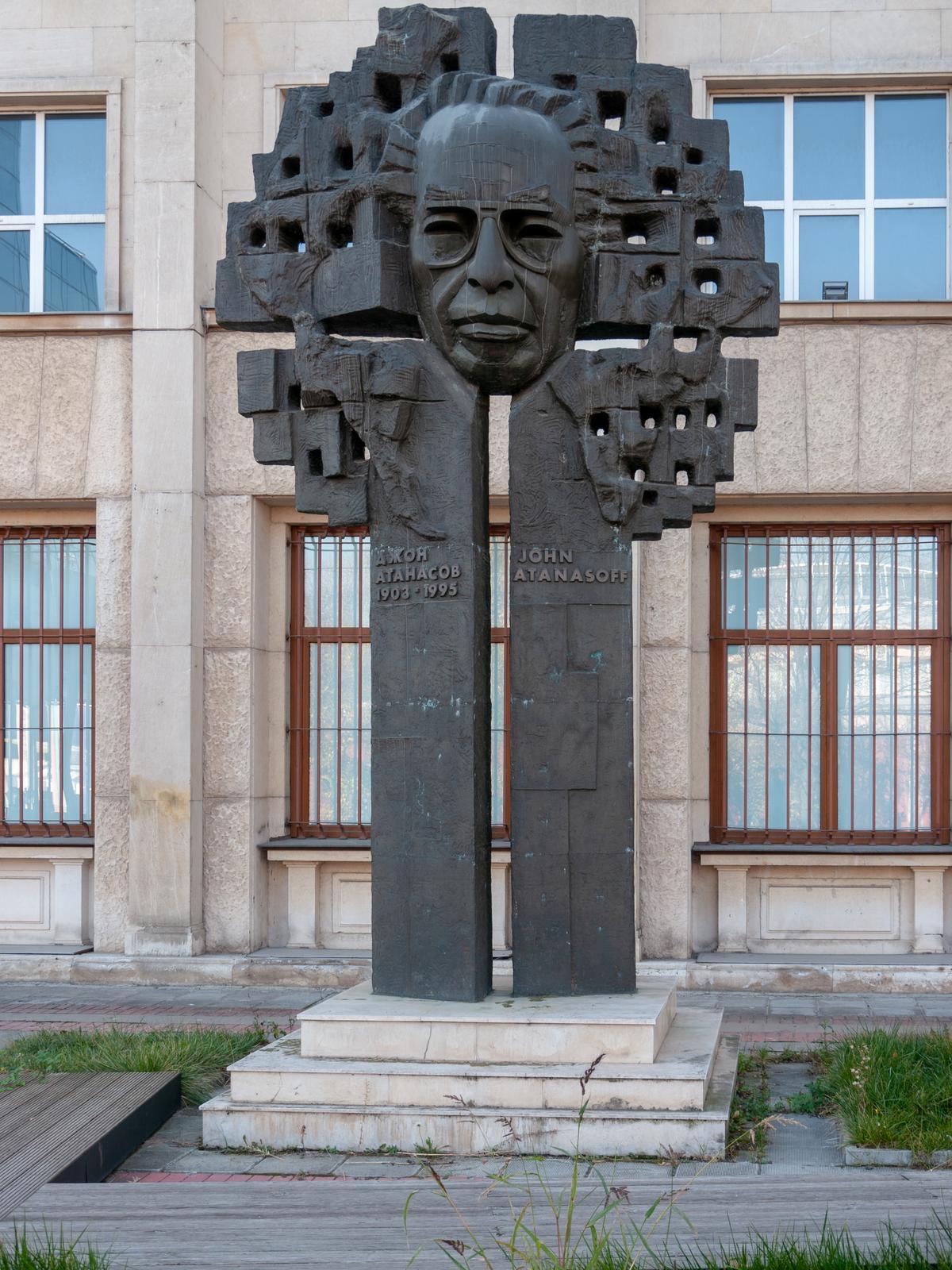
A sculpture in Sofia, Bulgaria, celebrating JVA.
| Photo Credit:
Matti Blume / Wikimedia Commons
JVA’s father, John Atanasoff, was a Bulgarian immigrant by the name Ivan Atanasov (that should explain why Bulgaria celebrates JVA). When he arrived in the U.S. with an uncle in 1889, immigration officials at Ellis Island changed his name to John Atanasoff!
JVA also had a son named John, who is still referred to as JVA II. That makes it three generations in the family with the same first and last names.
Published – October 19, 2025 12:21 am IST