


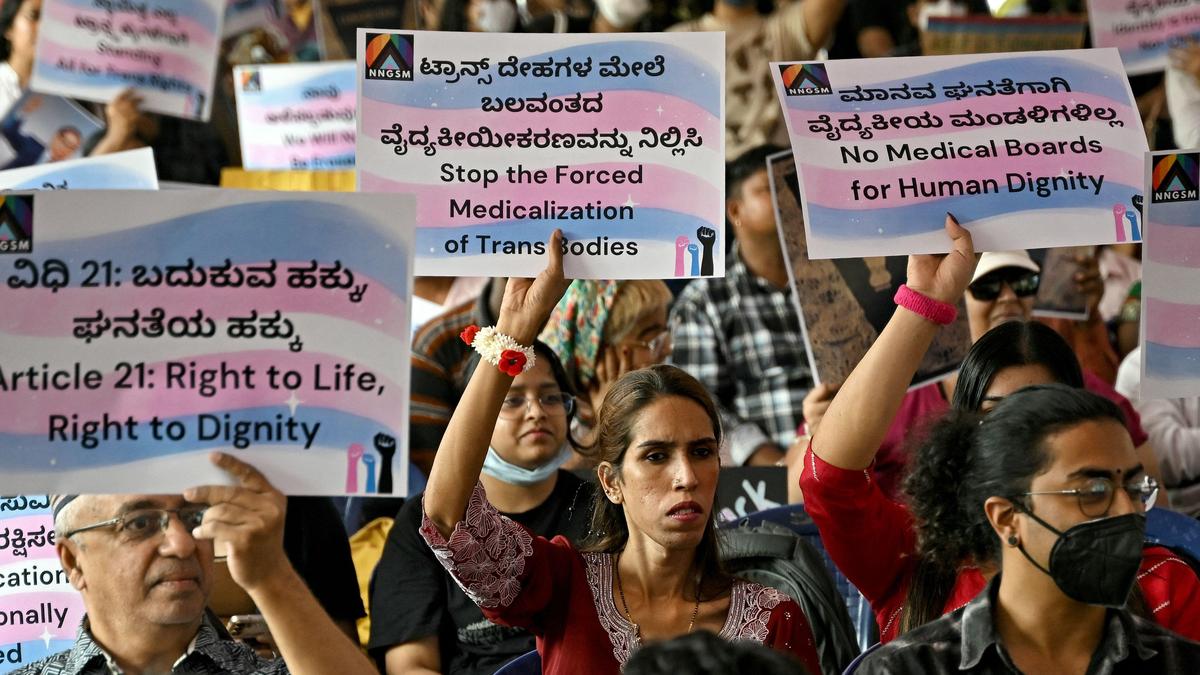
Christy Raj, a Bengaluru-based trans rights activist, says he was glued to the screen on the March 24 and 25.
“I barely moved, as if an IPL match was on. Except that this time, it was the Parliament debates on the Trans Bill 2026 on the screen,” he says.
The Transgender Persons (Protection of Rights) Amendment Bill, which limits the definition of “transgender person” to socio-cultural identities and intersex variations at birth and deprives gender minorities of the right to self-declare their identities, has triggered uproar, caused severe anxiety for the community and poses a huge question mark over their identities.
Much to the dread of many like Raj, Parliament passed the Bill on March 25, 2026, in a huge setback to decades of struggle. When a proposed law itself risks invalidating the dignity and erasing sections of the community, they ask, what justice remains for an already marginalised, stigmatised and deeply persecuted group.
Karnataka scenario
According to the 2011 Census, Karnataka is home to 20,266 transgender persons. Even this figure is widely acknowledged as a significant undercount. Yet, based on these numbers alone, Karnataka ranks among the States with the highest proportion of transgender persons relative to its population. This also means that the impact of the Bill is likely to be pronounced in States like Karnataka.
The trans-legal battle in India has been a long-drawn one, with the law often taking gingerly, slow and reactive steps to recognise the rights of the gender minorities.
Karnataka has played a significant role in shaping India’s gender minorities rights movement, with activists, lawyers and community groups laying the groundwork, building public opinion and contributing to some of the key legal milestones.
For example, Sangama was one of the earliest organisations to document instances of violence and police brutality against gender minorities.
In 2004, Kokila, an individual belonging to hijra community, was gang-raped by a group of men in Bengaluru. When she went to the police station seeking help, she was reportedly detained, abused and sexually assaulted again by police personnel. What this exposed was the social as well as institutional violence inflicted upon transgender communities.
Kokila, in 2006, filed an affidavit as part of the Delhi High Court proceedings in the Naz Foundation Vs. Government of NCT of Delhi which challenged Section 377 of the IPC. As the case moved to Supreme Court, Kokila’s affidavit became part of the larger body of material and arguments used to build the case in the apex court.
“In 2008, we held a huge rally in Bengaluru against Section 377, in which around 2,000 people participated. Then there was no looking back,” recalls Manohar Elavarthi, who founded Sangama in 1999.
Akkai Padmashali, who initially worked with Sangama and later founded Ondede, emerged as an important figure from the community in the organised fight for transgender rights during the same period. Petitions filed by Padmashali, among other petitions, became crucial in the reading down of Section 377.
Transgender community members feel that they are at a juncture where the fight, even for basics such as being treated with dignity and on par with others, seems far from over.
| Photo Credit:
ALLEN EGENUSE J
Around the same time, organisations like Alternative Law Forum (ALF) started supporting gender minorities navigate the legal system and helped build legal arguments that connected gender identity to constitutional rights and dignity
Other community-led organisations and coalitions such as Samara, Aneka, Raahi, KSMF, Solidarity, Okoota, Jeeva, Swatantra, CSGMR and MGSP, and several individuals from the State, have also been crucial in voicing concerns of the working class people of the transgender community and pushing for policy actions.
“The leadership in gender and sexual minorities movements in most cities is English-speaking middle or upper class. In Karnataka, the leaders are predominantly from the working class, so working class issues are at the forefront. That, I think, is the biggest strength of the movement in Karnataka,” says Elavarthi.
Yet another aspect that stands out is how the movement has picked up in smaller towns beyond Bengaluru, even if in smaller numbers. Soon after the Bill was introduced in Parliament, protests were held in at least eights districts in Karnataka.
State policy and quota
The efforts across decades have borne fruit too. In 2017, Karnataka introduced its State Policy on Transgender Persons and in 2021 became the first State in India to introduce a 1% reservation for transgender individuals in government jobs.
On a national level, the NALSA Vs. Union of India judgment in 2014 recognised the right of transgender persons to self-identify their gender. In 2018, the Supreme Court struck down Section 377. This was followed by the enactment of the Transgender Persons (Protection of Rights) Act, 2019, which, despite its shortcomings, marked a significant legislative step.
But rather than building on and addressing the gaps in the existing Act, the new Bill seeks to roll back years of progress secured through sustained struggle by the community, say the activists.
The Trans Bill, 2026
The Bill not only narrows the definition of “transgender person” to those with socio-cultural identities such as kinner, hijra, aravani, jogta, or eunuch, and persons forced to assume a transgender identity through mutilation or castration, but also folds persons with intersex variations or other congenital traits into this definition. Further, it specifically excludes persons with different sexual orientations and self-perceived sexual identities.
Currently, a transgender person can obtain legal recognition through self-declaration via an affidavit submitted to the District Magistrate (DM), without any requirement of medical examination. The proposed amendment, however, mandates a government-appointed Medical Board to provide recommendations to the DM before granting approval.
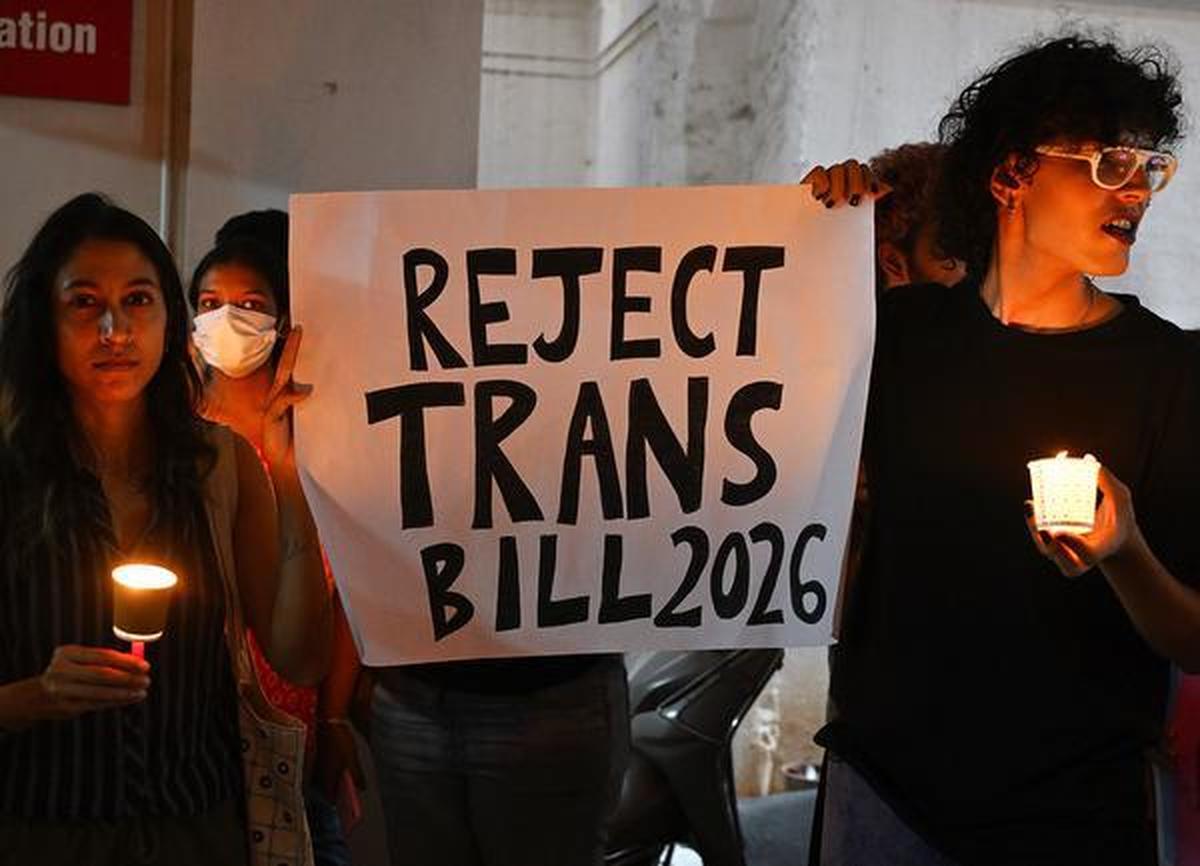
Activists also question the Union government’s rationale behind the The Transgender Persons (Protection of Rights) Amendment Bill, which is ‘prevention of misuse of schemes and protection of genuine transgender persons who face discrimination’.
| Photo Credit:
ALLEN EGENUSE J
The Bill set off alarm bells and a spate of protests across India. In Karnataka too, the community rose in protest quickly. Among other things, transgender rights organisations, as well as several civil rights organisations, wrote an open letter to the Prime Minister to withdraw the Bill.
Despite wide and vehement opposition, the Bill was passed by Parliament.
Overlooking nuances
The pressing question now is what happens to those left outside the government’s definitions — those from regional identities, trans women beyond traditional frameworks, and trans men who do not fall within any of the traditional socio-cultural identities.
Karnataka is home to regional identities such as jogamma, jogappa, mangalamukhi, marladi, kothi, shivshakti and so on. Arvind Narrain, lawyer and founding member of ALF, points out that some States, like Kerala, have no traditional transgender identities. The Bill, however, overlooks such regional nuances. Akkai Padmashali terms this a disrespect to cultures and identities other than the ones mentioned in the Bill, and to individuals like her.
“I identify as a woman. I don’t want to be recognised as a Hijra, Jogta, Kinner or Eunuch. I decide my identity and not the State,” she reiterates. Raj notes that even if one belongs to a category mentioned in the Bill, they need to prove their identity in front of a medical board now, which is a violation of personal liberty and contradictory to the NALSA judgment.
Then there is the case of transmen whose existence the Bill has entirely refused to acknowledge. “Within the larger transgender community itself, transmen are the most invisible. There are no traditional communities or cultural backup for them,” says Astha Kalarikkal, executive director at Raahi.
Nathaan, a trans right activist, says he gets several panic calls everyday from people asking what will happen to their existing transgender cards, pending applications, surgeries, and changes in other government documents. “The Bill gives no clarity and pushes already vulnerable people into more vulnerability,” he says.
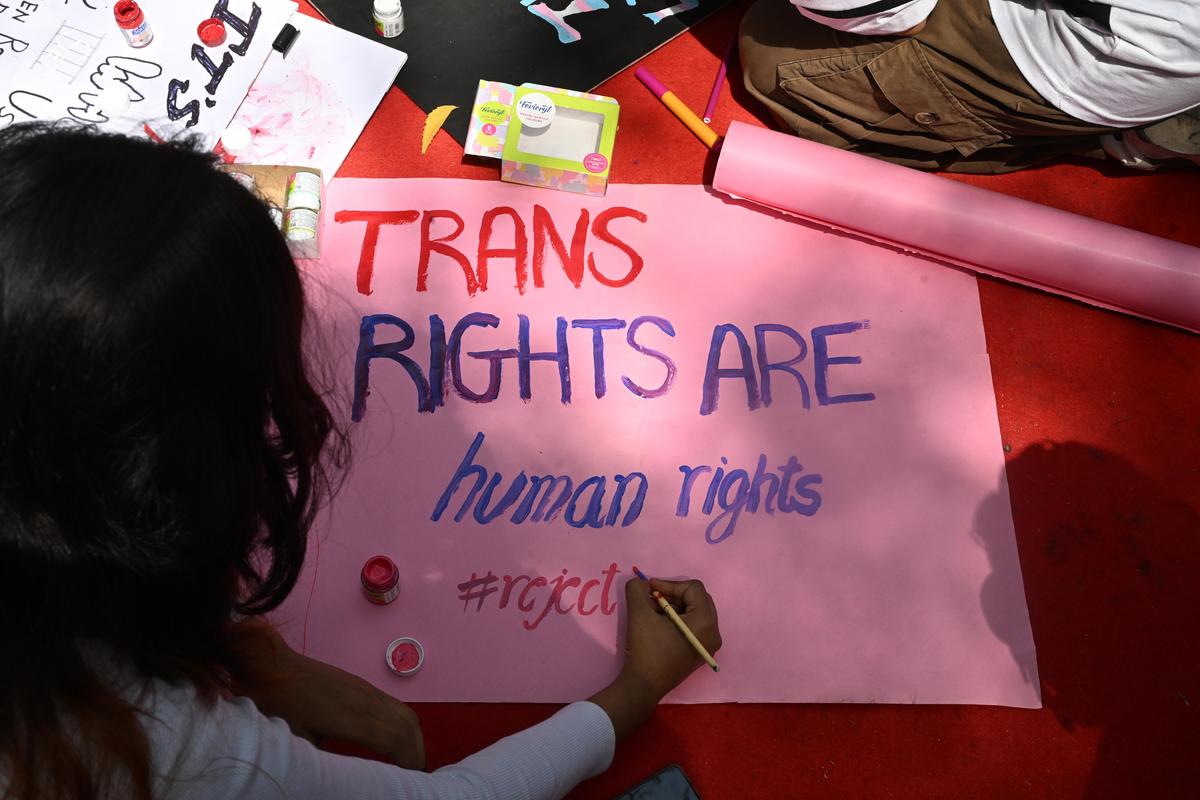
NEW DELHI 26/03/2026, People seen staging a Protest on Transgender Amendment Bill 2026 at Jantar Mantar , in New Delhi on Thursday. Sushil Kumar Verma / The Hindu
| Photo Credit:
SUSHIL KUMAR VERMA
“This is clearly a Bill rooted in Hindutva notions,” adds Raj. “Not only are all the groups legitimised by the government associated with the Hindu religion, but by refusing to acknowledge the existence of female-to-male individuals, the government has revealed its completely patriarchal mindset.”
Much to the chagrin of the community, the Bill also uses the term “eunuch” among the definitions, which has been historically used to dehumanise and humiliate the community. “I am not a eunuch. I am not impotent. I am a human being. This Bill is disrespectful towards the community and the plurality of the country,” lashes out Padmashali.
Criminalisation
One of the offences mentioned in the Bill is to unduly influence, coerce, force or entice a person into performing amputation, mutilation, surgical intervention, or emasculation to assume a transgender identity against their will. This will warrant a minimum of rigorous imprisonment for 10 years and maximum of imprisonment for life.
But in the case of gender minorities, many, on revealing their identities, are either forced out of their homes or subject to physical and mental harassment by their families. Eventually, many of them seek the help of communities and support groups and join the groups with the help of the community elders.
Under the new Bill, all of this could be interpreted as enticement or undue violence, points out Narrain.
“You cannot just get any person on the street and entice them. But the Bill speaks about criminalisation. Criminalisation of who? It could be any person who helps in any way, support organisations, law-based organisations or traditional communities,” he says.
Improvements needed
Activists like Raj feel that the Union government has often turned a blind eye to the community members in the South. While the Centre has rolled out the SMILE scholarship scheme for transgender students, not a single person from Bengaluru who applied for it have received it so far, he alleges.
In Karnataka, the government introduced the State Policy on Transgender Persons in 2017 and became the first State to introduce 1% reservation in government jobs for transgender individuals. The Mythri pension scheme for transgender persons was launched by the Karnataka government around 2012–13.
According to government sources, while around 35,000 people avail themselves of the Mythri pension, the 1% reservation has not found much success. As per the figures revealed by Home Minister G. Parameshwara recently, the horizontal reservation has led to four selections in the Home Department.
“Many of the community members haven’t been able to continue their education. So to take up jobs, they need coaching and support. We have been demanding that, but targeted programmes remain absent,” says Elavarthi.
The Karnataka government undertook a first of its kind survey of gender minorities in the State in 2025. A report prepared after the survey recommended free coaching for competitive exams, skill development and employment training and dedicated education support systems for transgender individuals. A dedicated transgender welfare board has also been a long-pending demand of the community. However, the Karnataka Budget saw no such announcements.
Continuing the fight
While the strong resistance from the State is a reflection of how Karnataka’s gender and sexual minorities movement has evolved and strengthened over the years, the community members feel that they are at a juncture where the fight, even for basics such as being treated with dignity and on par with others, seems far from over.
“We will not sit quietly. We are all set to file a petition before the Supreme Court,” says Padmashali. The SC-appointed committee led by Asha Menon, in which Padmashali is a member, has also passed a resolution against the Bill that was introduced without consulting the National Council for Transgender Persons. She highlights the need for political representation of transgender and intersex individuals.
Raj demands that the Karnataka goverment must ensure that, if the Act is passed, the law is not implemented in the State.
Activists also question the Union government’s rationale behind the Bill, which is ‘prevention of misuse of schemes and protection of genuine transgender persons who face discrimination.’ “The 2011 Census shows close to 5 lakh transgender individuals. Only around 30,000 transgender cards have been availed so far. So, what misuse are they referring to?” Narrain wonders.
Elavarthi argues that invasion of personal space is typical to the right wing. “They want to police what I eat, what I wear, my body, my relationship, my identity, when the reality is that everyone, even the cis heterosexual people, fall in a spectrum.”

“The Bill gives no clarity and pushes already vulnerable people into more vulnerability”Nathaan,Trans right activist
“The leadership in gender and sexual minorities movements in most cities is English-speaking middle or upper class. In Karnataka, the leaders are predominantly from the working class”Manohar Elavarthi,Founder of Sangama