




Ice is almost everywhere on the earth — in glaciers, snow, and clouds. Despite being so common, it still hides mysteries about its physical properties.
A long-standing puzzle concerns its electrical behaviour. Every water molecule is polar, meaning it has a positive and a negative end. But when water freezes into ordinary hexagonal ice (known as ice Ih), the overall crystal shows no polarity. The reason lies in the rules of how hydrogen atoms arrange themselves. Each oxygen must bond with two nearby hydrogen atoms, but across the lattice the hydrogen atoms’ orientations are random. This disorder prevents charges from building up in an organised way and instead cancels them out. As a result, ice is not piezoelectric, unlike quartz or certain ceramics. Piezoelectric materials generate electric charge when squeezed; ice does not.
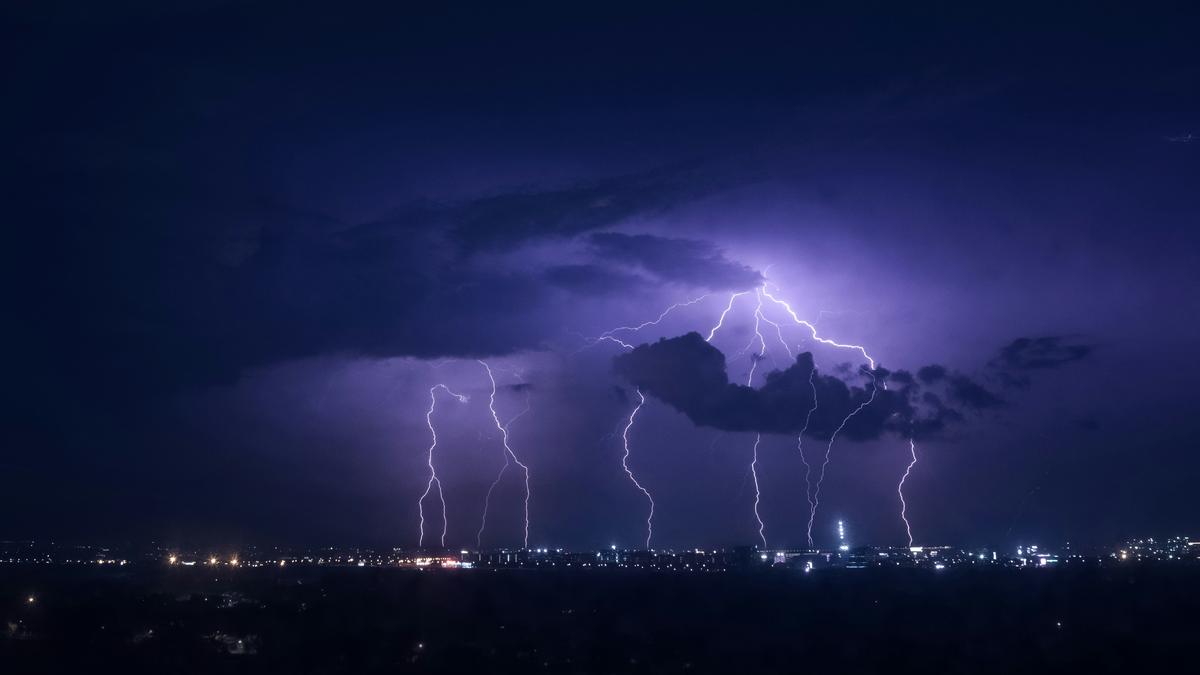
However, nature has often hinted at another story. Thunderclouds produce lightning when ice particles and graupel (soft hail) collide. Cracking ice sheets and avalanches release electromagnetic bursts. Clearly, ice can produce electricity when under stress, but the physical explanation has remained uncertain. Traditional models have invoked freezing potentials, surface ions or differences in temperature between colliding particles. Yet these explanations often fell short, failing to match observations of charge magnitudes or polarity reversals inside storms.
High stakes
This is where the concept of flexoelectricity becomes important. Flexoelectricity is the universal coupling between mechanical bending (strain gradients) and electric polarisation. Unlike piezoelectricity, flexoelectricity does not require a special crystal symmetry: it can occur in any material. When a solid is bent, compressed unevenly or otherwise deformed in a non-uniform way, charges can appear. The effect is usually small but it can grow in materials with high dielectric constants, such as ceramics.
Could it also occur in ice?
This is what a new study in Nature Physics, led by teams in China, Spain, and the US, set out to explore. Before this study, no one had directly measured flexoelectricity in ice. The prospect of confirming this is lucrative. It would mean that ice, while non-piezoelectric, is electromechanically active when bent. It would also suggest a new physical mechanism for thunderstorm charging, potentially complementing or even correcting older theories.
The stakes are in fact high: thunderstorm electrification is one of the oldest unsolved problems in atmospheric science. For more than a century, scientists have debated how colliding ice particles generate the vast electric fields that produce lightning. Resolving this mystery is essential for meteorology, aviation safety, and even climate science, since lightning influences atmospheric chemistry (and climate change is also making lightning strikes more common).
The researchers conducted the first systematic tests by trying to answer some questions. Two of them were: Is ice Ih actually flexoelectric, and if so, what is its coefficient? And can flexoelectricity explain the charging of ice particles in thunderstorms?
Their experiments and simulations provided strong evidence on both counts.
Search for anomalies
To test ice’s electromechanical properties, the researchers created ‘ice capacitors’. They sandwiched ultrapure, degassed water between two metal electrodes and then froze it at ambient pressure to form slabs of polycrystalline ice a few millimeters thick. Gold or platinum coatings were applied to aluminium foils to serve as electrodes. X-ray diffraction and Raman spectroscopy confirmed that the samples were in the normal hexagonal ice phase (Ih) and not some exotic variant.
The core of the experiment used a dynamic mechanical analyser. This device applied a controlled three-point bending motion: the ice slab rested on two supports while a probe pressed down in the middle. As the ice flexed, the researchers measured both the mechanical displacement and the resulting electrical charges. A charge amplifier connected to the electrodes captured signals while an oscilloscope synchronised the data. By analysing the relationship between strain gradients and polarisation, they extracted the flexoelectric coefficient — a number that says how well strongly bending ice produces charge.
The measurements were conducted over a wide temperature range, from 143 K to 273 K. This allowed the team to look for anomalies linked to phase transitions or surface effects. In parallel, they performed ab initio quantum mechanical simulations to model how ice-water interfaces with different metals — gold, platinum, aluminium — influenced surface ordering. These calculations helped explain experimental anomalies.

Finally, the team built a theoretical model for ice-graupel collisions in thunderstorms. Using classical contact mechanics and their measured flexoelectric coefficients, they calculated the amount of charge separation possible during collisions between particles. They compared their predictions with decades of laboratory data on ice charging in storm-like conditions.
The results were striking. First, the team showed for the first time that ice is indeed flexoelectric. Between 203 K and 248 K, the effective flexoelectric coefficient was consistently around 1.01-1.27 nanocoulombs per metre. This is not a trivial value: it’s comparable to that of well-studied dielectric ceramics such as strontium titanate and lead zirconate. In other words, ice, long thought to be electromechanically inert, can produce significant electric polarisation when bent.
Hidden surprises
Importantly for meteorology, the team showed that ice flexoelectricity could play a major role in thunderstorms. Their calculations of collision-induced polarisation matched the range of charges measured in past laboratory studies of ice-graupel impacts. Moreover, the model naturally explained puzzling features of thunderstorm electrification, such as the reversal of charge polarity with temperature. When the flexoelectric coefficient is positive, graupel tends to become negatively charged; when it turns negative at higher temperatures, the polarity reverses. This matched observations of thunderstorms’ tripole structures, where regions of opposite charges coexist.
The researchers cautioned that flexoelectricity is unlikely to be the only mechanism, however. Storm electrification is complex, involving surface ions, melting, fractures, and impurities. Yet flexoelectricity is universal: any inhomogeneous deformation must produce it. That made it a robust contributor to thunderstorm charging, just not the only one. Their work has potentially added a big new piece to a century-old puzzle.
The study may thus have transformed our understanding of ice. It showed that ordinary ice Ih, despite lacking piezoelectricity, is flexoelectric with a strength similar to ceramics. And it has proposed that flexoelectricity provides a natural, quantitative mechanism for the charging of ice particles in thunderstorms, potentially helping explain how lightning is born.
Finally, it seems even the most familiar material, water ice, still hides surprises. A snowflake is not just frozen water: under bending and collision, it can behave like a small generator. And in the turbulent dance of storm clouds, these minuscule generators may light up the skies.
Published – September 16, 2025 11:07 am IST