






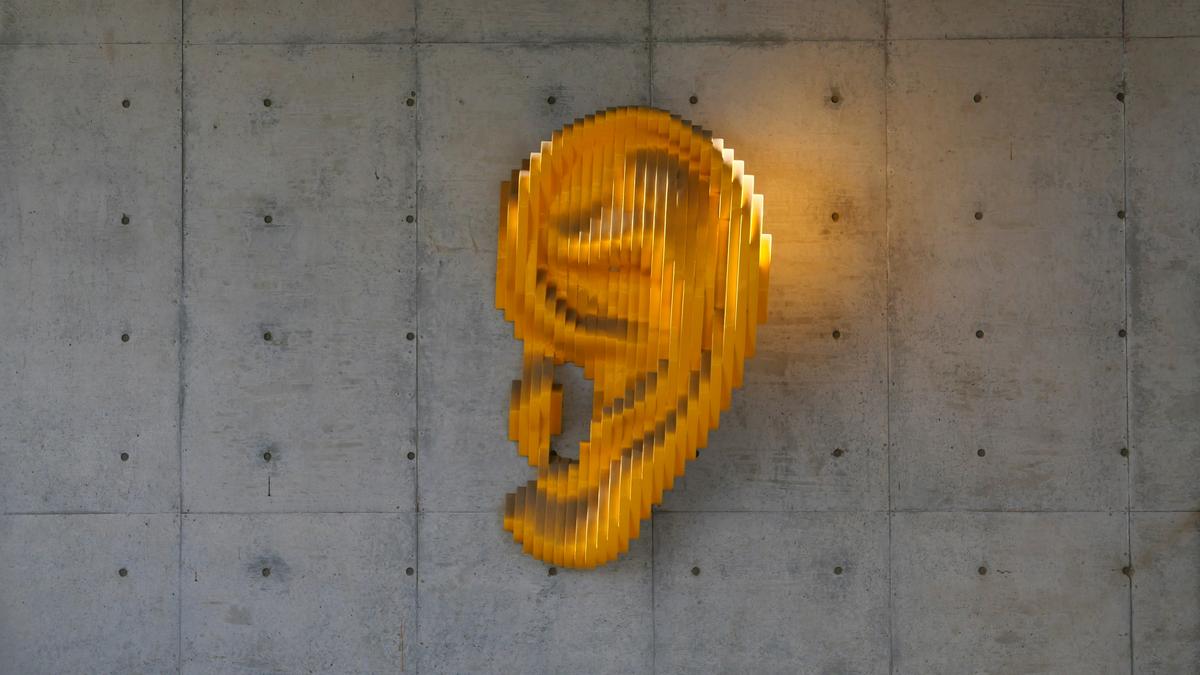
A tree that is flexible enough to shake in a gentle breeze will undoubtedly be uprooted during a squall. On the other hand, a hardy tree that resists the force of a strong gale will hardly shudder during a gentle breeze. But unlike the tree, our ears can handle both ends of the spectrum.
The human auditory system, a marvel of nature, doesn’t only detect the faintest sound signals but also demonstrates remarkable resilience in the face of thunderous noises. This adaptability allows us to distinguish the gentlest whispers from our loved ones and immerse ourselves in the thundering music of a nightclub.
Recent research has unveiled a fascinating mechanism that allows our auditory system to adapt to various sound environments. Just as our pupils dilate in the dark and contract in bright light, our ears have mechanisms that help adjust to ‘see’ in dim sound environments and protect us from harsh sound environments.
How do we hear?
At the heart of our auditory system are intricate hair cells nestled within the human cochlea. Each cochlea houses around 16,000 of these flask-shaped sensory cells, each with a cluster of hairlike projections called stereocilia. These stereocilia, arranged like a staircase from the shortest to the tallest, are the key to our hearing.
Two adjacent stereocilia are connected by a filamentous extracellular tether called a tip link. These tip links, functioning like a complex network of connections, are pivotal in our hearing process, converting sound waves into electrical signals our brain can interpret.
When sound waves reach the ear, they create vibrations in the inner ear fluid. These vibrations cause the stereocilia to bend, stretching the tip links that connect them. This stretching opens ion channels in the stereocilia that allow potassium ions to enter the hair cell and create an electrical signal.
Nerve cells attached to the hair cells pick up this signal and send it to the brain, where it is interpreted as sound. This mechanism is similar to a microphone converting sound waves into electrical signals.
A mechanical circuit breaker
Humans can perceive sound in the range of 20 Hz to 20 kHz in frequency and 5-120 decibels (dB) in intensity. These sounds produce a force of 10-100 piconewton (pN) on tip links. We must apply roughly one newton (N) of force to hold an apple or orange in our hands. One newton is equal to one thousand billion piconewtons. So we can imagine how small the force acting on the tip links is.
The auditory system relies on tip links. Each tip link consists of two proteins, cadherin-23 (CDH23) and protocadherin-15 (PCDH15). These proteins are at risk of breaking when exposed to loud noises. Surprisingly, this breaking is actually a protective mechanism that prevents damaging sounds from reaching the hair cells in the ear, which can’t regenerate once they are damaged. But unlike hair cells the tip links can regenerate, which helps preserve our hearing.
The tip links disassociate naturally in response to ambient sounds. Typically, a tip link complex’s average lifetime is about 31.8 seconds. The tip links unbind and rejoin repeatedly and maintain the network in the hair cells.
The temporary hearing loss we might experience after a loud blast or blaring music is the result of losing multiple tip link complexes at the same time. Once the complexes re-form, hair cell function returns to normal levels. In effect, they function like a mechanical circuit breaker in the auditory system.
The lifetime of the tip link is related to the loudness of the sounds to which they are exposed. If the loudness is high, the tip links survive only for a short duration. They break fast. At 1 kHz, the tip links experience a tension of 5 pN. At a higher frequency of 4 kHz, the tension shoots up to 34 pN. The average lifetime of the tip link complex is just eight seconds when subjected to a force of 10 pN.
This implies that the tip links must break up within minutes in noisy environments.
“The human ear is sensitive to even 5 dB, and the tip link that can respond to that low stimuli ought not to survive the piercing sound in a nightclub or orchestra, rendering most people deaf. Since this does not occur, it seems appropriate to expect a mechanism that safeguards the transduction at large forces,” Sabyasachi Rakshit, a lead author of the new paper and associate professor in the Department of Chemical Sciences at the Indian Institute of Science Education and Research, Mohali, said.
Abhishek Chaudhuri, the other lead author and also an associate professor in the same department, added: “We were interested to find the mechanism that enables tip links to survive forces of varying frequency and amplitude and capture the features that can explain uninterrupted hearing.”
Putting tip links through the paces
We can determine the strength of a length of thread by securing one end with a clamp to the roof and hanging weights on the other end. Similarly, the researchers used an atomic force microscope (AFM) to secure the tip link complexes and observed the lifespan of the tip link: how long it survived without breaking when the amount of force was changed.
They found that a tip-link complex exhibits three distinct types of responses based on the force.
As anticipated, the complex’s lifetime decreased when the applied force was low. But when the magnitude of the force was increased, the lifetime decreased. The complex was also surprisingly unaffected by mid-range tensile forces between around 36 pN and 70 pN.
When subjected to strong forces greater than 80 pN — representing intense sounds — the tip-links disconnected in order to protect the hearing system. At even higher forces, the tip links only remain intact for a short period of time.
“The tip links act like the force sensor, balancing the incoming force and stepping in to protect us from the danger. This response at a louder noise level cuts off the transmission protecting the hair cells,” Dr. Rakshit said.
Like a sensitive switchboard in our ears, the tip-link first detects the subtle mechanical signals from incoming sounds. It then converts them into electrical signals, allowing us to hear faint sounds. “However, this tiny protein-protein complex transforms into a gatekeeper when the sound is loud,” Dr. Chaudhuri said. We discovered that tip-links act as force filters, selectively transmitting low forces to activate ion channels while blocking intermediate force levels. Moreover, when faced with extremely high forces, the tip-links disengage altogether, preventing damage to our hearing apparatus.”
It is well-known that a mutation in the PCDH15 protein results in inherited deafness. “We conducted similar studies with mutated tip links, and found that the lifetime-force curve of the mutant is dramatically different,” says Sabyasachi.
The lifetime of the tip link showed three kinds of responses across the force range in regular tip links. However, in the mutated tip link, the response is reduced with increased force across all the force ranges.
“We were not able to see the mid-range behaviour found in the normal tip link, in the mutated tip links,” he added.
This implies that the ability of the normal tip link to respond to mid-range forces is crucial for hearing, and inherited deafness results from mutation-related loss of this function.
“By unravelling the intricate mechanisms of tip-links, we are paving the way for developing innovative strategies to protect against hearing loss caused by loud noises. With further research, we aspire to unlock more secrets of this fascinating biological system. This could potentially enhance the quality of life for millions affected by hearing impairment,” Amin Sagar, a lead author and a former postdoc at IISER Mohali, said.
The team consisted of Nisha Arora, Jagadish P. Hazra, Sandip Roy, Gaurav K. Bhati, Sarika Gupta, K. P. Yogendran, Abhishek Chaudhuri, Amin Sagar, and Sabyasachi Rakshit. The study paper was published in the journal Nature Communications.
T.V. Venkateswaran is a science communicator and visiting faculty member at the Indian Institute of Science Education and Research, Mohali.