



Skip to content
  • Facebook
  • X
  • Linkedin
  • WhatsApp
  • Associate Journalism
  • About Us
  • Privacy Policy
  • 033-46046046
  • editor@artifex.news
Artifex.News

Artifex.News

Stay Connected. Stay Informed.

  • Breaking News
  • World
  • Nation
  • Sports
  • Business
  • Science
  • Entertainment
  • Lifestyle
  • Toggle search form
  • Five Chinese dam workers, driver killed in attack in northwest Pakistan; China condemns attack
    Five Chinese dam workers, driver killed in attack in northwest Pakistan; China condemns attack World
  • Cambodia’s ex-leader Hun Sen becomes senate president
    Cambodia’s ex-leader Hun Sen becomes senate president World
  • Vijay Hazare Trophy: Karun Nair Slams Fifth Ton As Vidarbha Enter Semi-Finals; Haryana In Last Four
    Vijay Hazare Trophy: Karun Nair Slams Fifth Ton As Vidarbha Enter Semi-Finals; Haryana In Last Four Sports
  • Sri Lanka Police arrests wanted handler of 4 ISIS suspects detained in India
    Sri Lanka Police arrests wanted handler of 4 ISIS suspects detained in India World
  • Lens Aim To Build On Memorable Champions League Victory
    Lens Aim To Build On Memorable Champions League Victory Sports
  • The Man Who Gave India Maruti 800 Car
    The Man Who Gave India Maruti 800 Car World
  • Novak Djokovic Untroubled At French Open As Fans Hit By Alcohol Ban
    Novak Djokovic Untroubled At French Open As Fans Hit By Alcohol Ban Sports
  • 3 With 10th-Grade Education Set Up IT Firm, Cheat Nagpur Man Of Rs 5 Lakh
    3 With 10th-Grade Education Set Up IT Firm, Cheat Nagpur Man Of Rs 5 Lakh Nation
Using science to address India’s dog crisis

Using science to address India’s dog crisis

Posted on September 5, 2025 By admin


Dr Nishant Kumar, co-founder and chief scientist of the Thinkpaws Sustainability Research Foundation, a Delhi-based trans-disciplinary think tank, believes that too many decisions around the ongoing stray dog crisis are being shaped by “emotionally-charged knee-jerk reactions.” In his opinion, there is an urgent need to create policy benchmarks informed by dog behaviour and science, not human emotions.

Despite being such a diverse society, India “has not invested in extending the ambit of research that matches new environmental and social challenges inevitably tied with coexistence with non-humans,” according to Nishant, a DBT/Wellcome Trust Fellow at NCBS, Bengaluru (Host) and Oxford (Overseas Host).

This, in turn, means decision-makers are implementing solutions without understanding spatial distribution, behavioural patterns, or ecological drivers, he adds. “They’re operating on assumptions, not data. You can’t solve complex coexistence problems without understanding underlying social-ecological systems.”

Dogs being fed at Kengeri in Bengaluru
| Photo Credit:
SUDHAKARA JAIN

It is this gap that the Thinkpaws Foundation, established two years ago, aims to address through its research initiatives. In 2023, for instance, their team conducted a scientific survey across 14 strategically selected sites in Delhi to better understand the scale of the problem.

“Our systematic survey revealed a dog density of 550±87 dogs/km². We censused 1,484 individual dogs across 14 sampling units,” states a recent report published on their website. “When extrapolated across Delhi’s 1,500 km², this yields 825,313 street dogs (range: 694,568 to 956,059).”

Dr Nishant Kumar, co-founder and chief scientist of the Thinkpaws Sustainability Research Foundation

Dr Nishant Kumar, co-founder and chief scientist of the Thinkpaws Sustainability Research Foundation
| Photo Credit:
Special Arrangement

In an interview, Nishant reflects on the recent Supreme Court ruling that all stray dogs from the nation’s capital should be removed (a few days later, another bench of the top court amended the order and asked the municipal authorities to return the animals from where they were picked up after sterilisation and vaccination), his organisation’s research findings on the issue, and its implications.
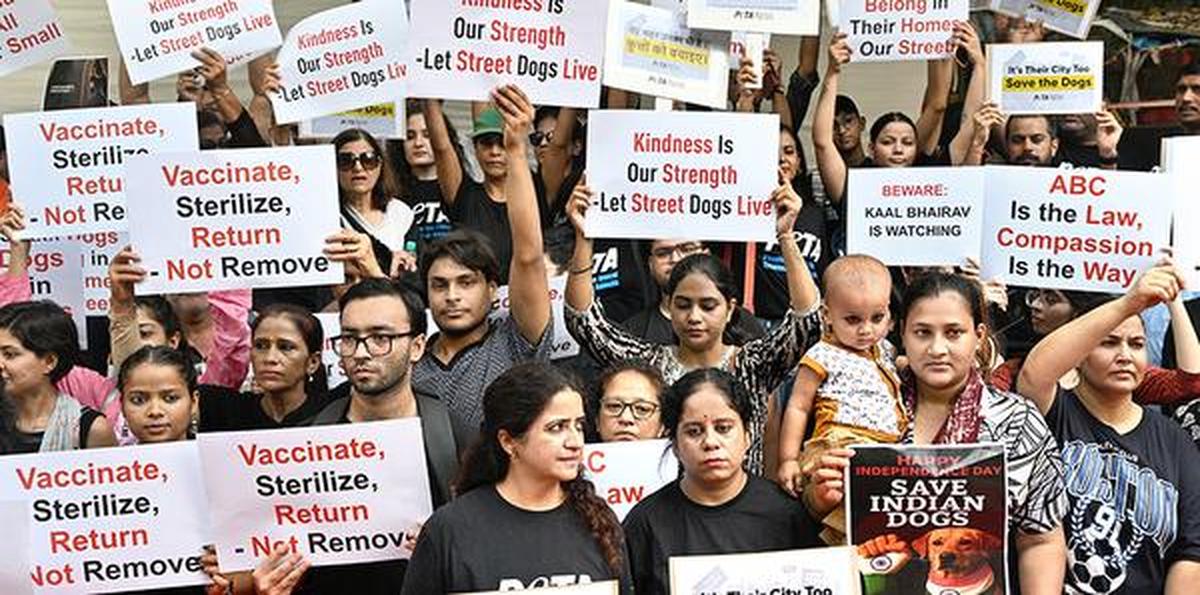
Animal rights activists protesting against the apex court order on stray dogs at Jantar Mantar

Animal rights activists protesting against the apex court order on stray dogs at Jantar Mantar
| Photo Credit:
SHASHI SHEKHAR KASHYAP


What do you think about the recent Supreme Court directive on stray dogs?


As a citizen, I would not expect the Supreme Court to intervene in such situations;principally, it needs robust scientific management that informs and facilitates better coexistence.

Historically, animals have been viewed from utilitarian benchmarks and/or as passive, something to be handled or managed – perspectives that could give way to new ethical and jurisprudential benchmarks.

I believe this swift action from the Supreme Court is based on valid sets of public or individual concerns/litigations. But coexistence conundrums are not new. The Delhi High Court has issued multiple legislative directions since 2008 regarding the creation of feeding platforms, mostly ineffective, because of their basis on human emotions. Animals don’t follow the idea of feeding platforms or langar.


As human beings, we have historically had a complex relationship with various animals; many are now considered “pests”, including the rock pigeon and macaques. They have coexisted with us and there is a strong cultural connection associated with feeding. How do we address India’s stray dogs, considering this aspect?


There is a famous line in jurisprudence saying that you have the right to (freely) swing your fist, but that right stops where my nose starts. Perhaps this may address the debate on how we should treat animals, considering the implications it might have on human/nonhuman well-being. In this case, the idea of “a nose” or discomfort with respect to what/where you are feeding, which creates issues, requires predictive scientific and technological interference.

Furthermore, human and nonhuman populations, as well as waste piles, have skyrocketed. Rich habitat/food resource pool of this kind in a limited space affects and regulates interfaces and mutual behaviour, shaping dog populations, as driven by local environments.

Scientists know animals better than we did 100 years ago, which informs how our health requirements are invariably tied with nonhumans and the environment (remember COVID-19). Modern perspectives need to evaluate/guide the concept of whether, where, and whom to feed, collectively shaped by the government, civil society researchers, and administrators. We surely have the means to channel the concerns and emotions people have for animals differently. This, for example, is visible in zoos that encourage people to adopt animals via donations. In the same way, if we have a better way of extending a similar kind of relationship to dogs, with evidence-based use of donation for well-being and interactions, shaping actual benefit for urban animals is not far off.


Could you talk about some of the key findings in your research?


Our research has allowed us to understand that each set of these breeding social units (dogs are social animals) is tuned to its local environment. Like people in X part of Delhi or Y part of Mumbai, dogs are also tuned to their local environment and make localised adjustments. When you have animals that are localised within their social and breeding units, (futile) attempts to manage by random relocations and cross-pairings have implications on conflicts within or across species, causing injuries/diseases.

Clearly, until we develop and achieve sanitary waste disposal practices that justify the absence of animals from the streets, their long-standing scavenging services are helpful. Meanwhile, we could use science to “engineer” where we want these services and avoid situations where it begets conflicts/diseases. And that can only happen through long-term research, which triangulates behaviour, demography and cognition — in other words, how animals respond by processing site-specific information.


Do we have a workable solution that considers both animal rights and human safety?


We are incorrectly conceptualising solutioning as a monolith, while dealing with animals that are conscious living beings, maintaining social systems tied to humans. The best way forward will require collaboration among stakeholders representing diverse ethical and scientific perspectives; this will shape a conversational language that fosters mutual tolerance for disagreements, while devising effective management interventions. 

Dialogues shall enable understanding of complex human-animal interfaces, complemented by multiple human/nonhuman stakeholders. Unless such practices regularly guide day-to-day discourse, we will continue to argue and enact reactive measures from individuals/organisations. These dogged situations represent the diversity of emotions people exhibit towards animals, which can’t be fathomed under right vs. wrong or other dichotomies (absolute removal vs. coexistence in streets).

Transdisciplinary science can effectively help us develop a common language, with its ability to incorporate constant course correction, informed by objective assessments of dynamic challenges like coexistence in a changing world. 

Indians possibly have the best bandwagon of cultural emotions and tolerance towards animals, but we need to board the bandwagon of science soon. This will guide better solutions, supported by inclusive discussions.


Source link

Science Tags:Delhi dogs

Post navigation

Previous Post: Access Denied
Next Post: Amazon India sees 170% rise in one-day deliveries in Kolkata

Related Posts

  • How reliable are studies that show moderate drinking has health benefits?
    How reliable are studies that show moderate drinking has health benefits? Science
  • White House directs NASA to create time standard for the moon
    White House directs NASA to create time standard for the moon Science
  • Why better prediction of cyclone intensity, heavy rainfall is needed
    Why better prediction of cyclone intensity, heavy rainfall is needed Science
  • India’s first solar observatory mission Aditya-L1 to be launched at 11.50 a.m. on September 2, 2023
    India’s first solar observatory mission Aditya-L1 to be launched at 11.50 a.m. on September 2, 2023 Science
  • Science for all | Footprints of two ancient hominin species found at the same spot in Kenya
    Science for all | Footprints of two ancient hominin species found at the same spot in Kenya Science
  • How will AI revolutionize drug development?
    How will AI revolutionize drug development? Science

More Related Articles

Geographers uncover why some rivers stay single while others split Geographers uncover why some rivers stay single while others split Science
Signs of life? Why astronomers are excited about carbon dioxide and methane in the atmosphere of an alien world Signs of life? Why astronomers are excited about carbon dioxide and methane in the atmosphere of an alien world Science
Medicinal foods: A missing category on the regulator’s plate Medicinal foods: A missing category on the regulator’s plate Science
Naturally occurring bile acid can blunt statin-induced diabetes Naturally occurring bile acid can blunt statin-induced diabetes Science
Year after Titan’s fatal dive, explorers vow to pursue ocean mysteries Year after Titan’s fatal dive, explorers vow to pursue ocean mysteries Science
A computer science conundrum that could transform healthcare A computer science conundrum that could transform healthcare Science
SiteLock

Archives

  • September 2025
  • August 2025
  • July 2025
  • June 2025
  • May 2025
  • April 2025
  • March 2025
  • February 2025
  • January 2025
  • December 2024
  • November 2024
  • October 2024
  • September 2024
  • August 2024
  • July 2024
  • June 2024
  • May 2024
  • April 2024
  • March 2024
  • February 2024
  • January 2024
  • December 2023
  • November 2023
  • October 2023
  • September 2023
  • August 2023
  • July 2023
  • June 2023
  • May 2023
  • April 2023
  • March 2023
  • February 2023
  • January 2023
  • December 2022
  • November 2022
  • October 2022
  • September 2022
  • August 2022
  • July 2022
  • June 2022
  • May 2022

Categories

  • Business
  • Nation
  • Science
  • Sports
  • World

Recent Posts

  • Imran Khan slams Army chief Munir for ‘inflicting oppression’ to prolong rule
  • Access Denied
  • South Korea vows support to Koreans arrested in U.S. immigration raid
  • Access Denied
  • GST overhaul: Nirmala Sitharaman writes to State Finance Ministers, thanks them

Recent Comments

  1. dfb{{98991*97996}}xca on UP Teacher Who Asked Students To Slap Muslim Classmate
  2. "dfbzzzzzzzzbbbccccdddeeexca".replace("z","o") on UP Teacher Who Asked Students To Slap Muslim Classmate
  3. 1}}"}}'}}1%>"%>'%> on UP Teacher Who Asked Students To Slap Muslim Classmate
  4. bfg6520<s1﹥s2ʺs3ʹhjl6520 on UP Teacher Who Asked Students To Slap Muslim Classmate
  5. pHqghUme9356321 on UP Teacher Who Asked Students To Slap Muslim Classmate
  • Algerian Boxer, Imane Khelif, In Gender Row, Goes For Olympic Gold
    Algerian Boxer, Imane Khelif, In Gender Row, Goes For Olympic Gold Sports
  • Sensex Rises 1,300 Points, Adani Stocks Rally As Flagship Firm Jumps 4%
    Sensex Rises 1,300 Points, Adani Stocks Rally As Flagship Firm Jumps 4% Nation
  • SAFF U17 Championship: Sumit Sharma’s Header Fetches India Full Points Against Bangladesh
    SAFF U17 Championship: Sumit Sharma’s Header Fetches India Full Points Against Bangladesh Sports
  • PM Narendra Modi Gifts Joe Biden A Silver Hand-Engraved Train Model, Jill Biden A Pashmina Shawl
    PM Narendra Modi Gifts Joe Biden A Silver Hand-Engraved Train Model, Jill Biden A Pashmina Shawl Nation
  • Nitin Gadkari Says Changes In Cost Of Fuel, Road Can Bring Logistics Cost To 9%
    Nitin Gadkari Says Changes In Cost Of Fuel, Road Can Bring Logistics Cost To 9% Nation
  • BJP Preps For State Elections, 2 Ministers To Be In Charge Of Maharashtra
    BJP Preps For State Elections, 2 Ministers To Be In Charge Of Maharashtra Nation
  • U.S. still working on trade deals despite court ruling, USTR says
    U.S. still working on trade deals despite court ruling, USTR says World
  • Experts say next American president will have to work closely with India, there’s no choice
    Experts say next American president will have to work closely with India, there’s no choice World

Editor-in-Chief:
Mohammad Ariff,
MSW, MAJMC, BSW, DTL, CTS, CNM, CCR, CAL, RSL, ASOC.
editor@artifex.news

Associate Editors:
1. Zenellis R. Tuba,
zenelis@artifex.news
2. Haris Daniyel
daniyel@artifex.news

Photograher:
Rohan Das
rohan@artifex.news

Artifex.News offers Online Paid Internships to college students from India and Abroad. Interns will get a PRESS CARD and other online offers.
Send your CV (Subjectline: Paid Internship) to internship@artifex.news

Links:
Associate Journalism
About Us
Privacy Policy

News Links:
Breaking News
World
Nation
Sports
Business
Entertainment
Lifestyle

Registered Office:
72/A, Elliot Road, Kolkata - 700016
Tel: 033-22277777, 033-22172217
Email: office@artifex.news

Editorial Office / News Desk:
No. 13, Mezzanine Floor, Esplanade Metro Rail Station,
12 J. L. Nehru Road, Kolkata - 700069.
(Entry from Gate No. 5)
Tel: 033-46011099, 033-46046046
Email: editor@artifex.news

Copyright © 2023 Artifex.News Newsportal designed by Artifex Infotech.