



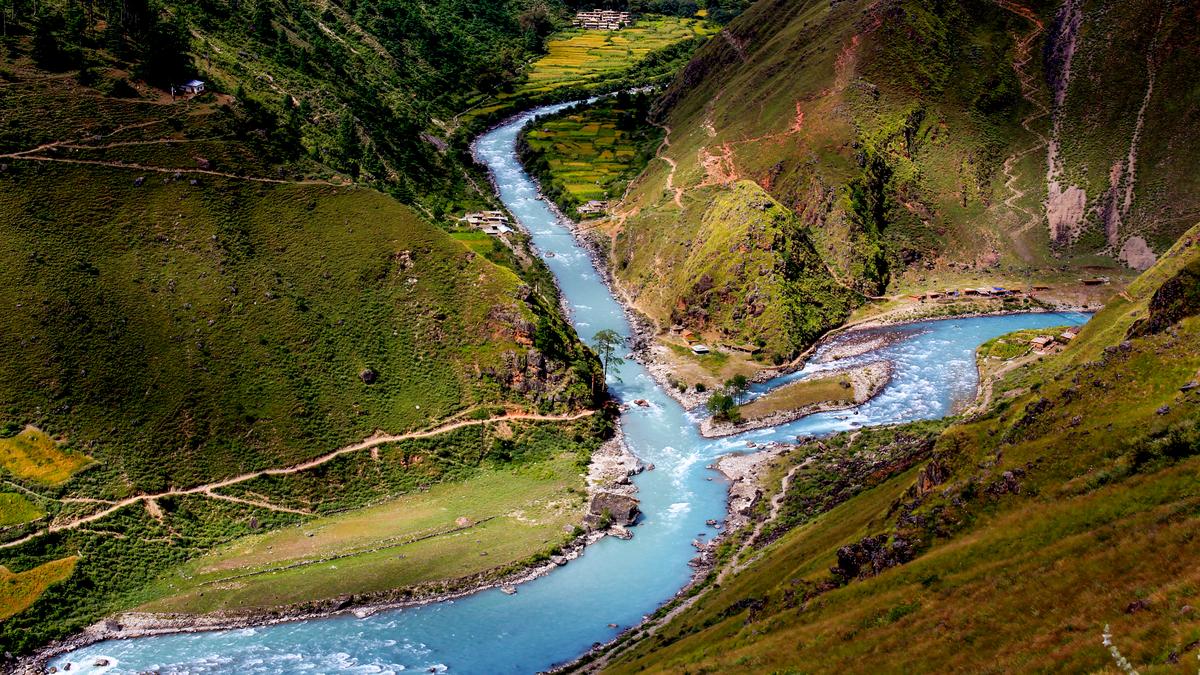
Some rivers split up as they flow while some others don’t. This riverine phenomenon has intrigued researchers for decades. What determines whether a river flows as a single thread or develops into a multi-threaded system? The question may sound simple but it has become a fundamental issue in river geomorphology, straddling concepts across geology, geography, ecology, and engineering.
Now, geographers at the University of California Santa Barbara (UCSB) have reported in a paper published in Science that they have solved the mystery.
By analysing the dynamics of 84 rivers over 36 years using satellite imagery and a novel image processing technique called particle image velocimetry, they say they have discovered the physical mechanism that causes there to be two types of rivers.
“We found that single-thread rivers are characterised by equilibrium between bank erosion and bar accretion — essentially, material lost from one bank is balanced by the material deposited on the other, maintaining a stable width,” the study’s senior author and and associate professor of geography at UCSB Vamsi Ganti said.
In contrast, he continued, multi-threaded rivers consistently exhibit higher rates of erosion relative to the deposition on the opposite banks, leading to the channel widening and eventually splitting. This imbalance, per the work, is the driving force behind multithreaded rivers.
That is, erosion is what drives the phenomenon of flow splitting in rivers.
‘Growing recognition’
The two main types of rivers, single-thread and multi-thread, also feature different flood and erosion risks, ecosystem services, and water resources. These hazards and features are becoming more relevant as people and governments cope with more frequent and more intense water weather events. As a result, the physical mechanism that dictates single- versus multi-threading has been becoming a more important subject of research.
While previous research mostly examined where different types of rivers could be found, Ganti said, they also focused on how these rivers changed over time.
Many models that try to predict flooding risk assume that the rivers are flowing in streams of a fixed depth and width. This is not the case, and the new study has revealed the consequences of this assumption.
“There is growing recognition that many rivers have historically transitioned from multi-channel to single-channel after human interference,” the study’s lead author and UCSB Earth Research Institute postdoc Austin Chadwick wrote in an email.
Human interference includes damming, diking, sediment mining, clearing and snagging, and agricultural development.
Vector map
To understand why some rivers flow in a single channel while others split into many threads, the researchers turned to satellites. They studied 36 years of global Landsat images, covering the period from 1985 to 2021. From a worldwide survey of nearly 400 river sections, they chose 84 that were wide enough and moved at a speed suitable for their analysis. These included both single-thread and multithread rivers across different climates, slopes, and water flows.
They used a computer technique called particle image velocimetry, which tracked small changes in images from year to year, letting scientists measure how much a riverbank eroded and how much material accreted on the opposite side. To do this, they converted the satellite pictures into maps showing where land was dry and where it was covered by water.
Then, by comparing thousands of cross-sections of the rivers over time, they generated millions of small vectors that recorded the directions and speeds of erosion and accretion.
Finally, they combined all this data — more than four lakh measurements of erosion versus accretion — to test whether the two processes balanced out. This allowed them to discover the patterns that caused single or multithread rivers.
Plants have a say
For many decades, scientists have believed that single-channeled, meandering rivers needed vegetated banks to form and that plants and meandering rivers coevolved. But in an analysis published recently in Science, Stanford University researchers reported that that idea is based on a misinterpretation of the sedimentary record.
“We show that vegetated river bends move in a different direction than unvegetated river bends, relative to the down-slope direction that the entire river flows,” Michael Hasson, the study’s lead author and a PhD scholar at Stanford, said.
This renders the sedimentary deposits that unvegetated meandering rivers produce fundamentally different from the deposits of vegetated meandering rivers, even though they have the same form.
While the Chadwick et al. study focused on why rivers became meandering or braided, Hasson et al. examined meandering rivers.
Given a straight valley, Hasson added, they found vegetated river bends will move outwards toward the sides of the valley whereas unvegetated river bends will move down the valley, without moving sideways.
“Our interpretation is that vegetation causes this difference in river movement mainly because it causes levees to form, which indirectly limits the sinuosity, a measure of how indirect a river’s path is, of the river,” Hasson said. “In turn, sinuosity controls how and where bends migrate.”
Insights for India
Chadwick et al. considered three stretches of the Ganga, near Patna, Farakka, and Paksey (Bangladesh). For the Brahmaputra, they examined stretches near Bahadurabad (Bangladesh), Pandu (India), Pasighat (India), and one further upstream in the Himalaya.
The Brahmaputra is a classical braided river, Ganti said. The team also found that the Brahmaputra’s threads eroded their banks fast.
“The shape of their channels is fundamentally unstable,” Chadwick said of these threads. “The subchannels are prone to widen and split over years and decades, because the flow laterally erodes riverbanks faster than it deposits along them.”
The find went against the conventional wisdom that erosion and deposition are in equilibrium.
“It is very surprising and intriguing that multi-thread rivers laterally erode faster than they deposit,” Chadwick said.
In sum, the study has unravelled “a new sort of way that rivers can maintain their form, which is fuelled not by equilibrium but instead cycles of instability as sub-channels repeatedly widen and split over time.”
“This fundamental instability is an important consideration for river management.”
Reducing flood risk
Chadwick also said that along multi-thread rivers like the Ganga and the Brahmaputra, the rating curves used to measure river flows must be updated more frequently in order as the channels change their shape.
The problem in India is that in many parts, braided river sections have been artificially confined to single channels using built embankments, Akshay Kadu, a hydrologist at Stantec, a global engineering design and consulting company, said. He wasn’t involved in the studies.
Another implication of the findings is that multi-channel rivers require significantly less space and time to return to their natural state, leading to lower restoration costs.
So, Kadu added, nature-based solutions such as removing artificial embankments, restoring the river’s connection with its natural floodplains, creating vegetated buffer zones along riverbanks, reactivating abandoned channels, and building wetlands in braided sections can significantly lower the risk of flooding in adjacent areas.
G.B.S.N.P. Varma is a freelance science journalist.