
Skip to content
  • Facebook
  • X
  • Linkedin
  • WhatsApp
  • YouTube
  • Associate Journalism
  • About Us
  • Privacy Policy
  • 033-46046046
  • editor@artifex.news
Artifex.News

Artifex.News

Stay Connected. Stay Informed.

  • Breaking News
  • World
  • Nation
  • Sports
  • Business
  • Science
  • Entertainment
  • Lifestyle
  • Toggle search form
  • Missed Arijit Singh’s Performance Ahead Of India vs Pakistan Clash? Watch It Here
    Missed Arijit Singh’s Performance Ahead Of India vs Pakistan Clash? Watch It Here Sports
  • Watch: Skydiver gets parachute caught on plane wing in Australia
    Watch: Skydiver gets parachute caught on plane wing in Australia World
  • Madras High Court’s Big Rebuke To Probe Agency In Illegal Sand Mining Row
    Madras High Court’s Big Rebuke To Probe Agency In Illegal Sand Mining Row Nation
  • Access Denied World
  • Israel strikes near Beirut, intercepts ‘hostile aircraft’
    Israel strikes near Beirut, intercepts ‘hostile aircraft’ World
  • Paris Olympics 2024: ‘Supershoes’ have changed running but do they confer unfair advantages?
    Paris Olympics 2024: ‘Supershoes’ have changed running but do they confer unfair advantages? Science
  • Access Denied Sports
  • Lack Of Live Event Venues, Foreign Payments Restrictions Getting In The Way Of Concert Economy Growth Business
Could rotating black holes be the wind turbines powering the distant future?

Could rotating black holes be the wind turbines powering the distant future?

Posted on September 26, 2024 By admin


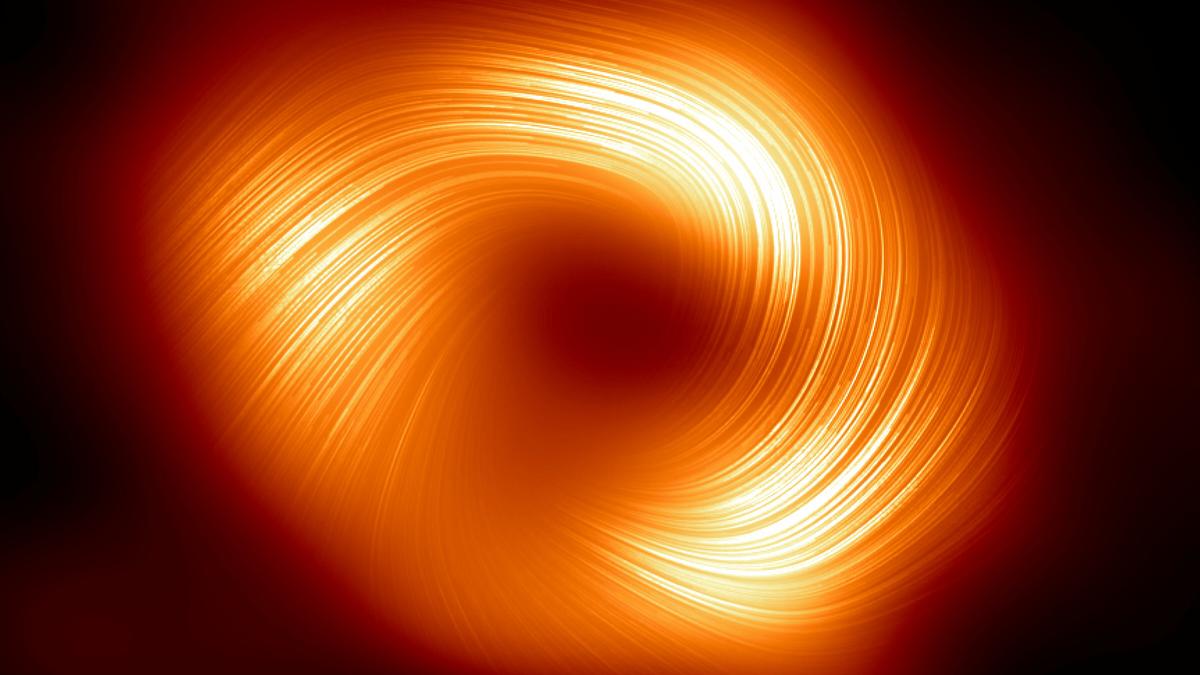
The Event Horizon Telescope (EHT) collaboration, who produced the first ever image of our Milky Way black hole released in 2022, has captured a new view of the massive object at the centre of our Galaxy: how it looks in polarised light. This is the first time astronomers have been able to measure polarisation, a signature of magnetic fields, this close to the edge of Sagittarius A*. This image shows the polarised view of the Milky Way black hole. The lines overlaid on this image mark the orientation of polarisation, which is related to the magnetic field around the shadow of the black hole.
| Photo Credit: Reuters

Black holes are mysterious objects – there’s a lot we don’t know about them. One longstanding question has been whether rotating black holes, which are so powerful they drag space-time along with them, could be used as an energy source.

The physicist Roger Penrose suggested that, if an object fell into a rotating black hole in such a way that it split – with one part escaping – the part that left should effectively gain energy from the black hole.

So if we sent objects or light towards a rotating black hole, we may be able to get energy back. It’s difficult to directly prove all this, however. But we have recently published our second study, in Nature Communications, experimentally verifying a more general theory behind it. This theory concerns all rotating objects that can absorb matter or radiation, and a black hole is, in essence, just a very big and effective absorber.

The idea dates back to 1971 and the Soviet physicist Yakov Zel’dovich. Generalising Penrose’s idea, he predicted something very simple. If you take a cylinder that absorbs energy from waves, and you spin it, then it should actually spend its own energy to amplify some waves (boosting their energy).

This would apply to waves that possessed their own inherent rotation (known as angular momentum) in the same direction as the cylinder and had a low enough frequency with respect to the cylinder’s rotation rate.

Zel’dovich’s proposal in turn inspired Stephen Hawking’s famous idea that black holes should slowly radiate their energy away by amplifying photons from the quantum vacuum.

Tricky experiment

Despite the simplicity of the Zel’dovich effect and its key relation to fundamental physics, this effect had not been directly tested until recently.

Zel’dovich’s condition for amplification was general, but his description of a hypothetical system that could show such an effect was quite specific. It involved waves travelling in free space (at the speed of light) with a type of angular momentum known as OAM, short for orbital angular momentum, (meaning the light beams were twisted) and hitting a rapidly rotating cylinder.

But this suggested that the amplification effect would be tiny, because unless the cylinder could rotate at a speed comparable to that of light – a construction that would be mechanically impossible today – the OAM waves that could meet the condition would be spread over an area so large that the cylinder would be in (what Zel’dovich termed) a “non-wave zone” – it would barely interact with the waves at all.

Due to this, it was wrongly thought to be basically unobservable in experiments.

Hard proof

That is until we realised that the effect should also occur in sound waves, which travel much slower than the speed of light. Using sound waves with orbital angular momentum, in 2020 we showed Zel’dovich amplification for the first time in an experiment.

After showing the effect existed in one system, we thought an electromagnetic version might not be so hard after all. We were able to remove the previous limitations by trapping the electromagnetic wave in a resonant circuit, rather than in free space. The oscillating waves in our single circuit didn’t have orbital angular momentum, but contained another type of angular momentum, termed “spin”.

With this circuit, we could funnel the oscillating magnetic part of the wave through a small area where we placed a rotating aluminium cylinder. We then measured how the power in the circuit changed with the cylinder rotation speed. If the cylinder was absorbing the field, it acted as a normal positive resistance in the circuit, draining the power. If it was amplifying the field, it acted as a negative resistance – as a power source.

We found that the amplification of the field by the cylinder was exactly as predicted by Zel’dovich’s condition – meaning we had proven the effect in electromagnetic waves for the first time.

In trying this experiment we also found something unexpected. The way this cylinder creates a negative resistance and amplifies the surrounding circuit when it spins fast enough is very similar to the way that wind turbines generate energy.

Inside a wind turbine is an induction generator, where an alternating current is sent in to create a rotating magnetic field around the rotor. And when the rotor blades spin faster than the surrounding rotating magnetic field, the current is amplified, and energy is generated.

While there is also other physics involved in modern induction generators, it is still astonishing that all the ingredients for proving the Zeldovich effect with electromagnetism were hiding in plain sight for so long.

This link we discovered to induction generators will enable us to optimise these electromagnetic experiments to test the Zel’dovich effect further, leaning on the many years of engineering that have gone in to making motor and generator technology better.

Perhaps the knowledge of this link to the Zel’dovich effect will also go the other way, providing engineers with a new physics perspective to harness for energy generation.

This experiment, showing the Zel’dovich effect is present in electromagnetism, also unlocks the potential to see the effect on a quantum level. Quantum theory tells us empty space is not empty – it has some fluctuations.

Any amplification effect should also be able to amplify such energy fluctuations into real photons – creating matter out of a quantum field. This would mean that a rotating cylinder, even in the absence of all other forces, would gradually slow down due to this process.

As for black holes, the implications are exciting. Perhaps in the future, harnessing the rotation of black holes could be used to power technology or spaceships.

Some have proposed conditions that would create a runaway energy generation effect termed a “black hole bomb”. With improvements to our experiment, we hope to also test this runaway amplification for the Zel’dovich effect.

This article is republished from The Conversation under a Creative Commons license. Read the original article.

Published – September 26, 2024 03:47 pm IST



Source link

Science Tags:astronomy news, black holes, rotating black holes, science news

Post navigation

Previous Post: Scientists are using ancient DNA to reveal the Iberian lynx’s ‘weapon’ against extinction
Next Post: Israel vows to keep fighting Hezbollah ‘until victory’

Related Posts

  • Early prediction of preeclampsia using a blood-derived biomarker
    Early prediction of preeclampsia using a blood-derived biomarker Science
  • New light-based tool could cut cost of spotting viral infections
    New light-based tool could cut cost of spotting viral infections Science
  • The rational ape: study says chimpanzees reason through their beliefs
    The rational ape: study says chimpanzees reason through their beliefs Science
  • Multiple Indian payloads launched by Space X’s Falcon 9
    Multiple Indian payloads launched by Space X’s Falcon 9 Science
  • 150 years of the Indian Association for the Cultivation of Science
    150 years of the Indian Association for the Cultivation of Science Science
  • Govt. approves four semiconductor plants in Odisha, Punjab, Andhra Pradesh
    Govt. approves four semiconductor plants in Odisha, Punjab, Andhra Pradesh Science

More Related Articles

How will AI revolutionize drug development? How will AI revolutionize drug development? Science
When Earth passed through the tail of Halley’s Comet When Earth passed through the tail of Halley’s Comet Science
Why can’t we see well right after entering a darker room? Why can’t we see well right after entering a darker room? Science
Study finds one way statins can cause diabetes, and a solution Study finds one way statins can cause diabetes, and a solution Science
Leafy chemistry: What happens when a leaf changes colour in autumn? Leafy chemistry: What happens when a leaf changes colour in autumn? Science
Fact-check: IIT Madras director V. Kamakoti’s comments on cow urine Fact-check: IIT Madras director V. Kamakoti’s comments on cow urine Science
SiteLock

Archives

  • October 2026
  • September 2026
  • August 2026
  • July 2026
  • June 2026
  • May 2026
  • April 2026
  • March 2026
  • February 2026
  • January 2026
  • December 2025
  • November 2025
  • October 2025
  • September 2025
  • August 2025
  • July 2025
  • June 2025
  • May 2025
  • April 2025
  • March 2025
  • February 2025
  • January 2025
  • December 2024
  • November 2024
  • October 2024
  • September 2024
  • August 2024
  • July 2024
  • June 2024
  • May 2024
  • April 2024
  • March 2024
  • February 2024
  • January 2024
  • December 2023
  • November 2023
  • October 2023
  • September 2023
  • August 2023
  • July 2023
  • June 2023
  • May 2023
  • April 2023
  • March 2023
  • February 2023
  • January 2023
  • December 2022
  • November 2022
  • October 2022
  • September 2022
  • August 2022
  • July 2022
  • June 2022
  • May 2022

Categories

  • Business
  • Nation
  • Science
  • Sports
  • World

Recent Posts

  • Delhi journalist who accused ACP of sexual harassment slapped with SC/ST Act over ‘casteist remarks’
  • Three Indians killed in Germany building fire: reports
  • Govt. to roll out National Electricity Data Sharing framework in October: Power Secretary
  • BCCI steps in to prevent further forfeitures by Arunachal Pradesh
  • TCCI seeks review of steep parking, access charges at Thiruvananthapuram airport

Recent Comments

  1. RobertTes on UP Teacher Who Asked Students To Slap Muslim Classmate
  2. Manuelret on UP Teacher Who Asked Students To Slap Muslim Classmate
  3. RobertTes on UP Teacher Who Asked Students To Slap Muslim Classmate
  4. RobertTes on UP Teacher Who Asked Students To Slap Muslim Classmate
  5. BrentWes on UP Teacher Who Asked Students To Slap Muslim Classmate
  • Access Denied Sports
  • Access Denied
    Access Denied Nation
  • Access Denied World
  • Bizarre – Flying Ants ‘Attack’ Stops India vs South Africa T20I In Centurion. Internet Can’t Keep Calm – Watch
    Bizarre – Flying Ants ‘Attack’ Stops India vs South Africa T20I In Centurion. Internet Can’t Keep Calm – Watch Sports
  • France’s Bastille Day parade meets the Olympic torch relay in an exceptional year
    France’s Bastille Day parade meets the Olympic torch relay in an exceptional year World
  • Israel tells its troops to prepare for a possible ground operation in Lebanon
    Israel tells its troops to prepare for a possible ground operation in Lebanon World
  • White House Official On “Closer” US-India Ties
    White House Official On “Closer” US-India Ties World
  • Access Denied Business

Editor-in-Chief:
Mohammad Ariff,
MSW, MAJMC, BSW, DTL, CTS, CNM, CCR, CAL, RSL, ASOC.
editor@artifex.news

Associate Editors:
1. Zenellis R. Tuba,
zenelis@artifex.news
2. Haris Daniyel
daniyel@artifex.news

Photograher:
Rohan Das
rohan@artifex.news

Associate Journalists
1. Subrata Paul - AN/2020/01
2. Quamruz Zaman - AN/2021/22
3. Ahmed Sha - AN/2021/035
4. Ajay Kumar Shaw - AN/2021/39
5. Tahqiqul Hoda - AN/2021/21

Artifex.News offers Online Paid Internships to college students from India and Abroad. Interns will get a PRESS CARD and other online offers.
Send your CV (Subjectline: Paid Internship) to internship@artifex.news

Links:
Associate Journalism
About Us
Privacy Policy

News Links:
Breaking News
World
Nation
Sports
Business
Entertainment
Lifestyle

Registered Office:
72/A, Elliot Road, Kolkata - 700016
Tel: 033-22277777, 033-22172217
Email: office@artifex.news

Editorial Office / News Desk:
No. 13, Mezzanine Floor, Esplanade Metro Rail Station,
12 J. L. Nehru Road, Kolkata - 700069.
(Entry from Gate No. 5)
Tel: 033-46011099, 033-46046046
Email: editor@artifex.news

Copyright © 2023 Artifex.News Newsportal designed by Artifex Infotech.