





Skip to content
  • Facebook
  • X
  • Linkedin
  • WhatsApp
  • YouTube
  • Associate Journalism
  • About Us
  • Privacy Policy
  • 033-46046046
  • editor@artifex.news
Artifex.News

Artifex.News

Stay Connected. Stay Informed.

  • Breaking News
  • World
  • Nation
  • Sports
  • Business
  • Science
  • Entertainment
  • Lifestyle
  • Toggle search form
  • Poland’s pro-EU opposition tipped to win election with record turnout
    Poland’s pro-EU opposition tipped to win election with record turnout World
  • The Taliban will attend a UN climate conference for the first time
    The Taliban will attend a UN climate conference for the first time World
  • Access Denied
    Access Denied Nation
  • Company that sent AI calls mimicking Joe Biden to voters agrees to pay  million fine
    Company that sent AI calls mimicking Joe Biden to voters agrees to pay $1 million fine World
  • Blue Origin Resumes Space Tourism Flights Today With 90-Year-Old On Board
    Blue Origin Resumes Space Tourism Flights Today With 90-Year-Old On Board World
  • Access Denied
    Access Denied Nation
  • Kavya Maran Can’t Hold Back Tears After SRH’s Heavy IPL Final Loss Against KKR – Watch
    Kavya Maran Can’t Hold Back Tears After SRH’s Heavy IPL Final Loss Against KKR – Watch Sports
  • India considering  billion plan to bail out State power distributors
    India considering $12 billion plan to bail out State power distributors Business
New light-based tool could cut cost of spotting viral infections

New light-based tool could cut cost of spotting viral infections

Posted on May 30, 2024 By admin


Viruses infect plants, animals, and humans. A virus’ spread from animals to humans could unleash pandemics like COVID-19 — significant public health crises with considerable economic and social fallout. To nip such infections in the bud, public health researchers have advocated the ‘One Health’ approach: monitoring and protecting plant, animal, environment, and human health in an integrated fashion.

Quick, easy, and cost-effective methods of detecting viral infections can go a long way in ensuring this outcome. Recently, researchers from Harvard University, Cambridge, and Jiangsu University, Zhenjiang, reported developing one such tool: it can detect if cells have been infected by a virus using only light and some knowledge of high-school physics.

Their paper was published in the journal Science Advances in March this year.

A fingerprint of infection

A viral infection can stress cells and change their shapes, sizes, and features. As the infection gains the upper hand and the body becomes ‘diseased’, the changes become more stark.

The researchers behind the new study translated these cellular changes into patterns that could be used to say if a cell had been infected. They infected cells from a pig’s testicles with pseudorabies virus, shone light on them through a microscope, and tracked how changes in the cells distorted the light.

The researchers recorded these distortions at different points of time so that the light data mimicked a progressing viral infection. Then they compared these distortions with those in light that had been shone through healthy cells. They finally reported that the difference between the two light patterns represented a ‘fingerprint’ of virus-infected cells.

Changes in contrast

The distortion in question referred to diffraction patterns. Diffraction is the tendency of light waves to spread out after they pass through narrow openings or around small objects. Once this diffracted light reaches, say, a wall, it renders a pattern of alternating light and dark rings or stripes around a dark centre.

The fingerprint was based on two parameters: the contrast between the light and dark stripes and the inverse differential moment, a mathematical value that defined how textured the diffraction pattern was.
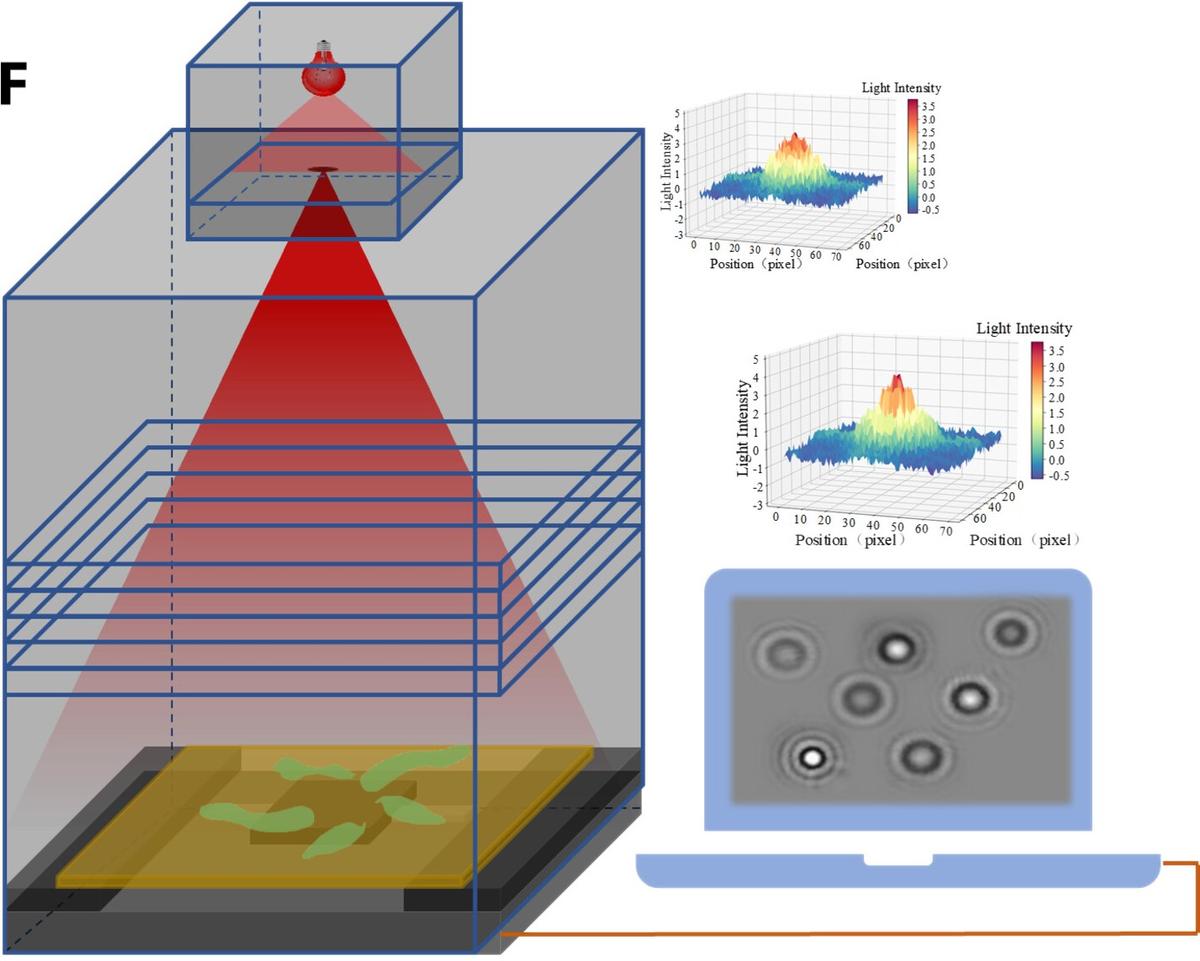
A schematic diagram of the test setup.

A schematic diagram of the test setup.
| Photo Credit:
DOI: 10.1126/sciadv.adl3466

The method can differentiate between uninfected, virus-infected, and dead cells. Virus-infected cells were elongated and had more clear boundaries than uninfected cells. This changed the contrast between light and dark stripes of the diffraction fingerprint, and increased the differences in light intensity.

Less time, money, complexity

Current methods to detect virus infections in cells are not straightforward. For example, in one technique, researchers isolate infected cells in the lab and add chemical reagents like dimethyl thiazolyl diphenyl tetrazolium bromide to them. The reagent destroys the cells, but not before the enzymes in the cells — called oxidoreductases and dehydrogenases —  react with the reagent to produce purple crystals of a chemical entity called formazan. This colour change tells researchers the cells could have had a viral infection. Cells dying of a viral infection lack these enzymes and thus produce little to no amounts of formazan crystals.

The researchers compared their new technique with this standard for accuracy, time, and cost. They reported that their light-based method could detect viral infections as accurately or even more accurately than the standard method.

The new method was also cheaper than the standard: while the equipment cost for the standard method using chemical reagents is about $3,000 (Rs 2.5 lakh), the cost of the new method described in this paper was about a tenth. Many research facilities around the world also procure reagents from other places, adding potential time delays and vulnerability of their research to supply-chain inefficiencies.

Finally, the new method reportedly takes only about two hours to detect virus infected cells, against the 40 hours the current standard required.

Advantages for livestock

According to the paper, the researchers placed a sample of cells on slides under a microscope and light was shone on them. They obtained and subsequently analysed the diffraction fingerprint, and correlated each fingerprint with the corresponding condition of the cells. The team is yet to conduct real-world tests.

The low cost and ease of use point are likely to be lucrative to people working closely with animals, especially “livestock or common pets such as dogs and cats,” the researchers wrote in their paper. The new tool can help spot viral infections in their bodies as well as for “the selection and breeding of excellent livestock and poultry species at the cellular level”.

A new tool in the arsenal

Indeed, the new method could help catch viral infections early — which could be very helpful during, say, a virulent bird flu outbreak. The one going on around the world killed more than 131 million poultry in 81 countries in 2022 and 2023, according to the World Health Organisation.

Scientists typically test samples from any part of the bird the virus could infect: windpipe, cloaca (the waste chamber for urine and faeces), or their waste itself. If a bird dies after displaying the symptoms associated with the infection, they also look for the pathogen in the carcass’s tissues.

The methods they use include polymerase chain reaction (of the ‘PCR’ fame during the COVID-19 pandemic) or antigen tests, which detect the genes or proteins associated with the H5N1 virus. While the new method is not specific to certain kinds of viruses, it can help detect viral infections in general and help stakeholders take preventive measures in time to avoid significant losses.

In fact, the tool’s generic nature could also be an advantage by catching a viral infection that is not due to H5N1, perhaps even a new virus.

Against the spread of viruses

Viral outbreaks in animals have significant economic consequences. According to a 2018 study in the journal Transboundary and Emerging Diseases, bird flu outbreaks in the Kuttanad region of Kerala imposed losses of Rs 23 lakh in 2014 (2018 rate). The study also estimated the Government of Kerala spent Rs 5.4 crore “to contain the disease spread through massive culling, surveillance and monitoring of poultry and humans due to [the] zoonotic nature of the disease”.

Against this backdrop, a rapid and cost-effective way to detect viral infections could help improve surveillance and reduce the cost of selecting healthy animals or birds for breeding. The existing methods to select animals for breeding require expensive DNA-sequencing tools, even if these tools are very good at identifying some desired features in an animal.

The light-based tool could also help low- and middle income countries with limited resources to realise the WHO’s recommendation to “rapidly detect, report and respond to animal outbreaks as the first line of defence” against the spread of viruses.

Joel P. Joseph is a freelance science journalist and researcher.


Source link

Science

Post navigation

Previous Post: UK Parliament Dissolves Ahead Of July 4 General Election
Next Post: Police Rescue 57 Minors From UP’s Ghaziabad Slaughterhouse

Related Posts

  • Shielding humans alone won’t prevent pandemics if animals can fall ill
    Shielding humans alone won’t prevent pandemics if animals can fall ill Science
  • IIT-Kanpur did Delhi cloud-seeding trial despite Met dept warning of ‘no clouds’
    IIT-Kanpur did Delhi cloud-seeding trial despite Met dept warning of ‘no clouds’ Science
  • Greenland ice found at risk of melting at CO2 levels lower than today’s
    Greenland ice found at risk of melting at CO2 levels lower than today’s Science
  • Evolution can change how an ecosystem collapses, study finds
    Evolution can change how an ecosystem collapses, study finds Science
  • Will chocolate’s future hinge on success of growing cocoa in the lab?
    Will chocolate’s future hinge on success of growing cocoa in the lab? Science
  • Breakthrough Prizes award .75 million to 2026 research leaders
    Breakthrough Prizes award $18.75 million to 2026 research leaders Science

More Related Articles

Nobel laureate supports India’s pursuit for a neutrino lab Nobel laureate supports India’s pursuit for a neutrino lab Science
Will chocolate’s future hinge on success of growing cocoa in the lab? Will chocolate’s future hinge on success of growing cocoa in the lab? Science
New chemical pathway found to worsen air quality in harsh winters New chemical pathway found to worsen air quality in harsh winters Science
Why Nipah virus outbreaks are occurring only in Kerala Why Nipah virus outbreaks are occurring only in Kerala Science
Bizarre’ bird-like dinosaur has scientists enthralled  Bizarre’ bird-like dinosaur has scientists enthralled  Science
CMFRI decodes genetic blueprint of Indian squid CMFRI decodes genetic blueprint of Indian squid Science
SiteLock

Archives

  • May 2026
  • April 2026
  • March 2026
  • February 2026
  • January 2026
  • December 2025
  • November 2025
  • October 2025
  • September 2025
  • August 2025
  • July 2025
  • June 2025
  • May 2025
  • April 2025
  • March 2025
  • February 2025
  • January 2025
  • December 2024
  • November 2024
  • October 2024
  • September 2024
  • August 2024
  • July 2024
  • June 2024
  • May 2024
  • April 2024
  • March 2024
  • February 2024
  • January 2024
  • December 2023
  • November 2023
  • October 2023
  • September 2023
  • August 2023
  • July 2023
  • June 2023
  • May 2023
  • April 2023
  • March 2023
  • February 2023
  • January 2023
  • December 2022
  • November 2022
  • October 2022
  • September 2022
  • August 2022
  • July 2022
  • June 2022
  • May 2022

Categories

  • Business
  • Nation
  • Science
  • Sports
  • World

Recent Posts

  • NIA arrests Hizb-ul-Mujahideen linked ‘narco-terrorist’ after extradition from Portugal
  • UAE designates 21 Lebanese individuals, organisations as terrorists over alleged Hezbollah links
  • FIFA World Cup 2026: Cristiano Ronaldo enters sixth edition looking to show he can thrive despite Saudi move
  • Annual Rose Show: Where every flower at Udhagamandalam’s rose garden tells a story
  • Visakhapatnam gets ₹1,501.03 crore Centre nod for water, drainage projects; Madhurawada gets lion’s share

Recent Comments

  1. WilliamGoT on UP Teacher Who Asked Students To Slap Muslim Classmate
  2. StanleyPeapy on UP Teacher Who Asked Students To Slap Muslim Classmate
  3. WilliamTOP on UP Teacher Who Asked Students To Slap Muslim Classmate
  4. DavidAnymn on UP Teacher Who Asked Students To Slap Muslim Classmate
  5. Jesusetexy on UP Teacher Who Asked Students To Slap Muslim Classmate
  • “Pitches Used For BBL”: Rohit Sharma Reacts To ‘Practice Wicket’ Controversy In Melbourne
    “Pitches Used For BBL”: Rohit Sharma Reacts To ‘Practice Wicket’ Controversy In Melbourne Sports
  • “Waste. India Committing Harakiri”: Ravi Shastri Livid After Virat Kohli Run Out In 3rd Test vs New Zealand
    “Waste. India Committing Harakiri”: Ravi Shastri Livid After Virat Kohli Run Out In 3rd Test vs New Zealand Sports
  • Opinion: Blog | Asha Bhosle Is Gone, But Her 'Bad Girl' Anthems Live On
    Opinion: Blog | Asha Bhosle Is Gone, But Her 'Bad Girl' Anthems Live On Nation
  • Access Denied
    Access Denied Nation
  • Access Denied
    Access Denied Nation
  • Access Denied Sports
  • Access Denied Sports
  • Iran’s Foreign Minister Araghchi returns to Islamabad as Pakistan races to save talks with U.S.
    Iran’s Foreign Minister Araghchi returns to Islamabad as Pakistan races to save talks with U.S. World

Editor-in-Chief:
Mohammad Ariff,
MSW, MAJMC, BSW, DTL, CTS, CNM, CCR, CAL, RSL, ASOC.
editor@artifex.news

Associate Editors:
1. Zenellis R. Tuba,
zenelis@artifex.news
2. Haris Daniyel
daniyel@artifex.news

Photograher:
Rohan Das
rohan@artifex.news

Artifex.News offers Online Paid Internships to college students from India and Abroad. Interns will get a PRESS CARD and other online offers.
Send your CV (Subjectline: Paid Internship) to internship@artifex.news

Links:
Associate Journalism
About Us
Privacy Policy

News Links:
Breaking News
World
Nation
Sports
Business
Entertainment
Lifestyle

Registered Office:
72/A, Elliot Road, Kolkata - 700016
Tel: 033-22277777, 033-22172217
Email: office@artifex.news

Editorial Office / News Desk:
No. 13, Mezzanine Floor, Esplanade Metro Rail Station,
12 J. L. Nehru Road, Kolkata - 700069.
(Entry from Gate No. 5)
Tel: 033-46011099, 033-46046046
Email: editor@artifex.news

Copyright © 2023 Artifex.News Newsportal designed by Artifex Infotech.