Skip to content
  • Facebook
  • X
  • Linkedin
  • WhatsApp
  • YouTube
  • Associate Journalism
  • About Us
  • Privacy Policy
  • 033-46046046
  • editor@artifex.news
Artifex.News

Artifex.News

Stay Connected. Stay Informed.

  • Breaking News
  • World
  • Nation
  • Sports
  • Business
  • Science
  • Entertainment
  • Lifestyle
  • Toggle search form
  • Access Denied Business
  • Man Working On Mumbai’s Coastal Road Hit By Diamond Merchant’s BMW, Dies
    Man Working On Mumbai’s Coastal Road Hit By Diamond Merchant’s BMW, Dies Nation
  • Access Denied Sports
  • Japan’s Takaichi says will ‘steadfastly protect’ territorial waters
    Japan’s Takaichi says will ‘steadfastly protect’ territorial waters World
  • England Stars “Can’t Stomach” Indian Players’ Fees: Sunil Gavaskar’s No Holds Barred Bashing On Sledging
    England Stars “Can’t Stomach” Indian Players’ Fees: Sunil Gavaskar’s No Holds Barred Bashing On Sledging Sports
  • Access Denied
    Access Denied Nation
  • Access Denied Sports
  • Access Denied
    Access Denied Nation
First brown dwarf ever found throws up surprise three decades later

First brown dwarf ever found throws up surprise three decades later

Posted on October 19, 2024 By admin


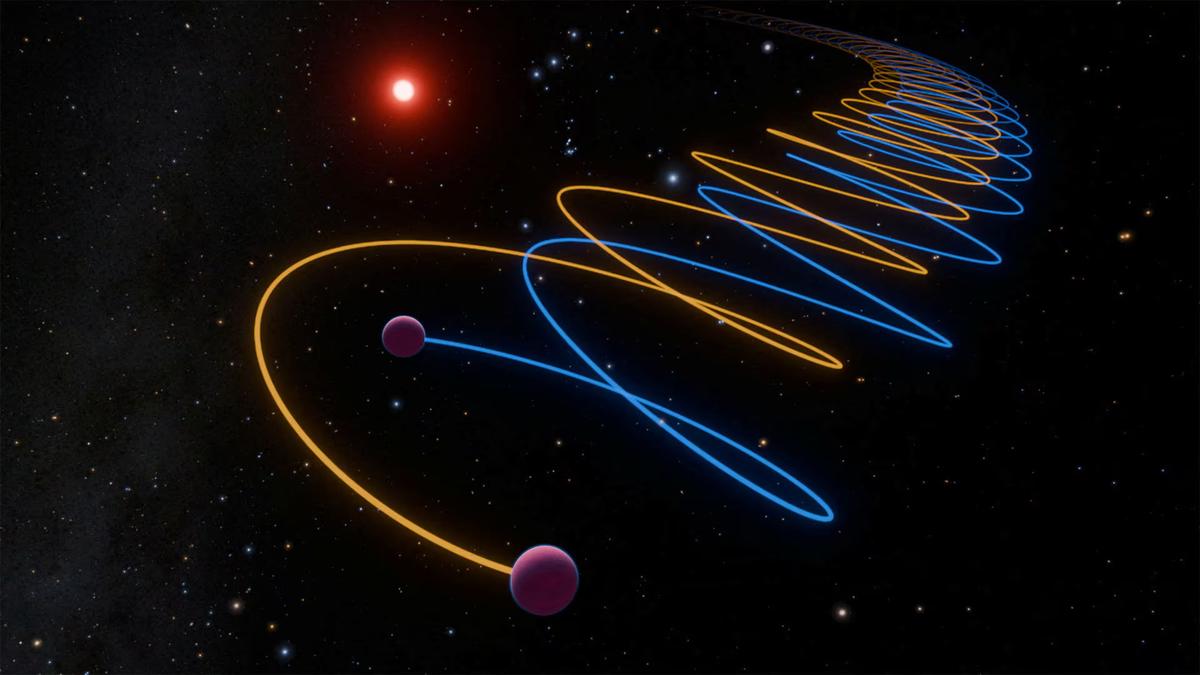
This artwork shows a pair of celestial objects called brown dwarfs, named Gliese 229Ba and Gliese 229Bb, located about 19 lightyears from our Solar System.
| Photo Credit: K. Miller, R. Hurt (Caltech/IPAC)/Reuters

In 1995, astronomers confirmed the discovery for the first time of a brown dwarf, a body too small to be a star and too big to be a planet – sort of a celestial tweener. But it turns out that was not the full story.

Researchers now have taken a fresh look at that brown dwarf and learned that it actually is not a single brown dwarf but rather two of them orbiting astonishingly close to each other while circling a small star. This was documented in two new studies using telescopes in Chile and Hawaii.

These two brown dwarfs are gravitationally locked to each other in what is called a binary system, an arrangement commonly observed among stars. So the brown dwarf that three decades ago was named Gliese 229B is now recognized as Gliese 229Ba, with a mass 38 times greater than our solar system’s largest planet Jupiter, and Gliese 229Bb, with a mass 34 greater than Jupiter.

They are located 19 light-years from our solar system – rather close in cosmic terms – in the constellation Lepus. A light year is the distance light travels in a year, 5.9 trillion miles (9.5 trillion km).

Binary brown dwarfs are a rarity. These two orbit each other every 12 days at a distance of only 16 times the separation between Earth and the moon. Only one other pair of brown dwarfs are known to orbit as close to each other as this twosome.

Brown dwarfs are neither a star nor a planet, but something in between. They could be considered wannabe stars that during their formative stages did not reach the mass necessary to ignite nuclear fusion at their core like a star. But they are more massive than the biggest planets.

“A brown dwarf is an object that fills the gap between a planet and a star. They are formally defined as objects that can burn a heavy form of hydrogen, called deuterium, but not the most common basic form of hydrogen,” said Sam Whitebook, a graduate student in Caltech’s division of physics, mathematics and astronomy and lead author of one of the studies, published in the Astrophysical Journal Letters.

“In practice, this means they range in mass from approximately 13 to 81 times the mass of Jupiter. Because they can’t fuse hydrogen, they can’t ignite the fusion channels that power most stars. This causes them to just glow dimly as they cool down,” Whitebook said.

The year 1995 was big for astronomers, with the discovery of the first planet beyond our solar system – an exoplanet – also being announced. Until Gliese 229B’s discovery, the existence of brown dwarfs had only been hypothesized. But there were anomalies about Gliese 229B, particularly after its mass was measured at about 71 times that of Jupiter.

“This didn’t make any sense since an object of that mass would be much brighter than Gliese 229B,” said Caltech astronomer Jerry Xuan, lead author of one of the studies, published in the journal Nature. “In fact, some models predict that objects with masses above 70 Jupiter masses fuse hydrogen and become stars, which was clearly not happening here.”

The new observations were able to discern two separate brown dwarfs. They orbit a common type of star called a red dwarf with a mass about six-tenths that of our sun. While both brown dwarfs are more massive than Jupiter, their diameter is actually smaller than the gas giant planet because they are more dense.

“We still don’t really know how different brown dwarfs form, and what the transition between a giant planet and a brown dwarf is. The boundary is fuzzy,” Xuan said. “This finding also shows us that brown dwarfs can come in weird configurations that we were not expecting. This goes to show how complex and messy the star formation process is. We should always be open to surprises.”

Published – October 19, 2024 05:47 pm IST



Source link

Science

Post navigation

Previous Post: 2 Paramilitary Soldiers Killed In Action In Chhattisgarh Maoist IED Attack
Next Post: “Going Abroad New Disease Among Children”: Vice President’s Lament

Related Posts

  • Scientists identify molten layer deep within interior of Mars
    Scientists identify molten layer deep within interior of Mars Science
  • UN holds emergency talks over sky-high costs for COP30 climate summit
    UN holds emergency talks over sky-high costs for COP30 climate summit Science
  • Japan successfully launches new cargo spacecraft to deliver supplies to ISS
    Japan successfully launches new cargo spacecraft to deliver supplies to ISS Science
  • Does 2022 H5N1 bind, replicate better in the respiratory tract?
    Does 2022 H5N1 bind, replicate better in the respiratory tract? Science
  • Indore tragedy: why do EV batteries catch fire? | Explained
    Indore tragedy: why do EV batteries catch fire? | Explained Science
  • If there’s a theory of AI, computer science is unlikely to provide it
    If there’s a theory of AI, computer science is unlikely to provide it Science

More Related Articles

Agnikul eyes to launch satellites by 2025: start-up CEO Ravichandran Agnikul eyes to launch satellites by 2025: start-up CEO Ravichandran Science
Traffic noise exposes kinks in India’s urban regulations Traffic noise exposes kinks in India’s urban regulations Science
The biology of belief, optimism, and good health The biology of belief, optimism, and good health Science
Hanle protects its dark skies and builds a future on stargazing Hanle protects its dark skies and builds a future on stargazing Science
How the next major breakthrough in cancer could come from India How the next major breakthrough in cancer could come from India Science
Panic in the time of cholera: addressing issues critical to managing a resurgence  Panic in the time of cholera: addressing issues critical to managing a resurgence  Science
SiteLock

Archives

  • May 2026
  • April 2026
  • March 2026
  • February 2026
  • January 2026
  • December 2025
  • November 2025
  • October 2025
  • September 2025
  • August 2025
  • July 2025
  • June 2025
  • May 2025
  • April 2025
  • March 2025
  • February 2025
  • January 2025
  • December 2024
  • November 2024
  • October 2024
  • September 2024
  • August 2024
  • July 2024
  • June 2024
  • May 2024
  • April 2024
  • March 2024
  • February 2024
  • January 2024
  • December 2023
  • November 2023
  • October 2023
  • September 2023
  • August 2023
  • July 2023
  • June 2023
  • May 2023
  • April 2023
  • March 2023
  • February 2023
  • January 2023
  • December 2022
  • November 2022
  • October 2022
  • September 2022
  • August 2022
  • July 2022
  • June 2022
  • May 2022

Categories

  • Business
  • Nation
  • Science
  • Sports
  • World

Recent Posts

  • BEST conductor dies in accident involving four buses in Mumbai
  • Nayar reckons KKR got a par total, rues missed chances
  • Pope Leo decries European military spending as ‘betrayal’ of diplomacy
  • Scent Of Rain, Shutterfly, Stud Poker and Starzella please
  • New factional battle lines emerge in Congress hours after nomination of Kerala CM

Recent Comments

  1. JamesHeR on UP Teacher Who Asked Students To Slap Muslim Classmate
  2. RafaelNar on UP Teacher Who Asked Students To Slap Muslim Classmate
  3. CarlosExorb on UP Teacher Who Asked Students To Slap Muslim Classmate
  4. Robertfloup on UP Teacher Who Asked Students To Slap Muslim Classmate
  5. Davidcag on UP Teacher Who Asked Students To Slap Muslim Classmate
  • Access Denied Sports
  • Access Denied Business
  • China Keen To Invest USD 1 Billion In Pakistan To Establish Medical City
    China Keen To Invest USD 1 Billion In Pakistan To Establish Medical City World
  • Access Denied
    Access Denied Nation
  • Giant Windbreaks, Outsized Fans And Patio Heaters: Here’s How Pakistan Aim To Beat England In 3rd Test
    Giant Windbreaks, Outsized Fans And Patio Heaters: Here’s How Pakistan Aim To Beat England In 3rd Test Sports
  • Access Denied World
  • Access Denied
    Access Denied Nation
  • S Jaishankar On India’s “Message” Against Terrorism After Uri And Balakot
    S Jaishankar On India’s “Message” Against Terrorism After Uri And Balakot Nation

Editor-in-Chief:
Mohammad Ariff,
MSW, MAJMC, BSW, DTL, CTS, CNM, CCR, CAL, RSL, ASOC.
editor@artifex.news

Associate Editors:
1. Zenellis R. Tuba,
zenelis@artifex.news
2. Haris Daniyel
daniyel@artifex.news

Photograher:
Rohan Das
rohan@artifex.news

Artifex.News offers Online Paid Internships to college students from India and Abroad. Interns will get a PRESS CARD and other online offers.
Send your CV (Subjectline: Paid Internship) to internship@artifex.news

Links:
Associate Journalism
About Us
Privacy Policy

News Links:
Breaking News
World
Nation
Sports
Business
Entertainment
Lifestyle

Registered Office:
72/A, Elliot Road, Kolkata - 700016
Tel: 033-22277777, 033-22172217
Email: office@artifex.news

Editorial Office / News Desk:
No. 13, Mezzanine Floor, Esplanade Metro Rail Station,
12 J. L. Nehru Road, Kolkata - 700069.
(Entry from Gate No. 5)
Tel: 033-46011099, 033-46046046
Email: editor@artifex.news

Copyright © 2023 Artifex.News Newsportal designed by Artifex Infotech.