



Astronomy is the oldest of the sciences. The sky is a free resource, and those who live away from city lights are fortunate to enjoy it for their passion, imagination, and even livelihoods. That’s the story of Hanle, a small Himalayan village that hosts one of the darkest skies in the world. Its Bortle-1 skies — the highest clarity rating on a nine-point scale — seem to say astronomy is for everyone.
Located in Ladakh, Hanle is now protected as India’s first dark sky reserve. It’s managed as part of a memorandum of understanding between the Indian Institute of Astrophysics (IIA) in Bengaluru, the Union Territory of Ladakh, and the Ladakh Hill Development Council in Leh. Once a region of nomadic people, Hanle is now emerging as a stargazing destination.
A dark sky reserve is a designated area with an exceptionally clear sky, and maintained that way by minimising light pollution. The Hanle Dark Sky Reserve, a unique government-funded and science-driven sustainable development initiative, is located within the Changthang Wildlife Sanctuary, surrounding the Indian Astronomical Observatory, a research facility operated by IIA.
The Observatory hosts two optical telescopes, the Himalayan Chandra Telescope and the GROWTH India Telescope (with IIT Bombay), and two Cherenkov telescopes — the High Altitude Gamma-Ray Telescope Array (with the Tata Institute of Fundamental Research) and the Major Atmospheric Cherenkov Experiment (with the Bhabha Atomic Research Centre).
“Countless clear sky nights, fewer atmospheric particles that absorb the celestial objects’ light, and low light pollution make Hanle an ideal location for astronomical observations,” Dorje Angchuk, the engineer-in-charge of the Observatory, said.
To minimise light pollution at the reserve, the IIA has distributed lamp shades, blackout curtains, and bulbs of warm tones to all homes and infrastructure in the village, Mr. Angchuk said. In support of astrotourism, IIA scientists have trained 25 local youth, 18 of whom are women, as “Astronomy Ambassadors”. These Ambassadors are equipped with telescopes and taught basic astronomy concepts. The night-sky tours they lead for visitors help them with a part-time income.
The star party
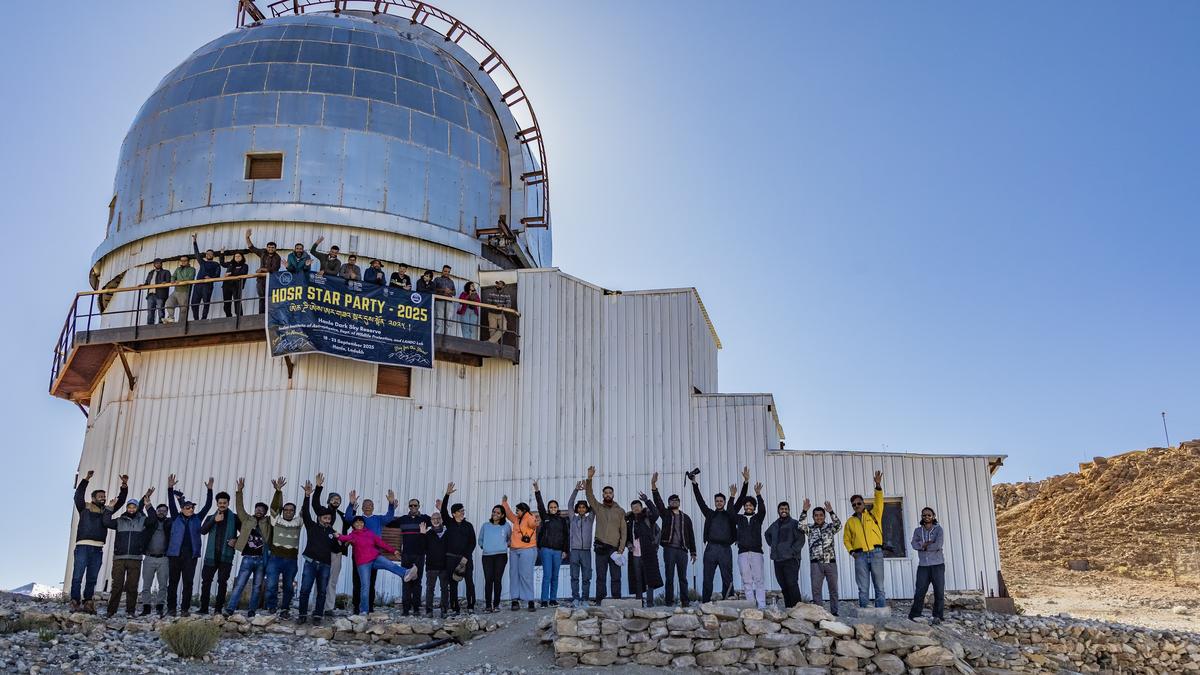
Since 2023, Hanle Dark Sky Reserve has been hosting an annual “star party” at this location. The third edition took place from September 18 to September 23 this year. At these parties, astronomy enthusiasts, astrophotographers, and stargazers together observe and celebrate the night sky. Their gathering creates space for astronomy education, hands-on learning, and collaboration.
Unlike conventional parties, a star party is a gathering held under dark skies, devoid of white light (or loud sounds for that matter), with the participants engaged in quiet observations.
Some 47 participants, including beginner as well as professional stargazers (and this author), gathered at this year’s party. The early evenings featured tutorials and lectures on the best ways to make use of the clear, dark skies, while the nights were spent viewing and capturing images of the heavens. The team was supported by volunteers from the Bangalore Astronomical Society and repeat participants.
“The skies in Hanle are so pristine that you can observe many elusive and exclusive phenomena not seen anywhere else,” Ajay Talwar, an amateur astronomer and telescope maker who runs a company called Aperture Telescope in Gurugram, said.
These phenomena include zodiacal light, a faint glow that appears during the twilight hours along the Sun’s path in the sky, caused by sunlight scattering off dust particles in the inner Solar System, and which he said “can only be viewed from Hanle”.
Mr. Talwar has been an astrophotographer since 1987. During the orientation programme for the star party, he spoke to the participants about other similar astronomical phenomena and the best times for viewing them. For example, the gegenschein, he said, is a luminous patch in the sky found opposite the sun’s position, a.k.a. the antisolar point. The Belt of Venus is likewise a pink band of light visible in the evening sky, above a dark blue band, in the direction opposite to that of the setting sun. The dark blue band is the earth’s shadow and the pink band is backscattered sunlight.
“Clear skies and dry weather and the time I get to spend with the sky brings me back here every year,” Neelam Talwar, an Air India crew member and a member of the Amateur Astronomers Association of New Delhi, said at the event.
Ms. Talwar expressed a particular fondness for capturing images of the Belt of Venus and the zodiacal light. She also shared accounts of last year’s events, where participants learned to capture people in the dark against a starry background by illuminating their subjects from different angles.
Hanle has low oxygen, low humidity, and high ultraviolet radiation — all factors considered very suitable for astronomy, according to Mr. Talwar. However, he added, they are very bad for the human body.
“So, it is very important to come here with a lot of planning and rest.”
Indeed, the IIA advised the star party’s attendees to arrive in Leh two days before the journey to Hanle so we could acclimatise ourselves to the low oxygen levels and dry air. A medical professional set out the potential health problems at high altitudes, and each had to complete a medical check-up before commencing the journey. At Hanle itself, which is located 4,250 m above sea level, there were nightly medical checks and volunteers to help.
Participants registered via an application form that the IIA opens for the star party around August. They were selected based on their experience, passion for astronomy, and their plans for utilising Hanle’s pristine skies.

Life around stars
Rangdol Dorje, an Astronomy Ambassador since 2022, said the local economy is thriving thanks to an influx of tourists to Hanle to look at the stars. According to Mr. Angchuk, the reserve had around 10,000 visitors in 2024.
Mr. Dorje also said visitors often ask if they can see the stars at night as they enter the village and that many are particularly interested in viewing planets and the moon through telescopes. Mr. Dorje studied computer science but said he found it easy to learn astronomical concepts, adding that “astronomy is for everyone”.
“Truly speaking, I’m really fortunate to be born in … Hanle,” Tsering Skitzom, a newly appointed Astronomy Ambassador with a background in accounting, said.
She added that sharing their natural surroundings and astronomy experiences with others outside Hanle is important.
“I think practical is more important than theoretical. We are doing practical learning through telescopes, with the help of the senior ambassadors,” Ms. Skitzom added.
There are fewer tourists in the winter because of the cold; at this time the Astronomy Ambassadors tutor the local schoolgoing children.
“I teach alternative learning courses on astronomy and culture as a pedagogical approach,” Padma Ishey, an Astronomy Ambassador, said. (The alternative approach refers to teaching topics that aren’t covered in schools). He added that young students will do better research if they learn about their own culture well.
Mr. Ishey and Anmol Tikoo, an educator and filmmaker, have been working on preserving local traditional knowledge of the night sky by collecting stories, proverbs, and folk songs from elders in Hanle and the surrounding area. Many participants said their presentation at the star party was eye-opening.
Come for the mountains
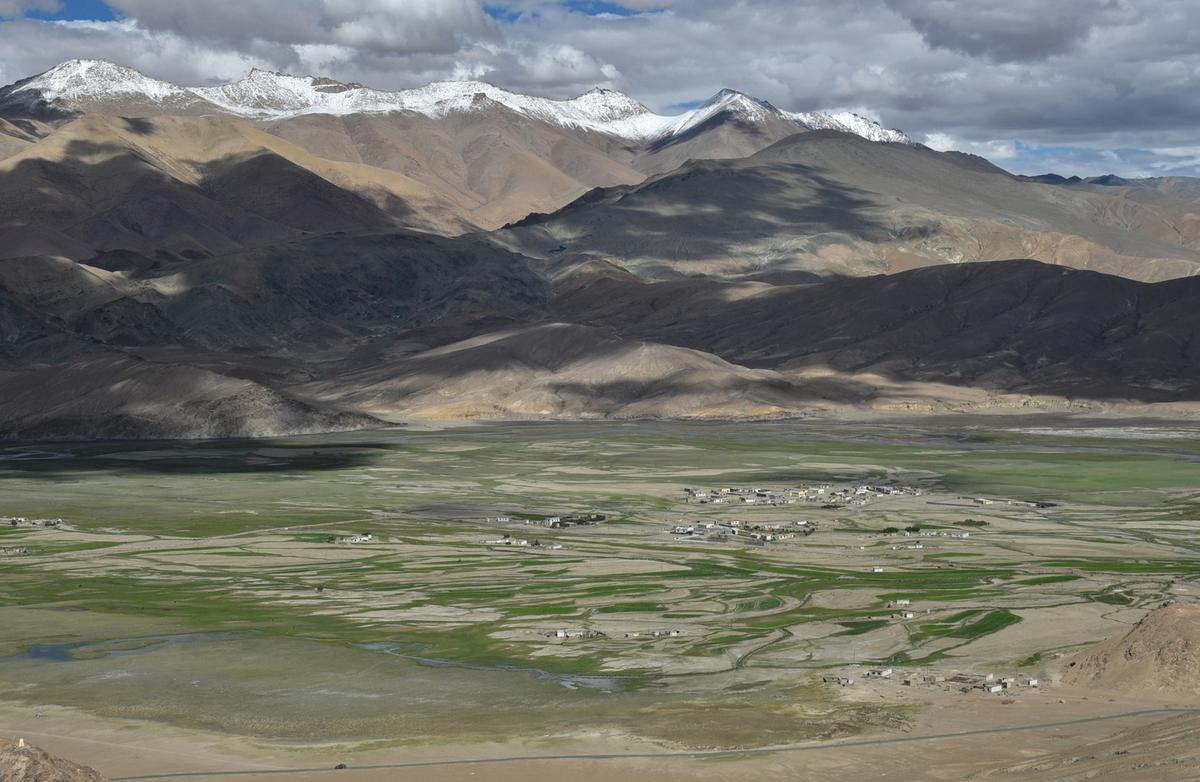
Hanle village and the Indus Rriver in Changthang.
| Photo Credit:
Ashish Kothari/KSL
Namratha Pathak, a scientist in the Department of Science and Technology of the Government of India, stressed the importance of the connection between science, nature, habitat, and Indigenous knowledge and urged their joint conservation. She also called her own star party experience “spectacular” and “breathtaking”, and said she would treasure seeing the Milky Way.
Khursheed Alam, a senior lecturer from Jammu and Kashmir, said he plans to share what he learnt with his students. “I learnt about different types of telescopes, especially the automated ones. One of the most interesting things I learnt was how to take astrophotographs using my phone.”

Rashmi Sheoran, an astronomy educator from Haryana who was attending the star party for the first time, said she used to believe that the images of the universe available on the internet were qualitatively superior to those seen through a telescope. Her time at the party changed her mind: “After seeing the planets with my own eyes, I found the view to be as good as or even better than pictures I had seen before,” she remarked.
Muneer Wani, a teacher and divisional nodal officer for STEM and Akaash labs in Jammu & Kashmir, said he’d encourage people interested in space science and astronomy to explore careers beyond the traditional engineering and medicine. At the party, Mr. Wani said he was able to improve his own astrophotography skills with help from Mr. Talwar, and succeeded in capturing high-quality images of the Milky Way and the Andromeda galaxy.
On the party’s last night, the participants welcomed tourists and locals to together explore the sky with telescopes. This open event involved nearly 300 people, including soldiers from the Indian Army and officers stationed nearby.
“To boost astro-tourism, we are building a mini-planetarium at [the reserve]. We also plan to build a transparent dome called the ‘Astroglobe’ to benefit tourists and stargazers during the harsh winter season,” Mr. Angchuk said.
With the motto “come for the mountains, stay for the stars”, the Hanle Dark Sky Reserve is showing how the Himalayan skies are being preserved today and will be carried forward for future generations, while also lending a helping hand to the local economy.
Shreejaya Karantha is a freelance science writer.