



Skip to content
  • Facebook
  • X
  • Linkedin
  • WhatsApp
  • Associate Journalism
  • About Us
  • Privacy Policy
  • 033-46046046
  • editor@artifex.news
Artifex.News

Artifex.News

Stay Connected. Stay Informed.

  • Breaking News
  • World
  • Nation
  • Sports
  • Business
  • Science
  • Entertainment
  • Lifestyle
  • Toggle search form
  • Three budding hockey players struck dead by lightning in Jharkhand Sports
  • Sensex, Nifty rise on firm global market trends Business
  • Rupee falls 11 paise to 83.45 against U.S. dollar Business
  • Rupee trades in narrow range against U.S. dollar in early trade Business
  • US To Send Indian Astronaut To International Space Station By Year-End: Envoy Eric Garcetti Nation
  • IPL-17: Chennai Super Kings face the heat in a crucial contest against Rajasthan Royals Sports
  • Harvinder Singh, Preethi Pal To Be India’s Flag-Bearers For Paralympics Closing Ceremony Sports
  • Similar Questions Set For Various Posts In Bengal Municipal Jobs Case: Report Nation

How skuas, frigatebirds, and gulls are helping spread avian influenza

Posted on September 17, 2024 By admin


It’s not easy finding food at sea. Seabirds often stay aloft, scanning the churning waters for elusive prey. Most seabirds take fish, squid, or other prey from the first few metres of seawater. Scavenging is common.

But there are other tactics. Frigatebirds, skuas, and gulls rely on the success of other seabirds. These large, strong birds chase, harry, and attack their targets until they regurgitate or drop the prey they’ve just caught. They’re the pirates of the seabird world, stealing hard-earned meals from other species. This behaviour is known as kleptoparasitism, from the Ancient Greek word kléptēs, thief.

The strategy is brutal, effective, and a core behaviour for these important seabirds. But as our new research shows, it comes with major risks for the thieves. The new strain of avian flu is killing birds by their millions – and we found kleptoparasitism could spread the virus very easily.

Food thieves at sea

It’s not that frigatebirds, skuas, and gulls can’t hunt. They can and do catch their own food. But hunting fish and squid is hard work. It’s much easier to use extortion tactics to win the food from other seabirds.

These tactics have made these birds very successful as foragers. They hang around the breeding sites of birds such as gannets and terns waiting for a tired parent to return from the sea with a crop of food.

For the seabirds being targeted, these kleptoparasitic birds are just one more threat. The world’s 362 species of seabird can be found across every ocean and many islands. At sea, they prey on fish and squid. When they nest or rest on islands, their nutrient-rich guano shapes soil and plant communities, defining entire ecosystems.

But they are not doing well. Just under half of all seabird species (155) are now classified between “near threatened” and “critically endangered” on the world’s list of threatened species, the IUCN Red List. Of those with known trends, 56% have populations in decline.

The threats they face are daunting. Invasive predators such as mice and rats eat eggs or chicks on breeding islands. Many are caught by fishing boats as accidental bycatch, while overfishing depletes their prey. Then there’s climate change, habitat loss, and many other threats, including disease.

Seabirds are generally long-lived. They often raise only one chick every one or two years. Many species breed in only a few locations. They take many years to mature. Put together, these traits make recovery from population declines slow.

Of parasites and viruses

Three years ago, a more lethal strain of avian influenza virus emerged. This HPAI H5N1 2.3.4.4b strain has spread around the world, killing at least 280 million wild birds. The strain can also infect and kill marine mammals such as seals.

“HPAI” stands for Highly Pathogenic Avian Influenza, meaning the virus can more readily cause severe disease and death. The strain has become an animal pandemic (formally, a panzootic). It’s made it to Antarctica, but not yet to Australia or the rest of Oceania.

We know seabirds are particularly at risk. Our new research has shown kleptoparasites are at an even higher risk relative to other seabirds.

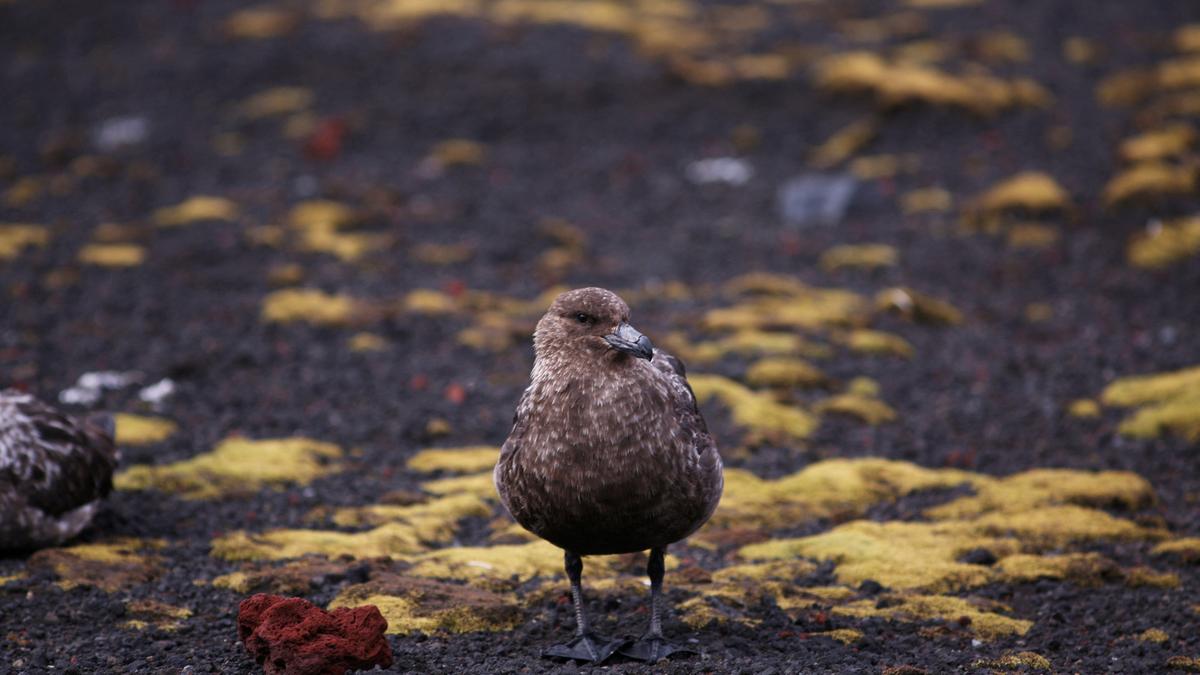
During the 2022 northern hemisphere summer, the virus killed roughly half of the world’s great skua (Stercorarius skua).

Food-stealing behaviour can enable the virus to spread. When a great skua harasses a gannet and makes it regurgitate food, the skua gets a fish meal – coated in saliva. If the gannet is infectious, its saliva will likely have a high viral load.

Once infected, these pirate birds can drive spread faster. Skuas, frigatebirds and gulls can cover great distances across polar regions and the tropics. They can transmit the disease to their mates, chicks, and other seabirds.

This means we could see outbreaks in new populations or places, hundreds or even thousands of kilometres apart. We have already seen signs of this in skua populations in the northern and southern hemispheres, with brown (Stercorarius antarcticus) and great skuas being some of the first detected H5N1 infections at new locations.

Skuas more often steal food from other seabirds when away from their breeding sites – including when they’re migrating back to these areas. If skuas get infected en route, they could bring the disease to their breeding sites and then beyond.

Frigatebirds are known for the red pouches on the necks of the males, which they inflate during breeding season. But they have other remarkable traits, such as travelling tens of thousands of kilometres across oceans outside breeding season. These travels are often broken up by “island-hopping”, where they will encounter and potentially infect other seabirds.

Frigatebirds and skuas have already suffered mass deaths from this strain of avian influenza.

While the virus is now almost everywhere, it hasn’t reached Australia, New Zealand, Oceania, and parts of Antarctica and the subantarctic. We can monitor skuas, frigatebirds and gulls for signs of illness to give us early warning that the virus has arrived.

By itself, avian influenza is a major threat to seabirds. But the outlook is even more dire when this is compounded with further human-caused threats. Identifying, managing, and reducing these threats is critical for their conservation, and the health of our islands and oceans.

This article is republished from The Conversation under a Creative Commons license. Read the original article.

Published – September 17, 2024 01:25 pm IST



Source link

Science Tags:Avian Influenza, Environment news, kleptoparasites birds, science news, seabirds, seabirds that steal other birds’ food

Post navigation

Previous Post: Wholesale Inflation Falls For Second Month In A Row To 1.31% In August
Next Post: How The Internet Went From Being Fun To Frustrating

Related Posts

  • Particles called quarks hold the key to the final fate of some stars Science
  • Buzzing breakthrough: genetic engineering gives mosquito control an upgrade Science
  • Nobel laureate supports India’s pursuit for a neutrino lab Science
  • IISc research uncovers link between cell biomechanics and wound healing Science
  • World breached 1.5° Celsius limit for entire year for first time: European climate agency Science
  • Study finds gene mutation that turns familiar faces into strangers Science

More Related Articles

‘Our world is built on basic science, and part of basic science is rationality’   Science
New Zealand to loosen gene editing regulation, make commercialisation easier Science
India set to transition to hyperlocal extreme weather forecasting Science
Ian Wilmut, a British scientist who led the team that cloned Dolly the Sheep, dies at age 79 Science
Why do medium-sized land animals like cheetahs tend to be fastest? Science
‘Green-beard’ genes could explain how altruism arose in nature Science
SiteLock

Archives

  • September 2024
  • August 2024
  • July 2024
  • June 2024
  • May 2024
  • April 2024
  • March 2024
  • February 2024
  • January 2024
  • December 2023
  • November 2023
  • October 2023
  • September 2023
  • August 2023
  • July 2023
  • June 2023
  • May 2023
  • April 2023
  • March 2023
  • February 2023
  • January 2023
  • December 2022
  • November 2022
  • October 2022
  • September 2022
  • August 2022
  • July 2022
  • June 2022
  • May 2022

Categories

  • Business
  • Nation
  • Science
  • Sports
  • World

Recent Posts

  • Virat Kohli Disappoints On Home Test Return; Rohit Sharma’s Reaction Says It All – Watch
  • U.S. lawmakers express outrage over vandalism of temple in New York
  • PM Modi in Srinagar LIVE: Security tightened ahead of Modi’s Jammu and Kashmir election rally
  • Sensex, Nifty scale fresh peaks after U.S. Federal Reserve’s rate cut
  • IL&FS firm NTBCL gets tax demand relief of ₹21,000 crore from ITAT

Recent Comments

  1. TpeEoPQa on UP Teacher Who Asked Students To Slap Muslim Classmate
  2. xULDsgPuBe on UP Teacher Who Asked Students To Slap Muslim Classmate
  3. KyJtkhneiLmcq on UP Teacher Who Asked Students To Slap Muslim Classmate
  4. mOyehudovB on UP Teacher Who Asked Students To Slap Muslim Classmate
  5. GFBvgSrWPcsp on UP Teacher Who Asked Students To Slap Muslim Classmate
  • Kufos succeeds in captive breeding of threatened Indian ornamental fish Science
  • As Michael Vaughan Asks For DRS Transparency, Hawk-Eye Founder Slams “Uneducated” Opinion Sports
  • Centre raises paddy MSP by ₹117 to ₹2,300 per quintal for 2024-25 Business
  • PM Modi In Austria, Community Event, Meeting With CEOs Planned Nation
  • China’s Weibo CEO Tests New Real-Name Policy On His Own Account World
  • FIDE Candidates Chess Tournament: R Praggnanandhaa Enters As India’s Best Bet Sports
  • New British Sikh MP wants to strengthen Labour’s India connection World
  • After Sharad Pawar’s ‘Smaller Parties’ Remark, Uddhav Thackeray’s Counter Nation

Editor-in-Chief:
Mohammad Ariff,
MSW, MAJMC, BSW, DTL, CTS, CNM, CCR, CAL, RSL, ASOC.
editor@artifex.news

Associate Editors:
1. Zenellis R. Tuba,
zenelis@artifex.news
2. Haris Daniyel
daniyel@artifex.news

Photograher:
Rohan Das
rohan@artifex.news

Artifex.News offers Online Paid Internships to college students from India and Abroad. Interns will get a PRESS CARD and other online offers.
Send your CV (Subjectline: Paid Internship) to internship@artifex.news

Links:
Associate Journalism
About Us
Privacy Policy

News Links:
Breaking News
World
Nation
Sports
Business
Entertainment
Lifestyle

Registered Office:
72/A, Elliot Road, Kolkata - 700016
Tel: 033-22277777, 033-22172217
Email: office@artifex.news

Editorial Office / News Desk:
No. 13, Mezzanine Floor, Esplanade Metro Rail Station,
12 J. L. Nehru Road, Kolkata - 700069.
(Entry from Gate No. 5)
Tel: 033-46011099, 033-46046046
Email: editor@artifex.news

Copyright © 2023 Artifex.News Newsportal designed by Artifex Infotech.