

Skip to content
  • Facebook
  • X
  • Linkedin
  • WhatsApp
  • YouTube
  • Associate Journalism
  • About Us
  • Privacy Policy
  • 033-46046046
  • editor@artifex.news
Artifex.News

Artifex.News

Stay Connected. Stay Informed.

  • Breaking News
  • World
  • Nation
  • Sports
  • Business
  • Science
  • Entertainment
  • Lifestyle
  • Toggle search form
  • Saudi Arabia Expresses “Solidarity” With Germany After Market Attack
    Saudi Arabia Expresses “Solidarity” With Germany After Market Attack World
  • Access Denied World
  • S Jaishankar Meets Maldives President Mohamed Muizzu To Deepen Ties
    S Jaishankar Meets Maldives President Mohamed Muizzu To Deepen Ties Nation
  • Guatemala passes anti-gang law, declares gangs terrorist groups
    Guatemala passes anti-gang law, declares gangs terrorist groups World
  • Access Denied
    Access Denied Nation
  • Is there an emerging threat of drug-resistant fungal infections? The jock itch case study
    Is there an emerging threat of drug-resistant fungal infections? The jock itch case study Science
  • Southeast Asian foreign ministers seek breakthrough in Myanmar conflict and South China Sea disputes
    Southeast Asian foreign ministers seek breakthrough in Myanmar conflict and South China Sea disputes World
  • Netanyahu Warns Hezbollah After Air Strike Kills 11
    Netanyahu Warns Hezbollah After Air Strike Kills 11 World
India set to transition to hyperlocal extreme weather forecasting

India set to transition to hyperlocal extreme weather forecasting

Posted on February 10, 2024 By admin


Weather forecasting plays a pivotal role in the country’s functioning. Accurately predicting rain, cyclones, heatwaves and drought are critical to inform decision making on disaster management. In India the Indian Meteorology Department (IMD) is the principal government agency in all matters relating to meteorology and it specialises in the incredibly complex science of predicting weather patterns by observing, modelling and interpreting a multitude of variables.

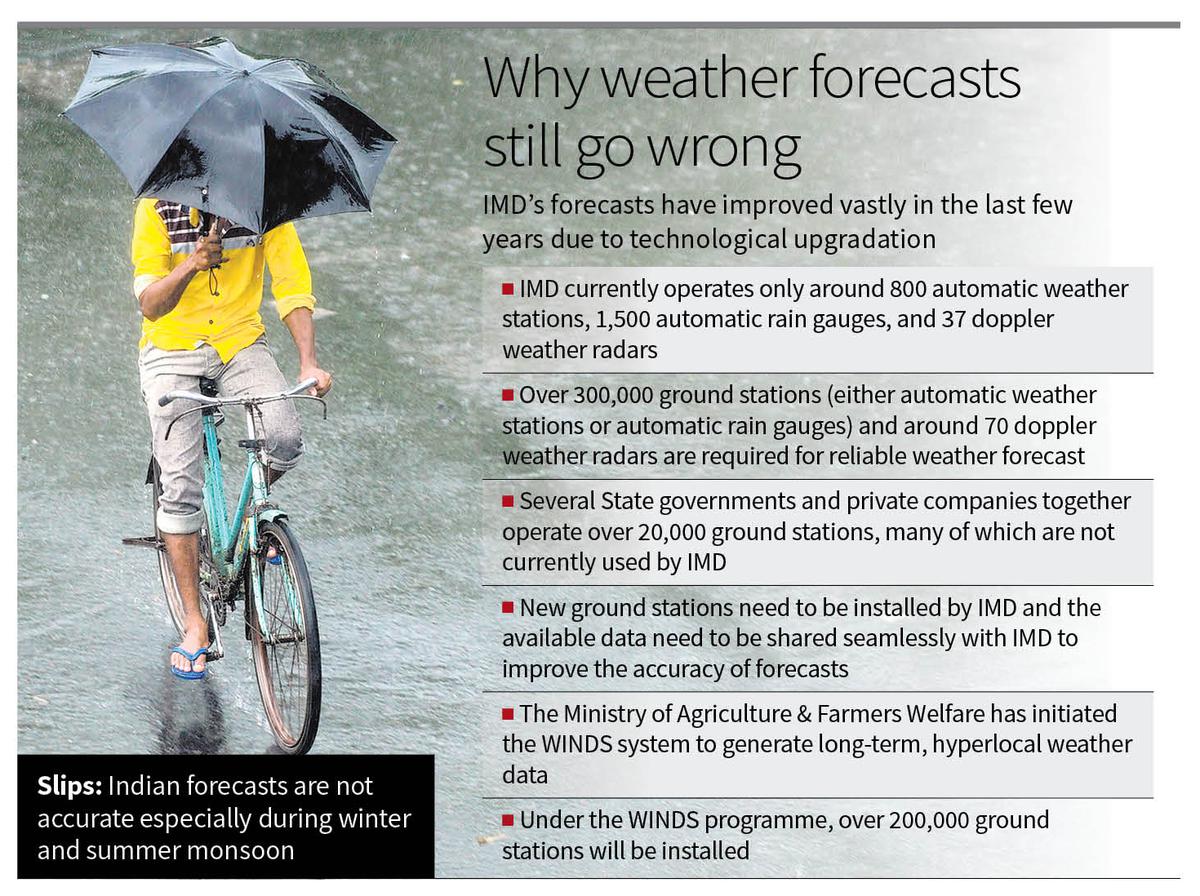
However, in tropical countries like India, weather variability is inherently higher. IMD’s forecasts have improved vastly in the last few years as it has upgraded to technologies similar to the ones used by the U.S., the U.K. and Japan, which are known to produce accurate forecasts. Yet, there are still many days and geographies for which Indian forecasts go wrong, especially during winter and summer monsoon.

One of the major hurdles is the lack of weather monitoring ground stations. Currently, IMD operates around 800 automatic weather stations (AWS), 1,500 automatic rain gauges (ARG) and 37 doppler weather radars (DWR). This is against the total requirements of more than 3,00,000 ground stations (AWS/ARG) and around 70 DWRs. It’s interesting to note that several Indian State governments and private companies operate a significant network of ground stations (more than 20,000), many of which are not currently used by IMD. The factors range from the inaccessibility of the data to their reliability.

Currently, most of the prediction software used in forecasting are based on the global forecasting system and weather research and forecasting models, both of which are not the most modern. In contrast, with the government’s focus on Make in India, its support to start-ups and the huge public and private investments in the sectors of agriculture and climate, many new age companies are switching to artificial intelligence/machine (AI/ML) learning for more predictions. At the same time though, these technologies are only as good and verifiable as the data they can access. Thus there is an urgent need for an integrated system to fill these data gaps. New ground stations will have to be installed and the available data have to be shared seamlessly.

A promising step forward was that recently, the Department of Agriculture & Farmers Welfare and the Ministry of Agriculture & Farmers Welfare have initiated the weather information network and data system (WINDS) to generate long-term, hyper-local weather data. The system will also promote the data for wider applications in agriculture and other sectors, it will help in creating a national-level data base, and it will assist in establishing the protocols required to access the country-wide data by the various public and private concerns. Under this programme, more than 200,000 ground stations (AWS and ARG) will be installed, which can help tremendously in enhancing weather data utilisation and thus in improving weather predictions and decision making.

Meanwhile, air pollution continues to be a challenge. In the last month large dense fog blanketed the NCR region, leading to near-zero visibility. This happens mainly because of the high particulate matter and smog in the atmosphere. Fog can trap the pollutants close to the ground, leading to an increase in respiratory and other health-related issues. Another cause for worry is that in foggy conditions, some pollutants like nitrogen  oxides  can  react  with  other  compounds  to  form  secondary pollutants, thus posing severe health risks, particularly to children and the elderly.

Air quality monitoring systems are currently very expensive and tend to be imported. Thanks to the Make in India initiatives, however, many Indian companies have started to manufacture low-cost and highly reliable sensor-based air quality monitoring systems. These are also easy to install and have low maintenance costs. Thus, it is now possible to install a large number of such instruments quickly, especially in the urban areas. The IITs are helping as well as they have started centres of excellence in this domain, with a mission to establish a nation-wide network of affordable air quality sensors. An integrated AI/ML-based model with data from the new air quality and weather sensors will be a major step forward to accurately predict fog as it will help in timely decision making around transportation and the health-related impacts of air pollution.

With the recent advances India is therefore poised towards establishing a world class, robust air quality and weather information network. What will bring everything together is a time-bound, inclusive approach by the various stakeholders to create this most important of national infrastructures. Once seamless data sharing and systems integration is achieved, India will have access to a new information gateway and one that is critical to addressing our climate and environmental challenges.

(Sachchida Nand Tripathi is Professor, Department of Civil Engineering, IIT Kanpur, and Ashish Agarwal is Founder & Chief Technology Officer, Ingen Technologies)



Source link

Science Tags:Disaster management, Weather forecasting, Weather forecasting in India, Weather information network

Post navigation

Previous Post: Probability of survival decreases with increased duration of CPR
Next Post: What likely caused the extreme ice-age more than 700 million years ago?

Related Posts

  • Innovators come together in Bengaluru to find ways to ensure access to effective antibiotics 
    Innovators come together in Bengaluru to find ways to ensure access to effective antibiotics  Science
  • What are ‘Bharat Small Reactors’ and small modular reactors?
    What are ‘Bharat Small Reactors’ and small modular reactors? Science
  • When welfare met demographic concerns
    When welfare met demographic concerns Science
  • How OpenAI’s ChatGPT helped scientists crack a tedious physics problem
    How OpenAI’s ChatGPT helped scientists crack a tedious physics problem Science
  • Food systems largest violators of planetary limits: 2025 EAT-Lancet Commission
    Food systems largest violators of planetary limits: 2025 EAT-Lancet Commission Science
  • One-third of TB patients received no payment for nutrition support
    One-third of TB patients received no payment for nutrition support Science

More Related Articles

Govt. approves four semiconductor plants in Odisha, Punjab, Andhra Pradesh Govt. approves four semiconductor plants in Odisha, Punjab, Andhra Pradesh Science
Mumbai-led team helps reveal mysterious twin rings around galaxy Mumbai-led team helps reveal mysterious twin rings around galaxy Science
Why countries struggle to eliminate fossil fuel subsidies | Explained Why countries struggle to eliminate fossil fuel subsidies | Explained Science
India launches NASA-ISRO earth observation satellite  India launches NASA-ISRO earth observation satellite  Science
New state of matter is a solid-liquid hybrid New state of matter is a solid-liquid hybrid Science
What are retractions and why do they matter? | Explained What are retractions and why do they matter? | Explained Science
SiteLock

Archives

  • May 2026
  • April 2026
  • March 2026
  • February 2026
  • January 2026
  • December 2025
  • November 2025
  • October 2025
  • September 2025
  • August 2025
  • July 2025
  • June 2025
  • May 2025
  • April 2025
  • March 2025
  • February 2025
  • January 2025
  • December 2024
  • November 2024
  • October 2024
  • September 2024
  • August 2024
  • July 2024
  • June 2024
  • May 2024
  • April 2024
  • March 2024
  • February 2024
  • January 2024
  • December 2023
  • November 2023
  • October 2023
  • September 2023
  • August 2023
  • July 2023
  • June 2023
  • May 2023
  • April 2023
  • March 2023
  • February 2023
  • January 2023
  • December 2022
  • November 2022
  • October 2022
  • September 2022
  • August 2022
  • July 2022
  • June 2022
  • May 2022

Categories

  • Business
  • Nation
  • Science
  • Sports
  • World

Recent Posts

  • Visakhapatnam Collector calls for inter-departmental synergy to boost investments
  • Kohli’s masterful knock powers Royal Challengers to the top
  • Vijay Narayan earns rare distinction of being Advocate General under two different governments
  • Learn from Sri Lanka’s experience on impact of fertilizer supply chains: experts
  • Sewage pollution of Cooum, groundwater depletion raise alarm

Recent Comments

  1. Leonardren on UP Teacher Who Asked Students To Slap Muslim Classmate
  2. NathanQuins on UP Teacher Who Asked Students To Slap Muslim Classmate
  3. Davidgof on UP Teacher Who Asked Students To Slap Muslim Classmate
  4. NathanJobre on UP Teacher Who Asked Students To Slap Muslim Classmate
  5. Davidcag on UP Teacher Who Asked Students To Slap Muslim Classmate
  • Karnataka High Court bars ICTPI from enrolling candidates
    Karnataka High Court bars ICTPI from enrolling candidates Nation
  • Nasrallah’s body found: source close to Hezbollah
    Nasrallah’s body found: source close to Hezbollah World
  • 15 Injured As ‘Drunk’ Man Goes On Rampage In SUV In Assam, Bad Road Stops Him
    15 Injured As ‘Drunk’ Man Goes On Rampage In SUV In Assam, Bad Road Stops Him Nation
  • Access Denied Business
  • World Championships Highlights: Neeraj Chopra Wins Historic Gold, Relay Team Finishes 5th
    World Championships Highlights: Neeraj Chopra Wins Historic Gold, Relay Team Finishes 5th Sports
  • Access Denied World
  • Access Denied Business
  • Access Denied World

Editor-in-Chief:
Mohammad Ariff,
MSW, MAJMC, BSW, DTL, CTS, CNM, CCR, CAL, RSL, ASOC.
editor@artifex.news

Associate Editors:
1. Zenellis R. Tuba,
zenelis@artifex.news
2. Haris Daniyel
daniyel@artifex.news

Photograher:
Rohan Das
rohan@artifex.news

Artifex.News offers Online Paid Internships to college students from India and Abroad. Interns will get a PRESS CARD and other online offers.
Send your CV (Subjectline: Paid Internship) to internship@artifex.news

Links:
Associate Journalism
About Us
Privacy Policy

News Links:
Breaking News
World
Nation
Sports
Business
Entertainment
Lifestyle

Registered Office:
72/A, Elliot Road, Kolkata - 700016
Tel: 033-22277777, 033-22172217
Email: office@artifex.news

Editorial Office / News Desk:
No. 13, Mezzanine Floor, Esplanade Metro Rail Station,
12 J. L. Nehru Road, Kolkata - 700069.
(Entry from Gate No. 5)
Tel: 033-46011099, 033-46046046
Email: editor@artifex.news

Copyright © 2023 Artifex.News Newsportal designed by Artifex Infotech.