




Skip to content
  • Facebook
  • X
  • Linkedin
  • WhatsApp
  • YouTube
  • Associate Journalism
  • About Us
  • Privacy Policy
  • 033-46046046
  • editor@artifex.news
Artifex.News

Artifex.News

Stay Connected. Stay Informed.

  • Breaking News
  • World
  • Nation
  • Sports
  • Business
  • Science
  • Entertainment
  • Lifestyle
  • Toggle search form
  • Probe Agency Goes To Top Court Challenging Hemant Soren’s Bail In Land Scam Case
    Probe Agency Goes To Top Court Challenging Hemant Soren’s Bail In Land Scam Case Nation
  • Asia Cup 2023 | India’s top-order keen to decode the Shaheen Afridi riddle
    Asia Cup 2023 | India’s top-order keen to decode the Shaheen Afridi riddle Sports
  • Kalpakkam fast breeder reactor attains criticality
    Kalpakkam fast breeder reactor attains criticality Science
  • Markets settle higher on buying in bank, auto stocks
    Markets settle higher on buying in bank, auto stocks Business
  • Access Denied
    Access Denied Nation
  • Tom Latham Looking Forward To Challenge Of Beating ‘Well-Rounded’ India
    Tom Latham Looking Forward To Challenge Of Beating ‘Well-Rounded’ India Sports
  • Rescue efforts on as rain and storms kill 20 in Brazil
    Rescue efforts on as rain and storms kill 20 in Brazil World
  • Access Denied
    Access Denied Nation
Buzzing breakthrough: genetic engineering gives mosquito control an upgrade

Buzzing breakthrough: genetic engineering gives mosquito control an upgrade

Posted on September 10, 2023 By admin


A mosquito hangs from a leaf, Bengaluru, October 28, 2019.
| Photo Credit: Syed Ali/Unsplash

Throughout human history, mosquitoes have constantly buzzed in the background of human existence, irritating us with their incessant bites and occasionally wreaking havoc by transmitting deadly diseases. The earliest known mosquitoes from the fossil record date back at least 70 million years, and evidence of mosquito-borne diseases like malaria dates back to Egyptian mummies from 2000 BC.

Apart from malaria, which claims the lives of over half a million people every year and infects close to 250 million, mosquitoes serve as vectors for various other diseases. These include dengue, Zika, lymphatic filariasis, and yellow fever. Understandably, our relationship with these tiny, blood-sucking insects has been far from cordial.

Help from sequencing tech

The rapid urbanisation of the world’s populations, especially in many large and economically developing countries like India, has led to annual surges in mosquito-borne illnesses like dengue. Together with climate change and its cascading consequences, mosquito-borne diseases have expanded into new territories. A notable example is the indigenous cases of dengue in France in recent years.

It is not surprising then that mosquito control has taken centrestage today and the battle continues unrelenting with an array of tools – from mosquito nets to insecticides and the use of symbionts like Wolbachia. But with insecticide resistance in mosquitoes rising to alarming proportions, it has become imperative that newer approaches to mosquito control gain prominence, even despite the availability of a first-generation malaria vaccine that officials in different countries are currently implementing in a pilot in endemic regions.

In the last two decades, our ability to read or sequence the genomes of organisms, and edit and manipulate these genomes, has given us new tools in this fight. Thanks to advancements in next-generation sequencing techniques, we now have access to the whole genome sequences of multiple mosquito species. Notably, researchers from the University of California, the Tata Institute of Genetics and Society, and the Institute of Bioinformatics and Applied Biotechnology have helped prepare high-quality reference genomes for Anopheles stephensi, a major malaria-vector mosquito. (The two latter institutes are based in Bengaluru.)

The availability of these high-quality sequences, coupled with our capacity to genetically manipulate them, offers unprecedented opportunities.

The gene drive

The fundamental idea behind genetic manipulation of mosquitoes is to systematically control their populations by interfering with their reproduction. Scientists worldwide have developed various genetic modification approaches. A major one in this endeavour is gene-drive technology, whose end result is for mosquitoes to selectively inherit some genes, rather than the inheritance to follow the rules of Mendelian genetics.
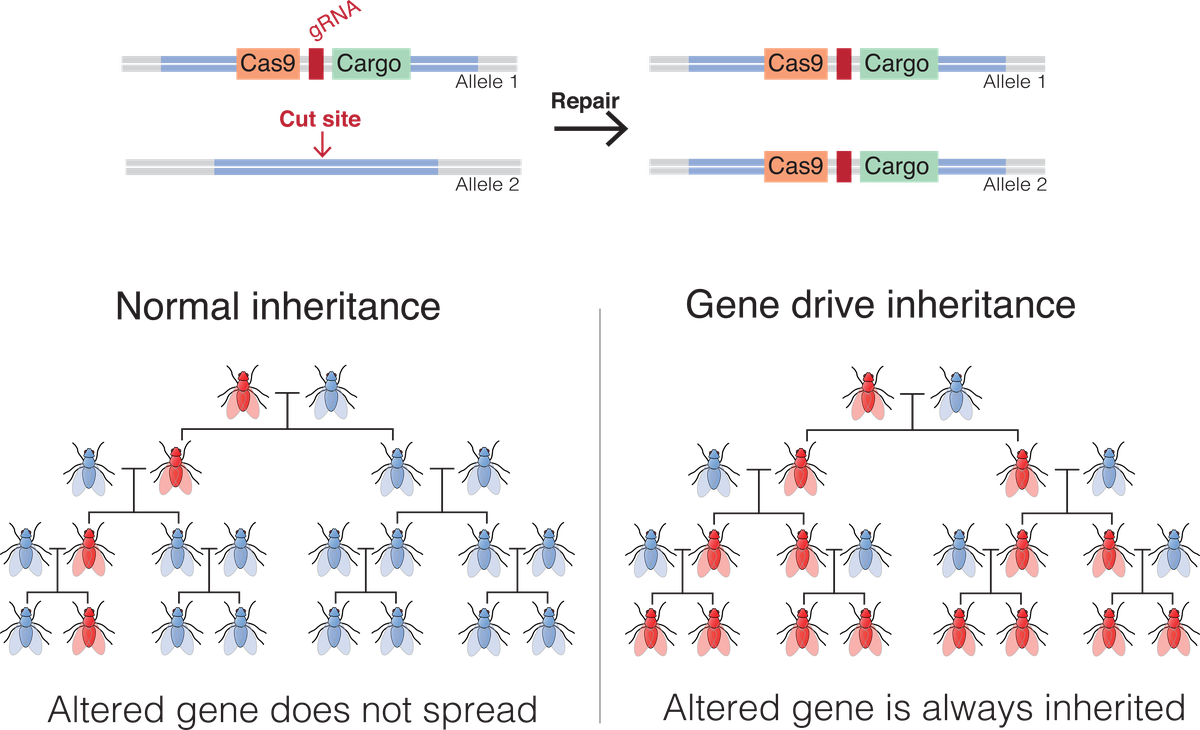
How a gene drive works in flies.

How a gene drive works in flies.
| Photo Credit:
Mariuswalter (CC BY-SA 4.0)

This technology was conceived by Austin Burt, professor at Imperial College London, in a 2003 paper published in Royal Society Proceedings. Here, a protein cuts the mosquito’s DNA at a part that doesn’t encode a particular sequence in the genome. This triggers a natural mechanism in the cell containing the DNA to repair it and forces the cell to incorporate a sequence, called the drive sequence, into the damaged portion.

Numerous gene-drive versions are documented in the literature, but they all focus on reducing mosquito populations’ reproductive capabilities or rendering them sterile. As a result, the malaria parasite won’t be able to replicate inside the mosquito’s gut. In a recent paper in Science Advances, researchers at Imperial College London genetically enhanced a gene expressed in the midgut of mosquitoes to secrete two antimicrobial substances called magainin 2 and melittin. They are detrimental to the Plasmodium parasite’s development in the midgut and also reduce the lifespan of female mosquitoes. Computational modelling studies have suggested that this approach could significantly disrupt malaria transmission.

Benefits as well as risks

In 2020, the U.S. Environmental Protection Agency authorised the release of a genetically modified mosquito called OX5034 in counties in Florida and Texas. Oxitec developed this mosquito with a gene sensitive to an antibiotic, tetracycline. The authorisation followed extensive field trials conducted by the company in Brazil. Genetically modified male OX5034 mosquitoes mated with female mosquitoes but the self-limiting gene prevented female offspring from surviving. As a result, the male mosquitoes would disappear from the environment after around a dozen generations.

Genetically modified mosquitoes have been used in outdoor but controlled conditions in India, Brazil, and Panama as well. Early results from these trials showed promising drops in mosquito populations, around 90% during the trials. Additional trials have shown that such technologies can decrease incidence of dengue significantly as well.

These technologies can bring benefits as well as risks, in different ways. An immediate implication is that the drastic reduction in the mosquito population could alter food chains and ecosystems that involve mosquitoes. So it’s likely that the gap in the food chain could be ‘invaded’ by other mosquitoes or in fact other insects. As such, we don’t fully understand the implications in the short and longer terms. And since the consequences will be shared by individuals, communities, and populations, in that order, what constitutes a right decision and what processes are to be followed remains a dilemma to policymakers.

A timeless struggle

It is therefore not surprising that the genetic engineering of mosquitoes and trials involving genetically modified mosquitoes have faced multifaceted challenges in different parts of the world. Critics have expressed concerns about unintended consequences, such as unforeseen ecological disruptions or the potential for engineered genes to spread beyond target mosquito populations.

Some of these concerns are valid and require extensive data collection, close monitoring, and multistakeholder discussions surrounding the adoption of this technology. Closer home, on the regulatory front, the Department of Biotechnology released comprehensive guidelines for genetically engineered insects earlier this year. They provide a roadmap for researchers, outlining procedures and regulations for working with such insects in the country.

The battle between mosquitoes and humankind seems to be a timeless struggle, a testament to human ingenuity against frustrating troublemakers aided by evolution.

The authors are senior consultants at the Vishwanath Cancer Care Foundation.



Source link

Science Tags:dengue, gene drive, genetic engineering, malaria, Mendelian laws, mosquito control, Oxitec, Wolbachia

Post navigation

Previous Post: TDP Chief Chandrababu Naidu To Court
Next Post: Maldives presidential election heading for 2nd round after no clear winner emerges

Related Posts

  • Marius, the man who named Jupiter’s Galilean moons
    Marius, the man who named Jupiter’s Galilean moons Science
  • Societies embrace gene therapy but resist genetic change in crops
    Societies embrace gene therapy but resist genetic change in crops Science
  • Climate, land-use change reduced flows in 70% of China’s river stations
    Climate, land-use change reduced flows in 70% of China’s river stations Science
  • How linguists figured Hindi, Greek, English all come from a single ancient language
    How linguists figured Hindi, Greek, English all come from a single ancient language Science
  • NASA-ISRO mission to launch NISAR satellite on July 30, confirms ISRO chairman
    NASA-ISRO mission to launch NISAR satellite on July 30, confirms ISRO chairman Science
  • Better future for India in medicine means embracing immunology today
    Better future for India in medicine means embracing immunology today Science

More Related Articles

Sun-observing spacecraft sheds light on the solar wind’s origin Sun-observing spacecraft sheds light on the solar wind’s origin Science
Why 32 European countries are facing the largest climate action lawsuit till date | Explained Why 32 European countries are facing the largest climate action lawsuit till date | Explained Science
Budget 2025: FM opens up Nuclear power sector to private players and incentivises distribution reforms Budget 2025: FM opens up Nuclear power sector to private players and incentivises distribution reforms Science
‘I wanted every Kannadiga to feel proud of the king cobra’ ‘I wanted every Kannadiga to feel proud of the king cobra’ Science
Webb telescope confirms the universe is expanding at an unexpected rate Webb telescope confirms the universe is expanding at an unexpected rate Science
IISc and Pratiksha Trust launch moonshot project on brain co-processors IISc and Pratiksha Trust launch moonshot project on brain co-processors Science
SiteLock

Archives

  • May 2026
  • April 2026
  • March 2026
  • February 2026
  • January 2026
  • December 2025
  • November 2025
  • October 2025
  • September 2025
  • August 2025
  • July 2025
  • June 2025
  • May 2025
  • April 2025
  • March 2025
  • February 2025
  • January 2025
  • December 2024
  • November 2024
  • October 2024
  • September 2024
  • August 2024
  • July 2024
  • June 2024
  • May 2024
  • April 2024
  • March 2024
  • February 2024
  • January 2024
  • December 2023
  • November 2023
  • October 2023
  • September 2023
  • August 2023
  • July 2023
  • June 2023
  • May 2023
  • April 2023
  • March 2023
  • February 2023
  • January 2023
  • December 2022
  • November 2022
  • October 2022
  • September 2022
  • August 2022
  • July 2022
  • June 2022
  • May 2022

Categories

  • Business
  • Nation
  • Science
  • Sports
  • World

Recent Posts

  • NEET UG paper leak 2026: CBI produces five accused before Delhi court
  • With encroachments gone, civic body takes up restoration of Rockfort Teppakulam
  • Sooryavanshi named in India A squad for Sri Lanka tri-series, Tilak to lead side
  • Gold rises ₹650 to ₹1.66 lakh/10g in Delhi
  • France allows asymptomatic passengers off new cruise ship struck by stomach bug outbreak

Recent Comments

  1. JasonDag on UP Teacher Who Asked Students To Slap Muslim Classmate
  2. JamesHeR on UP Teacher Who Asked Students To Slap Muslim Classmate
  3. RafaelNar on UP Teacher Who Asked Students To Slap Muslim Classmate
  4. CarlosExorb on UP Teacher Who Asked Students To Slap Muslim Classmate
  5. Robertfloup on UP Teacher Who Asked Students To Slap Muslim Classmate
  • India, Canada agree to work towards ‘new chapter’ in ties
    India, Canada agree to work towards ‘new chapter’ in ties World
  • Madhav, Aryan mount a stirring fightback for Uttar Pradesh
    Madhav, Aryan mount a stirring fightback for Uttar Pradesh Sports
  • Access Denied Sports
  • Access Denied
    Access Denied Nation
  • Arjun Vajpai: ‘Need To Be At The Peak Of Mental And Physical Fitness When Competing Against Mother Nature’
    Arjun Vajpai: ‘Need To Be At The Peak Of Mental And Physical Fitness When Competing Against Mother Nature’ Sports
  • New U.S. sanctions target Sudan’s warring military leader
    New U.S. sanctions target Sudan’s warring military leader World
  • S Jaishankar Warns Of Global Geopolitical ‘Storm’, Outlines India’s Role
    S Jaishankar Warns Of Global Geopolitical ‘Storm’, Outlines India’s Role Nation
  • 14 Skeletons Found In Ruined 5,000-Year-Old Neolithic Tomb In Scotland
    14 Skeletons Found In Ruined 5,000-Year-Old Neolithic Tomb In Scotland World

Editor-in-Chief:
Mohammad Ariff,
MSW, MAJMC, BSW, DTL, CTS, CNM, CCR, CAL, RSL, ASOC.
editor@artifex.news

Associate Editors:
1. Zenellis R. Tuba,
zenelis@artifex.news
2. Haris Daniyel
daniyel@artifex.news

Photograher:
Rohan Das
rohan@artifex.news

Artifex.News offers Online Paid Internships to college students from India and Abroad. Interns will get a PRESS CARD and other online offers.
Send your CV (Subjectline: Paid Internship) to internship@artifex.news

Links:
Associate Journalism
About Us
Privacy Policy

News Links:
Breaking News
World
Nation
Sports
Business
Entertainment
Lifestyle

Registered Office:
72/A, Elliot Road, Kolkata - 700016
Tel: 033-22277777, 033-22172217
Email: office@artifex.news

Editorial Office / News Desk:
No. 13, Mezzanine Floor, Esplanade Metro Rail Station,
12 J. L. Nehru Road, Kolkata - 700069.
(Entry from Gate No. 5)
Tel: 033-46011099, 033-46046046
Email: editor@artifex.news

Copyright © 2023 Artifex.News Newsportal designed by Artifex Infotech.