




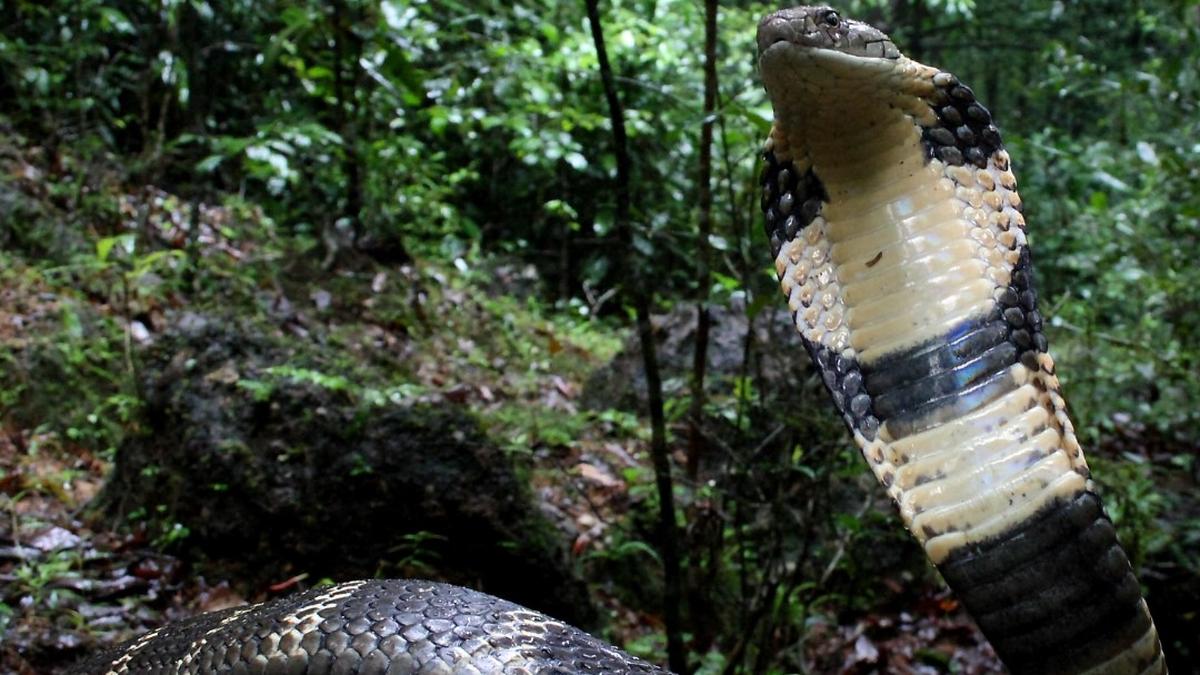
It all started with a snake bite back in 2005. Dr. P. Gowri Shankar was rescuing a king cobra when the ten-foot-long snake suddenly struck him.
“You can die within 20 minutes if you get bitten,” says the founder-director of the Kālinga Foundation (kaalinga sarpa is Kannada for King Cobra) located in the Agumbe rainforests in the Malnad region of the Central Western Ghats. Shankar was lucky. “The snake didn’t inject enough venom because I reacted quickly… Didn’t give him a chance to hold onto me and pump it in,” he says. But even the minuscule amount of venom resulted in terrible swelling and pain. The snake bite was treated symptomatically, “like COVID before we had the vaccine,” he says.
While there is a polyvalent antivenom available in India, which is frequently used to treat bites by the “big four” snakes in the country — Russell’s viper, saw-scaled viper, common krait, and Indian cobra — it doesn’t work against the bite of a king cobra. But since, till recently, it was assumed that the king cobra was a single species widely distributed through many parts of Asia, he turned to the few vials of antivenom from Thailand that he had in his possession, hoping that it would work against the bite.
“But my body did not accept it. I couldn’t breathe, and blisters were everywhere,” recalls Shankar, who finally did not pursue this line of treatment. “Though we had a slight idea that Thai king cobra antivenom did not work on Indian king cobras, it was proved by this incident,” he says.
Gowri Shankar has been rescuing king cobras for decades.
| Photo Credit:
SPECIAL AARANGEMENT
Four species
Shankar’s near-death experience got him wondering why the antivenom did not work since the species of king cobra from India was thought to be the same as the one in Thailand (besides the Indian subcontinent, king cobras are found in Southeast Asia and southern China).
“That is when I started thinking they may be two different species. So I decided to do my PhD in this,” says Shankar, who registered for his PhD in 2013, spending the next decade or so closely examining the morphology and genetics of these snakes. This research confirmed his hunch: there was more than one species of king cobra. In fact, he and his colleagues discovered that the king cobra is a complex of at least four distinct species, overturning a 186-year-long belief that they belonged to a single species.
Since 1836, when the Danish naturalist Theodore Edward Cantor first described the animal, the king cobra was considered a single species. There was, however, one scientist who had his doubts ‒ the Sri Lankan palaeontologist Paulus Edward Pieris Deraniyagala. According to Shankar, in the early 1960s, Deraniyagala suggested that there were several subspecies of the animal, but “the scientific community did not accept it since there was no proper evidence,” he says.
Hunt for evidence
Shankar spent the next ten years travelling across the country and world, visiting museums to gather material to support his hypothesis. Eventually, he and his collaborators published a groundbreaking study in 2021 that proved the king cobra (Ophiophagus hannah) has four divergent, independent lineages. “In that paper, we just delimited their population and figured that there was one 1-4 % genetic difference between them…mostly focused on the genetic and distribution part,” he says.
More recently, in 2024, Shankar and his team showed that there are four species of the king cobra. These include the Northern king cobra (Ophiophagus hannah), Sunda king cobra (Ophiophagus bungarus), Western Ghats king cobra (Ophiophagus kaalinga) and Luzon king cobra (Ophiophagus salvatan), all of which show clear morphological differences, including in their banding patterns. “I went into much more detail in the second paper, where the morphological characters were studied, and names were given,” says Shankar. “We didn’t give the names in the earlier one because we weren’t sure about the morphology.”
Why this matters
Resolving species confusion is vital for multiple reasons. For one, the treatment strategy for king cobra bites will have to be reconsidered, given that only one antivenom ‒ the one from Thailand that he was given, currently in possession of very few people here ‒ is available in the country to treat king cobra bites. “We import small quantities of anti-venom for our (professional snake catchers) safety, but I kind of proved, after my bite, it does not work,” says Shankar, who feels that there needs to be more work done in India on king cobra antivenom. “We are currently not prepared…are still struggling with anti-venom for the big four species, in fact. But now that everybody knows there are different species, we will focus on that.”
And two, the recent discovery has significant implications for our conservation efforts. For instance, till now, because the king cobra was seen as a single species whose range extended from India to the Philippines, it was regarded as a widely distributed species and classified as ‘Vulnerable’ by the IUCN. However, that could change. Each of the four species, including the one found in the Western Ghats, maybe in a more precarious situation due to their endemic distribution. “The species in the Western Ghats is already under massive threat due to habitat destruction,” he says. “We are now asking IUCN to change the status of the Western Ghats king cobra to ‘Endangered.’ “
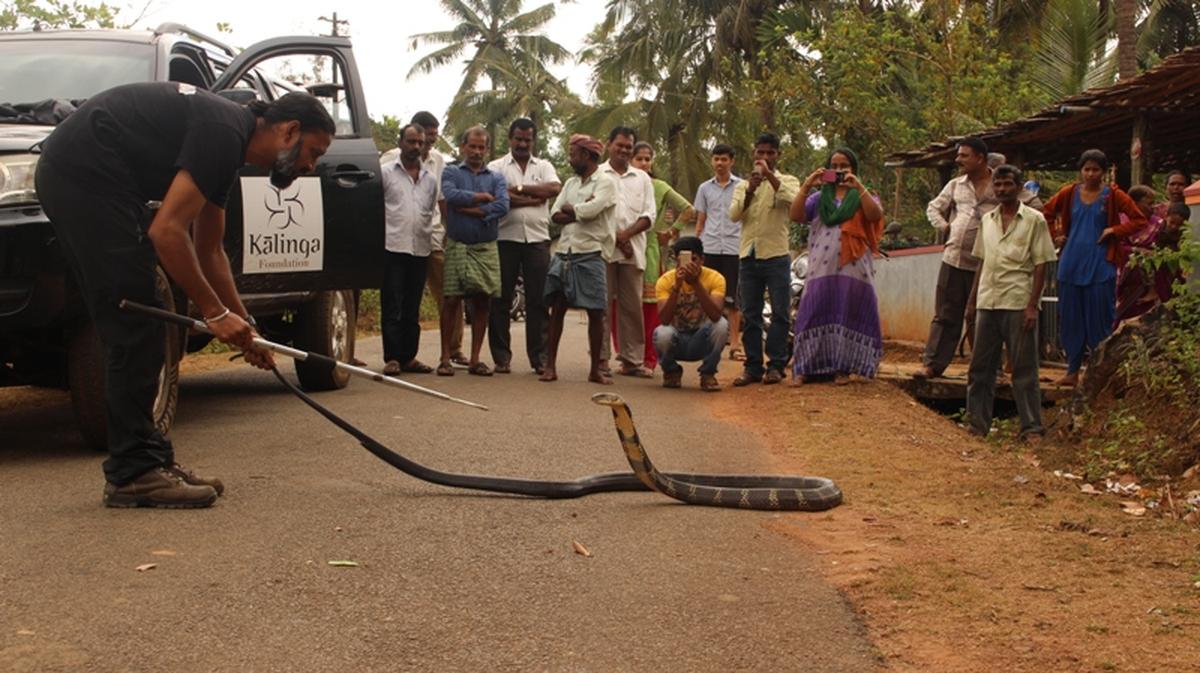
Gowri Shankar believes that training and outreach are essential for conservation.
| Photo Credit:
Sujan Bernard
Fascinating insights
The king cobra belongs to the family Elapidae, which many other venomous snakes, including cobras, coral snakes, kraits, mambas, sea snakes and sea kraits, are also part of. They (king cobras) have a long evolutionary history, going back at least three to five million years ago, says Shankar, who suspects that the Luzon king cobra, endemic to the island of Luzon in the northern Philippines, is among the world’s oldest species.
“Then they started flowing into the rest of Southeast Asia…. coming into India and all the way to the Western Ghats,” he says, adding that because they became geographically isolated, the king cobra evolved into at least four separate species over time. “As the populations separate, the breeding and gene flow stops as they are not interacting with each other,” he says. “They then become an independently-evolving species.”
The genus name, Ophiophagus, comes from the Greek words ophi (snake) and phagos (eating), an allusion to the serpent’s diet. “King cobras might be eating at least 30 species of other snakes,” explains Shankar, adding that these animals also exhibit cannibalistic behaviour, preying on smaller members of their own species.
Shankar shares some other fascinating insights about these animals: they can grow up to 15 feet, emit a growling sound, males engage in physical combat to impress females, and they are the only species of snakes that build nests. “I have monitored close to 50 nests, and they are beautiful,” he reveals, referring to king cobras as among the best engineers in nature. “We often get 6000-8000 mm of rainfall, but not even a single drop reaches the nest chamber.”
In love with the king
Shankar has been fascinated by snakes for as long as he can remember, catching his first one when he was 13. “We had shifted to a house in the K.R. Puram area,” he says, recalling how that part of Bengaluru was flanked by paddy fields and fairly isolated back then. During the monsoon season, the compound of that house would flood, bringing snakes like the buff-striped and checkered keelbacks with it. “My first snake was buff-striped keelback,” he recalls.
He encountered his first King Cobra in the zoo of Bengaluru’s Bannerghatta National Park, where he often escaped during college hours, and was immediately hooked. He was already rescuing snakes by then, mostly rat snakes and cobras, and by the late 1990s, he decided to do it professionally, going on to join the Bangalore Society for the Prevention of Cruelty to Animals (now called the Karuna Animal Welfare Association of Karnataka) and later The Madras Crocodile Bank Trust & Centre for Herpetology. “In the croc bank, we had 18 king cobras as captive-bred specimens, so I started managing them,” says Shankar.
In 2005, he helped Crocodile Bank founder Romulus Whitaker set up the Agumbe Rainforest Research Station (ARRS), working there for the next seven years until he quit to establish the Kālinga Centre for Rainforest Ecology and Kālinga Foundation. Kālinga Centre for Rainforest Ecology. “For my PhD, I had to be in my own field. My wife and I liked Agumbe and wanted to settle down there,” says Gowri Shankar, who was awarded a doctorate in 2023 from the Maharaja Sriram Chandra Bhanja Deo University.
Umbrella species
Talking about his work at Kālinga, Shankar says that as an organisation, they have rescued close to 500 animals from distress situations and trained nearly a thousand snake rescuers. And while research does not take the backseat ‒ he has authored around 11 scientific papers on king cobras — he is equally passionate about outreach and education, relying on myriad media.
Shankar is firmly convinced that conserving the Western Ghats king cobra, an apex predator in the rainforest ecosystem, could help save the rainforests where they are found. “Rainforests are really important as 68% of the carbon sink happens there; without them, we would run into a huge problem,” he says. Fortunately, because of the snake’s important role in religion and culture, many Indians do not just tolerate it, they even worship it.
In Karnataka there is the concept of Nagabanas or sacred groves for snakes, where the forest is completely untouched, says Shankar, who chose to name the Western Ghats species as Ophiophagus kaalinga as an ode to the State that offers so much reverence and protection to this iconic animal. “I wanted to tell the world that if these people can coexist with one of the longest venomous snakes so peacefully, why can’t you,” he says. “And I wanted every Kannadiga to feel proud of it.”
(The official announcement ceremony will be held at the J.N. Tata Auditorium, Malleswaram, on November 22, at 4 p.m.)
Published – November 21, 2024 09:00 am IST