

Skip to content
  • Facebook
  • X
  • Linkedin
  • WhatsApp
  • YouTube
  • Associate Journalism
  • About Us
  • Privacy Policy
  • 033-46046046
  • editor@artifex.news
Artifex.News

Artifex.News

Stay Connected. Stay Informed.

  • Breaking News
  • World
  • Nation
  • Sports
  • Business
  • Science
  • Entertainment
  • Lifestyle
  • Toggle search form
  • Access Denied World
  • Access Denied Business
  • ‘Ultra-left’ blamed for youth’s killing that shocked France
    ‘Ultra-left’ blamed for youth’s killing that shocked France World
  • Hamas Says It Will Not Agree To Truce That Does Not End War In Gaza
    Hamas Says It Will Not Agree To Truce That Does Not End War In Gaza World
  • Access Denied World
  • Vikrant Massey, Bhumi Pednekar On Pariksha Pe Charcha
    Vikrant Massey, Bhumi Pednekar On Pariksha Pe Charcha Nation
  • Sabarmati Express Derailed Due To Object On Track, Says Ashwini Vaishnaw
    Sabarmati Express Derailed Due To Object On Track, Says Ashwini Vaishnaw Nation
  • 111-Year-Old Briton, World’s New Oldest Man, Reveals Secret To His Longevity After Guinness World Records
    111-Year-Old Briton, World’s New Oldest Man, Reveals Secret To His Longevity After Guinness World Records World
New measurements reveal the enormous halos shrouding all galaxies

New measurements reveal the enormous halos shrouding all galaxies

Posted on September 11, 2024 By admin


Have you ever wanted to make a $150,000 gamble? If you’re right, you open a new window to the universe. But if you’re wrong, you’ve just wasted a lot of money and time.

That is exactly what my team did when we pointed the Keck telescope at Mauna Kea Observatory in Hawai’i at what looked like empty space, hoping to reveal the hidden gas that shrouds all galaxies in the universe. There were cheers in the control room when we realised our gamble had paid off.

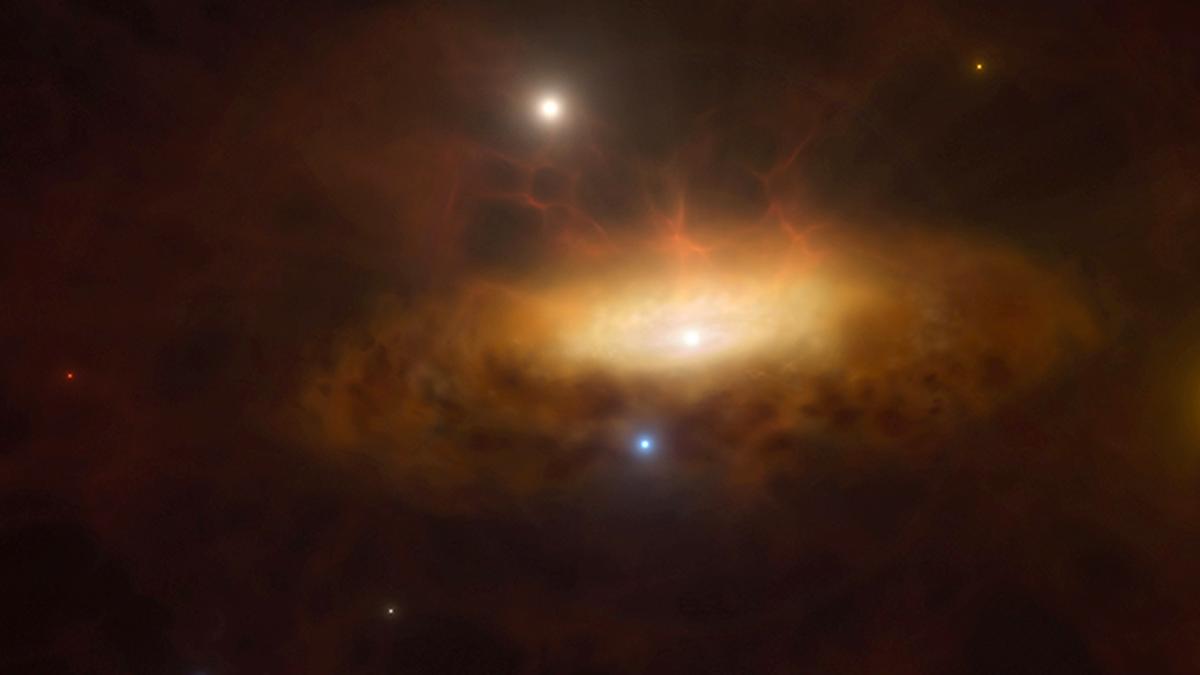
In a study published today in Nature Astronomy, we reveal the first detailed picture of the gas shroud around a galaxy, extending 100,000 light years out into “empty” space. If our own Milky Way has a similar halo, it is likely already interacting with the halo of our nearest galactic neighbour, Andromeda.

Most of the universe is not the bright stars

Most of the matter in the universe is not in the bright stars that make up the spectacular images of galaxies we see. For one thing, galaxies are surrounded by dark matter – which astronomers believe is some kind of exotic invisible particle.

But even most of the normal matter is not in stars. Instead, it is in gigantic clouds of gas that surround galaxies.

We believe these halos around galaxies contain as much as 70–90% of the universe’s normal matter (mostly consisting of hydrogen, helium, carbon, nitrogen and oxygen gas).

Understanding this diffuse gas – which is where all the stars and planets we see had their beginnings – helps us understand more about our own story, on the grandest scales.

However, this halo of gas is spread out over huge areas of space, which makes it extremely faint. In fact, it is 10,000 to 100,000 times fainter than the bright parts of galaxies.

We have known about these gas halos since the 1950s, when astronomers discovered they were absorbing certain frequencies of light that passed through them.

However, these measurements reduce gigantic regions of space stretching hundreds of thousands of light years into a single point – so we knew very little about the exact size or shape of the halos, or the way gas flows between them and their host galaxies.

How to see a galactic halo

For a long time, it was believed to be impossible to capture an image of the halos. However, that changed with the development of a new kind of spectrograph – a device for viewing the spectrum of different wavelengths of light in an image – called an “image slicer”.

The image slicer lets us take spectroscopic images of regions of the night sky to much fainter levels than previous generation instruments.

A team led by Chris Martin at Caltech (one of our collaborators on this project) built an ultra-faint spectrograph called the Keck Cosmic Web Imager and put it on the Keck telescope. The Keck is one of the largest optical telescopes in the world, and its location atop the Mauna Kea volcano in Hawai’i is one of the best astronomical sites in the world.

With the new device in place, we are able to see extremely faint things in the sky.

We used this instrument to stare for an entire night at the apparently empty space around a galaxy. This was followed by intense work analysing the data, as we were working at the limits of what the telescope could do.

Credit here goes to Nikki Nielsen, now a professor at Oklahoma University, who led the data analysis and the writing of the paper when she was working in our team at Swinburne University. To our excitement the gamble paid off, and returned data that allowed us to generate an image of the halo of gas around one galaxy.

What does the shroud of gas around galaxies look like?

Our team took images of the glow of hydrogen and oxygen gas over a region ten times larger than what would normally be called a “galaxy”.

This was exciting! Firstly, because it confirmed the idea that most of the universe’s ordinary matter is in these diffuse halos of gas.

We also found that the galaxy does not smoothly “fade out” into the surrounding halo. There is an abrupt break from one to the other.

In the past, a lot of debate surrounded the nature of this transition. In our data, it is easy to see an abrupt change near the edge of where the vast majority of stars are located.

Why can we see the halo at all?

There is still a mystery as to why we can see the gas at all. It is glowing, but we don’t know why.

We often see the glow of hydrogen gas inside a galaxy, but there we know it is glowing because it has been heated up by strong radiation from nearby stars. Outside a galaxy, however, there are not enough nearby stars to heat up the gas enough to explain the glow we see.

One possibility is that the halo is made of streams of gas moving in different directions. When the streams collide at high speed, the shock makes them glow.

Another possibility is that some very heavy stars and certain black holes (both inside galaxies) produce very large amounts of ultraviolet light. Some of this light can escape the galaxy, and might provide a kind of ambient background UV lighting for the cosmos.

Combined with fast-moving streams of gas, the ultraviolet background might be enough to produce the glow we have seen – but it will take more observations to know for sure.

This article is republished from The Conversation under a Creative Commons license. Read the original article.

Published – September 11, 2024 02:56 pm IST



Source link

Science Tags:astronomy news, halo shrouding galaxies, science news, space news

Post navigation

Previous Post: Japan Penguin Found Safe 2 Weeks After Escape, Keeper Calls It A Miracle
Next Post: Kamala Harris vs. Donald Trump debate: Trump vows to end Russia-Ukraine war if elected as U.S. President

Related Posts

  • EU agencies track bird flu virus variants on increasing threat to humans
    EU agencies track bird flu virus variants on increasing threat to humans Science
  • NASA capsule bearing asteroid sample in imminent return to Earth
    NASA capsule bearing asteroid sample in imminent return to Earth Science
  • How does Gaganyaan’s vital crew escape system work? | Explained
    How does Gaganyaan’s vital crew escape system work? | Explained Science
  • Trilobite fossils from upstate New York reveal extra set of legs
    Trilobite fossils from upstate New York reveal extra set of legs Science
  • After a health emergency, air pollution foretells an economic one
    After a health emergency, air pollution foretells an economic one Science
  • Primates often gave birth to twins 60M years ago: new research
    Primates often gave birth to twins 60M years ago: new research Science

More Related Articles

Cracking the mystery of how proteins found their shapes Cracking the mystery of how proteins found their shapes Science
US faces risk of losing to China in second moon race US faces risk of losing to China in second moon race Science
What makes the brain the most complicated object in the universe What makes the brain the most complicated object in the universe Science
Europe ‘back in space’ despite Ariane 6 debut glitch Europe ‘back in space’ despite Ariane 6 debut glitch Science
Reshaping during healing in plants Reshaping during healing in plants Science
CDFD research finds how fungal pathogen which kills 2.5 million people every year evades host immune cells CDFD research finds how fungal pathogen which kills 2.5 million people every year evades host immune cells Science
SiteLock

Archives

  • May 2026
  • April 2026
  • March 2026
  • February 2026
  • January 2026
  • December 2025
  • November 2025
  • October 2025
  • September 2025
  • August 2025
  • July 2025
  • June 2025
  • May 2025
  • April 2025
  • March 2025
  • February 2025
  • January 2025
  • December 2024
  • November 2024
  • October 2024
  • September 2024
  • August 2024
  • July 2024
  • June 2024
  • May 2024
  • April 2024
  • March 2024
  • February 2024
  • January 2024
  • December 2023
  • November 2023
  • October 2023
  • September 2023
  • August 2023
  • July 2023
  • June 2023
  • May 2023
  • April 2023
  • March 2023
  • February 2023
  • January 2023
  • December 2022
  • November 2022
  • October 2022
  • September 2022
  • August 2022
  • July 2022
  • June 2022
  • May 2022

Categories

  • Business
  • Nation
  • Science
  • Sports
  • World

Recent Posts

  • ATS questions 57 in Maharashtra over alleged gangster network links
  • Nicobarese oppose proposal for three wildlife sanctuaries
  • Visakhapatnam Collector calls for inter-departmental synergy to boost investments
  • Kohli’s masterful knock powers Royal Challengers to the top
  • Senior IPS officer Asra Garg posted IGP Intelligence

Recent Comments

  1. RichardClage on UP Teacher Who Asked Students To Slap Muslim Classmate
  2. StevenLek on UP Teacher Who Asked Students To Slap Muslim Classmate
  3. Leonardren on UP Teacher Who Asked Students To Slap Muslim Classmate
  4. NathanQuins on UP Teacher Who Asked Students To Slap Muslim Classmate
  5. Davidgof on UP Teacher Who Asked Students To Slap Muslim Classmate
  • Access Denied Sports
  • Chartered Accountants from UK, Canada might be allowed to practice in India: ICAI President
    Chartered Accountants from UK, Canada might be allowed to practice in India: ICAI President Business
  • Access Denied
    Access Denied Nation
  • SBI’s eRupee Can Now Be Accessed Via UPI
    SBI’s eRupee Can Now Be Accessed Via UPI Business
  • Access Denied Sports
  • Counter-terrorism: Pakistan, China hold military-level talks
    Counter-terrorism: Pakistan, China hold military-level talks World
  • Scientists Want To Breed Mosquitoes With “Toxic” Semen. This Is Why
    Scientists Want To Breed Mosquitoes With “Toxic” Semen. This Is Why World
  • Putin calls Maduro, Lukashenko meets Venezuela envoy as Trump cranks up pressure
    Putin calls Maduro, Lukashenko meets Venezuela envoy as Trump cranks up pressure World

Editor-in-Chief:
Mohammad Ariff,
MSW, MAJMC, BSW, DTL, CTS, CNM, CCR, CAL, RSL, ASOC.
editor@artifex.news

Associate Editors:
1. Zenellis R. Tuba,
zenelis@artifex.news
2. Haris Daniyel
daniyel@artifex.news

Photograher:
Rohan Das
rohan@artifex.news

Artifex.News offers Online Paid Internships to college students from India and Abroad. Interns will get a PRESS CARD and other online offers.
Send your CV (Subjectline: Paid Internship) to internship@artifex.news

Links:
Associate Journalism
About Us
Privacy Policy

News Links:
Breaking News
World
Nation
Sports
Business
Entertainment
Lifestyle

Registered Office:
72/A, Elliot Road, Kolkata - 700016
Tel: 033-22277777, 033-22172217
Email: office@artifex.news

Editorial Office / News Desk:
No. 13, Mezzanine Floor, Esplanade Metro Rail Station,
12 J. L. Nehru Road, Kolkata - 700069.
(Entry from Gate No. 5)
Tel: 033-46011099, 033-46046046
Email: editor@artifex.news

Copyright © 2023 Artifex.News Newsportal designed by Artifex Infotech.