




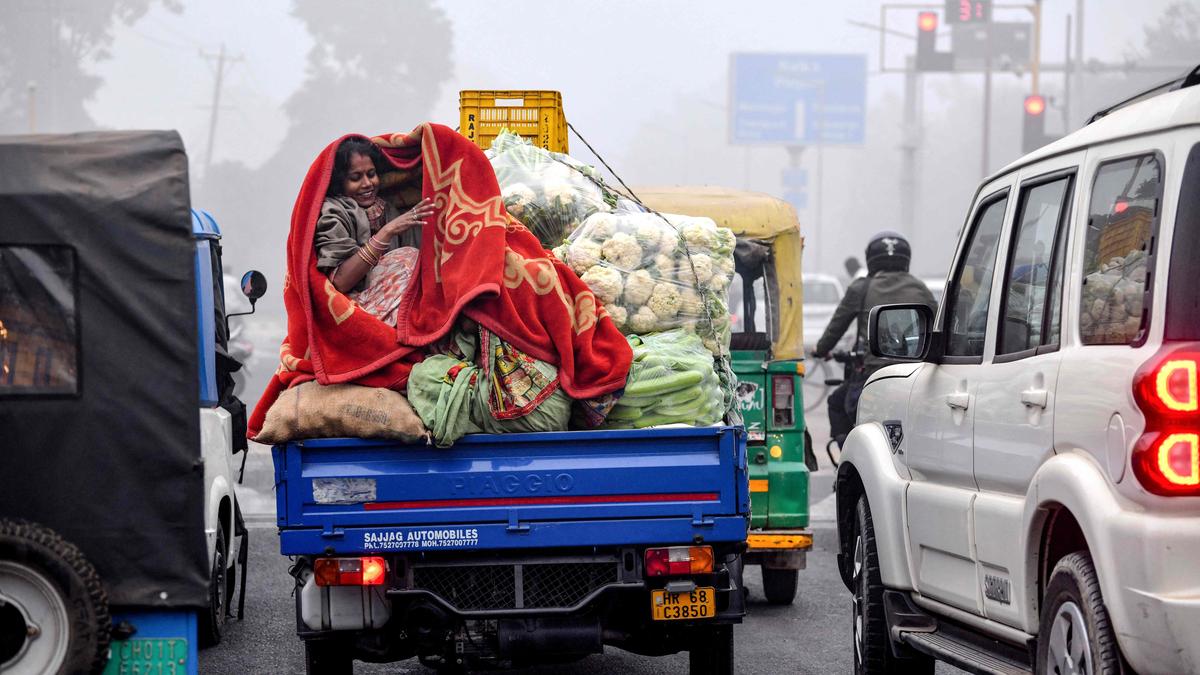
In his 36 years as a thoracic surgeon, Dr Arvind Kumar has literally heard and opened tens of thousands of chests. According to him, the human lung, a pristine pink at birth, tells the tale of each breath taken over a lifetime.
“For years, I could trace the pattern of urban pollution on lung tissue as black deposits — a few spots here, larger stains there. Now it’s everywhere,” Dr Kumar said from his office in Medanta Medicity Hospital, Gurugram. He has been disturbed by the harrowing effects of air pollution on lungs, and not just in people with lung diseases or the elderly. “The lungs of teenagers now look like the lungs of lifelong smokers. Pollution isn’t just in our cities — it’s inside us.”
This transformation of chest health is an invisible epidemic affecting millions across India, now underscored by the findings in the United Nations Environment Programme (UNEP) Emissions Gap and Adaptation Gap reports for 2024. Emissions are increasing worldwide but in few places as much as in India, more than 6% from last year.
The data is unequivocal: pollution is now more than an environmental issue. It’s a national health emergency.
An unseen health crisis
India’s poor air quality has been silently affecting communities for decades, with lethal results. “Air pollution is the biggest environmental risk to health, even the leading cause of premature death in India,” Dr Pallavi Pant of the Health Effects Institute said.
According to her research, nearly 2 million lives were cut short in India in 2021 alone due to pollution-related diseases. Among the most affected are pregnant women, children, the elderly, and those already facing health challenges. “For these populations, the risk of respiratory infections, impaired lung function, and even cardiovascular conditions due to pollution is devastating and far-reaching,” she said.
Exposure to air pollution can permanently impair lung development, leading to chronic respiratory issues and asthma in children. “These aren’t just minor inconveniences,” according to Dr Pant. “This is a fundamental health crisis where children grow up with a lifetime of diminished health and quality of life.”
To her, the real tragedy is that risks fall heaviest on the most vulnerable. “Those with fewer resources are the hardest hit. They often live closest to pollution sources and lack the means to protect themselves. This is a crisis of inequality as much as [of] health.”
Dr Soumya Swaminathan, former chief scientist at the World Health Organisation (WHO) and chairperson of the M.S. Swaminathan Research Foundation, Chennai, said, “The impacts of poor air quality are systemic. High pollution levels are linked to non-communicable diseases such as hypertension, diabetes, and stroke. We’re talking about lifelong health impairments that are often invisible but devastating.”
According to her, early and prolonged exposure to pollutants during critical periods like pregnancy and early childhood can predispose individuals to lifelong illnesses. “Children are growing up with a fundamentally compromised baseline for health,” she added.
A fractured response
India launched the National Clean Air Programme (NCAP) in 2019 to reduce particulate matter pollution by 20-30% by 2024, before adjusting the target to a 40% reduction by 2026.
According to experts, the NCAP has significant room for improvement. “The NCAP has become, for many, a symbol of intent without effective action,” Dr Kumar said. “We have policies but where we’re faltering is in ground-level implementation.”
Dr Kumar argued health must be a central focus of environmental policies whereas current efforts are “piecemeal and lack teeth”. He described the NCAP’s measures as “band-aid solutions” and called for stricter enforcement and a shift toward health-centric policies and ground-level action.
Dr Pant commended the NCAP’s role in raising awareness and enhancing air quality monitoring but also called out its shortcomings in sustained, source-specific emission reductions. She suggested instead that a regionalised approach could allow for more targeted, impactful solutions. “The NCAP needs localised strategies focused on specific emission sources,” she said.
Dr Swaminathan also urged the NCAP to go beyond monitoring pollutants to focus on reducing emissions and prioritising health outcomes. “The NCAP’s goals need to integrate public health directly. Pollution control isn’t just about air quality. It’s about people’s lives,” she said. “The program must shift from mere monitoring to actively reducing emissions with health as its primary focus.”
Vaibhav Chaturvedi, an environmental economist at the Council on Energy, Environment and Water, stressed that the NCAP’s targets are unrealistic if it doesn’t pivot towards clean energy and reduce India’s dependence on fossil fuels. “To make the NCAP effective, we need a structural overhaul, particularly in how we produce and consume energy,” he said.
Sophie Gumy, a technical officer with the WHO’s Air Quality and Health Unit, expressed belief that the NCAP lacks the comprehensive, multi-sectoral approach required to achieve meaningful progress. She also said it needs to be accompanied by policies that protect vulnerable populations disproportionately affected by air pollution.
“NCAP is a beginning, but a whole-society approach that spans sectors and prioritises the vulnerable is essential,” she said.
Economic and social costs
“Poor air quality isn’t just costing lives; it’s costing livelihoods,” Gumy added.
Dr Swaminathan also called air pollution an economic crisis as well for its ability to raise healthcare costs and lower productivity (through lost work and school days). “Poor air quality leads to increased hospitalisations and higher healthcare costs, adding a financial burden on families and the health system,” she said.
Vulnerable, low-income communities bear the heaviest burden: “The poorest are most exposed yet least equipped to mitigate these effects,” according to Dr Swaminathan — a situation reminiscent of the effects of climate change. “The burden of non-communicable diseases linked to pollution continues to rise” even as climate-related challenges like heat waves exacerbate health and productivity losses.
Dr Kumar’s ‘My Solution to Pollution’ campaign, under his foundation and the Doctors for Clean Air initiative, encourages communities to take small but meaningful action. “People can’t wait for government solutions alone,” he said. “If 140 crore people commit to small actions, like reducing idling cars outside schools or limiting waste-burning, we can significantly reduce the local pollution load.”
A pilot program to prevent idling vehicles near school zones showed improved air quality, a potential model for broader change. “If each of us does our part, we can reduce pollution at the ground level.”
The clean energy caveat
Despite increasing public awareness, India’s heavy dependence on fossil fuels remains a significant obstacle to change. While the government promotes electric vehicles, Dr Kumar warned their benefits would be limited if their batteries are charged with coal-fired electricity. He contended that an overhaul of energy infrastructure is required, including a complete transition away from coal.
“We’re tackling the problem from the wrong end,” Chaturvedi, the environmental economist, said. “We’re addressing symptoms — dust suppression, controlling stubble burning — but not the root cause, which is our reliance on fossil fuels and inadequate clean energy infrastructure.”
“True progress in air quality will require a pivot from coal to renewables, coupled with a robust national investment in sustainable infrastructure.”
Dr Pant also pointed out that people in rural locales bank extensively on biomass and also need access to cleaner energy. “For many rural families, wood and animal dung are the only affordable options for cooking fuel,” she said, adding that the health impact of household pollution, particularly for women and children, is as important as urban air quality.
Policy reforms, public accountability
Experts said it could be critical for the NCAP to adopt a regional approach rather than presume one size can fit all. Dr Pant suggested localised targets could allow India’s diverse regions to address their most pressing pollution sources — industrial emissions, agricultural burning, or urban vehicle congestion — differently. “Air pollution is deeply complex. By prioritising interventions at the state and local levels, we can tailor strategies to where they’re needed most,” she said.
Second, while experts have mixed reactions to listing pollution as a cause of death on death certificates, Dr Kumar said this explicit acknowledgment could increase public awareness. “When you add pollution to the death certificate, you’re making people see the cause-and-effect link in their lives,” he says. Dr Swaminathan agrees: “Having an official link on death records could push more serious health and policy actions against pollution.”
She also proposed establishing a regulatory body akin to the U.S. Environment Protection Agency to enforce environmental standards and integrate interdisciplinary policymaking. “India lacks a comprehensive body to regulate air, water, and other pollutants that threaten public health,” she said. Dr Pant echoed her, saying “a unified regulatory body could streamline and strengthen India’s fragmented environmental policies.”

But Dr Kumar was wary of bureaucratic hurdles: “We don’t need more agencies; we need stronger enforcement.”
Toward lasting solutions
The UNEP reports called for systemic changes in the transportation, energy, and health sectors to curb pollution effectively. Experts agreed a national clean air strategy should prioritise public health, climate mitigation, and community engagement. For Dr Kumar, the urgency can’t be overstated. “Pollution is now in our lungs, and it’s not going to leave on its own. Each breath we take is a reminder of how much needs to change.”
“This isn’t only about the environment,” Dr Pant added: “it’s about every person in this country having the right to breathe without fear.”
India stands at a crossroads and its choices today will determine the health of generations to come. As Gumy said, “Investing in clean air today is investing in India’s economic and social future.”
Vijay Shankar Balakrishnan is a freelance journalist based in Ludwigshafen am Rhein, Germany.
Published – November 22, 2024 07:49 am IST