

Skip to content
  • Facebook
  • X
  • Linkedin
  • WhatsApp
  • YouTube
  • Associate Journalism
  • About Us
  • Privacy Policy
  • 033-46046046
  • editor@artifex.news
Artifex.News

Artifex.News

Stay Connected. Stay Informed.

  • Breaking News
  • World
  • Nation
  • Sports
  • Business
  • Science
  • Entertainment
  • Lifestyle
  • Toggle search form
  • Vijayasai Reddy Resigns From Rajya Sabha, 4th YSRCP MP To Quit Since 2024 Polls Rout
    Vijayasai Reddy Resigns From Rajya Sabha, 4th YSRCP MP To Quit Since 2024 Polls Rout Nation
  • Access Denied
    Access Denied Nation
  • Access Denied Sports
  • Only 6.68 pc of population filed income tax return in 2023-24 fiscal
    Only 6.68 pc of population filed income tax return in 2023-24 fiscal Business
  • Access Denied
    Access Denied Nation
  • Access Denied
    Access Denied Nation
  • Chhattisgarh Security Personnel Killed In Accidental Firing In Dantewada During Anti-Maoist Operation
    Chhattisgarh Security Personnel Killed In Accidental Firing In Dantewada During Anti-Maoist Operation Nation
  • Access Denied
    Access Denied Nation
How does Gaganyaan’s vital crew escape system work? | Explained

How does Gaganyaan’s vital crew escape system work? | Explained

Posted on October 15, 2025 By admin


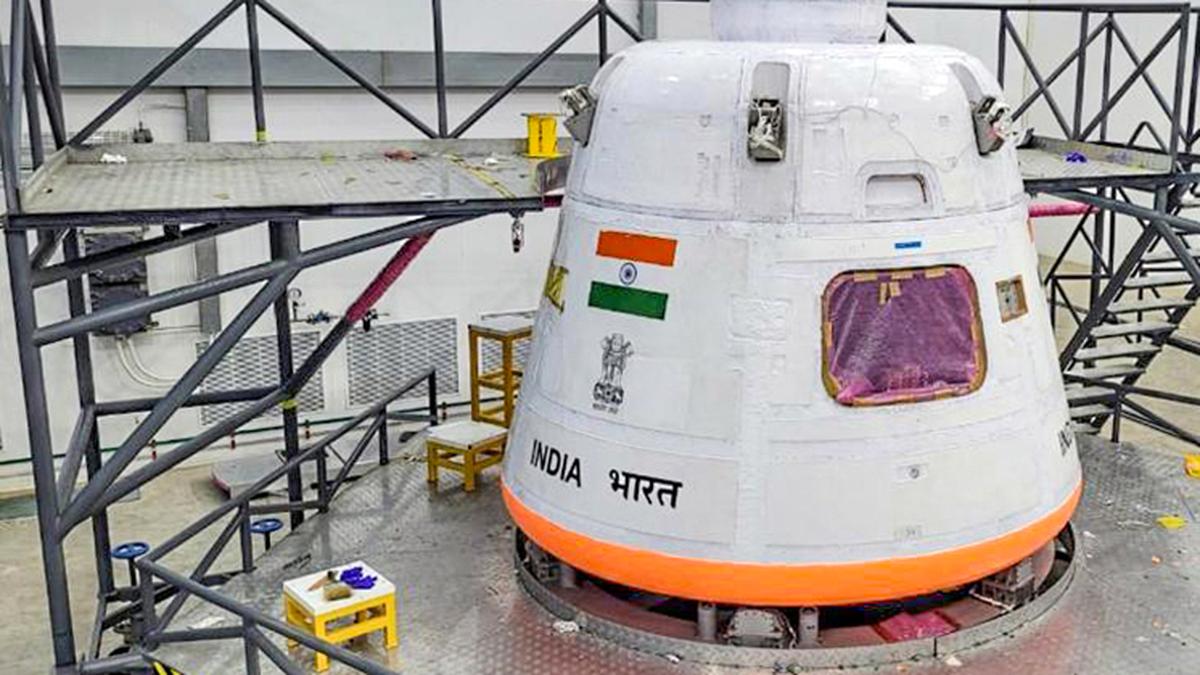
ISRO preparing to commence unmanned flight tests for the Gaganyaan Mission, in Sriharikota in 2023.
| Photo Credit: ANI

The story so far: The Gaganyaan mission aims to safely transport Indian astronauts to a low-earth orbit of around 400 km altitude using the human-rated LVM3 (HLVM3) rocket as the launch vehicle, and to return them safely. In human space missions, crew safety is more important than mission success. It is imperative that safety is addressed during all phases: launch pad, ascent, orbit, and descent.

What is the CES?

A dedicated Crew Escape System (CES) will be used during the initial part of the atmospheric phase of the Gaganyaan mission to ensure crew safety in the event of a contingency that jeopardises the mission. The CES is designed to rapidly separate the crew module, along with the crew, from a malfunctioning launch vehicle, and move it to a safe distance in the least possible time. The atmospheric phase of flight is one of the most critical stages of the ascent, during which the rocket accelerates to hypersonic speeds — more than five times the speed of sound — and will be experiencing very high structural loads. The HLVM3 rocket is equipped with two powerful S200 solid-fuel boosters to lift off, and unlike liquid or cryogenic engines, solid motors cannot be shut down once they are ignited. Thus, the CES must extract the crew module with greater acceleration than the launch vehicle itself, and in minimal time. The CES is a quick-acting system positioned at the forward end of the launch vehicle and is equipped with multiple special-purpose solid motors. These motors use high burn-rate propellants that consume fuel faster than conventional solid motors, generating higher acceleration.

In the Gaganyaan mission, the CES could impart acceleration up to 10-times that of gravity. For a healthy human body, such high acceleration is tolerable for a few seconds if the crew is positioned correctly, with the acceleration acting perpendicular to the chest and the body pressed against the seat in a “child in cradle” orientation. Rocket systems are more intricate than those of aircraft, with rocket reliability much lower than that of passenger aircraft. Nevertheless, the CES significantly improves crew survival probability through its heritage-based design, redundant systems, and robust mission planning.

What are different types?

The CES is classified into two types based on the way it extracts the crew module: (i) puller type — used in Gaganyaan, where the CES pulls the crew module away from the launch vehicle; (ii) pusher type — used in vehicles like SpaceX’s Falcon 9, where the crew module is pushed away using compact, high-thrust liquid-fuel engines. Both systems have advantages and disadvantages, with the choice depending on propulsion technology and system integration aspects. The U.S.’s Saturn V, Russia’s Soyuz, and China’s Long March vehicles also use puller-type CES designs.

In September, 1983, two Soviet cosmonauts escaped a massive explosion on the launchpad when their Soyuz rocket caught fire just before lift-off. Their lives were saved by the launch vehicle’s automatic crew escape system. This remains the first and only time a crewed launch escape system was activated before lift-off.

Once the CES has moved the crew module a safe distance away from the failing vehicle, the module will be released and decelerated by a multistage parachute system. This will reduce the module’s velocity in steps, ensuring it splashes down safely in the sea without exceeding the crew’s physiological limits upon impact. Typically, the crew will remain inside the module until splashdown. But during the Soviet Union’s first human spaceflight, Yuri Gagarin ejected from the Vostok module at approximately 7 km altitude and parachuted safely to the ground.

The Integrated Vehicle Health Management system (IVHM), which is a network of sensors, electronics, and software, will aid in taking a decision to activate the CES when a contingency arises. It will monitor all vital parameters of vehicle systems and crew health in real time. Based on the synthesised information and the flight regime, it will ensure prompt anomaly detection, minimise false alarms, and activate the CES early enough to protect the crew.

Has it been tested?

The ISRO has developed a cost-effective, single-stage Test vehicle powered by the Vikas engine to validate the CES. The first successful test occurred in October 2023, during which the CES was activated when the Test vehicle reached transonic conditions — a critical phase in atmospheric flight when the velocity transitions from subsonic to supersonic. ISRO plans additional Test vehicle flights to simulate other critical ascent trajectory conditions. The CES is a cornerstone of the Gaganyaan programme and reflects ISRO’s commitment to astronaut safety. By integrating advanced engineering, rigorous testing, and reliable systems like the IVHM, the CES ensures India’s first human spaceflight mission will prioritise the safe return of its crew, even in the face of unforeseen challenges.

Unnikrishnan Nair S. is former director, VSSC; Founding Director, HSFC; and an expert in orbital reentry and human spaceflight technologies.

Published – October 15, 2025 08:30 am IST



Source link

Science

Post navigation

Previous Post: Access Denied
Next Post: Access Denied

Related Posts

  • Discover the secrets of negligible senescence in tortoises and turtles, offering insights for anti-ageing research and potential medical breakthroughs.
    Discover the secrets of negligible senescence in tortoises and turtles, offering insights for anti-ageing research and potential medical breakthroughs. Science
  • Can white matter changes in the brain determine our ageing trajectory?
    Can white matter changes in the brain determine our ageing trajectory? Science
  • A twist in the tale: are scientists wrong about dark energy?
    A twist in the tale: are scientists wrong about dark energy? Science
  • The perfect flaw: how a diamond defect is changing quantum physics
    The perfect flaw: how a diamond defect is changing quantum physics Science
  • Unravelling the links between consanguinity and genetic diseases
    Unravelling the links between consanguinity and genetic diseases Science
  • NASA hit by fuel leak during practice countdown of moon rocket
    NASA hit by fuel leak during practice countdown of moon rocket Science

More Related Articles

The Hindu Daily Quiz | On balancing rocks- Feb 29, 2024 The Hindu Daily Quiz | On balancing rocks- Feb 29, 2024 Science
India’s capacity to scale next-generation biologics draws focus at BioAsia 2026 India’s capacity to scale next-generation biologics draws focus at BioAsia 2026 Science
As thoughts become digitised, who will protect our neurorights? | Explained As thoughts become digitised, who will protect our neurorights? | Explained Science
Mosquitoes began biting hominins 1.8 million years ago, study says Mosquitoes began biting hominins 1.8 million years ago, study says Science
Firefly Sparkle galaxy offers a taste of the infant Milky Way Firefly Sparkle galaxy offers a taste of the infant Milky Way Science
Can white matter changes in the brain determine our ageing trajectory? Can white matter changes in the brain determine our ageing trajectory? Science
SiteLock

Archives

  • May 2026
  • April 2026
  • March 2026
  • February 2026
  • January 2026
  • December 2025
  • November 2025
  • October 2025
  • September 2025
  • August 2025
  • July 2025
  • June 2025
  • May 2025
  • April 2025
  • March 2025
  • February 2025
  • January 2025
  • December 2024
  • November 2024
  • October 2024
  • September 2024
  • August 2024
  • July 2024
  • June 2024
  • May 2024
  • April 2024
  • March 2024
  • February 2024
  • January 2024
  • December 2023
  • November 2023
  • October 2023
  • September 2023
  • August 2023
  • July 2023
  • June 2023
  • May 2023
  • April 2023
  • March 2023
  • February 2023
  • January 2023
  • December 2022
  • November 2022
  • October 2022
  • September 2022
  • August 2022
  • July 2022
  • June 2022
  • May 2022

Categories

  • Business
  • Nation
  • Science
  • Sports
  • World

Recent Posts

  • Rashid arguably back to his best: Hayden
  • BRS leader Praveen Kumar demands SIT probe with women police officers into POCSO case against Bandi Sanjay’s son
  • Khader urges students to be assets to family and nation
  • Global jitters keep FPIs on edge, ₹14,231 crore pulled out in May
  • ISL | Dominant Kerala Blasters rolls past Mohammedan SC

Recent Comments

  1. HubertInvig on UP Teacher Who Asked Students To Slap Muslim Classmate
  2. Richardhoabe on UP Teacher Who Asked Students To Slap Muslim Classmate
  3. Robertnof on UP Teacher Who Asked Students To Slap Muslim Classmate
  4. EnriqueExins on UP Teacher Who Asked Students To Slap Muslim Classmate
  5. Andrewfoods on UP Teacher Who Asked Students To Slap Muslim Classmate
  • Vijay Hazare Trophy | Knockouts is about handling pressure and we should have done that: TN skipper Sai Kishore
    Vijay Hazare Trophy | Knockouts is about handling pressure and we should have done that: TN skipper Sai Kishore Sports
  • Access Denied
    Access Denied Nation
  • ‘Knew Sunil Narine Would Be A T20 Legend’: Gautam Gambhir Praises KKR Star
    ‘Knew Sunil Narine Would Be A T20 Legend’: Gautam Gambhir Praises KKR Star Sports
  • Access Denied Sports
  • Access Denied Business
  • UP Cops Arrest Mystery Man Who Hit Sleeping Women On Head, 1 Of Them Died
    UP Cops Arrest Mystery Man Who Hit Sleeping Women On Head, 1 Of Them Died Nation
  • “India’s Momentum Today Has To Be Experienced To Be Believed”: S Jaishankar In Singapore
    “India’s Momentum Today Has To Be Experienced To Be Believed”: S Jaishankar In Singapore World
  • Access Denied
    Access Denied Nation

Editor-in-Chief:
Mohammad Ariff,
MSW, MAJMC, BSW, DTL, CTS, CNM, CCR, CAL, RSL, ASOC.
editor@artifex.news

Associate Editors:
1. Zenellis R. Tuba,
zenelis@artifex.news
2. Haris Daniyel
daniyel@artifex.news

Photograher:
Rohan Das
rohan@artifex.news

Artifex.News offers Online Paid Internships to college students from India and Abroad. Interns will get a PRESS CARD and other online offers.
Send your CV (Subjectline: Paid Internship) to internship@artifex.news

Links:
Associate Journalism
About Us
Privacy Policy

News Links:
Breaking News
World
Nation
Sports
Business
Entertainment
Lifestyle

Registered Office:
72/A, Elliot Road, Kolkata - 700016
Tel: 033-22277777, 033-22172217
Email: office@artifex.news

Editorial Office / News Desk:
No. 13, Mezzanine Floor, Esplanade Metro Rail Station,
12 J. L. Nehru Road, Kolkata - 700069.
(Entry from Gate No. 5)
Tel: 033-46011099, 033-46046046
Email: editor@artifex.news

Copyright © 2023 Artifex.News Newsportal designed by Artifex Infotech.