

Skip to content
  • Facebook
  • X
  • Linkedin
  • WhatsApp
  • YouTube
  • Associate Journalism
  • About Us
  • Privacy Policy
  • 033-46046046
  • editor@artifex.news
Artifex.News

Artifex.News

Stay Connected. Stay Informed.

  • Breaking News
  • World
  • Nation
  • Sports
  • Business
  • Science
  • Entertainment
  • Lifestyle
  • Toggle search form
  • Access Denied Sports
  • Access Denied Sports
  • Border-Gavaskar trophy: Avoid getting into confrontations with Virat Kohli as it brings best out of him, says Shane Watson
    Border-Gavaskar trophy: Avoid getting into confrontations with Virat Kohli as it brings best out of him, says Shane Watson Sports
  • Access Denied Business
  • Access Denied World
  • Saurashtra fossils say early humans didn’t stick to coast as they moved
    Saurashtra fossils say early humans didn’t stick to coast as they moved Science
  • Putin, Zelenskyy Invite PM Modi After Elections: “See India As Peacemaker”
    Putin, Zelenskyy Invite PM Modi After Elections: “See India As Peacemaker” Nation
  • Prohibitory Orders At Pune Picnic Spots After Lonavala Waterfall Tragedy
    Prohibitory Orders At Pune Picnic Spots After Lonavala Waterfall Tragedy Nation
Brains that don’t see in greyscale first over-rely on colours: Project Prakash study

Brains that don’t see in greyscale first over-rely on colours: Project Prakash study

Posted on June 26, 2024 By admin


The world has many colours and being able to see them is a great source of joy. But a newborn baby mostly sees the world in black and white. The photosensitive cone cells in the child’s eyes don’t mature until they’re around four months old. In this time, the brain uses other visual cues to make sense of the world.

In May, a team of Indian and U.S. researchers reported in the journal Science that this delay in developing colour vision is actually important for overall vision development.

“We are able to explain why normal visual development happens the way it does,” study co-lead Priti Gupta, a cognitive neuroscientist, told The Hindu.

Dr. Gupta leads the research team in India for ‘Project Prakash’, a U.S.-based initiative of IIT Delhi, Dr Shroff’s Charity Eye Hospital in New Delhi, and the Massachusetts Institute of Technology.

Project Prakash treats and rehabilitates blind children in India. These children helped the researchers shed light on how the brain learns to see.

Importance of colour vision

Humans don’t need colour vision to recognise objects but colours can provide adaptation and survival advantages, Dr. Gupta said.

“If you look at food, you can recognise it without colour. But if something has gone bad, then you need to see the colour of that thing to understand.”

Yet there is more to colour vision than meets the eye.

“They’re very mesmerised by colours,” Dr. Gupta said of the children at Project Prakash. They often described objects around them with their colour. “Their reliance on colours is a little more than what normal children have.” This observation gave the researchers an idea: “to show them some things without colour”.

They brought together a group of visually impaired children and young adults between 8 and 26 years of age and asked them to identify objects in images — a tree, a bus, chicken, a stack of books, etc. — first in grayscale and then in colour. In another test, they asked the group to determine which of two discs presented to them had a lighter hue while the researchers adjusted the colour.

The children could recognise colour images and discs quite well — even those who were barely two days out of eye surgery. But they had a tough time recognising black and white images.

Children without any visual impairment had trouble neither with colour nor grayscale images, on the other hand.

The researchers realised the issue wasn’t the colour vision of the visually impaired children. Instead, it was the abnormal way in which their vision had developed: to rely too much on colour.
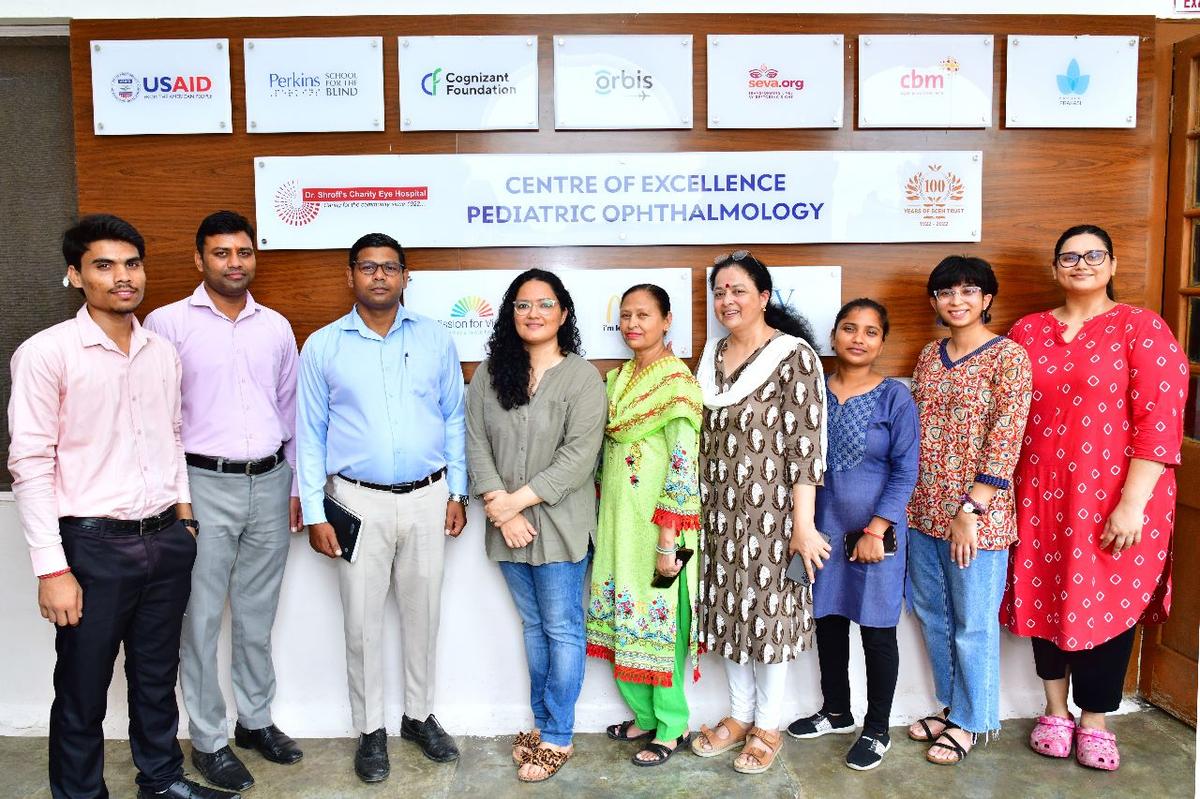
Members of the Project Prakash team in India (from left): Abhishek Kumar, Rakesh Kumar, Ajay Chawariya, Priti Gupta, Shakila Bi, Suma Ganesh, Ranupriya, Naviya Lall, and Dhun Verma.

Members of the Project Prakash team in India (from left): Abhishek Kumar, Rakesh Kumar, Ajay Chawariya, Priti Gupta, Shakila Bi, Suma Ganesh, Ranupriya, Naviya Lall, and Dhun Verma.
| Photo Credit:
Himanshu Kumar

Mimicking visual development

Normally, a child first understands the world in grayscale. But the first time the children at Project Prakash experienced normal vision, their eyes had developed enough to see colours as well, so they skipped the grayscale phase. Their brain processed black and white images differently as a result.

To understand the effects of this issue, the researchers needed a proxy to the brain that they could tweak to learn in response to different visual stimuli. They set up a deep convolutional neural network (CNN) — a computer program that processes information the way neurons in the brain’s visual cortex do. Engineers have previously used deep CNNs in image recognition software.

“They are not perfect models. But they are the best models people have at this point of time,” Dr. Gupta said.

They trained four CNNs, one each on colour and grayscale images in a particular order: grey-grey, colour-colour, colour-grey, grey-colour.

They found the grey-CNN recognised both greyscale and colour images better than any of the other models.

The colour-colour model — which most mimicked visual development among Project Prakash’s children — fared worse at identifying greyscale images.

The researchers attributed this to the colour-colour model’s overreliance on colour cues when examining images because its training data was composed solely of colour images. The grey-colour model had learnt enough cues from the greyscale images and was thus better able to recognise colour images.

These findings suggest why the children too performed poorly in colour tests. “They already start out with very clear vision as compared to a normal, developing baby,” Dr. Gupta said.

Optimising visual development

It’s fascinating that the brain develops object recognition and colour perception at different times, study co-author Dr Suma Ganesh and Project Prakash’s clinical lead said.

Dr. Ganesh is an eye surgeon, pediatric ophthalmologist, and medical director at Dr. Shroff’s Charity Eye Hospital in New Delhi.

“We never thought that if one [perception] is removed, it has a lot of impact on the other.” she said. 

It’s unclear whether this particular study would bring about any rehabilitation benefits though. 

“At the moment, I wouldn’t say we have done anything much on the rehabilitation side,” Dr. Gupta said. “But all of this knowledge that’s coming to us will eventually be used for better treatments.”

But she added that there are ideas that can help. For example, children could also be made to experience a room deprived of colour, simulating a black and white or a greyscale environment, for a few hours at a time. “Maybe that helps to fine tune their cells to actually generalise better,” she said.

However, she admitted such ‘tests’ could also have ethical concerns and that their efficacy would have to be checked with animal models first.

Karthik Vinod is interning with The Hindu.


Source link

Science

Post navigation

Previous Post: US Voters Prefer Trump On Economy, Biden For Democracy: Survey
Next Post: WikiLeaks Says Julian Assange To Fly To Australia Within Hours

Related Posts

  • Early northeast monsoon onset creates ‘triple whammy’ in South India
    Early northeast monsoon onset creates ‘triple whammy’ in South India Science
  • The physics of why Shami’s ‘bolt upright’ seam works magic
    The physics of why Shami’s ‘bolt upright’ seam works magic Science
  • Major study opens window to the brain when an emotion first appears
    Major study opens window to the brain when an emotion first appears Science
  • In axolotls and flatworms, regeneration is a body-wide choreograph
    In axolotls and flatworms, regeneration is a body-wide choreograph Science
  • Entrepreneur and pilot, Gopichand Thotakura is aiming for a place in Indian space history
    Entrepreneur and pilot, Gopichand Thotakura is aiming for a place in Indian space history Science
  • The Science Quiz | The lives of hormones
    The Science Quiz | The lives of hormones Science

More Related Articles

How IIIT-B’s algorithms are teaching the grid to think green How IIIT-B’s algorithms are teaching the grid to think green Science
Budget may cut reliance on foreign telescopes; trips on space spending Budget may cut reliance on foreign telescopes; trips on space spending Science
ISRO believes enhanced possibility of water ice in polar craters of Moon ISRO believes enhanced possibility of water ice in polar craters of Moon Science
Private US moon lander still working after breaking leg and falling, but not for long Private US moon lander still working after breaking leg and falling, but not for long Science
Even on ‘clear’ days, the air can be chemically toxic Even on ‘clear’ days, the air can be chemically toxic Science
NASA announces further delays in Artemis moon missions NASA announces further delays in Artemis moon missions Science
SiteLock

Archives

  • May 2026
  • April 2026
  • March 2026
  • February 2026
  • January 2026
  • December 2025
  • November 2025
  • October 2025
  • September 2025
  • August 2025
  • July 2025
  • June 2025
  • May 2025
  • April 2025
  • March 2025
  • February 2025
  • January 2025
  • December 2024
  • November 2024
  • October 2024
  • September 2024
  • August 2024
  • July 2024
  • June 2024
  • May 2024
  • April 2024
  • March 2024
  • February 2024
  • January 2024
  • December 2023
  • November 2023
  • October 2023
  • September 2023
  • August 2023
  • July 2023
  • June 2023
  • May 2023
  • April 2023
  • March 2023
  • February 2023
  • January 2023
  • December 2022
  • November 2022
  • October 2022
  • September 2022
  • August 2022
  • July 2022
  • June 2022
  • May 2022

Categories

  • Business
  • Nation
  • Science
  • Sports
  • World

Recent Posts

  • China, U.S. should be ‘partners not rivals’, says Xi Jinping after meeting Donald Trump
  • Iran working on Hormuz ‘protocol’ to cover ‘costs’, says Deputy Foreign Minister Gharibabadi
  • Zydus Lifesciences arm to acquire U.S. oncology firm Assertio for $166 million
  • Israel-Iran war LIVE: Iran working on Hormuz ‘protocol’ to cover ‘costs’, says Dy FM Gharibabadi
  • Russia to fulfil all agreements on energy supply to India: FM Lavrov

Recent Comments

  1. Jeffreyroure on UP Teacher Who Asked Students To Slap Muslim Classmate
  2. Stevemonge on UP Teacher Who Asked Students To Slap Muslim Classmate
  3. RichardClage on UP Teacher Who Asked Students To Slap Muslim Classmate
  4. StevenLek on UP Teacher Who Asked Students To Slap Muslim Classmate
  5. Leonardren on UP Teacher Who Asked Students To Slap Muslim Classmate
  • The Pinochet fan – The Hindu
    The Pinochet fan – The Hindu World
  • Pride and fear in Iran after missile attack on Israel
    Pride and fear in Iran after missile attack on Israel World
  • Good show by Ernakulam schools in Class 12 exams
    Good show by Ernakulam schools in Class 12 exams Nation
  • Alcaraz and Sabalenka win Laureus Sportsman and Sportswoman of the year
    Alcaraz and Sabalenka win Laureus Sportsman and Sportswoman of the year Sports
  • MS Dhoni Announcement On The Way? Chennai Super Kings’ ‘Stay Back’ Post Leaves Fans Guessing
    MS Dhoni Announcement On The Way? Chennai Super Kings’ ‘Stay Back’ Post Leaves Fans Guessing Sports
  • U.S.-Israeli strike kills Iran Guards intelligence chief
    U.S.-Israeli strike kills Iran Guards intelligence chief World
  • Chandrababu Naidu Seeks Meet With Revanth Reddy To Discuss Post-Bifurcation Issues
    Chandrababu Naidu Seeks Meet With Revanth Reddy To Discuss Post-Bifurcation Issues Nation
  • Copa America Hosts USA Labelled ‘Embarrassment’, Doubts Cast Over 2026 FIFA World Cup
    Copa America Hosts USA Labelled ‘Embarrassment’, Doubts Cast Over 2026 FIFA World Cup Sports

Editor-in-Chief:
Mohammad Ariff,
MSW, MAJMC, BSW, DTL, CTS, CNM, CCR, CAL, RSL, ASOC.
editor@artifex.news

Associate Editors:
1. Zenellis R. Tuba,
zenelis@artifex.news
2. Haris Daniyel
daniyel@artifex.news

Photograher:
Rohan Das
rohan@artifex.news

Artifex.News offers Online Paid Internships to college students from India and Abroad. Interns will get a PRESS CARD and other online offers.
Send your CV (Subjectline: Paid Internship) to internship@artifex.news

Links:
Associate Journalism
About Us
Privacy Policy

News Links:
Breaking News
World
Nation
Sports
Business
Entertainment
Lifestyle

Registered Office:
72/A, Elliot Road, Kolkata - 700016
Tel: 033-22277777, 033-22172217
Email: office@artifex.news

Editorial Office / News Desk:
No. 13, Mezzanine Floor, Esplanade Metro Rail Station,
12 J. L. Nehru Road, Kolkata - 700069.
(Entry from Gate No. 5)
Tel: 033-46011099, 033-46046046
Email: editor@artifex.news

Copyright © 2023 Artifex.News Newsportal designed by Artifex Infotech.