
Skip to content
  • Facebook
  • X
  • Linkedin
  • WhatsApp
  • YouTube
  • Associate Journalism
  • About Us
  • Privacy Policy
  • 033-46046046
  • editor@artifex.news
Artifex.News

Artifex.News

Stay Connected. Stay Informed.

  • Breaking News
  • World
  • Nation
  • Sports
  • Business
  • Science
  • Entertainment
  • Lifestyle
  • Toggle search form
  • Helicopter carrying Iran’s President suffers a ‘hard landing,’ state TV says without further details
    Helicopter carrying Iran’s President suffers a ‘hard landing,’ state TV says without further details World
  • Access Denied Business
  • Access Denied Sports
  • India vs Japan LIVE Streaming, ACC U19 Asia Cup 2024: When And Where To Watch?
    India vs Japan LIVE Streaming, ACC U19 Asia Cup 2024: When And Where To Watch? Sports
  • Access Denied World
  • Access Denied World
  • Access Denied Sports
  • Access Denied World
Saurashtra fossils say early humans didn’t stick to coast as they moved

Saurashtra fossils say early humans didn’t stick to coast as they moved

Posted on December 11, 2024 By admin


Genetic studies have painted a neat picture of human evolution and migration around the world. By studying how frequently DNA in the mitochondria (the cellular structure responsible for producing energy) mutates, scientists have found that Homo sapiens evolved in Africa for millennia, then emigrated to different parts of the world.

Scientists mostly agree on this out-of-Africa theory of human evolution and migration, but they frequently disagree on when exactly our ancestors migrated and what routes they took to different parts of the globe.

Several genetic studies have supported the coastal dispersion idea: that migrating humans travelled along the coast, especially in the tropics, where the weather was warm and wet and food was plentiful. In 2005, the mitochondrial genomes from 260 Orang Asli people revealed early humans dispersed rapidly around 65,000 years ago on the coast of the Indian Ocean before reaching Australia. In 2020, the nuclear and mitochondrial DNA from the remains of a 2,700-year-old individual in Japan showed a strong “genetic affinity” with indigenous Taiwanese tribes. The authors of the study concluded the finding supported coastal migration. Human settlements in the Andaman archipelago have also been linked to  coastal journeys.

But there’s a problem: archeological evidence has disagreed with the coastal dispersion model. For example, “all Palaeolithic archaeological sites in India are inland,” Michael Petraglia, director of the Australian Research Centre for Human Evolution at Griffith University, said. Along with his team, Petraglia has studied several archeological sites in the country. “There is not a shred of archaeological evidence along the entire Indian Ocean coastline to support this model.”

Instead, Petraglia deferred to the inland dispersal model: the idea that human ancestors took “more interior, terrestrial routes”.

A new study of archeological sites in India’s Saurashtra peninsula, published in the journal Quaternary Environments and Humans in October, has mounted yet another challenge to the coastal dispersion model.

Early humans in Saurashtra

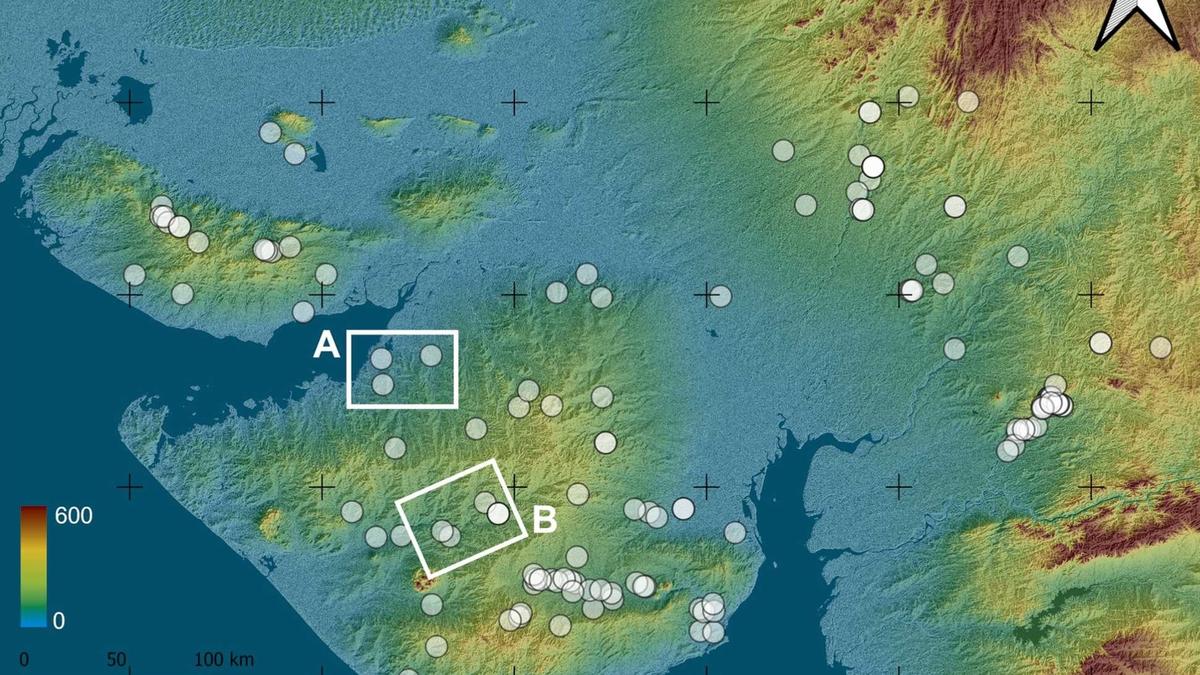
In the study, scientists from the Max Planck Institute for Geoanthropology and the Tübingen University, Germany; the Maharaja Sayajirao University of Baroda, Vadodara; and the University of Philippines investigated the Bhadar and Aji river basins of the Saurashtra peninsula in Gujarat. They discovered artefacts of tools made by early human inhabitants — pieces of chert, jasper, chalcedony, bloodstone, and agate that were chipped again and again to achieve a desired shape and size.

The researchers used a method called relative dating to date these artefacts. In this method, archeologists first identify how deep in the earth an artefact was found. As older civilisations fall and newer ones replace them, the older artefacts become buried deeper. They are thus often found organised in layers. Based on the layer in which an artefact is found, researchers can figure out the layer’s age from older studies that used more precise dating methods (a.k.a. absolute dating).

In this way, the researchers estimated the artefacts found in the Aji and Bhadar river basins were 56,000 to 48,000 years old — around the Middle Palaeolithic age.

Among other things, this period is characterised by an advanced tool-making technique where humans flaked off small pieces from a larger oval piece of stone.

Coast v. hinterland

In 2013, British archaeologist Paul Mellars suggested human ancestors moved from Africa to Australia through coastal routes in the Late Palaeolithic age 40,000-10,000 years ago. If this was true for Saurashtra, the team would have found artefacts indicative of the Late Palaeolithic, particularly sharper blade-like tools. But the researchers wrote in their paper that they found no such tools dating to the Late Palaeolithic.

According to Petraglia, Mellars’s hypothesis “was not based on any convincing archaeological evidence on the coast.”

The researchers also drew on existing models of sea-level changes during the Middle Palaeolithic. From these models, they deduced “Saurashtra would have been a vast landmass connected to Kutch in the north, Makran in the northwest, and the Western Ghats in the southeast,” according to their paper. In other words, the sites the researchers studied would have been much farther from the coast in the Middle Palaeolithic.

Together with the fact that other Middle Palaeolithic sites have been found in “central and peninsular India”, the authors have suggested that human ancestors moved inland to disperse across the Indian subcontinent instead of sticking to the coast.

Petraglia also said that if the humans had indeed stayed on the coast, they would have depended on “marine resources like fish and shellfish” for food — whereas the current study found no such evidence.

Thus, it seems people arrived at the Saurashtra peninsula in the Middle Palaeolithic and explored the Indian landmass — both by dispersing away from the coast and using inland routes.

Beyond the debate

According to Shanti Pappu, visiting professor of archaeology at Krea University, Andhra Pradesh, the study’s strength lies in providing new data from“an important region in Indian prehistory”. At the same time, she said “precise dating must be done to confirm” the age of these artefacts, which the researchers also said in their paper.

Pappu, who is also secretary of the Sharma Centre for Heritage Education, agreed there is mounting evidence disputing a purely coastal migration of human ancestors but she also advised caution: “debates on coastal movements for this time period are difficult to prove or disprove, owing to the lack of securely dated sites on the land and the submergence of other sites” due to the later rise in sea levels.

Like Pappu, Gyaneshwar Chaubey, a professor of biological anthropology at the Banaras Hindu University, said that the study is a prompt to move beyond the “debate on dispersal”. “The current study highlights a broader expansion of Palaeolithic occupation in the Saurashtra region, encompassing coastal margins, hinterlands, and inland areas,” he said.

Sayantan Datta is a science journalist and a faculty member at Krea University.

Published – December 11, 2024 05:30 am IST


Source link

Science

Post navigation

Previous Post: Syrian Rebels Say Take Control Of Eastern City Of Deir Ezzor
Next Post: Trump names Andrew Ferguson as head of Federal Trade Commission to replace Lina Khan

Related Posts

  • Secrets in the sky: What’s in the sky this July
    Secrets in the sky: What’s in the sky this July Science
  • Reclaiming India’s fragrance heritage — why a name matters
    Reclaiming India’s fragrance heritage — why a name matters Science
  • NISAR mission launch highlights: GSLV-F 16 successfully places NISAR satellite in orbit
    NISAR mission launch highlights: GSLV-F 16 successfully places NISAR satellite in orbit Science
  • Two forerunners that set the stage for ISRO’s Gaganyaan test
    Two forerunners that set the stage for ISRO’s Gaganyaan test Science
  • Science Snapshots: April 26, 2026
    Science Snapshots: April 26, 2026 Science
  • Bringing underwater experience to the visually-challenged, Accessible Science Corner unveiled in Chennai
    Bringing underwater experience to the visually-challenged, Accessible Science Corner unveiled in Chennai Science

More Related Articles

Sci-Five | The Hindu Science Quiz: On Cloning Sci-Five | The Hindu Science Quiz: On Cloning Science
Sci-Five | The Hindu Science Quiz: On Ozone Sci-Five | The Hindu Science Quiz: On Ozone Science
How did kangaroos evolve to hop? How did kangaroos evolve to hop? Science
Unwrapping India’s plastic packaging problem: from boom to crisis Unwrapping India’s plastic packaging problem: from boom to crisis Science
Union Minister Hardeep Singh Puri inaugurates India Energy Week 2025  Union Minister Hardeep Singh Puri inaugurates India Energy Week 2025  Science
Offshore wind set to triple by 2030 despite U.S. slowdown, says report Offshore wind set to triple by 2030 despite U.S. slowdown, says report Science
SiteLock

Archives

  • May 2026
  • April 2026
  • March 2026
  • February 2026
  • January 2026
  • December 2025
  • November 2025
  • October 2025
  • September 2025
  • August 2025
  • July 2025
  • June 2025
  • May 2025
  • April 2025
  • March 2025
  • February 2025
  • January 2025
  • December 2024
  • November 2024
  • October 2024
  • September 2024
  • August 2024
  • July 2024
  • June 2024
  • May 2024
  • April 2024
  • March 2024
  • February 2024
  • January 2024
  • December 2023
  • November 2023
  • October 2023
  • September 2023
  • August 2023
  • July 2023
  • June 2023
  • May 2023
  • April 2023
  • March 2023
  • February 2023
  • January 2023
  • December 2022
  • November 2022
  • October 2022
  • September 2022
  • August 2022
  • July 2022
  • June 2022
  • May 2022

Categories

  • Business
  • Nation
  • Science
  • Sports
  • World

Recent Posts

  • FIR against Tumakuru madrasa management after 24 runaway children allege abuse and forced labour
  • Six die in an accident in Tiruppur district
  • Stock markets pare early gains; trade lower
  • Watch: Trump: ‘Believe it or not, we’re going to get a settlement between Russia and Ukraine’
  • PM Modi reduces convoy size: Sources

Recent Comments

  1. DavidAnymn on UP Teacher Who Asked Students To Slap Muslim Classmate
  2. Jesusetexy on UP Teacher Who Asked Students To Slap Muslim Classmate
  3. JeffryFok on UP Teacher Who Asked Students To Slap Muslim Classmate
  4. StanleyPeapy on UP Teacher Who Asked Students To Slap Muslim Classmate
  5. RonaldLam on UP Teacher Who Asked Students To Slap Muslim Classmate
  • T20 is all about being proactive and backing one’s instincts: Deepak Hooda
    T20 is all about being proactive and backing one’s instincts: Deepak Hooda Sports
  • Sensex jumps 416 points to hit new record peak in early trade
    Sensex jumps 416 points to hit new record peak in early trade Business
  • Kylian Mbappe Injury Leaves France To Prepare Plan B At Euro 2024
    Kylian Mbappe Injury Leaves France To Prepare Plan B At Euro 2024 Sports
  • Booker Prize: Canadian-Hungarian-British writer David Szalay wins for fiction with his novel ‘Flesh’
    Booker Prize: Canadian-Hungarian-British writer David Szalay wins for fiction with his novel ‘Flesh’ World
  • TII, Classic Legends to license BSA trademarks under JV
    TII, Classic Legends to license BSA trademarks under JV Business
  • Access Denied Business
  • U.K. charges three men with arson over attack on Jewish community ambulances
    U.K. charges three men with arson over attack on Jewish community ambulances World
  • Access Denied Business

Editor-in-Chief:
Mohammad Ariff,
MSW, MAJMC, BSW, DTL, CTS, CNM, CCR, CAL, RSL, ASOC.
editor@artifex.news

Associate Editors:
1. Zenellis R. Tuba,
zenelis@artifex.news
2. Haris Daniyel
daniyel@artifex.news

Photograher:
Rohan Das
rohan@artifex.news

Artifex.News offers Online Paid Internships to college students from India and Abroad. Interns will get a PRESS CARD and other online offers.
Send your CV (Subjectline: Paid Internship) to internship@artifex.news

Links:
Associate Journalism
About Us
Privacy Policy

News Links:
Breaking News
World
Nation
Sports
Business
Entertainment
Lifestyle

Registered Office:
72/A, Elliot Road, Kolkata - 700016
Tel: 033-22277777, 033-22172217
Email: office@artifex.news

Editorial Office / News Desk:
No. 13, Mezzanine Floor, Esplanade Metro Rail Station,
12 J. L. Nehru Road, Kolkata - 700069.
(Entry from Gate No. 5)
Tel: 033-46011099, 033-46046046
Email: editor@artifex.news

Copyright © 2023 Artifex.News Newsportal designed by Artifex Infotech.