




To synthesise a carbon nanostructure that was “blacker than black”, Ananya Sah and C. Subramaniam started with a material that was white.
In Prof. Subramaniam’s laboratory in IIT Bombay, Dr. Sah heated a special form of silicon dust called DFNS (for dendritic fibrous nanosilica) in a furnace. Once heated, she introduced acetylene gas into the chamber. The white powder turned black – a sign that carbon had been deposited on the DFNS.
Then she collected the black powder and treated it with a strong chemical that dissolved the DFNS away, leaving carbon particles behind.
The structure of the silicon particles – 50-1,200 nanometers in size – resembled spikes arranged around a sphere. With the silicon filling taken away, what was left behind were little carbon beads whose surfaces were pocked with cone-shaped pits. In effect, the beads were spherical nanostructures composed of carbon cones.
Unprecedented efficiency
When Dr. Sah and Prof. Subramaniam examined some of these spheres under a microscope, they were struck by the particles’ appearance: like tiny marigold flowers, made only of carbon. They called the material carbon nanoflorets.
In a paper published in September in ACS Applied Materials & Interfaces, a team led by Prof. Subramaniam reported that these nanoflorets could absorb sunlight at many frequencies and convert it to heat with an unprecedented efficiency.
The nanoflorets also didn’t easily dissipate the heat generated into the environment, making the material a good candidate to heat other materials, like water, using solar energy, the paper noted.
Vivek Polshettiwar, professor of chemistry at the Tata Institute of Fundamental Research, Mumbai, and leader of the team that invented DFNS in 2010, told this writer that the study’s results underscore the particles’ “excellent societal utility”.
Two different techniques
According to Prof. Polshettiwar, this isn’t the first time such carbon nanomaterials have been synthesised. In 2018, his own group had reported identical structures that it dubbed “carbon nanospheres with wrinkled cages”.
But, he added, his and Prof. Subramaniam’s work differed in the techniques used to deposit carbon on the DFNS template (although this didn’t affect the characteristics of the product).
Prof. Polshettiwar’s team used formaldehyde-phenol polymerisation chemistry whereas Prof. Subramaniam’s team used chemical vapour deposition (CVD). In CVD, volatile compounds like acetylene are used to deposit a thin carbon film on the silicon-dust template.
‘Blacker than black’
The new study sprang from what Prof. Subramaniam called a “keen observation” by Dr. Sah: the nanoflorets were “extremely black – blacker than black” in colour, she had reportedly said.
“Anything which is very black basically means that it is a good absorber of light,” according to Prof. Subramaniam.
What happens to the absorbed light? The team conducted experiments to demonstrate that the nanoflorets converted the light energy they absorbed into thermal energy – a process called solar-thermal conversion – with a remarkable efficiency of 87%.
This is the “highest among known materials,” the authors wrote in their paper.
Unusual properties
The carbon nanoflorets’ high efficiency comes from three properties.
First: the nanoflorets absorb three frequencies in sunlight – infrared, visible light, and ultraviolet. Other common materials for solar-thermal conversion, like photovoltaic materials used in solar panels, absorb only visible and ultraviolet light.
More than half of the energy in sunlight arrives to the earth as infrared radiation. So the nanoflorets can absorb much more energy from the sun.
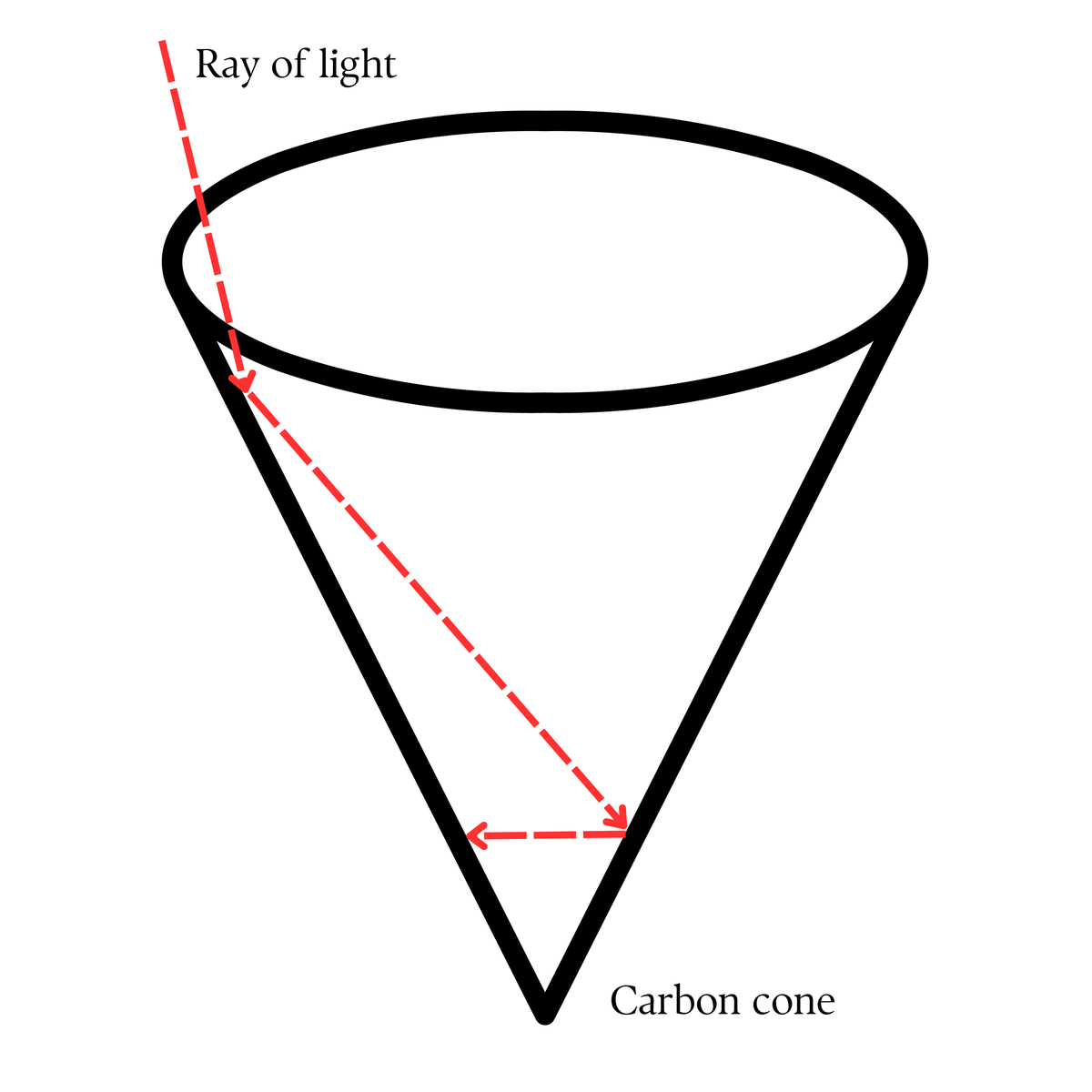
The other two properties responsible for the material’s high light-heat conversion efficiency are a result of its shape. As light falls on the material, the carbon cones ensure that very little is reflected back. Instead, most light is reflected internally.
A simple schematic diagram showing the path of sunlight insight a carbon nanofloret.
| Photo Credit:
Sayantan Datta
Second, one risk with a material that can convert sunlight into heat is that it can also lose it to its environment. The carbon nanoflorets don’t, however, thanks to long-range disorder: parts of the structure at some distance from each other possess different physical properties. As a result, heat waves in the material aren’t carried over long distances, reducing the amount of heat dissipated away.
Taken together, the carbon nanoflorets efficiently absorb sunlight and convert to a remarkable degree into heat, Prof. Subramaniam said.
Patented product
In their study, the researchers reported that a 1 m sq. coating of carbon nanoflorets on a surface could vaporise 5 litres of water in an hour – which, Prof. Subramaniam said in a statement, is “at least five-times better than commercial solar stills”.
The researchers have also applied for and recently received a patent for the nanoflorets, and are excited about commercialising them.
T. Pradeep, a professor of chemistry at IIT Madras, told this writer that the material is ripe for commercialisation because carbon is inexpensive and the nanoflorets can generate heat sustainably, without having to burn fossil fuels.
“India is a country that is blessed with a lot of light, but also has areas that have low temperatures,” Prof. Pradeep said. In such regions, the nanofloret coatings can help heat up housing and sterilise surfaces in hospitals, he added.
When Prof. Subramaniam’s team applied to the IIT Bombay Alumni Network for funding to commercialise the material, one of the persons who evaluated the proposal was Hemant Kanakia, an alumnus and serial entrepreneur. Dr. Kanakia called the proposal the “best among the lot of 36 proposals” he checked.
Other than the nanoflorets’ remarkable properties, they could generate ecologically sustainable heating, he said.
No risks found so far
“Given that the material can be coated on a vast variety of surfaces, it can heat up those using sunlight. If one were to use a coating of this material to heat up their homes, they would be doing so in an ecologically sound way while reducing the carbon footprint,” Dr. Kanakia added.
According to an institute statement, Prof. Subramaniam’s team has already found that the nanoflorets can be coated on paper, metal, and terracotta clay.
Prof. Subramaniam also said that the nanoflorets pose no risk of inhalation: “once coated, the adhesion is nearly as good as paint on a wall.” When they tested the stability of the coating, they found that it had a “minimum lifetime of 8 years”.
Prof. Polshettiwar agreed, adding that more tests could clarify whether the coating might degrade faster under more heat or sunlight.
Efficient heating solution
“It is remarkable that a professor who started out with a fundamental discovery was actually interested in going beyond writing an academic paper and seeking an actual application,” according to Dr. Kanakia, who studied electrical engineering at IIT Bombay. “We need more such researchers in our education system.”
Prof. Subramaniam is currently building a startup to be incubated by IIT Bombay. Its first goal is to scale up the production of the coating, which it will then sell to companies looking for efficient heating solutions.
The researchers are also studying the nanoflorets’ other physical and chemical properties and potential applications. “Given its unique structural and morphological properties, we believe it has a wide range of unexplored applications,” Dr. Sah said.
Sayantan Datta (they/them) are a queer-trans freelance science writer, communicator and journalist. They are currently a faculty member at Krea University and tweet at @queersprings.