





An ambitious public-private partnership project by an Agriculture Ministry body to install automatic rain gauges and automatic weather stations in States is proceeding at a crawl, with completion rates in the single digits and at least a year behind deadline. Over 96% of planned sensors are yet to be installed.
The reason, companies tasked with the implementation say, is a paucity of land to install these weather stations and an alleged “retrospective” insistence by the India Meteorological Department (IMD) that these sensors be set up on the ground rather than on rooftops.
The Weather Information Network and Data System (WINDS) is a programme to set up a nationwide network of weather sensors to supply hyper-local weather data. This is mainly to aid in computing insurance estimates and payouts under the Pradhan Mantri Fasal Bima Yojana (PMFBY). It is run by the Ministry of Agriculture and Farmers Welfare, and executed through the Mahalanobis National Crop Forecast Centre (MNCFC).
Over 50,000 sensors planned
Under the WINDS network, the States, through their implementing private partners, are required to set up the sensor network. The Hindu could confirm that three companies — Skymet Weather Services; Ingen Technologies Private Limited, a wholly-owned subsidiary of Weather Risk Management Services; and Azista Industries — were collectively asked to instal 1,197 automatic weather stations (AWSs) and 49,313 automatic rain gauges (ARGs), or about 50,500 sensors in all.
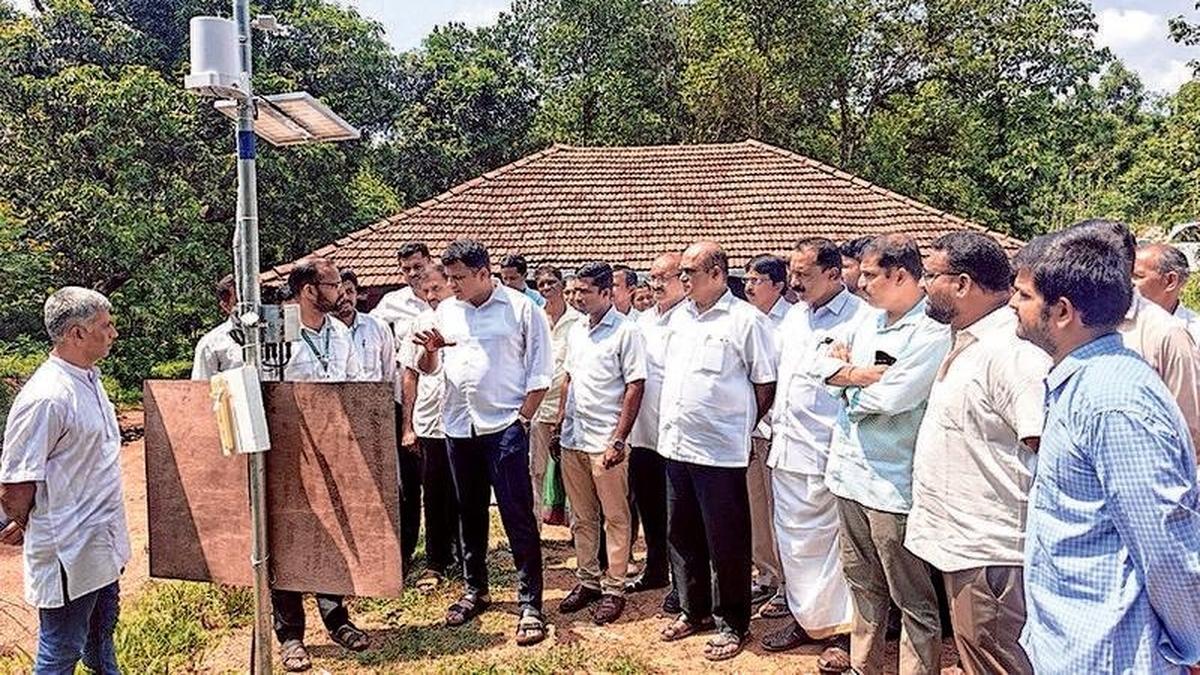
An ARG measures rainfall only, though about 10% of ARGs at the gram panchayat level also carry a temperature sensor. An AWS measures rainfall along with air temperature, relative humidity, wind speed, and wind direction. Data from these sensors flow into data centres run by government agencies, to prepare hourly, daily, and fortnightly forecasts.
Majority of proposed sites rejected
According to documents viewed by The Hindu, Uttar Pradesh was to have installed 27,487 ARGs — over half the ARG target — followed by Uttarakhand (7,983), Odisha (7,286), Assam (2,140), and Himachal Pradesh (about 3,550).
For AWSs, Odisha’s target was the largest at 434, ahead of Assam (196), U.P. (157), and Kerala (148). According to a status update on September 9 — the latest that The Hindu was able to confirm — the network has delivered 113 AWSs (9.4% of target) and 1,730 ARGs (4%), leaving a shortfall of about 48,700 (96%).
The bottleneck is mostly site selection rather than hardware, the documents reveal. Of the 27,644 sites in U.P., 16,478 were rejected. In Odisha, 5,666 of 7,720 sites were rejected, while 524 of 946 sites were rejected in Kerala. The documents also flag hundreds of “duplicate sites” that were approved at the panchayat and block level but need re-checking, sites pending clearances, and those which the States have yet to share with the implementing partners.
Retrospective changes
A representative of one of the private partner companies, who asked not to be named, told The Hindu that the delays stem from a shortage of suitable land and from the requirement that rain gauges be placed on the ground rather than on rooftops. He blamed changes made to the WINDS guidelines “retrospectively.”
The manual published on September 1, 2023 allowed an ARG to be placed on the roof of a single-storey building where siting requirements could not be met or in flood-prone areas, he claimed, adding that the IMD had approved this as a member of the WINDS Committee. About two and a half years later, and after six States had already issued tenders or work orders, the Agriculture Department amended the manual on the IMD’s advice on December 3, 2025, to retroactively limit rooftop ARGs to just 10% to 15% of the total, he said.
‘Height affects weather data’
IMD officials contend that the requirement that ARGs and AWSs be located on the ground is “essential” to ensure that the data collected is accurate.
“The underlying principle – and this is a requirement of the World Meteorological Organisation whose guidelines we adhere to – is that sensors must be on the ground and only in exceptional situations be situated on rooftops. Height significantly affects weather data,” S. Hosalikar, a former senior meteorologist with the IMD and a member of the 2023 committee, told The Hindu.
The 2023 document says: “ARGs shall be located on a level piece of ground, covered with short grass or natural earth,” ideally 4×3 metres in size. “If suitable siting requirements are not met or in case of flood prone areas,” the ARG can go on “the rooftop of the one-story building… rooftop units need a stable foundation and a tamper-proof setup,” adds the document, which was perused by The Hindu.
Cap on rooftop sensors
The manual sets no numerical cap on rooftop units. This only appears in the 2025 amendment which specifies a 10% cap. It also requires that rooftop installations be allowed only if States issue a justification note saying there is no suitable ground space. In flood- or landslide-prone regions, the ceiling is 15%, with prior State recommendation and approval sent to the WINDS Committee.
“Measuring rainfall from the top of the building and from the ground makes a significant difference as some part of falling rain evaporates. Secondly, a consistent network of ground-based sensors is necessary to ensure standardised data, which is difficult to achieve if sensors are on rooftops (with variable heights). India lives in its villages and it should not be that challenging to get small plots of land,” IMD director general M. Mohapatra told The Hindu. He underlined that the IMD was only a technical partner for the project and was not administering it.
The Hindu reached out to Soumya Bandopadhyay, director of the MNCFC, the nodal agency in charge of the project, seeking a comment but did not get any response till the time of going to press.
Published – October 15, 2026 11:02 pm IST