



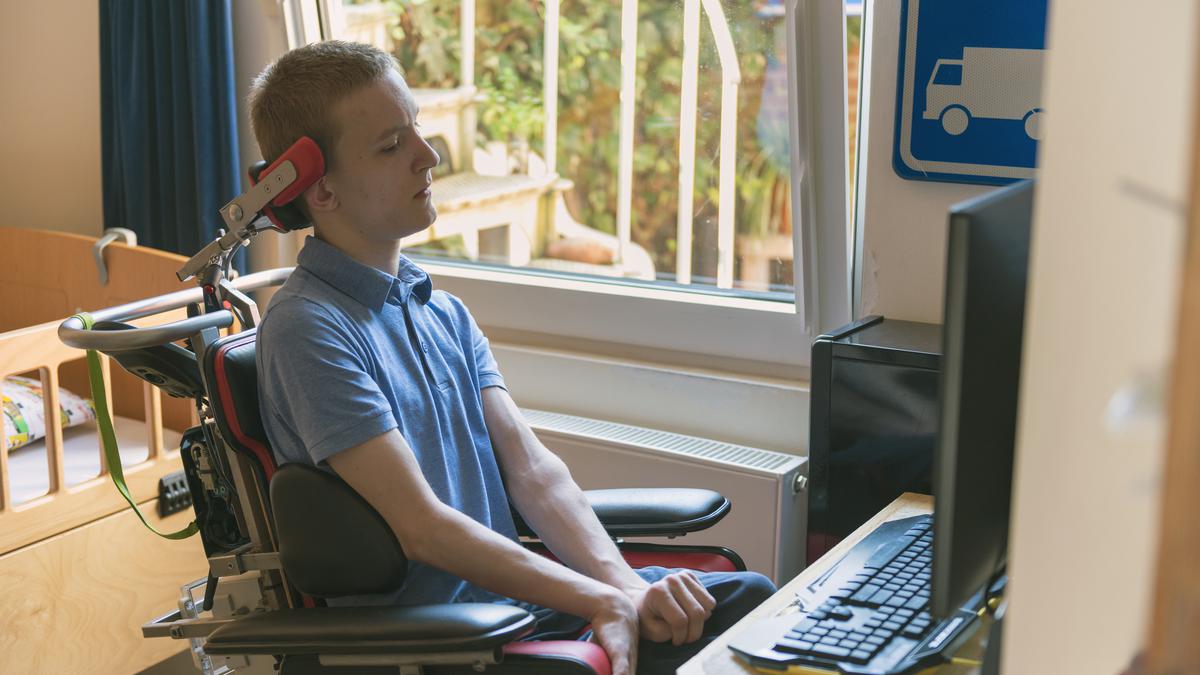
The only way Nita Parekh (69) of Pune, is able to communicate with her family and, on rare occasions, with others is by blinking her eyes and nodding slightly. “The last time I saw her standing was probably in August 2021”, said Sohil Parekh (45), Mrs. Parekh’s only child and primary caregiver, along with his father. Unable to move a muscle below her neck, Mrs. Parekh has been bedridden for almost two years due to the debilitating effects of a rare disease called Amyotrophic Lateral Sclerosis (or ALS).
ALS is a neurodegenerative disease in which special nerve cells called motor neurons in the brain and spine – which control an individual’s voluntary functions like walking, chewing, talking, moving their arms- are affected. As these nerve cells progressively die, the muscles dependent on them are unable to function or move, due to which they begin to atrophy or waste away. ALS is a progressive disease. “Once it involves the motor neurons that regulate respiratory muscles, breathing gets affected’, explains Joy Desai, a neurologist in Mumbai.
Currently, there is no effective cure for ALS and the best therapies are drugs and other interventions that could lengthen the life of the person with ALS (or PALS). While the disease progresses differently in each individual, the average survival time is three years , according to The ALS Association, a non-profit organisation, or between 20 to 48 months on an average, according to a study by Chio et. al, 2009.
Difficulty with the diagnosis
From the onset of symptoms, it takes around 8 to 15 months for diagnosis, according to a study by Paganoni et. al. That is because there are also no definite biomarkers yet.
This amount of time between the onset of symptoms and confirmed diagnosis is agonising for the caregivers and PALS.
“For ALS, motor cell failure needs to be detected in at least 2 regions of the body; either one of the upper limbs or any of the lower limbs, and one more region like the bulbar region which controls the muscles needed for swallowing, speaking, chewing, and other functions”, Dr. Desai says. Suppose one comes in with just one symptom like one hand not working like before or a leg that drags, then that is not enough for it to be diagnosed as ALS, he adds.
Changes in ways of living
Usha Gupta’s symptoms started appearing from February that year, but it wasn’t until December that she was diagnosed with ALS. While it was a shock that Mrs. Usha [61] had been struck with an incurable and fatal disorder, it also came with the difficulties of transforming her son Ajay’s and her husband’s lives.
Being a caregiver is a challenging task for a loved one. “Right now, she is completely bedridden, and has to be tube fed”, said Ajay. Like Mrs. Nita, the only way Mrs. Usha is able to communicate is by blinking. Ajay had to give up attempts at the CA final exams, and now, he is on medication to help him cope with depression, faces the daily worry of a nurse or aayah (nursemaid) not showing up for work – wherein he’d have to skip work and help out, and a medical emergency given his mother’s advanced stage of ALS.
Caregivers are completely uprooted from their routine. In Mumbai, Devaunshi Talsania [39], whose mother, Veena Doshi, succumbed to ALS in October 2017, mentioned, “From 9 in the morning to 10 in the night, I used to be by my mother’s side because she needed help for each and every thing. I took her to the washroom every morning, and also bathed her since I was the only female help accessible to her.” Devaunshi had to quit her job, so that she could visit her mother every single day. “Of course it affected a lot of areas of my life, whether it’s my overall health or social life. But at the end of the day that is nothing compared to the fact that my mother needed me”, she said.
The mental health of the PALS, and their caregivers is affected severely. A 2021 study called ‘Prevalence of depression among amyotrophic lateral sclerosis (ALS) patients: A systematic review and meta-analysis’ by Heidari et. al. draws the conclusion that there is a high prevalence of depression among people with ALS, affecting their quality of life and mobility.
“My mother was very independent and active. She lost her desire to meet people, even her siblings, or socialise because she hated receiving sympathy, and for others to see her in that [paralysed] state. She was very depressed”, said Devaunshi.
Infrastructural inefficiencies
Out of the many problems that affect the quality of life of a PALS, one of them is the lack of accessibility of those restricted to a wheelchair due to infrastructural inefficiencies. While it was next to impossible for Devaunshi to take her mother down from the first floor to a park nearby, as she lived in an 80 year-old building which is not wheelchair-friendly, Ajay does not take his mother out of the residential complex, due to the fear of safety and the lack of empathy he experienced from car and bike drivers in Kolkata.
“If I had to compare what I witnessed in the U.S. and in India, when it came to how wheelchair-friendly they are, I’d say that in India, accessibility does not exist. It’s ironic that even the office of the neurologist we went to was not accessible”, said Sohil. Due to the lack of space in their home in Mumbai, Sohil and his family moved to a bigger flat in Pune, where navigating with a wheelchair is possible. “My mother was active and would go for Satsang daily too. We also had to make modifications to our car so that a wheelchair could be integrated to it. Ramps, lifting equipment, commode chairs, are few tools that we acquired to help with mobility”, Sohil explained.
ALS does not distinguish between the rich and the poor, but the financial demands it makes are staggering, if one pursues treatment. Ajay spends over Rs. 1 lakh monthly for his mother. “Medications are around Rs. 35-40,000 every month. We have to hire a nurse and a nursemaid as well. So if you add up the medication cost, salaries, cost of daily physiotherapy, and the opportunity cost, you could say that I easily spend around 1.2-1.5 lakhs per month”, he broke it down.There is no insurance cover for persons with ALS.
Rare disease tag
A salient feature of the Union Government’s National Policy for Rare Diseases (NPRD), 2021, is that ‘financial assistance up to Rs. 50 lakh will be provided to the patients suffering from any category of rare diseases and getting treatment in any of the Centre of Excellence identified’.
The World Health Organisation (WHO) defines a rare disease as an ‘often debilitating lifelong disease or disorder with a prevalence of 1 or less, per 1000 population’. However, the NPRD also states the average prevalence threshold used to define rare diseases is from 1 to 6 in 10,000 people.
Six out of one lakh people have ALS, according to a study called “Global Epidemiology of Amyotrophic Lateral Sclerosis: A Systematic Review of the Published Literature” by Chio et. al. This amounts to less than 1 in 10,000 having ALS, and thus, should qualify as a ‘rare disease’ in India, as per the definitions stated in the NPRD.
(Gautam.doshi@thehindu.co.in)