


Skip to content
  • Facebook
  • X
  • Linkedin
  • WhatsApp
  • YouTube
  • Associate Journalism
  • About Us
  • Privacy Policy
  • 033-46046046
  • editor@artifex.news
Artifex.News

Artifex.News

Stay Connected. Stay Informed.

  • Breaking News
  • World
  • Nation
  • Sports
  • Business
  • Science
  • Entertainment
  • Lifestyle
  • Toggle search form
  • Access Denied
    Access Denied Nation
  • Women’s T20 World Cup 2024: Australia On Brink Of Semifinals After Dominant Win Over Pakistan
    Women’s T20 World Cup 2024: Australia On Brink Of Semifinals After Dominant Win Over Pakistan Sports
  • Climate change triggered intensified rain, wind in Hurricane Milton: experts
    Climate change triggered intensified rain, wind in Hurricane Milton: experts World
  • Govt. approves fifth edition of credit guarantee scheme, extends cover to airlines
    Govt. approves fifth edition of credit guarantee scheme, extends cover to airlines Business
  • What is China’s panda diplomacy? | Explained
    What is China’s panda diplomacy? | Explained World
  • NYC Mayor Zohran Mamdani to urge King Charles III to return Koh-i-Noor diamond
    NYC Mayor Zohran Mamdani to urge King Charles III to return Koh-i-Noor diamond Nation
  • Video Claiming PM Referred To ‘Panj Pyare’ As His Uncle Is Fake
    Video Claiming PM Referred To ‘Panj Pyare’ As His Uncle Is Fake Nation
  • Access Denied
    Access Denied Nation
In manifesto, scientists oppose ‘militarisation’ of quantum research

In manifesto, scientists oppose ‘militarisation’ of quantum research

Posted on February 22, 2026 By admin


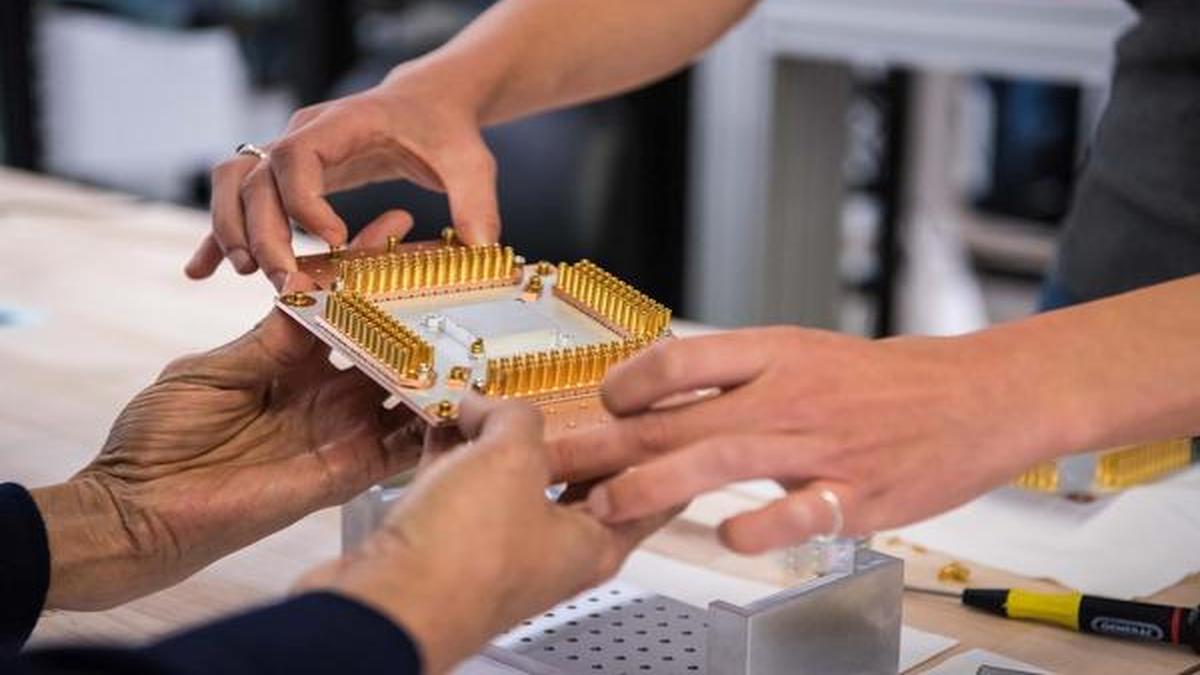
A group of quantum researchers has issued a manifesto urging colleagues to resist what it calls the “militarisation” of quantum science. The authors, who describe themselves as “Quantum Scientists for Disarmament”, say they oppose military uses of quantum research, reject military funding for academic work, and want universities to disclose which quantum projects take defence money.

The manifesto, uploaded to the arXiv repository on the web on January 13, frames its call as a response to wider trends in rearmament and the spread of dual-use technologies, i.e. those that claim civilian value while also serving defence goals. The group proposes four immediate steps: to speak as a collective against military use, to force an ethics debate inside the field, to create a forum for concerned researchers, and to establish a public database listing defence-funded projects at public universities.

“We still believe that war must be utterly rejected as a means of settling international disputes, and that peace can only be guaranteed by diplomacy, international treaties, and cooperation, rather than by mutual assured destruction,” the manifesto says. “As scientists working in a non-neutral research field, we can raise our voices toward that aim.”

Military patronage

The researchers argue that quantum physics is no longer just basic science and that its military applications have become evident. These include quantum communications, space and drone sensing, high-precision timing for navigation, and surveillance.

The manifesto says that NATO, for example, has located its quantum physics work inside its broader “emerging and disruptive technologies” agenda and released a public quantum strategy summary in 2024 that described research in this field as an element of strategic competition. European institutions have also described quantum physics as relevant to defence projects, with the European Commission describing quantum sensors as offering performance improvements for military operations.

The manifesto also says India’s National Quantum Mission works in “strong collaboration” with the public and private defence sectors. Late last month, India’s Chief of Defence Staff released a ‘Military Quantum Mission Policy Framework’ to guide how the armed forces plan to integrate quantum technologies.

Researchers don’t always see the defence implications of a project at the outset. Even when partial information exists, institutions can hide it behind funding structures and partnership vehicles. This is why they say they’ve called for a public database, to force agencies and institutions to be clear about who funds what, and to reduce the room for any actors to deny their involvement after a technology finds its way into a military application.

Military patronage has a long history in physics, a field in which it has often shaped research agendas without always dictating the day-to-day contents of experiments. Quantum physics itself grew out of attempts in the early 20th century to explain atoms and light, work associated with figures such as Max Planck, Albert Einstein, Niels Bohr, Werner Heisenberg, and Erwin Schrödinger. But the second half of the century pushed quantum ideas into devices like atomic clocks, masers and lasers, and semiconductor physics, all of which states treated as strategic technologies.

Accounts of the development of quantum electronics and universities’ incentives and organisational structures during the Cold War have paved the way for debates about whether such patronage only accelerated research or also changed its direction, and about how much agency scientists have retained inside these funding systems.

The Defense Advanced Research Projects Agency (DARPA) at the U.S. Department of Defence is also famed for directly funding quantum information science for decades. 

‘Soft power’

Today, however, quantum physics, cyber security, advanced artificial intelligence, and space systems are all capabilities that governments want to control, scale, and weaponise, often with the anxiety that their rivals might do so first.

The manifesto acknowledges that the greater threat isn’t every piece of quantum research leading to a weapon but that defence-linked funding can reshape the whole ecosystem in the military establishment’s favour. This is mainly because its funding is stable, which is attractive for students and universities.

“The expansion of military funding for both basic and applied research on emerging technologies, including quantum technologies, is not limited to the world’s major military powers. In a broader context, this opaque expansion often takes the form of asymmetric military-academic partnerships between the defense departments of powerful nations and academic institutions of the Global South,” the manifesto adds.

“This strategy serves as a subtle mechanism through which hegemonic countries impose their ‘soft’ power over nations of the Global South. For instance, from the perspective of states that can spend less of their public money on science, these funds can support projects that would not be executed otherwise, and help maintain pre-existing infrastructure and personnel, appearing as nearly irrecusable offers.”

mukunth.v@thehindu.co.in

Published – February 22, 2026 03:39 pm IST



Source link

Science

Post navigation

Previous Post: Access Denied
Next Post: Access Denied

Related Posts

  • High costs, poor training deepen India’s stinging snakebite toll
    High costs, poor training deepen India’s stinging snakebite toll Science
  • ‘Online education is one of the biggest finds of the last decade’
    ‘Online education is one of the biggest finds of the last decade’ Science
  • How does a speed gun work?
    How does a speed gun work? Science
  • South Africa petrochem unit world’s single largest greenhouse gas source
    South Africa petrochem unit world’s single largest greenhouse gas source Science
  • After Pragyan, lander Vikram also put in sleep mode 
    After Pragyan, lander Vikram also put in sleep mode  Science
  • Science News: With lunar missions looming, scientists grow chickpeas in ‘moon dirt’
    Science News: With lunar missions looming, scientists grow chickpeas in ‘moon dirt’ Science

More Related Articles

India set to transition to hyperlocal extreme weather forecasting India set to transition to hyperlocal extreme weather forecasting Science
Why Cambodia’s novel H5N1 reassortant virus needs close monitoring Why Cambodia’s novel H5N1 reassortant virus needs close monitoring Science
The Science Quiz | Cholesterol The Science Quiz | Cholesterol Science
Why do we get headaches? Why do we get headaches? Science
Brains that don’t see in greyscale first over-rely on colours: Project Prakash study Brains that don’t see in greyscale first over-rely on colours: Project Prakash study Science
A planet on the edge: are Saturn’s rings older than they look? A planet on the edge: are Saturn’s rings older than they look? Science
SiteLock

Archives

  • May 2026
  • April 2026
  • March 2026
  • February 2026
  • January 2026
  • December 2025
  • November 2025
  • October 2025
  • September 2025
  • August 2025
  • July 2025
  • June 2025
  • May 2025
  • April 2025
  • March 2025
  • February 2025
  • January 2025
  • December 2024
  • November 2024
  • October 2024
  • September 2024
  • August 2024
  • July 2024
  • June 2024
  • May 2024
  • April 2024
  • March 2024
  • February 2024
  • January 2024
  • December 2023
  • November 2023
  • October 2023
  • September 2023
  • August 2023
  • July 2023
  • June 2023
  • May 2023
  • April 2023
  • March 2023
  • February 2023
  • January 2023
  • December 2022
  • November 2022
  • October 2022
  • September 2022
  • August 2022
  • July 2022
  • June 2022
  • May 2022

Categories

  • Business
  • Nation
  • Science
  • Sports
  • World

Recent Posts

  • Kohli’s masterful knock powers Royal Challengers to the top
  • Vijay Narayan earns rare distinction of being Advocate General under two different governments
  • Learn from Sri Lanka’s experience on impact of fertilizer supply chains: experts
  • Sewage pollution of Cooum, groundwater depletion raise alarm
  • Netanyahu’s office says he visited UAE secretly during the Iran war

Recent Comments

  1. NathanQuins on UP Teacher Who Asked Students To Slap Muslim Classmate
  2. Davidgof on UP Teacher Who Asked Students To Slap Muslim Classmate
  3. NathanJobre on UP Teacher Who Asked Students To Slap Muslim Classmate
  4. Davidcag on UP Teacher Who Asked Students To Slap Muslim Classmate
  5. RichardClage on UP Teacher Who Asked Students To Slap Muslim Classmate
  • I am absolutely keen for a comeback, says Shreyas Iyer
    I am absolutely keen for a comeback, says Shreyas Iyer Sports
  • Pant in focus as he returns to competitive action
    Pant in focus as he returns to competitive action Sports
  • Japan and EU announce new defence pact
    Japan and EU announce new defence pact World
  • Left-wing Connolly set to win Irish Presidency as opponents concede
    Left-wing Connolly set to win Irish Presidency as opponents concede World
  • Access Denied World
  • IIT Bombay scientists develop solar heat battery for freezing Himalayan homes 
    IIT Bombay scientists develop solar heat battery for freezing Himalayan homes  Science
  • Myanmar ethnic armed group claims control of border region
    Myanmar ethnic armed group claims control of border region World
  • “Not Going To Give You…”: Ricky Ponting’s Blunt Advice To Out-Of-Form Marnus Labuschagne
    “Not Going To Give You…”: Ricky Ponting’s Blunt Advice To Out-Of-Form Marnus Labuschagne Sports

Editor-in-Chief:
Mohammad Ariff,
MSW, MAJMC, BSW, DTL, CTS, CNM, CCR, CAL, RSL, ASOC.
editor@artifex.news

Associate Editors:
1. Zenellis R. Tuba,
zenelis@artifex.news
2. Haris Daniyel
daniyel@artifex.news

Photograher:
Rohan Das
rohan@artifex.news

Artifex.News offers Online Paid Internships to college students from India and Abroad. Interns will get a PRESS CARD and other online offers.
Send your CV (Subjectline: Paid Internship) to internship@artifex.news

Links:
Associate Journalism
About Us
Privacy Policy

News Links:
Breaking News
World
Nation
Sports
Business
Entertainment
Lifestyle

Registered Office:
72/A, Elliot Road, Kolkata - 700016
Tel: 033-22277777, 033-22172217
Email: office@artifex.news

Editorial Office / News Desk:
No. 13, Mezzanine Floor, Esplanade Metro Rail Station,
12 J. L. Nehru Road, Kolkata - 700069.
(Entry from Gate No. 5)
Tel: 033-46011099, 033-46046046
Email: editor@artifex.news

Copyright © 2023 Artifex.News Newsportal designed by Artifex Infotech.