Skip to content
  • Facebook
  • X
  • Linkedin
  • WhatsApp
  • YouTube
  • Associate Journalism
  • About Us
  • Privacy Policy
  • 033-46046046
  • editor@artifex.news
Artifex.News

Artifex.News

Stay Connected. Stay Informed.

  • Breaking News
  • World
  • Nation
  • Sports
  • Business
  • Science
  • Entertainment
  • Lifestyle
  • Toggle search form
  • Access Denied Sports
  • Access Denied Business
  • SpaceX Falcon 9 may resume flights while FAA probe underway
    SpaceX Falcon 9 may resume flights while FAA probe underway Science
  • Rohit Sharma To Join LSG? South Africa Great Gives Big Verdict, Weighs In On KL Rahul Situation
    Rohit Sharma To Join LSG? South Africa Great Gives Big Verdict, Weighs In On KL Rahul Situation Sports
  • Harmanpreet confident of team’s chances at the World Cup
    Harmanpreet confident of team’s chances at the World Cup Sports
  • Law Tribunal Suggests SpiceJet Settle Issues With Aircraft Lessors
    Law Tribunal Suggests SpiceJet Settle Issues With Aircraft Lessors Nation
  • Team India’s new head coach to take charge from Sri Lanka series: BCCI secretary Jay Shah
    Team India’s new head coach to take charge from Sri Lanka series: BCCI secretary Jay Shah Sports
  • Rane Brake Lining Q1 standalone net slids by 11% to ₹5.2 crore
    Rane Brake Lining Q1 standalone net slids by 11% to ₹5.2 crore Business
As Vikram-1 reaches orbit, Skyroot faces a steep climb to business success

As Vikram-1 reaches orbit, Skyroot faces a steep climb to business success

Posted on July 19, 2026 By admin


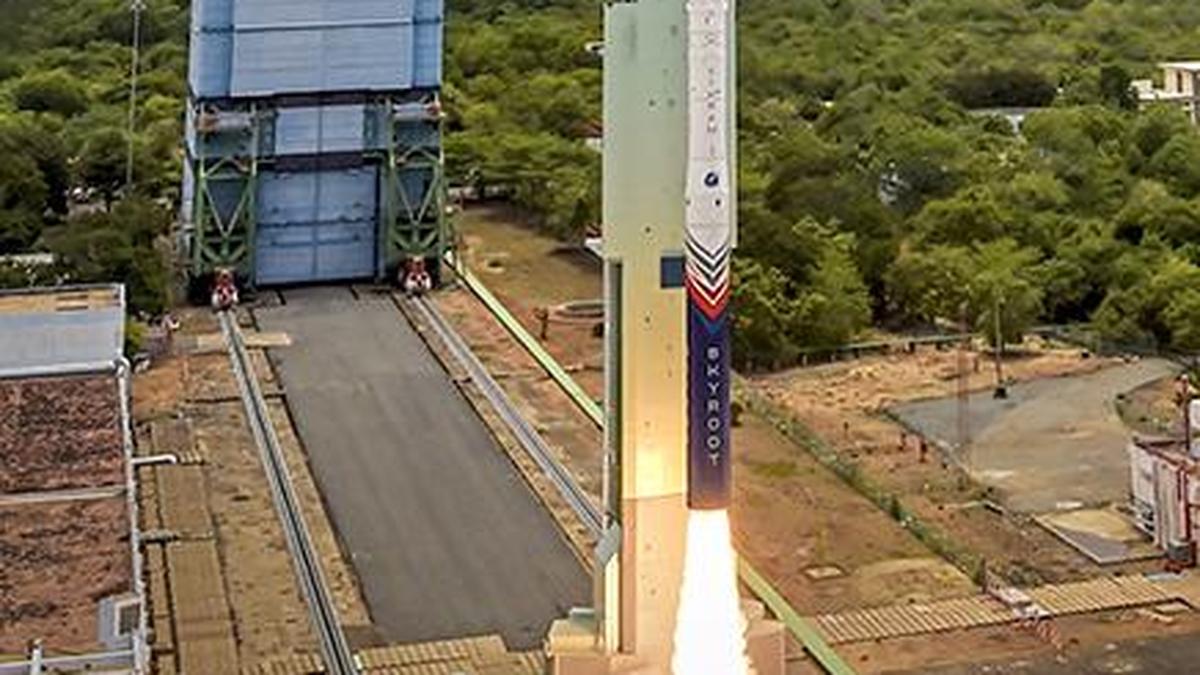
India had its first private orbital rocket launch at 12.05 p.m. on July 18. So far, all orbital rockets India had launched as part of its space programme had been state-funded and led by the Indian Space Research Organisation (ISRO). Hyderabad-based Skyroot Aerospace changed that by launching its small-satellite launch vehicle Vikram-1 to a low-earth orbit. The mission has been dubbed ‘Aagaman’, Hindi for ‘arrival’.

Since 2020, the Indian government has opened the domestic space sector to private companies by creating institutions such as IN-SPACe and allowing private firms to build launch vehicles and use ISRO infrastructure. Thus far, worldwide, only a small number of private companies have successfully developed orbital launch vehicles, including SpaceX, Rocket Lab, Firefly Aerospace, and a clutch of Chinese firms. A similarly short list of others, including ABL Space Systems and Isar Aerospace, are still searching for success.

Significant feat

A successful first flight is a significant feat. Many rockets, including the storied Falcon 9, have failed their maiden flights. But the same feat also shows the full context in which Skyroot is now operating. As a commercial entity, a single launch — crucial though it is — will not catapult the company to success. The global small-satellite launch market is evolving and there are still considerable challenges, including domestic demand and market uncertainties.

Former ISRO engineers Pawan Kumar Chandana and Naga Bharath Daka founded Skyroot Aerospace in 2018. It had its first milestone in 2022 when it successfully launched Vikram-S, the first privately developed Indian rocket on a suborbital flight.

Vikram-1 is a four-stage rocket. The first three stages use solid fuel and the fourth uses liquid fuel. Skyroot has said that once its manufacturing has been streamlined, it will be able to produce one Vikram-1 rocket per month.

Mission Aagaman was a developmental flight of Vikram-1. This means the company tested the rocket by putting it through its paces, especially to check parameters that cannot be fully understood unless the rocket is flying. According to the company, Mission Aagaman was to validate stage separation, propulsion, guidance and navigation, structural performance, avionics, fairing deployment, upper-stage separation, and orbital insertion.

Inserting itself into the intended orbit would have been the mission’s hardest part, as the launch vehicle would have had to accelerate to high speed while maintaining its guidance and propulsion.

It also carried some payloads, although the primary mission focused on the rocket itself. Vikram-1 has a payload capacity of 290 kg to a 500-km sun-synchronous orbit and 480 kg to a low-inclination orbit at similar altitude. Skyroot has said it will have two more developmental flights after this before the rocket will be deemed market-ready.

“The company’s roadmap includes Vikram-2, capable of carrying up to 1,000 kg to low-earth orbit, with its maiden flight targeted for 2027, and a fully reusable launch vehicle, with both booster and upper stage engineered for recovery and reuse,” the company said in a post-launch statement.

Building a business

Building rockets is one thing. Building a business is another — and arguably significantly more valuable. Broadly, the small-satellite launch market in which Skyroot is hoping to excel has become challenging. A successful business today requires growth as well as industrial maturity and access to demand.

In the half-decade until 2021, many forecasts anticipated a boom in the demand for launching satellites weighing 100-500 kg. While the demand has grown since, not every entrant has been equally profitable. Launch vehicle revenues have been growing more slowly than those of satellite manufacturing, creating consolidation pressure. The forecast had assumed demand would be diffused across enterprises but following a series of geopolitical realignments, demand is today increasingly concentrated in satellite constellations.

Skyroot cofounders Naga Bharath Daka and Pawan Kumar Chandana.

Skyroot cofounders Naga Bharath Daka and Pawan Kumar Chandana.
| Photo Credit:
The Hindu

On the cost front, many small-satellite makers are flying their payloads as rideshares on larger rockets, especially the SpaceX Falcon 9. The launch fee has thus dropped dramatically. For added measure, while a launch vehicle dedicated to small satellites will offer flexibility and the option to pick specific orbits to deploy into, satellite-makers still have to pay something of a premium over the lower costs offered by rideshare launches.

The PSLV itself is such a launcher, although public confidence in its abilities has come under a cloud thanks to two successive failures, the reasons for which the government has refused to disclose.

That said, Vikram-1 may have an advantage in the form of India’s lower manufacturing and labour costs, access to ISRO’s infrastructure, and the country’s increasing focus on manufacturing, including of satellites.

Next, startups across Europe, the U.S., China, Japan, and Australia are also developing small-satellite launchers — and many have folded or pivoted away after struggling to secure launch contracts from what is already a small pool of customers. Vikram-1 will also compete with ISRO’s own new Small Satellite Launch Vehicle.

Third, launch services are low-margin and capital intensive, especially when compared to satellite manufacturing, downstream applications, data services, and communications. Then come the costs of compliance for debris mitigation and other regulatory obligations. Of course, Skyroot itself may diversify in future after it has established itself in the sector. India’s own commercial space ecosystem is only just beginning to expand and includes potential future collaborators like Pixxel, Bellatrix Aerospace, and Dhruva Space. Even so, the domestic market remains relatively limited.

Big picture

The big picture is that the Skyroot factory capable of producing 12 Vikram-1 rockets every year will be an asset if there is demand for 12 Vikram-1 launches every year. But even ISRO does not launch 12 small satellites a year today. In other words, Skyroot will have to find and secure international customers.

When it does, it will still have to contend with a simple fact: even when small satellites account for a third of all satellites launched, as some projections have said will be the case in the decade until 2035, they will only account for less than one-tenth of the total launch mass.

None of this diminishes what Skyroot achieved on Saturday. Designing, building, testing, and flying an orbital launch vehicle on the very first attempt is a rare accomplishment anywhere in the world. It is certainly a milestone for India’s private space sector. But it remains that the companies that endure have repeatedly reached orbit through a trustworthy process, at prices customers are willing to pay.

With the success of Mission Aagaman, Skyroot now has an opportunity to build that kind of business.

Published – July 19, 2026 08:00 am IST



Source link

Science Tags:india, Skyroot business success, Vikram-1 launch

Post navigation

Previous Post: What makes Skyroot’s Vikram-1 launch unique? | Explained
Next Post: As Vikram-1 reaches orbit, Skyroot faces a steep climb to business success

Related Posts

  • 18% hike for Department of Space in Union Budget, lion’s share for development of space technologies
    18% hike for Department of Space in Union Budget, lion’s share for development of space technologies Science
  • Snow leopards are the world’s least genetically diverse big cat
    Snow leopards are the world’s least genetically diverse big cat Science
  • Hurricane Melissa a ‘beast’ among a string of monster Atlantic storms
    Hurricane Melissa a ‘beast’ among a string of monster Atlantic storms Science
  • Data from all-civilian crew details health effects of space travel
    Data from all-civilian crew details health effects of space travel Science
  • Forest loss from SE Asia rubber is up to 3 times more than thought: study
    Forest loss from SE Asia rubber is up to 3 times more than thought: study Science
  • Hahnöfersand bone: of contention – The Hindu
    Hahnöfersand bone: of contention – The Hindu Science

More Related Articles

Science quiz: The natural artists called minerals Science quiz: The natural artists called minerals Science
IAF signs MoA with IISc and FSID IAF signs MoA with IISc and FSID Science
Nobel Prize for microRNA find underscores RNA’s primacy in biology Nobel Prize for microRNA find underscores RNA’s primacy in biology Science
How to achieve universal health coverage across India How to achieve universal health coverage across India Science
How a wandering white shark’s epic journey could provide clues for protecting them How a wandering white shark’s epic journey could provide clues for protecting them Science
SpaDeX Mission | Two satellites just 50 feet away for an exciting handshake says ISRO SpaDeX Mission | Two satellites just 50 feet away for an exciting handshake says ISRO Science
SiteLock

Archives

  • July 2026
  • June 2026
  • May 2026
  • April 2026
  • March 2026
  • February 2026
  • January 2026
  • December 2025
  • November 2025
  • October 2025
  • September 2025
  • August 2025
  • July 2025
  • June 2025
  • May 2025
  • April 2025
  • March 2025
  • February 2025
  • January 2025
  • December 2024
  • November 2024
  • October 2024
  • September 2024
  • August 2024
  • July 2024
  • June 2024
  • May 2024
  • April 2024
  • March 2024
  • February 2024
  • January 2024
  • December 2023
  • November 2023
  • October 2023
  • September 2023
  • August 2023
  • July 2023
  • June 2023
  • May 2023
  • April 2023
  • March 2023
  • February 2023
  • January 2023
  • December 2022
  • November 2022
  • October 2022
  • September 2022
  • August 2022
  • July 2022
  • June 2022
  • May 2022

Categories

  • Business
  • Nation
  • Science
  • Sports
  • World

Recent Posts

  • Doctors assault case: Bombay High Court cancels bail of Shiv Sena corporator
  • NY Mayor says still mulling Netanyahu arrest during UN meet
  • Russian missiles strike Kyiv killing one, wounding 13
  • Rahul, Kharge write to PM; seek probe into theft of donations at Ayodhya Ram temple
  • Man found murdered in Kozhikode

Recent Comments

  1. ShawnNof on UP Teacher Who Asked Students To Slap Muslim Classmate
  2. TimothyBlums on UP Teacher Who Asked Students To Slap Muslim Classmate
  3. Scottemove on UP Teacher Who Asked Students To Slap Muslim Classmate
  4. WilliamNer on UP Teacher Who Asked Students To Slap Muslim Classmate
  5. DavidQuera on UP Teacher Who Asked Students To Slap Muslim Classmate
  • Why Trump’s Plan On Palestinian Displacement From Gaza Rings Alarm Bells In Area
    Why Trump’s Plan On Palestinian Displacement From Gaza Rings Alarm Bells In Area World
  • Nirmala Sitharaman, Other BJP Leaders Take Holy Dip At Sangam
    Nirmala Sitharaman, Other BJP Leaders Take Holy Dip At Sangam Nation
  • Access Denied Business
  • Trump Says Nobody Warned Him Of A Problem Before Assassination Attempt
    Trump Says Nobody Warned Him Of A Problem Before Assassination Attempt World
  • Access Denied
    Access Denied Nation
  • Access Denied Business
  • Fresh Bomb Threats To Over 70 Flights After Series Of Hoax Calls: Report
    Fresh Bomb Threats To Over 70 Flights After Series Of Hoax Calls: Report Nation
  • Daily quiz | On asteroid names
    Daily quiz | On asteroid names Science

Editor-in-Chief:
Mohammad Ariff,
MSW, MAJMC, BSW, DTL, CTS, CNM, CCR, CAL, RSL, ASOC.
editor@artifex.news

Associate Editors:
1. Zenellis R. Tuba,
zenelis@artifex.news
2. Haris Daniyel
daniyel@artifex.news

Photograher:
Rohan Das
rohan@artifex.news

Artifex.News offers Online Paid Internships to college students from India and Abroad. Interns will get a PRESS CARD and other online offers.
Send your CV (Subjectline: Paid Internship) to internship@artifex.news

Links:
Associate Journalism
About Us
Privacy Policy

News Links:
Breaking News
World
Nation
Sports
Business
Entertainment
Lifestyle

Registered Office:
72/A, Elliot Road, Kolkata - 700016
Tel: 033-22277777, 033-22172217
Email: office@artifex.news

Editorial Office / News Desk:
No. 13, Mezzanine Floor, Esplanade Metro Rail Station,
12 J. L. Nehru Road, Kolkata - 700069.
(Entry from Gate No. 5)
Tel: 033-46011099, 033-46046046
Email: editor@artifex.news

Copyright © 2023 Artifex.News Newsportal designed by Artifex Infotech.