


Skip to content
  • Facebook
  • X
  • Linkedin
  • WhatsApp
  • YouTube
  • Associate Journalism
  • About Us
  • Privacy Policy
  • 033-46046046
  • editor@artifex.news
Artifex.News

Artifex.News

Stay Connected. Stay Informed.

  • Breaking News
  • World
  • Nation
  • Sports
  • Business
  • Science
  • Entertainment
  • Lifestyle
  • Toggle search form
  • Is Global Scientific Progress Under Threat? Why China Is Central To It
    Is Global Scientific Progress Under Threat? Why China Is Central To It World
  • After 40 Years, Woman Becomes First In Bihar To Get Citizenship Under CAA
    After 40 Years, Woman Becomes First In Bihar To Get Citizenship Under CAA Nation
  • Four Indian Boxers March Into Semis At Asian U-22 And Youth Championships
    Four Indian Boxers March Into Semis At Asian U-22 And Youth Championships Sports
  • Scott Edwards: the selfless keeper of the Oranje flame
    Scott Edwards: the selfless keeper of the Oranje flame Sports
  • Access Denied
    Access Denied Nation
  • India expresses concern over demolition of Hindu deity’s statue in Thailand-Cambodia conflict
    India expresses concern over demolition of Hindu deity’s statue in Thailand-Cambodia conflict World
  • Sri Lanka’s Presidential polls: Ranil Wickremesinghe backed by grand alliance of more than 30 parties
    Sri Lanka’s Presidential polls: Ranil Wickremesinghe backed by grand alliance of more than 30 parties World
  • Access Denied Sports
Indian team discovers rare ‘bow and arrow’ radio galaxy two billion light years from Earth

Indian team discovers rare ‘bow and arrow’ radio galaxy two billion light years from Earth

Posted on July 2, 2026 By admin


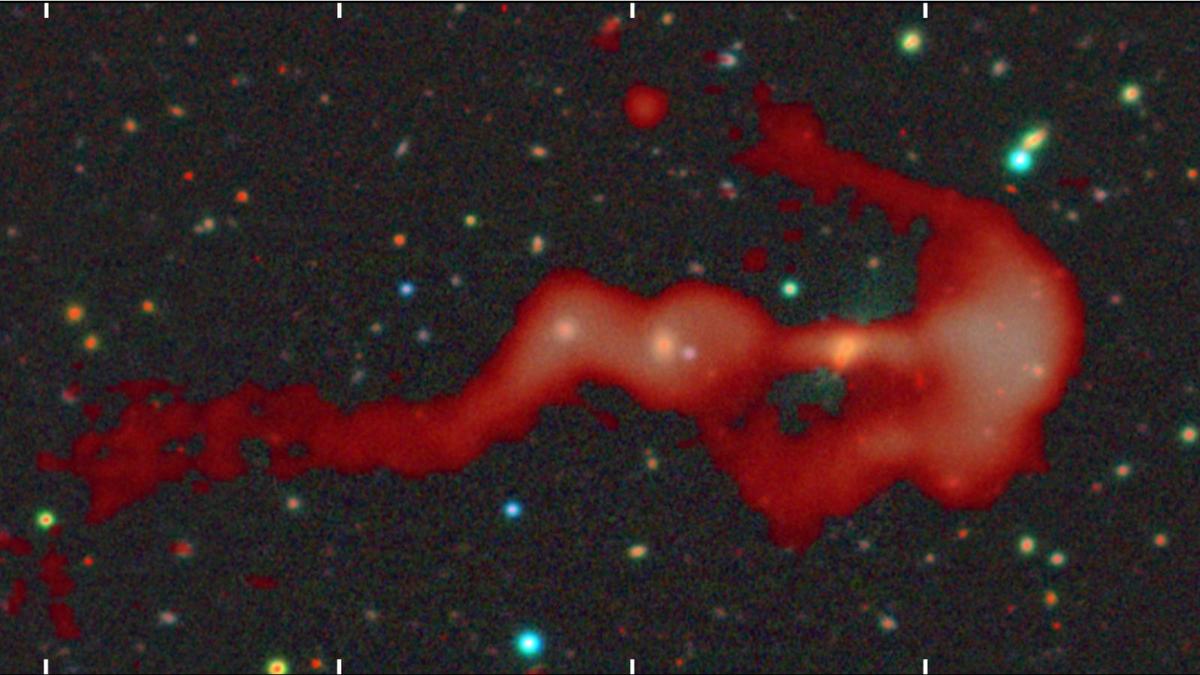
Twelve Indian researchers across three countries have discovered a rare, nonconformist radio galaxy, shaped like a bow and arrow and 1.8 million light years wide, located approximately 2 billion light years from Earth.

A light year is about 5.88 trillion miles. A radio galaxy, powered by supermassive black holes at its core, is a type of active galaxy that emits very high amounts of energy in the form of radio waves.

The newly discovered arc-like system has been named RAD-BAARG, where RAD stands for RAD@home Astronomy Collaboratory, India’s first citizen science research platform in astronomy based at Kharghar in Navi Mumbai. BAARG expands to Bow And Arrow Radio Galaxy.

The research team’s paper, titled “RAD@home discovery of a bow-and-arrow radio galaxy tracing a ∼560 kpc bow-shock structure in a multi-halo environment”, was published in the journal Monthly Notices of the Royal Astronomical Society on June 22. According to the paper, the “highly unusual” and asymmetric structure is unlike those seen in standard radio galaxies.

Kpc is short for kiloparsec, a unit of astronomical distance equal to 1,000 parsecs, or about 3,260 light-years.

The lead author of the study is Ananda Hota of the University of Mumbai and the founder-director of the 13-year-old RAD@home, which enables university students and others to conduct extragalactic research and make astronomical discoveries from the comfort of their homes.

The other authors — all associated with RAD@home — are Pratik Dabhade of the Poland-based National Centre for Nuclear Research; Shubhrangshu Ghosh of Sikkim’s Shri Ramasamy Memorial (SRM) University; Mitali Damle of New York University Abu Dhabi; Souvik Manik and Sabyasachi Pal of West Bengal’s Midnapore City College; C. Konar of Noida-based Amity University; Sagar Sethi of Poland’s University of Warmia and Mazury; and Pranim Limbo, Aditya Sahasranshu, Sravani Vaddi, and Arundhati Purohit.

Supersonic fall

The RAD-BAARG was found using ultra-sensitive images from the LOFAR (Low Frequency Array) Two-metre Sky Survey, one of the deepest radio surveys ever conducted at low frequencies. Its discovery follows the team’s 2025 identification of the farthest and most powerful Odd Radio Circle known at that time.

According to Mr. Ghosh, the huge black holes in radio galaxies launch enormous jets of relativistic magnetised plasma into intergalactic space. In the RAD-BAARG, one of the jets appears to interact with a large bow-shock-like structure formed as the host galaxy falls through the surrounding hot gas toward a nearby cluster of galaxies.

“Similar to the shock wave formed ahead of a supersonic aircraft, a galaxy moving faster than the speed of sound in the surrounding intra-cluster medium can compress the ambient gas and generate a large-scale shock front. The radio-emitting plasma from RAD-BAARG appears to illuminate this otherwise extremely faint structure, making it visible in low-frequency radio images,” Mr. Ghosh told The Hindu.

“The western side of the source contains a narrow jet feeding a sector-shaped emission region and a giant arc-like feature extending over nearly 560 kpc (1.8 million light years). On the opposite side, the jet develops a distorted S-shaped morphology followed by a faint offset tail extending to almost 600 kpc. The overall structure suggests strong interaction between the radio plasma and the surrounding large-scale environment,” he said.

The research team found that the host galaxy resides in a dynamically complex environment containing nearby cluster-scale systems at similar distances. The morphology was observed to be consistent with interaction between the radio jets and large-scale environmental gradients, bulk gas motions, and possible shock-related compression associated with the galaxy’s infall.

An infall refers to the gravity-induced inward movement of gas, dust, or cosmic bodies toward a massive object.

Also read | Mumbai-led team helps reveal mysterious twin rings around galaxy

Clearest radio signatures

“Although theoretical studies and computer simulations have long predicted bow shocks around infalling galaxies, detecting them directly has proven extremely difficult because the surrounding gas is extraordinarily diffuse and faint. The RAD-BAARG provides an unusually detailed radio view of such a phenomenon,” Mr. Ghosh said.

“The structure of this source is unlike that of any radio galaxy I have seen in 25 years. Its remarkable morphology appears to display signatures of interaction between relativistic radio plasma and a large-scale shock generated during the galaxy’s infall into a nearby cluster environment,” Mr. Hota said.

“BAARG is exciting not just because of its striking bow and arrow shape, but because it sits in a complex multi-halo environment where gas flows, infall, and possible shocks can reshape radio plasma,” Mr. Dabhade said.

The researchers said LOFAR helped them see the faint, low-surface-brightness emission from the RAD-BAARG in “remarkable” detail. They hoped that next generation radio astronomy facilities, including the Square Kilometre Array Observatory under construction, would facilitate a better understanding of how radio galaxies evolve within the large-scale cosmic environment.

The team also suggested using Artificial Intelligence and machine learning techniques to identify additional unusual radio galaxies hidden within the enormous data volumes expected from upcoming radio sky surveys.

Published – July 03, 2026 12:36 am IST



Source link

Science Tags:Galaxy from Earth, India ‘bow and arrow’ radio galaxy, Indian team discovers galaxy, RAD@home Collaboratory, ‘bow and arrow’ radio galaxy

Post navigation

Previous Post: After WhatsApp, Telegram and Signal receive notices on username feature
Next Post: Ellyse Perry and Ashleigh Gardner — linchpins of an imperious Aussie machine

Related Posts

  • V. Narayanan, who is set to take over as ISRO Chairman, terms his new assignment ‘a great responsibility’
    V. Narayanan, who is set to take over as ISRO Chairman, terms his new assignment ‘a great responsibility’ Science
  • Three-hour long maiden test flight of Gaganyaan mission to commence at 7 am on October 21  
    Three-hour long maiden test flight of Gaganyaan mission to commence at 7 am on October 21   Science
  • From refugee to Nobel: Yaghi hails science’s ‘equalising force’
    From refugee to Nobel: Yaghi hails science’s ‘equalising force’ Science
  • The A to Z Science Quiz!
    The A to Z Science Quiz! Science
  • Why can’t anything travel faster than light and what would happen if it did?
    Why can’t anything travel faster than light and what would happen if it did? Science
  • Can light pollution be a new risk factor for Alzheimer’s?
    Can light pollution be a new risk factor for Alzheimer’s? Science

More Related Articles

Former CSIR chief Girish Sahni passes away Former CSIR chief Girish Sahni passes away Science
The discoverers of radio emissions from Jupiter The discoverers of radio emissions from Jupiter Science
GalaxEye launches Mission Drishti, India’s largest privately developed Earth observation satellite GalaxEye launches Mission Drishti, India’s largest privately developed Earth observation satellite Science
Obaid Siddiqi lectures to commence in Bengaluru this July Obaid Siddiqi lectures to commence in Bengaluru this July Science
Inside the underground lab in China tasked with solving a physics mystery Inside the underground lab in China tasked with solving a physics mystery Science
Hanle protects its dark skies and builds a future on stargazing Hanle protects its dark skies and builds a future on stargazing Science
SiteLock

Archives

  • September 2026
  • August 2026
  • July 2026
  • June 2026
  • May 2026
  • April 2026
  • March 2026
  • February 2026
  • January 2026
  • December 2025
  • November 2025
  • October 2025
  • September 2025
  • August 2025
  • July 2025
  • June 2025
  • May 2025
  • April 2025
  • March 2025
  • February 2025
  • January 2025
  • December 2024
  • November 2024
  • October 2024
  • September 2024
  • August 2024
  • July 2024
  • June 2024
  • May 2024
  • April 2024
  • March 2024
  • February 2024
  • January 2024
  • December 2023
  • November 2023
  • October 2023
  • September 2023
  • August 2023
  • July 2023
  • June 2023
  • May 2023
  • April 2023
  • March 2023
  • February 2023
  • January 2023
  • December 2022
  • November 2022
  • October 2022
  • September 2022
  • August 2022
  • July 2022
  • June 2022
  • May 2022

Categories

  • Business
  • Nation
  • Science
  • Sports
  • World

Recent Posts

  • After October 1, only smaller 5 or 10 kg LPG refills await non-eKYC households
  • Pakistan forces kill five terrorists, rescue 23 abductees in Balochistan
  • Asian Games 2026: Smriti Mandhana surpasses Suzie Bates to become women’s T20I cricket’s leading run-scorer
  • Hope flows anew with revival of Andhra’s Veligonda project
  • NMDC looks to hit 60 MT iron ore production mark this fiscal: Chairman

Recent Comments

  1. Glennalbub on UP Teacher Who Asked Students To Slap Muslim Classmate
  2. PhilipLog on UP Teacher Who Asked Students To Slap Muslim Classmate
  3. DennisDum on UP Teacher Who Asked Students To Slap Muslim Classmate
  4. DonaldFrosy on UP Teacher Who Asked Students To Slap Muslim Classmate
  5. DonaldFrosy on UP Teacher Who Asked Students To Slap Muslim Classmate
  • Industrialist Harsh Goenka Shares Video Of CEAT’s Winter Tyre Tests Conducted Near Arctic Circle
    Industrialist Harsh Goenka Shares Video Of CEAT’s Winter Tyre Tests Conducted Near Arctic Circle Nation
  • See For Yourself, Says Manipur BJP MLA Rajkumar Imo Singh Amid Row Over Congress’s Deleted Video
    See For Yourself, Says Manipur BJP MLA Rajkumar Imo Singh Amid Row Over Congress’s Deleted Video Nation
  • 25 new Atal Canteens opened; 1 lakh people to get ₹5 meals daily
    25 new Atal Canteens opened; 1 lakh people to get ₹5 meals daily Nation
  • Ranji Trophy Semi-Final: Priyank Panchal Slams Ton For Gujarat; Vidarbha Eye Victory Over Mumbai
    Ranji Trophy Semi-Final: Priyank Panchal Slams Ton For Gujarat; Vidarbha Eye Victory Over Mumbai Sports
  • How does the Gaganyaan’s life-support system operate?
    How does the Gaganyaan’s life-support system operate? Science
  • "Sore Today…": Pujara's Post After BGT Squad Reveal Has Internet Talking
    "Sore Today…": Pujara's Post After BGT Squad Reveal Has Internet Talking Sports
  • India vs Australia Fourth Test: Border-gavaskar trophy Boxing Day Test in Melbourne. Day 1 tickets sold out at the iconic Melbourne Cricket Ground
    India vs Australia Fourth Test: Border-gavaskar trophy Boxing Day Test in Melbourne. Day 1 tickets sold out at the iconic Melbourne Cricket Ground Sports
  • Rupee rises 19 paise to 87.20 against U.S. dollar in early trade
    Rupee rises 19 paise to 87.20 against U.S. dollar in early trade Business

Editor-in-Chief:
Mohammad Ariff,
MSW, MAJMC, BSW, DTL, CTS, CNM, CCR, CAL, RSL, ASOC.
editor@artifex.news

Associate Editors:
1. Zenellis R. Tuba,
zenelis@artifex.news
2. Haris Daniyel
daniyel@artifex.news

Photograher:
Rohan Das
rohan@artifex.news

Artifex.News offers Online Paid Internships to college students from India and Abroad. Interns will get a PRESS CARD and other online offers.
Send your CV (Subjectline: Paid Internship) to internship@artifex.news

Links:
Associate Journalism
About Us
Privacy Policy

News Links:
Breaking News
World
Nation
Sports
Business
Entertainment
Lifestyle

Registered Office:
72/A, Elliot Road, Kolkata - 700016
Tel: 033-22277777, 033-22172217
Email: office@artifex.news

Editorial Office / News Desk:
No. 13, Mezzanine Floor, Esplanade Metro Rail Station,
12 J. L. Nehru Road, Kolkata - 700069.
(Entry from Gate No. 5)
Tel: 033-46011099, 033-46046046
Email: editor@artifex.news

Copyright © 2023 Artifex.News Newsportal designed by Artifex Infotech.