






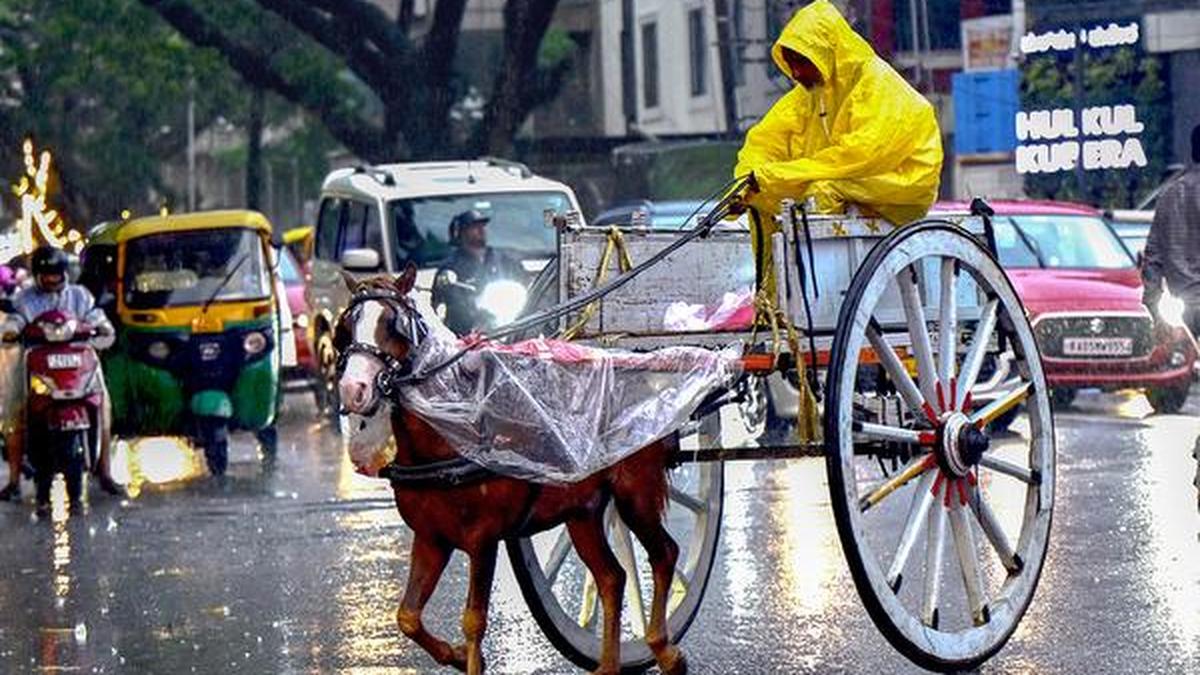
Rain pours misery on a horse in Bengaluru on June 13, 2026.
| Photo Credit: SUDHAKARA JAIN/The Hindu
Of late, increasingly concentrated rainfall and violent floods have devastated India’s cities and farms alike. For years, scientists have debated whether this is simply natural variation or the direct result of climate change.
A new study in Environmental Research Letters has found the smoking gun. Specifically, for the first time, researchers have dispositive evidence that human activity is the primary driver.
The researchers, from IIT-Delhi and KSMDB College in Kollam, analysed rainfall data from 1905 to 2014. Then they used a technique called fingerprinting, where, like a forensic investigator looking for a fingerprint at a crime scene, the scientists looked for specific signs of human influence in the atmosphere. By comparing real-world observations with several computer models, they were able to separate natural weather cycles like the El Niño from changes caused specifically by human activity.
The work has revealed a contest in India’s skies between greenhouse gases, which warm the atmosphere, and aerosols, particles from car exhaust and factories that scatter sunlight and can actually suppress rains. The impact was most visible in the country’s core monsoon zone, including West Central India.
“In West Central India, we find both observed increases in extreme precipitation indices and evidence that greenhouse gas forcing is a dominant driver of this intensification,” T.S. Chaithra, a PhD student at the Centre for Atmospheric Sciences, IIT Delhi, and the study’s first author, told The Hindu. “Together, these findings indicate that the statistical characteristics of extreme rainfall are changing over time.”
Many Indian scientists and policymakers are working to reduce air pollution. However, as the air becomes cleaner and the aerosol load drops, the cooling effect will vanish. When this happens, the full force of greenhouse gas warming will be ‘unmasked’, potentially leading to a surge in extreme rainfall events that are now being kept in check.
However, Ms. Chaithra said the team is “cautious about saying urban planners should stop using historical rainfall baselines entirely” and that “historical observations remain essential” to understand “local rainfall characteristics and vulnerabilities”.
But she also warned that the old rules of thumb may misguide.
“Our results suggest that it may no longer be appropriate to assume stationarity in extreme rainfall,” she said, adding later: “More broadly, historical rainfall statistics alone may not provide a reliable guide to future risk in a warming climate, particularly in regions where extreme rainfall is already showing a clear upward trend.”
mukunth.v@thehindu.co.in
Published – June 17, 2026 08:15 am IST