

Skip to content
  • Facebook
  • X
  • Linkedin
  • WhatsApp
  • Associate Journalism
  • About Us
  • Privacy Policy
  • 033-46046046
  • editor@artifex.news
Artifex.News

Artifex.News

Stay Connected. Stay Informed.

  • Breaking News
  • World
  • Nation
  • Sports
  • Business
  • Science
  • Entertainment
  • Lifestyle
  • Toggle search form
  • Russia formalises Putin election win, dismissing criticism
    Russia formalises Putin election win, dismissing criticism World
  • “Why Can’t Centre Consider Genuine Demands Of Farmers?” Supreme Court
    “Why Can’t Centre Consider Genuine Demands Of Farmers?” Supreme Court Nation
  • AAP Broke All Records Of Corruption During 10-Year Rule: BJP President
    AAP Broke All Records Of Corruption During 10-Year Rule: BJP President Nation
  • Gautam Gambhir’s Fiery “TRP” Retort When Asked About Relationship With Virat Kohli
    Gautam Gambhir’s Fiery “TRP” Retort When Asked About Relationship With Virat Kohli Sports
  • Typhoon Matmo strengthens, prompting China to evacuate 150,000 people ahead of landfall
    Typhoon Matmo strengthens, prompting China to evacuate 150,000 people ahead of landfall World
  • Access Denied Sports
  • Why do students fear math? | National Mathematics Day
    Why do students fear math? | National Mathematics Day Science
  • ‘Will Be Relieved When Accused Are Punished’: RG Kar Victim’s Father
    ‘Will Be Relieved When Accused Are Punished’: RG Kar Victim’s Father Nation
Ahead of Chandrayaan-4, IIT and PRL team decodes moon’s titanium-rich rocks

Ahead of Chandrayaan-4, IIT and PRL team decodes moon’s titanium-rich rocks

Posted on March 24, 2026 By admin


The moon’s surface is covered by ancient lava flows that are often different from those found on the earth. While volcanic rocks on the earth rarely contain more than 2% titanium dioxide (TiO2), some lunar basalts — common volcanic rocks — carry up to 18%, a fact that planetary scientists have struggled to explain for decades.

A new study by researchers from IIT-Kharagpur and the Physical Research Laboratory (PRL), Ahmedabad, published in Geochimica et Cosmochimica Acta, has now offered an experimental account of how these titanium-rich basalts could have formed.

The study’s authors were Himela Moitra, Sujoy Ghosh, Tamalkanti Mukherjee, Saibal Gupta, and Kuljeet Kaur Marhas.

Cameras on landers

The Chandrayaan-4 mission, which the Indian Space Research Organisation (ISRO) has planned for 2028, aims to collect rock samples from the moon and return them to the earth, making the choice of landing site critical. The study’s findings could help inform that decision.

Prof. Ghosh, one of the lead authors and associate professor at IIT-Kharagpur, said, “Regions near the lunar south pole, such as those being evaluated for Chandrayaan-4, including areas near Shiv Shakti  region, have been studied in detail using data from Chandrayaan-2, NASA’s Lunar Reconnaissance Orbiter, and other missions. What our work adds is a deep interior perspective.”

According to the study’s first author Himela Moitra, “High-resolution microscopic cameras on landers can help identify minerals in lunar rocks, while instruments such as X-ray fluorescence and X-ray diffraction can determine their chemical composition before collection.”

“Spectroscopic tools such as Raman and visible-near infrared spectroscopy can help confirm the mineral phases in rocks before they are collected. Similar instruments have already been successfully used in Mars missions,” Tamalkanti Mukherjee, a PhD student at IIT Kharagpur and co-author of the study, added.

The European Space Agency is also planning to launch its Lunar Volatile and Mineralogy Mapping Orbiter mission in 2028 to map the distribution of water and ilmenite on the moon.

Too high or too low

Roughly 4.3 billion years ago, the moon was still cooling from a global ocean of molten rock. In the process, olivine and orthopyroxene crystallised first, then plagioclase, which floated up to form the moon’s pale crust. The last to crystallise was a dense, iron- and titanium-rich layer containing minerals called clinopyroxene, ilmenite, and fayalitic olivine. Scientists call this the ilmenite-bearing cumulate (IBC) layer.

The IBC layer was too dense to stay put. Gravity pulled it downwards through the less dense, magnesium-rich mantle in a process called cumulate overturn. As it sank into the hotter regions of the lunar interior, the IBC layer began to melt. The titanium-rich partial melts it produced are widely thought to be the source of the moon’s titanium-rich basalts — but the exact mechanism has remained contested.

When researchers previously tried to melt IBC rocks in the lab, the resulting liquids didn’t match the basalts on the moon’s surface: they either didn’t have enough magnesium or were too dense to rise and erupt as lava. The authors of the new study set out to find the missing link.

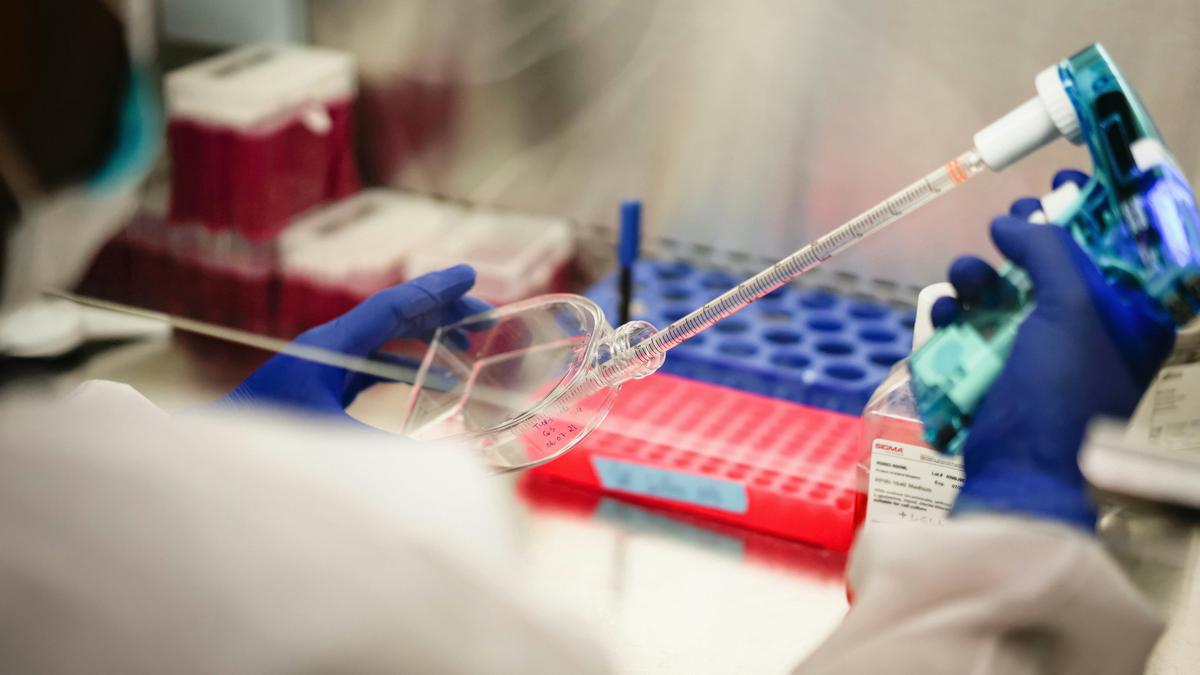
They  used a piston-cylinder apparatus at IIT Kharagpur, capable of exerting pressures up to 3 gigapascals (GPa) of pressure — equivalent to that under 700 km deep inside the moon — and temperatures of 1,500 °C.

The team designed two sets of experiments. In one set, they placed a thin layer of a synthetic IBC layer above a layer of San Carlos olivine, a mineral on the earth that is a good proxy for the moon’s magnesium-rich mantle, inside a capsule and subjected it to pressures of 1-3 GPa and temperatures of 1,075-1,500 °C. This setup mimicked the place where a sinking IBC layer comes in contact with the mantle. In the other kind of experiments, the team blended the two materials together before subjecting them to similar conditions, simulating a chemical interaction during a slow descent or ascent.

‘Significant progress’

The results of the tests suggested that basalts high in titanium were created in a complex process involving both reactions and mixing.

The first kind of experiments generated melts containing 9-19% titanium dioxide but they were stubbornly low in magnesium oxide, which is the same discrepancy older studies had run into. The mixed experiments produced basalts that were too high in magnesium and too low in titanium, on the other hand.

“Indian laboratories, including those at IIT Kharagpur, PRL Ahmedabad, and other ISRO centres, have made significant progress in recent years,” Prof. Ghosh said. “Our study demonstrates that high-pressure experimental work relevant to planetary interiors can now be carried out entirely within India, marking an important step toward building indigenous capability in planetary science.”

When the team simulated a combination of these processes and outcomes on a computer, they found that some molten rocks could have risen directly and erupted with moderate amounts of titanium. Those rocks very rich in titanium could have however become stuck deep inside the moon. Later, fresh magma rising from below could have mixed with these trapped pockets and the combined molten mass could have erupted as lava rich in titanium.

Repository of melts

Per the study, this two-stage model could successfully reproduce the observed magnesium, titanium, silicon, and iron contents of the moon’s high-titanium basalts, but underestimated aluminium oxide and calcium oxide.

The model could also explain why volcanic activity high in titanium continued throughout the moon’s geological history rather than being confined to its earliest period: because the natural satellite had a repository of titanium-rich melts in its interior for billions of years, waiting for the right conditions to bring them to the surface.

mukunth.v@thehindu.co.in

Published – March 24, 2026 08:10 am IST


Source link

Science

Post navigation

Previous Post: Moon was formed around 4.51 billion years ago: study
Next Post: Access Denied

Related Posts

  • Large Hadron Collider discovers a new particle
    Large Hadron Collider discovers a new particle Science
  • How can the sky glow even after sunset?
    How can the sky glow even after sunset? Science
  • The Science Quiz | A brief history of the earth
    The Science Quiz | A brief history of the earth Science
  • Why do we get goosebumps?
    Why do we get goosebumps? Science
  • Major Boeing-made communications satellite disintegrates in orbit
    Major Boeing-made communications satellite disintegrates in orbit Science
  • Scientists urged to rethink ‘smoking gun’ signals in topological physics
    Scientists urged to rethink ‘smoking gun’ signals in topological physics Science

More Related Articles

For Assam tea, erratic climate and stagnant prices present a crisis For Assam tea, erratic climate and stagnant prices present a crisis Science
Heart disease kills 28.6 lakh Indians every year and yet, treatment is uneven and erratic Heart disease kills 28.6 lakh Indians every year and yet, treatment is uneven and erratic Science
Skygazers watch ‘Ring of Fire’ eclipse over Western Hemisphere Skygazers watch ‘Ring of Fire’ eclipse over Western Hemisphere Science
Nobel laureate supports India’s pursuit for a neutrino lab Nobel laureate supports India’s pursuit for a neutrino lab Science
Study traces the route of Ebola virus to the skin surface Study traces the route of Ebola virus to the skin surface Science
How do we know the speed of light? How do we know the speed of light? Science
SiteLock

Archives

  • March 2026
  • February 2026
  • January 2026
  • December 2025
  • November 2025
  • October 2025
  • September 2025
  • August 2025
  • July 2025
  • June 2025
  • May 2025
  • April 2025
  • March 2025
  • February 2025
  • January 2025
  • December 2024
  • November 2024
  • October 2024
  • September 2024
  • August 2024
  • July 2024
  • June 2024
  • May 2024
  • April 2024
  • March 2024
  • February 2024
  • January 2024
  • December 2023
  • November 2023
  • October 2023
  • September 2023
  • August 2023
  • July 2023
  • June 2023
  • May 2023
  • April 2023
  • March 2023
  • February 2023
  • January 2023
  • December 2022
  • November 2022
  • October 2022
  • September 2022
  • August 2022
  • July 2022
  • June 2022
  • May 2022

Categories

  • Business
  • Nation
  • Science
  • Sports
  • World

Recent Posts

  • Access Denied
  • Access Denied
  • Access Denied
  • Kim vows to ’irreversibly’ cement North Korea’s nuclear status, calls South ’most hostile’
  • Access Denied

Recent Comments

  1. Adolphlum on UP Teacher Who Asked Students To Slap Muslim Classmate
  2. Adolphlum on UP Teacher Who Asked Students To Slap Muslim Classmate
  3. Adolphlum on UP Teacher Who Asked Students To Slap Muslim Classmate
  4. Robertexota on UP Teacher Who Asked Students To Slap Muslim Classmate
  5. RobertDream on UP Teacher Who Asked Students To Slap Muslim Classmate
  • Science for all: First real-time video of how an embryo implants itself produced
    Science for all: First real-time video of how an embryo implants itself produced Science
  • “We All Thought It Was Out”: Beau Webster Contemplates Virat Kohli’s Ruled Out Catch In 5th Australia Test
    “We All Thought It Was Out”: Beau Webster Contemplates Virat Kohli’s Ruled Out Catch In 5th Australia Test Sports
  • From Yashasvi Jaiswal To Nitish Reddy, 10 Emerging International Cricketers Who Enjoyed A Breakout 2024
    From Yashasvi Jaiswal To Nitish Reddy, 10 Emerging International Cricketers Who Enjoyed A Breakout 2024 Sports
  • North Korea says no interest in summit with Japan, rejects more talks
    North Korea says no interest in summit with Japan, rejects more talks World
  • Access Denied
    Access Denied Nation
  • Obesity rare in rural children despite genetic susceptibility: study
    Obesity rare in rural children despite genetic susceptibility: study Science
  • India Have ‘Lost In Big Match Situations’, Sourav Ganguly’s Concerns Ahead Of World Cup 2023
    India Have ‘Lost In Big Match Situations’, Sourav Ganguly’s Concerns Ahead Of World Cup 2023 Sports
  • Company that sent AI calls mimicking Joe Biden to voters agrees to pay  million fine
    Company that sent AI calls mimicking Joe Biden to voters agrees to pay $1 million fine World

Editor-in-Chief:
Mohammad Ariff,
MSW, MAJMC, BSW, DTL, CTS, CNM, CCR, CAL, RSL, ASOC.
editor@artifex.news

Associate Editors:
1. Zenellis R. Tuba,
zenelis@artifex.news
2. Haris Daniyel
daniyel@artifex.news

Photograher:
Rohan Das
rohan@artifex.news

Artifex.News offers Online Paid Internships to college students from India and Abroad. Interns will get a PRESS CARD and other online offers.
Send your CV (Subjectline: Paid Internship) to internship@artifex.news

Links:
Associate Journalism
About Us
Privacy Policy

News Links:
Breaking News
World
Nation
Sports
Business
Entertainment
Lifestyle

Registered Office:
72/A, Elliot Road, Kolkata - 700016
Tel: 033-22277777, 033-22172217
Email: office@artifex.news

Editorial Office / News Desk:
No. 13, Mezzanine Floor, Esplanade Metro Rail Station,
12 J. L. Nehru Road, Kolkata - 700069.
(Entry from Gate No. 5)
Tel: 033-46011099, 033-46046046
Email: editor@artifex.news

Copyright © 2023 Artifex.News Newsportal designed by Artifex Infotech.