


Skip to content
  • Facebook
  • X
  • Linkedin
  • WhatsApp
  • YouTube
  • Associate Journalism
  • About Us
  • Privacy Policy
  • 033-46046046
  • editor@artifex.news
Artifex.News

Artifex.News

Stay Connected. Stay Informed.

  • Breaking News
  • World
  • Nation
  • Sports
  • Business
  • Science
  • Entertainment
  • Lifestyle
  • Toggle search form
  • England tour of India: India vs England third Twenty20 international in Rajkot on January 28, 2025. Mohammed Shami returns to Indian team
    England tour of India: India vs England third Twenty20 international in Rajkot on January 28, 2025. Mohammed Shami returns to Indian team Sports
  • UN Security Council Member Countries Condemn Hamas But No Unanimity
    UN Security Council Member Countries Condemn Hamas But No Unanimity World
  • Australia Finalise T20 World Cup Squad, Delhi Capitals Star Included In Reserves
    Australia Finalise T20 World Cup Squad, Delhi Capitals Star Included In Reserves Sports
  • Goan-origin Portuguese Prime Minister Antonio Costa bows out
    Goan-origin Portuguese Prime Minister Antonio Costa bows out World
  • 10-Month-Old Raped By Man Who Used To Visit Her Parents’ House In Gujarat
    10-Month-Old Raped By Man Who Used To Visit Her Parents’ House In Gujarat Nation
  • Silver crashes ₹12,500 to ₹2.43 lakh/kg; gold declines ₹900
    Silver crashes ₹12,500 to ₹2.43 lakh/kg; gold declines ₹900 Business
  • Access Denied
    Access Denied Nation
  • Australia tests advanced SM-6 naval air defence missile for first time
    Australia tests advanced SM-6 naval air defence missile for first time World
Greenland ice found at risk of melting at CO2 levels lower than today’s

Greenland ice found at risk of melting at CO2 levels lower than today’s

Posted on August 13, 2024 By admin


As we focused our microscope on the soil sample for the first time, bits of organic material came into view: a tiny poppy seed, the compound eye of an insect, broken willow twigs and spikemoss spores. Dark-coloured spheres produced by soil fungi dominated our view.

These were unmistakably the remains of an arctic tundra ecosystem – and proof that Greenland’s entire ice sheet disappeared more recently than people realise.

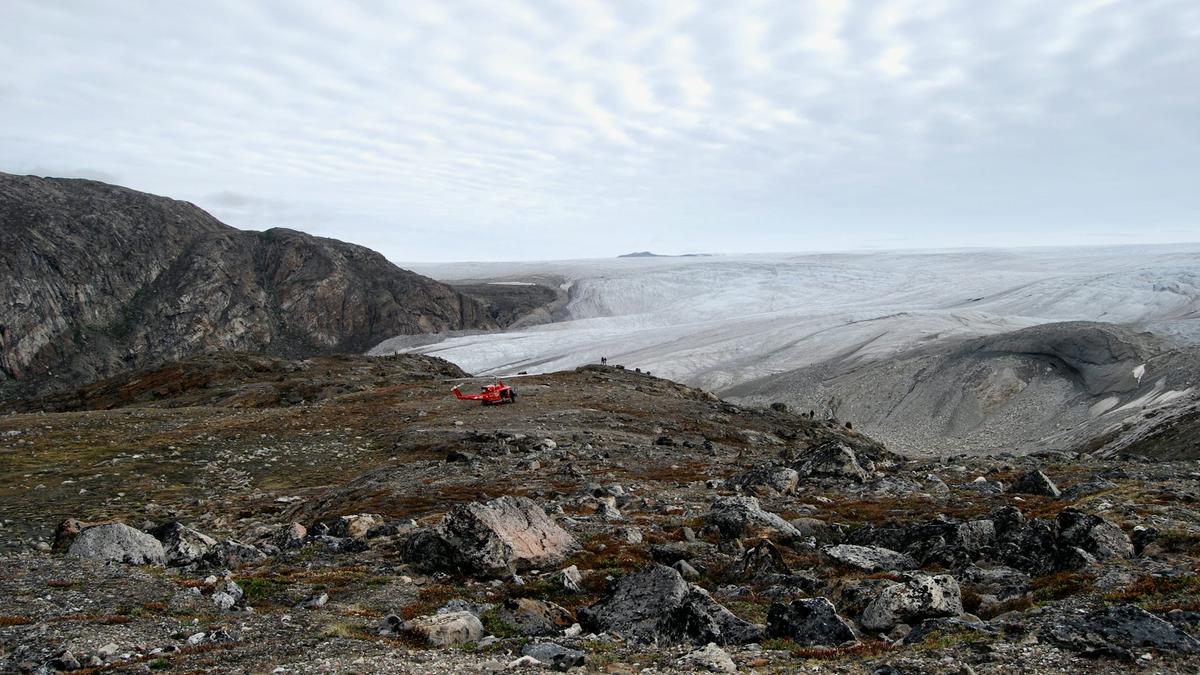
These tiny hints of past life came from a most unlikely place – a handful of soil that had been buried under 2 miles of ice below the summit of the Greenland ice sheet. Projections of future melting of the ice sheet are unambiguous: When the ice is gone at the summit, at least 90% of Greenland’s ice will have melted.

In 1993, drillers at the summit completed the Greenland Ice Sheet Project 2 ice core, or GISP2, nicknamed the two-mile time machine. The seeds, twigs and spores we found came from a few inches of soil at the bottom of that core — soil that had been tucked away dry, untouched for three decades in a windowless Colorado storage facility.

Our new analysis builds on the work of others who, over the past decade, have chipped away at the belief that Greenland’s ice sheet was present continuously since at least 2.6 million years ago when the Pleistocene ice ages began. In 2016, scientists measuring rare isotopes in rock from above and below the GISP2 soil sample used models to suggest that the ice had vanished at least once within the past 1.1 million years.

Now, by finding well-preserved tundra remains, we have confirmed that Greenland’s ice sheet had indeed melted before and exposed the land below the summit long enough for soil to form and for tundra to grow there. That tells us that the ice sheet is fragile and could melt again.

A landscape with Arctic poppies and spikemosses

To the naked eye, the tiny bits of past life are unremarkable – dark flecks, floating between shiny grains of silt and sand. But, under the microscope, the story they tell is astounding. Together, the seeds, megaspores and insect parts paint a picture of a cold, dry and rocky environment that existed sometime in the past million years.

Above ground, Arctic poppies grew among the rocks. Atop each stalk of this small but tenacious herb, a single cupped flower tracked the Sun across the sky to make the most of each day’s light.

Tiny insects buzzed above mats of diminutive rock spikemoss, creeping across the gravelly surface and bearing spores in summer. 

In the rocky soil were dark spheres called sclerotia, produced by fungi that team up with plants’ roots in soil to help both get the nutrients they need. Nearby, willow shrubs adapted to life in the harsh tundra with their small size and fuzzy hair covering their stems.

Each of these living things left clues behind in that handful of soil – evidence that told us Greenland’s ice was once replaced by a hardy tundra ecosystem.

Greenland’s ice is fragile

Our discoveries, published on August 5, 2024, in the Proceedings of the National Academy of Sciences, demonstrate that Greenland’s ice is vulnerable to melting at atmospheric carbon dioxide concentrations lower than today. Concerns about this vulnerability have driven scientists to study the ice sheet since the 1950s.

In the 1960s, a team of engineers extracted the world’s first deep ice core at Camp Century, a nuclear-powered Army base built into the ice sheet over 100 miles from the northwest Greenland coast. They studied the ice, but they had little use for the chunks of rock and soil brought up with the bottom of the core. Those were stored and then lost until 2019, when they were rediscovered in a lab freezer. Our team was among the scientists called in to analyse them.

In the Camp Century soil, we also found plant and insect remains that had been frozen beneath the ice. Using rare isotopes and luminescence techniques, we were able to date them to a period about 400,000 years ago, when temperatures were similar to today. 

Another ice core, DYE-3 from south Greenland, contained DNA showing that spruce forests covered that part of the island at some point in the past million years.

The biological evidence makes a convincing case for the fragility of Greenland’s ice sheet. Together, the findings from three ice cores can only mean one thing: With the possible exception of a few mountainous areas to the east, ice must have melted off the entire island in the past million years.

Losing the ice sheet

When Greenland’s ice is gone, world geography changes – and that’s a problem for humanity.

As the ice sheet melts, sea level will eventually rise more than 23 feet, and coastal cities will flood. Most of Miami will be underwater, and so will much of Boston, New York, Mumbai, and Jakarta.

Today, sea level is rising at more than an inch each decade, and in some places, several times faster. By 2100, when today’s kids are grandparents, sea level around the globe is likely to be several feet higher.

Using the past to understand the future

The rapid loss of ice is changing the Arctic. Data about past ecosystems, like we have collected from under Greenland’s ice, helps scientists understand how the ecology of the Arctic will change as the climate warms.

When temperatures rise, bright white snow melts and ice shrinks, exposing dark rock and soil that soaks up heat from the Sun. The Arctic is becoming greener with every passing year, thawing underlying permafrost and releasing more carbon that will further warm the planet.

Human-caused climate change is on pace to warm the Arctic and Greenland beyond temperatures they have experienced for millions of years. To save Greenland’s ice, studies show the world will need to stop greenhouse gas emissions from its energy systems and reduce carbon dioxide levels in the atmosphere.

Understanding the environmental conditions that triggered the ice sheet’s last disappearance, and how life on Greenland responded, will be crucial for gauging the future risks facing the ice sheet and coastal communities around the world.

Paul Bierman is a fellow of the Gund Institute for Environment, professor of natural resources and environmental science, University of Vermont. Halley Mastro is a graduate fellow of the Gund Institute for Environment and a graduate research assistant in natural resources and environmental science, University of Vermont. This article is republished from The Conversation.

The Conversation


Source link

Science Tags:Greenland ice melting, permafrost thawing, sea level rise

Post navigation

Previous Post: Surat’s diamond factories lose sparkle as global recession hits sector
Next Post: Donald Trump Recalls Assassination Bid

Related Posts

  • Dedicated rare earth corridors in TN, Kerala, would promote mining: CII
    Dedicated rare earth corridors in TN, Kerala, would promote mining: CII Science
  • Jeff Bezos’ Blue Origin launches massive New Glenn rocket on first test flight
    Jeff Bezos’ Blue Origin launches massive New Glenn rocket on first test flight Science
  • Antarctic winter sea ice hits ‘extreme’ record low
    Antarctic winter sea ice hits ‘extreme’ record low Science
  • Microneedle patch reverses hair loss caused by autoimmune disease
    Microneedle patch reverses hair loss caused by autoimmune disease Science
  • New portable atomic clock offers very accurate timekeeping at sea
    New portable atomic clock offers very accurate timekeeping at sea Science
  • RRI technique yields certified randomness with one qubit
    RRI technique yields certified randomness with one qubit Science

More Related Articles

ISRO is all geared up for Gaganyaan, says Group Director at Satish Dhawan Space Centre ISRO is all geared up for Gaganyaan, says Group Director at Satish Dhawan Space Centre Science
ISRO to launch 6,500 kg communication satellite built by U.S. in couple of months: Chairman ISRO to launch 6,500 kg communication satellite built by U.S. in couple of months: Chairman Science
The trouble with a Nobel for mRNA COVID vaccines The trouble with a Nobel for mRNA COVID vaccines Science
What science is finding about the Shroud of Turin and the controversy around it What science is finding about the Shroud of Turin and the controversy around it Science
Fossil reveals Cretaceous drama of croc attacking flying reptile Fossil reveals Cretaceous drama of croc attacking flying reptile Science
Scientists reveal secrets of Earth’s magnificent desert star dunes Scientists reveal secrets of Earth’s magnificent desert star dunes Science
SiteLock

Archives

  • May 2026
  • April 2026
  • March 2026
  • February 2026
  • January 2026
  • December 2025
  • November 2025
  • October 2025
  • September 2025
  • August 2025
  • July 2025
  • June 2025
  • May 2025
  • April 2025
  • March 2025
  • February 2025
  • January 2025
  • December 2024
  • November 2024
  • October 2024
  • September 2024
  • August 2024
  • July 2024
  • June 2024
  • May 2024
  • April 2024
  • March 2024
  • February 2024
  • January 2024
  • December 2023
  • November 2023
  • October 2023
  • September 2023
  • August 2023
  • July 2023
  • June 2023
  • May 2023
  • April 2023
  • March 2023
  • February 2023
  • January 2023
  • December 2022
  • November 2022
  • October 2022
  • September 2022
  • August 2022
  • July 2022
  • June 2022
  • May 2022

Categories

  • Business
  • Nation
  • Science
  • Sports
  • World

Recent Posts

  • ATS questions 57 in Maharashtra over alleged gangster network links
  • Nicobarese oppose proposal for three wildlife sanctuaries
  • Visakhapatnam Collector calls for inter-departmental synergy to boost investments
  • Kohli’s masterful knock powers Royal Challengers to the top
  • Senior IPS officer Asra Garg posted IGP Intelligence

Recent Comments

  1. RichardClage on UP Teacher Who Asked Students To Slap Muslim Classmate
  2. StevenLek on UP Teacher Who Asked Students To Slap Muslim Classmate
  3. Leonardren on UP Teacher Who Asked Students To Slap Muslim Classmate
  4. NathanQuins on UP Teacher Who Asked Students To Slap Muslim Classmate
  5. Davidgof on UP Teacher Who Asked Students To Slap Muslim Classmate
  • T20 World Cup: PCB keen on roping Viv Richards as mentor for national team
    T20 World Cup: PCB keen on roping Viv Richards as mentor for national team Sports
  • Access Denied World
  • At least 12 medical staff killed in Israeli strike on health centre in southern Lebanon: ministry
    At least 12 medical staff killed in Israeli strike on health centre in southern Lebanon: ministry World
  • Rupee rises 5 paise to close at 83.06 against U.S. dollar
    Rupee rises 5 paise to close at 83.06 against U.S. dollar Business
  • Paralympic Star Nitesh Kumar Cites BAI Apathy, Wants Badminton To Be Placed Under PCI
    Paralympic Star Nitesh Kumar Cites BAI Apathy, Wants Badminton To Be Placed Under PCI Sports
  • Badruddin Ajmal’s Party AIUDF Demands 10% Reservation For Muslims In Assam
    Badruddin Ajmal’s Party AIUDF Demands 10% Reservation For Muslims In Assam Nation
  • INOXGFL Group Signs Three MoUs Worth Rs 17,000 Crore With Uttar Pradesh, Assam and Kerala Business
  • Arvind Kejriwal Wants To Join Enforcement Directorate Probe, But…: Atishi
    Arvind Kejriwal Wants To Join Enforcement Directorate Probe, But…: Atishi Nation

Editor-in-Chief:
Mohammad Ariff,
MSW, MAJMC, BSW, DTL, CTS, CNM, CCR, CAL, RSL, ASOC.
editor@artifex.news

Associate Editors:
1. Zenellis R. Tuba,
zenelis@artifex.news
2. Haris Daniyel
daniyel@artifex.news

Photograher:
Rohan Das
rohan@artifex.news

Artifex.News offers Online Paid Internships to college students from India and Abroad. Interns will get a PRESS CARD and other online offers.
Send your CV (Subjectline: Paid Internship) to internship@artifex.news

Links:
Associate Journalism
About Us
Privacy Policy

News Links:
Breaking News
World
Nation
Sports
Business
Entertainment
Lifestyle

Registered Office:
72/A, Elliot Road, Kolkata - 700016
Tel: 033-22277777, 033-22172217
Email: office@artifex.news

Editorial Office / News Desk:
No. 13, Mezzanine Floor, Esplanade Metro Rail Station,
12 J. L. Nehru Road, Kolkata - 700069.
(Entry from Gate No. 5)
Tel: 033-46011099, 033-46046046
Email: editor@artifex.news

Copyright © 2023 Artifex.News Newsportal designed by Artifex Infotech.