


Skip to content
  • Facebook
  • X
  • Linkedin
  • WhatsApp
  • YouTube
  • Associate Journalism
  • About Us
  • Privacy Policy
  • 033-46046046
  • editor@artifex.news
Artifex.News

Artifex.News

Stay Connected. Stay Informed.

  • Breaking News
  • World
  • Nation
  • Sports
  • Business
  • Science
  • Entertainment
  • Lifestyle
  • Toggle search form
  • Record Heat Temperatures In Ukraine After Russian Attacks On Power Plants
    Record Heat Temperatures In Ukraine After Russian Attacks On Power Plants World
  • 1 Innings, 10 Wickets With Hat-Trick: Bihar Cricketer Suman Kumar, 18, Achieves Historic First In Elite BCCI Tournament. Watch
    1 Innings, 10 Wickets With Hat-Trick: Bihar Cricketer Suman Kumar, 18, Achieves Historic First In Elite BCCI Tournament. Watch Sports
  • Daniil Medvedev Cruises Into Dubai Semi-Finals
    Daniil Medvedev Cruises Into Dubai Semi-Finals Sports
  • Alaska political leaders hope to see Trump undo restrictions on oil drilling
    Alaska political leaders hope to see Trump undo restrictions on oil drilling World
  • How has Gen Z uprising forced changes in Nepal? | Explainer
    How has Gen Z uprising forced changes in Nepal? | Explainer World
  • Manmohan spoke of military action against Pakistan after 2011 Mumbai terror attack: former British PM Cameron in memoir
    Manmohan spoke of military action against Pakistan after 2011 Mumbai terror attack: former British PM Cameron in memoir World
  • Pauling, the (near) perfect man for science
    Pauling, the (near) perfect man for science Science
  • Access Denied World
‘Cloning’ hurdle skirted to make perfect copy of quantum state

‘Cloning’ hurdle skirted to make perfect copy of quantum state

Posted on April 1, 2026 By admin


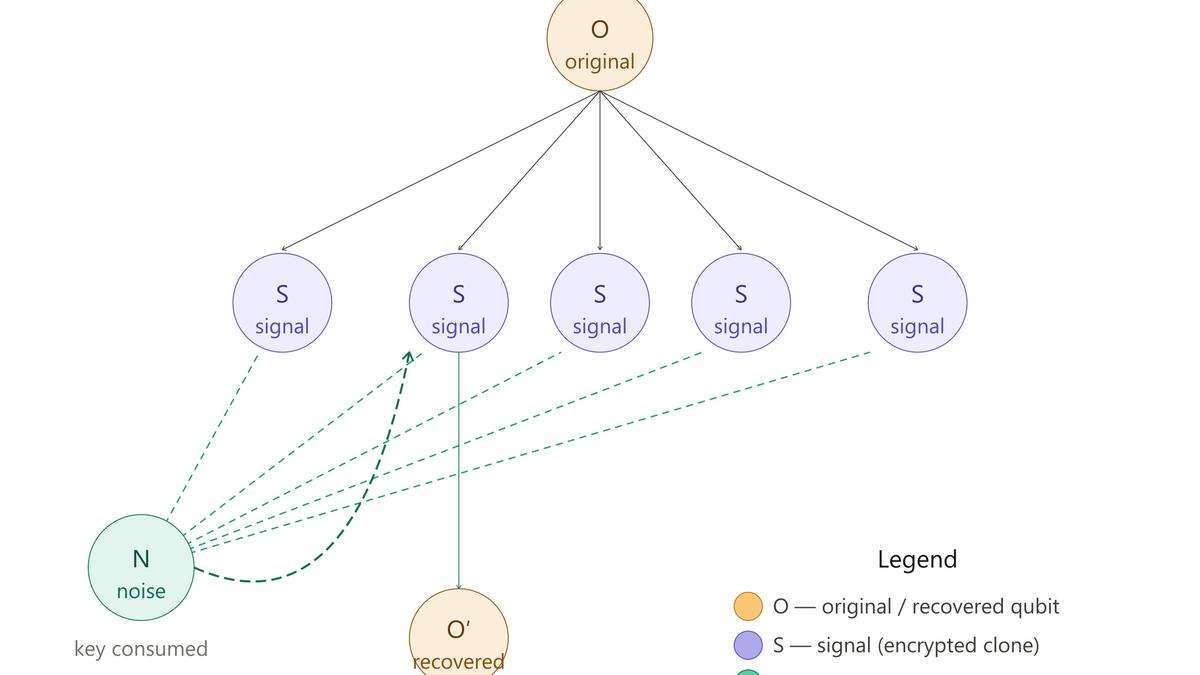
Researchers have shown a loophole in the no-cloning theorem by creating perfect copies using ideas from information theory. The protocol is illustrated here.
| Photo Credit: Image created with Sonnet 4.6

Quantum physics has a rule called the no-cloning theorem that prevents you from making a perfect copy of an unknown quantum state. It has shaped everything from quantum cryptography to quantum computing, and researchers have largely accepted it as an inalienable constraint.

Copying data in classical computing is trivial. We routinely copy files to the cloud for backup and make copies of code to share it. Quantum computers, however, cannot do any of this in the obvious way because of the no-cloning theorem, which is thus a serious obstacle to building robust quantum infrastructure.

But recently, a team of physicists from Japan, Canada, Germany, and IBM Quantum experimentally demonstrated a loophole in the theorem, showing that quantum information can indeed be duplicated provided the clones remain encrypted.

A key for noise

Previous researchers had developed approximate methods that produced imperfect copies with about 83% fidelity, the proven maximum for these approaches. But these copies were noisy and impractical.

In 2023, Koji Yamaguchi and Achim Kempf — two of the new paper’s authors — reported the loophole (published in Physical Review Letters on January 6 this year). Rather than accepting degraded copies, they proved (on paper) that it is possible to create perfect ones as long as each copy is scrambled by quantum noise so that it is individually useless.

This noise is not random. It is recorded in a set of ‘noise qubits’ that serves as the decryption key. To create clones, the original qubit is allowed to interact with a series of signal qubits, called the quantum register, in a way that spreads the information across multiple signal qubits. At this stage, each new qubit is a clone but also a maximally mixed state, meaning it looks like random noise to an observer.

When you want to recover the original state, you apply the decryption operation to any one of the encrypted clones using the full set of noise qubits. This restores the original perfectly. But the decryption process consumes the key. So after you decrypt one clone, the key is gone and every remaining clone becomes permanently scrambled. Which means you only get one perfect recovery. (The no-cloning theorem says you cannot freely access multiple identical copies.)

Four tests

To test this idea, the team ran experiments directly on the IBM Heron R2 superconducting processors, which feature 156 physical qubits, using up to 154 qubits across four experiments.

The first experiment measured how fidelity — how close the recovered state is to the original state — decayed as the number of encrypted clones grew from 2 to 15. The team found that making more copies did not make each copy harder to recover. The second test confirmed that the clones were quantum rather than classical.

The third was the most ambitious. Instead of creating all clones in a single step, the team cloned one qubit, then cloned those clones, and so on. Using all 154 available qubits, the researchers found that with more qubits with equal levels of noise, up to 729 clones could be produced while keeping the signal detectable.

Finally, the team applied the protocol in parallel across multiple qubits simultaneously entangled in a GHZ state — a complex form of entanglement involving many qubits. And they confirmed that they could use encrypted cloning to back up entire quantum registers rather than just single isolated qubits.

Refined understanding

According to the authors of the study, their experiments require scientists to refine the understanding of the no-cloning theorem. They argued that the real constraint is not that quantum information cannot be copied and spread widely — it can — but that the access to that information is restricted and that each setup allows only one shot at retrieving it.

“For example, encrypted cloning enables … redundant quantum cloud storage: a quantum cloud storage provider hosts encrypted clones of a client’s quantum data on separate servers,” the authors wrote. “As long as at least one of the servers survives, the client can recover all of their data perfectly by decrypting the surviving clones. Quantum cloud storage could serve as a platform also for quantum cloud computing.”

This is a rare instance in which a new, profound idea has been tested almost immediately, and the initial results prove that the protocol performs as expected. A key advantage of this protocol over many earlier proposals is that the recovered qubit is identical to the original state rather than an approximate copy. The work is sure to stimulate further research on building reliable quantum memories, which are essential for many quantum information processing protocols.

S. Srinivasan is a professor of physics at Krea University.

Published – April 03, 2026 07:30 am IST



Source link

Science

Post navigation

Previous Post: Access Denied
Next Post: Access Denied

Related Posts

  • Union Budget 2025: Finance Minister announces ₹20,000 crore Nuclear Energy Mission for small modular reactors
    Union Budget 2025: Finance Minister announces ₹20,000 crore Nuclear Energy Mission for small modular reactors Science
  • No direct evidence to show plastics cause autism, but what does BPA do?
    No direct evidence to show plastics cause autism, but what does BPA do? Science
  • Medicine Nobel 2024 awarded to Victor Ambros and Gary Ruvkun
    Medicine Nobel 2024 awarded to Victor Ambros and Gary Ruvkun Science
  • Before and after satellite images of Wayanad landslip
    Before and after satellite images of Wayanad landslip Science
  • U.S. drops a core radiation safety rule as global reforms near
    U.S. drops a core radiation safety rule as global reforms near Science
  • Watch | ‘Artificial skin’ prototype developed by scientists in Austria
    Watch | ‘Artificial skin’ prototype developed by scientists in Austria Science

More Related Articles

Fetus in fetu – The Hindu Fetus in fetu – The Hindu Science
What scientists find when they find nothing What scientists find when they find nothing Science
Drug regulator warns about Meropenem, Disodium Drug regulator warns about Meropenem, Disodium Science
Astronomers puzzle over ‘inside out’ planetary system Astronomers puzzle over ‘inside out’ planetary system Science
Mpox RT-PCR Kit: India develops indigenous mpox detection kit, gets approval from CDSCO Mpox RT-PCR Kit: India develops indigenous mpox detection kit, gets approval from CDSCO Science
Can science’s peer-review system guarantee academic rigour? Can science’s peer-review system guarantee academic rigour? Science
SiteLock

Archives

  • May 2026
  • April 2026
  • March 2026
  • February 2026
  • January 2026
  • December 2025
  • November 2025
  • October 2025
  • September 2025
  • August 2025
  • July 2025
  • June 2025
  • May 2025
  • April 2025
  • March 2025
  • February 2025
  • January 2025
  • December 2024
  • November 2024
  • October 2024
  • September 2024
  • August 2024
  • July 2024
  • June 2024
  • May 2024
  • April 2024
  • March 2024
  • February 2024
  • January 2024
  • December 2023
  • November 2023
  • October 2023
  • September 2023
  • August 2023
  • July 2023
  • June 2023
  • May 2023
  • April 2023
  • March 2023
  • February 2023
  • January 2023
  • December 2022
  • November 2022
  • October 2022
  • September 2022
  • August 2022
  • July 2022
  • June 2022
  • May 2022

Categories

  • Business
  • Nation
  • Science
  • Sports
  • World

Recent Posts

  • PM Modi UAE visit LIVE: PM Modi reaches UAE, marks the beginning of five-nation visit
  • Gautam Adani agrees to $18 million penalty in U.S. bribery case
  • AIADMK split: Velumani faction willing to hold talks with Palaniswami on intra-party issues
  • Jaishankar, Iran’s Araghchi discuss West Asia crisis, energy security and maritime stability
  • The View From India Newsletter: Rifts in the Gulf

Recent Comments

  1. BrianKig on UP Teacher Who Asked Students To Slap Muslim Classmate
  2. JamesMah on UP Teacher Who Asked Students To Slap Muslim Classmate
  3. BrianWhape on UP Teacher Who Asked Students To Slap Muslim Classmate
  4. Davidcag on UP Teacher Who Asked Students To Slap Muslim Classmate
  5. WilliamGoT on UP Teacher Who Asked Students To Slap Muslim Classmate
  • Paris Olympics Says Operations ‘Running Normally’ After IT Outage
    Paris Olympics Says Operations ‘Running Normally’ After IT Outage Sports
  • Magna Carta, Siege Courageous, Don Carlos, Prokofiev and Amazing Stride excel
    Magna Carta, Siege Courageous, Don Carlos, Prokofiev and Amazing Stride excel Sports
  • Access Denied World
  • Pope says Trump’s planned deportations would be ‘calamity’
    Pope says Trump’s planned deportations would be ‘calamity’ World
  • Inspired By Mohammed Siraj, Now Babar Azam Takes Up ‘Bail-Switching’ Trend
    Inspired By Mohammed Siraj, Now Babar Azam Takes Up ‘Bail-Switching’ Trend Sports
  • Russian peacekeepers started withdrawal from Nagorno-Karabakh: Kremlin
    Russian peacekeepers started withdrawal from Nagorno-Karabakh: Kremlin World
  • Access Denied Sports
  • 10 rescued after a small plane crashes off the Florida coast
    10 rescued after a small plane crashes off the Florida coast World

Editor-in-Chief:
Mohammad Ariff,
MSW, MAJMC, BSW, DTL, CTS, CNM, CCR, CAL, RSL, ASOC.
editor@artifex.news

Associate Editors:
1. Zenellis R. Tuba,
zenelis@artifex.news
2. Haris Daniyel
daniyel@artifex.news

Photograher:
Rohan Das
rohan@artifex.news

Artifex.News offers Online Paid Internships to college students from India and Abroad. Interns will get a PRESS CARD and other online offers.
Send your CV (Subjectline: Paid Internship) to internship@artifex.news

Links:
Associate Journalism
About Us
Privacy Policy

News Links:
Breaking News
World
Nation
Sports
Business
Entertainment
Lifestyle

Registered Office:
72/A, Elliot Road, Kolkata - 700016
Tel: 033-22277777, 033-22172217
Email: office@artifex.news

Editorial Office / News Desk:
No. 13, Mezzanine Floor, Esplanade Metro Rail Station,
12 J. L. Nehru Road, Kolkata - 700069.
(Entry from Gate No. 5)
Tel: 033-46011099, 033-46046046
Email: editor@artifex.news

Copyright © 2023 Artifex.News Newsportal designed by Artifex Infotech.