



The story so far:
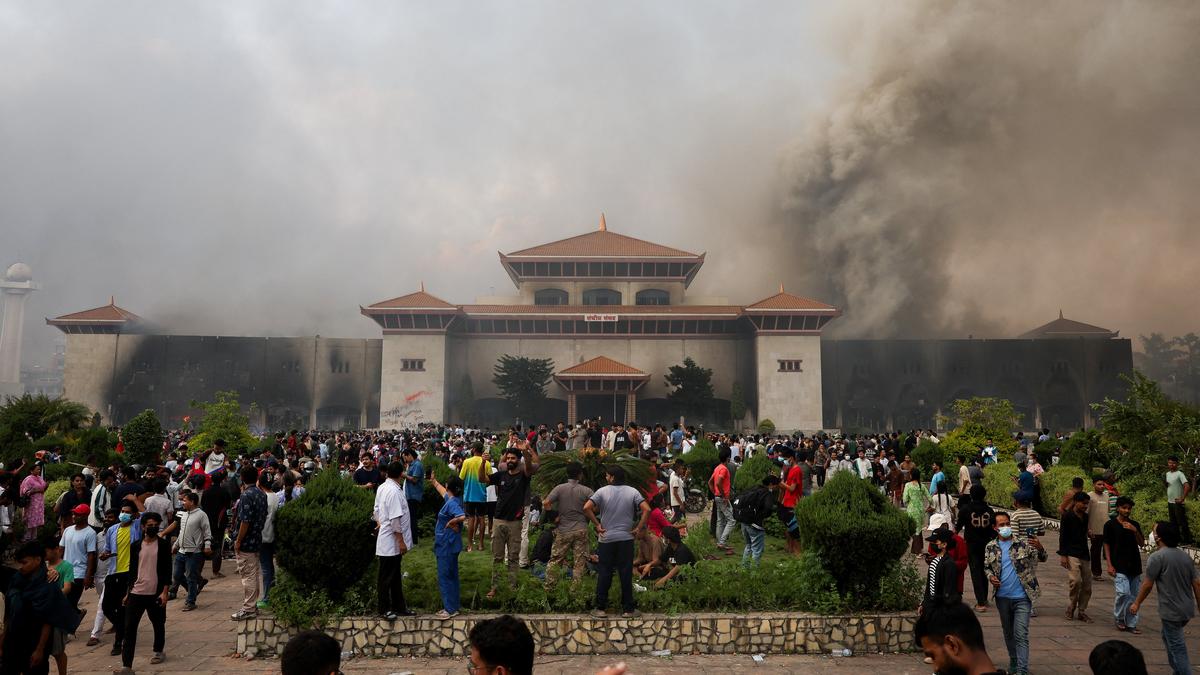
On September 4, 2025 in Nepal, the (then) ruling Communist Party of Nepal (Unified Marxist-Leninist)’s K.P. Sharma Oli-led government banned 26 major social media platforms, citing non-compliance with registration requirements. This triggered widespread Gen Z-led protests from September 8, with demonstrators viewing it as an attempt to silence dissent. The protests quickly escalated from peaceful gatherings in Kathmandu to violent confrontations as demonstrators marched toward Parliament. At least 34 people have died and over 1,000 were hospitalised. The next day, multiple government buildings were attacked, including Parliament, the Supreme Court, and the Prime Minister’s office complex. Politicians’ homes were burnt down and prisoners freed from jails, including arrested politician and ex-minister Rabi Lamichhane of the Rastriya Swatantra Party (RSP).
Prime Minister Oli also resigned on September 9. After three days of negotiations involving the President, Army Chief General Ashokraj Sigdel, and Gen Z leaders, former Supreme Court Chief Justice Sushila Karki was appointed as interim Prime Minister with a mandate to conduct elections by March 2026. She immediately recommended dissolving Parliament.
Also read | ‘Unconstitutional’, ‘arbitrary’: Nepal parties slam House dissolution move
What are the reasons for the protest beyond the social media ban?
In recent years, many youngsters of Nepal have migrated out of the country for better job opportunities. Social media outlets are used by a bulk of such people and others, not just for venting about concerns on the nature of governance but also for communication and business. Shutting down these outlets, therefore, was seen as a major inconvenience. The youth, however, did not term the protests as something targeted at the social media ban, but as an agitation against corruption in governance.

Ever since the 2015 Constitution, power has alternated between three veteran leaders – Mr. Oli, Mr. Pushpa Kamal Dahal (Prachanda) of the Communist Party of Nepal (Maoist-Centre), and Mr. Sher Bahadur Deuba of the Nepali Congress. Despite the relatively progressive Constitution, governments have been perceived as corrupt and unable to improve economic conditions, providing unstable governance through constantly changing alliances.
What makes this uprising different from other Jan Andolans?
The 2025 Gen Z uprising differs fundamentally from Jan Andolan 1 (1990) and Jan Andolan 2 (2006) in leadership, triggers, and objectives.
Unlike previous movements led by established political parties like the Nepali Congress and UML in 1990, and the Seven Party Alliance with Maoists in 2006, the 2025 protests were driven by Gen Z activists with no traditional party affiliations. The movement was largely coordinated through social media platforms like Instagram and Discord rather than formal political structures.
Jan Andolan 1 was triggered by an Indian trade embargo and aimed at ending the Panchayat system to establish constitutional monarchy. Jan Andolan 2 sought to end absolute monarchy and establish a republic through a Constituent Assembly. The 2025 uprising occurred within an existing democratic republic but challenged the entire political class, demanding dissolution of Parliament and establishment of a new leadership outside traditional party structures.
The previous movements operated within or sought to create new constitutional frameworks. The 2025 protests represent a rejection of the post-2015 political settlement rather than seeking systemic constitutional change.
Were monarchist forces behind the violence?
In the violence on September 9, multiple government buildings were targeted, including Parliament, the Supreme Court, and the Singha Durbar office complex, which houses the Prime Minister’s office and other ministries. Politicians’ homes were also attacked and burnt. The buildings of Nepal’s largest media house, Kantipur, were also burnt, but the group’s flagship English-language newspaper, The Kathmandu Post, managed to bring out its print edition, even as its internet servers were down.

Gen Z activists claimed that vandalism and arson were not done by them but by miscreants who infiltrated the protests. The protests evolved beyond the original movement’s peaceful intentions into widespread destruction of state infrastructure, suggesting involvement of other elements beyond the core Gen Z organisers.
While it is too early to say that pro-monarchy activists were responsible for the September 2025 violence, there has been a pattern of pro-monarchist activity in recent months. In March 2025, pro-monarchy rallies turned violent, resulting in casualties when royalist forces clashed with security personnel. Former king Gyanendra’s arrival in Kathmandu that same month sparked rallies calling for monarchy’s return, supported by the Rastriya Prajatantra Party.
How was the interim government formed?
Following Mr. Oli’s resignation, Nepal entered a three-day power vacuum with intense negotiations among key stakeholders. The selection process involved the President’s Office, the Nepal Army, Gen Z leaders, and major political parties, with the Army Chief playing a crucial mediating role.
Hami Nepal, a non-profit organisation led by 36-year-old Sudan Gurung, originally established for earthquake relief in 2015, emerged as a key voice. The organisation had gained credibility through transparent disaster relief work during COVID-19. Gen Z youth conducted extensive online discussions through social media before collectively endorsing Sushila Karki, a former Chief Justice of the Supreme Court.

Several prominent figures were considered, including Kathmandu Mayor Balendra Shah (who ultimately endorsed Ms. Karki), former Nepal Electricity Authority chief Kulman Ghising, ex-education minister Sumana Shrestha of the RSP, and Dharan Mayor Harka Sampang.
President Ram Chandra Poudel appointed Ms. Karki under Article 61 of the Constitution after extended consultations, citing “extraordinary circumstances.”
Is the dissolution of Parliament constitutional?
The dissolution could likely be unconstitutional. Article 76(7) of Nepal’s 2015 Constitution allows dissolution only after failed Prime Minister appointments and requires the PM’s recommendation. Article 66(2) mandates Presidential actions must occur “on [the] recommendation of the Council of Ministers.” No constitutional provision permits dissolution based on public protests alone.
The fact that dissolution occurred immediately after the interim PM’s appointment makes it constitutionally questionable, as it bypassed prescribed procedures and violated separation of powers principles. This could constitute grounds for judicial review by the Supreme Court’s Constitutional Bench.
Major political parties including the Nepali Congress, CPN-UML, and CPN (Maoist Centre), along with the Nepal Bar Association, have condemned the dissolution as “unconstitutional” and “arbitrary,” with lawyers warning that it undermines constitutional supremacy and contradicts previous Supreme Court rulings on parliamentary reinstatement.
What challenges do this crisis pose for Nepal’s democratic future?
The 2025 uprising highlights fundamental flaws in Nepal’s post-2015 political settlement. While the 2015 Constitution established a progressive federal democratic republic with provisions for inclusive representation, its implementation has been marked by chronic political instability.
Since 2015, power has rotated among the same three leaders through constantly shifting alliances rather than ideological differences. This “musical chairs” approach to governance has prevented consistent policy implementation and economic development, fuelling public disillusionment.
Besides, the Constitution’s federal structure remains incomplete, with disputes over provincial boundaries and resource distribution unresolved. The Gen Z movement’s success in forcing extra-constitutional change was an outcome of its impatience with traditional democratic processes.
The interim government’s ability to conduct credible elections by March 2026 and whether new political forces can emerge to challenge the established triumvirate will be crucial tests.
Nepal’s democratic future depends on whether a newly reconstituted political class can move beyond patronage-based politics toward genuine policy competition, complete the federal transition envisioned in the Constitution, and address youth unemployment and migration.
However, if anti-democratic forces exploit this moment to reverse the gains of the previous Jan Andolans, then Nepal will undergo a democratic regression – in line with what has transpired in Bangladesh following its own anti-government, student-driven protests last year.