


Skip to content
  • Facebook
  • X
  • Linkedin
  • WhatsApp
  • YouTube
  • Associate Journalism
  • About Us
  • Privacy Policy
  • 033-46046046
  • editor@artifex.news
Artifex.News

Artifex.News

Stay Connected. Stay Informed.

  • Breaking News
  • World
  • Nation
  • Sports
  • Business
  • Science
  • Entertainment
  • Lifestyle
  • Toggle search form
  • Case Against BJP Leader CT Ravi Over Social Media Post: Karnataka Poll Body
    Case Against BJP Leader CT Ravi Over Social Media Post: Karnataka Poll Body Nation
  • ‘Gutted Not To Watch Stars In Action’: Fans React As Day 2 Of India vs Bangladesh Test Gets Washed Out
    ‘Gutted Not To Watch Stars In Action’: Fans React As Day 2 Of India vs Bangladesh Test Gets Washed Out Sports
  • Why are India’s communications satellites so heavy? | Explained
    Why are India’s communications satellites so heavy? | Explained Science
  • Man arrested for setting fire to U.S. Sen. Bernie Sanders’ office door in Vermont
    Man arrested for setting fire to U.S. Sen. Bernie Sanders’ office door in Vermont World
  • Wimbledon 2024 Women’s Singles Final Highlights: Krejcikova Defeats Paolini In 3-Set Thriller To Win Maiden Wimbledon Title
    Wimbledon 2024 Women’s Singles Final Highlights: Krejcikova Defeats Paolini In 3-Set Thriller To Win Maiden Wimbledon Title Sports
  • Rajnath Singh On Death Of 5 Armymen In Jammu’s Kathua
    Rajnath Singh On Death Of 5 Armymen In Jammu’s Kathua Nation
  • Access Denied
    Access Denied Nation
  • S Jaishankar’s “Karma” Swipe At Pakistan
    S Jaishankar’s “Karma” Swipe At Pakistan Nation
Scientists confirm HIV capsid is a good drug target despite resistance

Scientists confirm HIV capsid is a good drug target despite resistance

Posted on February 24, 2026 By admin


In 1987, four years after the discovery of HIV as the causative agent of AIDS, scientists reported the first drug effective against the virus, called zidovudine. Zidovudine targeted a viral enzyme called reverse transcriptase, and prevented the virus from completing its life-cycle. However, zidovudine was no magic bullet. It could hold the virus at bay for a while, but HIV quickly learned to outsmart it, and the resulting drug resistance meant many patients soon lost the drug’s protective effect.

It quickly became clear why zidovudine alone would not keep HIV in check. The virus is exceptionally good at making copying ‘mistakes’ when it turns its RNA into DNA, generating endless new variants. Some of these variants possess the property of drug resistance. Importantly however, these changes can’t happen just anywhere. Some parts of the virus are so essential to its survival that they must remain largely unchanged. Altering them would break the virus itself.

So researchers decided to aim more drugs at these ‘must keep’ regions, where the virus has little room to evolve. The insight led to the development of multiple antiretroviral drugs targeting different viral proteins, including reverse transcriptase, protease, and integrase, laying the foundation for combination therapies that could suppress the virus far more effectively and durably.

Provocative question

In 1999, a paper in the journal Science detailed how another protein of HIV, called the capsid, folds into its unique protective shape. The study was important because the capsid is a structure that protects the virus’s RNA from the environment. The work provided the breakthrough to understanding how the capsid folds into its unique 3D structure. Soon, the same team reported that most mutations in the capsid protein could render HIV incapable of infecting cells, showing that it was much more vulnerable than previously believed.

The discovery raised a provocative question: if the capsid was so essential, and so fragile, could it itself be a drug target? For years, the answer seemed to be ‘no’. Scientists at major pharmaceutical companies started working on potential molecules that could latch onto the capsid and disrupt its carefully balanced structure, effectively stopping the virus in its tracks.

While one candidate seemed promising, it had a persistent problem: it didn’t easily dissolve in water. Since solubility was a basic requirement for most medicines to circulate reliably in the body, the researchers had to keep tweaking it to see if they could improve its solubility while maintaining its potency. Then, after more than two decades of persistence, the problem was turned on its head. 

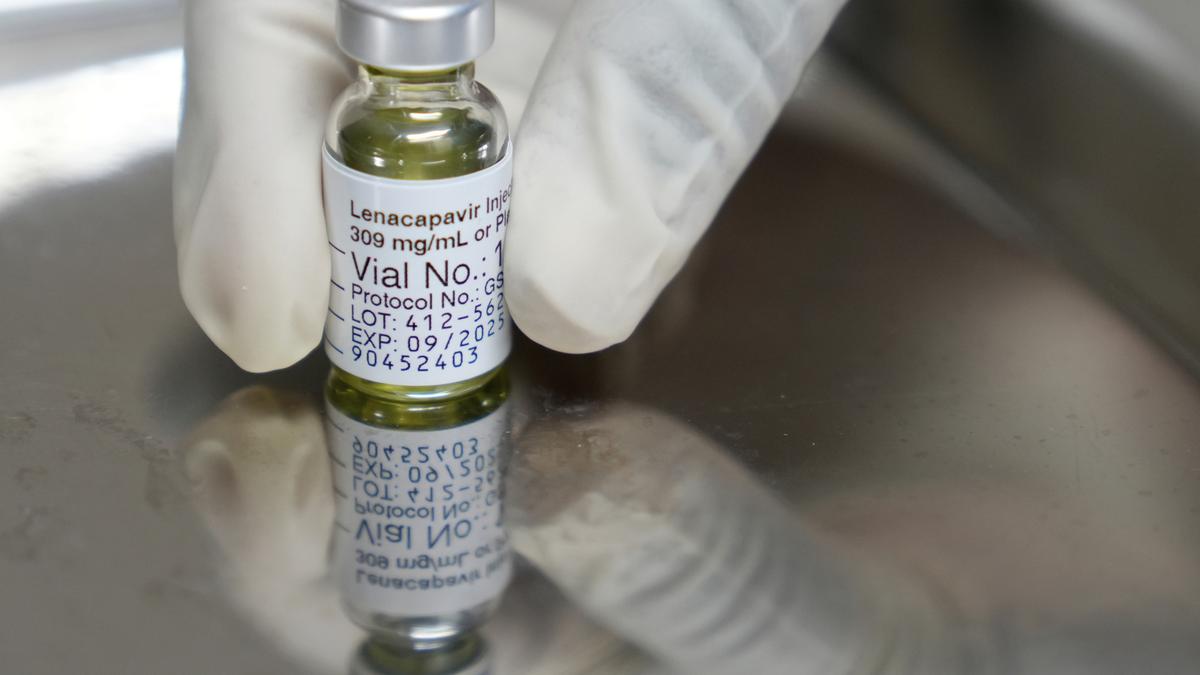
On June 18, 2025, the U.S. Food and Drug Administration (FDA) approved lenacapavir, the world’s first capsid-based HIV inhibitor. Its poor solubility, once a liability, became its greatest strength. Instead of being taken daily, lenacapavir is injected under the skin of the abdomen just once every six months, forming a slow-release reservoir that steadily delivers the drug into the bloodstream.

The results were astonishing: in clinical trials, it prevented HIV infection in high-risk individuals with 100% effectiveness. Lenacapavir was not a cure but, as a Science article put it, it may be the next best thing to an HIV vaccine.

Acting solo

However, one hard-learnt lesson from four decades of HIV research is that no single drug has ever escaped resistance. Given enough time, the virus finds a way, which is why HIV is always treated with combinations of drugs and never one alone.

In a study published recently in Science Translational Medicine, researchers from across the U.S., including the pharmaceutical company Gilead Sciences, examined viruses from patients who received lenacapavir as part of treatment, rather than prevention, and identified a small set of changes in the capsid protein, most commonly involving positions known that reduced the drug’s effectiveness.

Importantly, these resistance mutations emerged primarily when lenacapavir was acting alone, without other fully active drugs in the regimen. When lenacapavir was used in proper combination therapy, viral suppression was largely maintained, reinforcing the long-standing rule of HIV treatment: that the virus can escape one blockade but not many at once.

To test whether the resistance came at a price, the researchers engineered the drug-resistant viruses in the laboratory. They took capsid sequences from patients who had developed resistance, inserted those exact mutations into a standard laboratory HIV strain, then watched how these altered viruses behaved.

The results were striking. Viruses carrying the strongest resistance mutations often replicated at less than 20-30% of normal levels, even in the absence of the drug. In effect, escaping lenacapavir meant HIV had to damage one of its own components, the capsid, and that was the cost of its survival.

Shells of other viruses

The study reaffirmed the longstanding belief that the viral capsid is actually a very good drug target and that the virus can’t afford to change it too much. This certainty opens the door to a new generation of drugs that target the capsid, with the reassurance that resistance will come at a high cost to the virus. With this proof in hand, researchers can now explore capsid-focused strategies more aggressively, combining them with existing therapies.

Beyond HIV, the work also adds to proof that it’s a good idea for researchers to examine the protective shells of other viruses, which may be similarly vulnerable.

The four-plus decades of HIV research are a reminder that scientific progress is often slow, uneven, and unglamorous. For years, capsid inhibitors were under scrutiny and may have even been abandoned permanently if not for those researchers who kept at it, unwilling to abandon an idea they believed the science supported. If the story of lenacapavir teaches us anything, it is that sometimes, breakthroughs are the result of persistence and not inspiration.

Arun Panchapakesan is an assistant professor at the Y.R. Gaitonde Centre for AIDS Research and Education, Chennai.

Published – February 25, 2026 05:30 am IST


Source link

Science

Post navigation

Previous Post: Access Denied
Next Post: Access Denied

Related Posts

  • New book throws light on the people who helped build India’s first rockets
    New book throws light on the people who helped build India’s first rockets Science
  • European carbon removal specialists to support new projects in India
    European carbon removal specialists to support new projects in India Science
  • India aims to send astronaut to the moon by 2040
    India aims to send astronaut to the moon by 2040 Science
  • New research traces how Africa’s wildcats became today’s house cats
    New research traces how Africa’s wildcats became today’s house cats Science
  • How reasonable accommodations at workplaces improve mental health for persons with disabilities
    How reasonable accommodations at workplaces improve mental health for persons with disabilities Science
  • Dogs understand more than they let on, create mental images of known words: Study
    Dogs understand more than they let on, create mental images of known words: Study Science

More Related Articles

Naturally occurring bile acid can blunt statin-induced diabetes Naturally occurring bile acid can blunt statin-induced diabetes Science
Study finds distinct blood markers for early detection of gallbladder cancer Study finds distinct blood markers for early detection of gallbladder cancer Science
India selects two astronaut-designates for upcoming Axiom-4 mission to International Space Station India selects two astronaut-designates for upcoming Axiom-4 mission to International Space Station Science
With Sci-Hub gone, will the ‘One Nation, One Subscription’ scheme step up? With Sci-Hub gone, will the ‘One Nation, One Subscription’ scheme step up? Science
PM Modi “directs” ISRO to land man on moon by 2040 PM Modi “directs” ISRO to land man on moon by 2040 Science
Northern Lights: Severe solar storm triggers rare auroral arc in Ladakh sky Northern Lights: Severe solar storm triggers rare auroral arc in Ladakh sky Science
SiteLock

Archives

  • May 2026
  • April 2026
  • March 2026
  • February 2026
  • January 2026
  • December 2025
  • November 2025
  • October 2025
  • September 2025
  • August 2025
  • July 2025
  • June 2025
  • May 2025
  • April 2025
  • March 2025
  • February 2025
  • January 2025
  • December 2024
  • November 2024
  • October 2024
  • September 2024
  • August 2024
  • July 2024
  • June 2024
  • May 2024
  • April 2024
  • March 2024
  • February 2024
  • January 2024
  • December 2023
  • November 2023
  • October 2023
  • September 2023
  • August 2023
  • July 2023
  • June 2023
  • May 2023
  • April 2023
  • March 2023
  • February 2023
  • January 2023
  • December 2022
  • November 2022
  • October 2022
  • September 2022
  • August 2022
  • July 2022
  • June 2022
  • May 2022

Categories

  • Business
  • Nation
  • Science
  • Sports
  • World

Recent Posts

  • IPL 2026 | A win against LSG will do a world of good for CSK
  • Karnataka maps 86.37% electors with family linkage in draft voter roll exercise; Bengaluru continues to trail State average
  • Vessel seized off UAE’s Fujairah and heading toward Iranian waters, UKMTO says
  • New govt should implement existing welfare schemes, says Congress MP
  • NEET UG paper leak 2026: CBI produces five accused before Delhi court

Recent Comments

  1. CordellVoice on UP Teacher Who Asked Students To Slap Muslim Classmate
  2. Wesleyunfix on UP Teacher Who Asked Students To Slap Muslim Classmate
  3. JasonDag on UP Teacher Who Asked Students To Slap Muslim Classmate
  4. JamesHeR on UP Teacher Who Asked Students To Slap Muslim Classmate
  5. RafaelNar on UP Teacher Who Asked Students To Slap Muslim Classmate
  • Biden Declines Public Negotiation Of US Stance On Israel Attacking Iran
    Biden Declines Public Negotiation Of US Stance On Israel Attacking Iran World
  • India’s Electricity Demand Just For ACs To Exceed Africa’s Total Consumption: IEA
    India’s Electricity Demand Just For ACs To Exceed Africa’s Total Consumption: IEA Nation
  • Members of Parliamentary Standing Committee visit Polavaram project in Andhra Pradesh
    Members of Parliamentary Standing Committee visit Polavaram project in Andhra Pradesh Nation
  • Access Denied Business
  • BJP Suspends J&K Unit Vice President, 2 Others For Running Against Party Candidates
    BJP Suspends J&K Unit Vice President, 2 Others For Running Against Party Candidates Nation
  • Rural Development Ministry Allocated With Rs 1.88 Lakh Crore In Budget 2025
    Rural Development Ministry Allocated With Rs 1.88 Lakh Crore In Budget 2025 Nation
  • Access Denied Sports
  • Stock markets decline for second day on losses in private banks, weak global trends
    Stock markets decline for second day on losses in private banks, weak global trends Business

Editor-in-Chief:
Mohammad Ariff,
MSW, MAJMC, BSW, DTL, CTS, CNM, CCR, CAL, RSL, ASOC.
editor@artifex.news

Associate Editors:
1. Zenellis R. Tuba,
zenelis@artifex.news
2. Haris Daniyel
daniyel@artifex.news

Photograher:
Rohan Das
rohan@artifex.news

Artifex.News offers Online Paid Internships to college students from India and Abroad. Interns will get a PRESS CARD and other online offers.
Send your CV (Subjectline: Paid Internship) to internship@artifex.news

Links:
Associate Journalism
About Us
Privacy Policy

News Links:
Breaking News
World
Nation
Sports
Business
Entertainment
Lifestyle

Registered Office:
72/A, Elliot Road, Kolkata - 700016
Tel: 033-22277777, 033-22172217
Email: office@artifex.news

Editorial Office / News Desk:
No. 13, Mezzanine Floor, Esplanade Metro Rail Station,
12 J. L. Nehru Road, Kolkata - 700069.
(Entry from Gate No. 5)
Tel: 033-46011099, 033-46046046
Email: editor@artifex.news

Copyright © 2023 Artifex.News Newsportal designed by Artifex Infotech.