






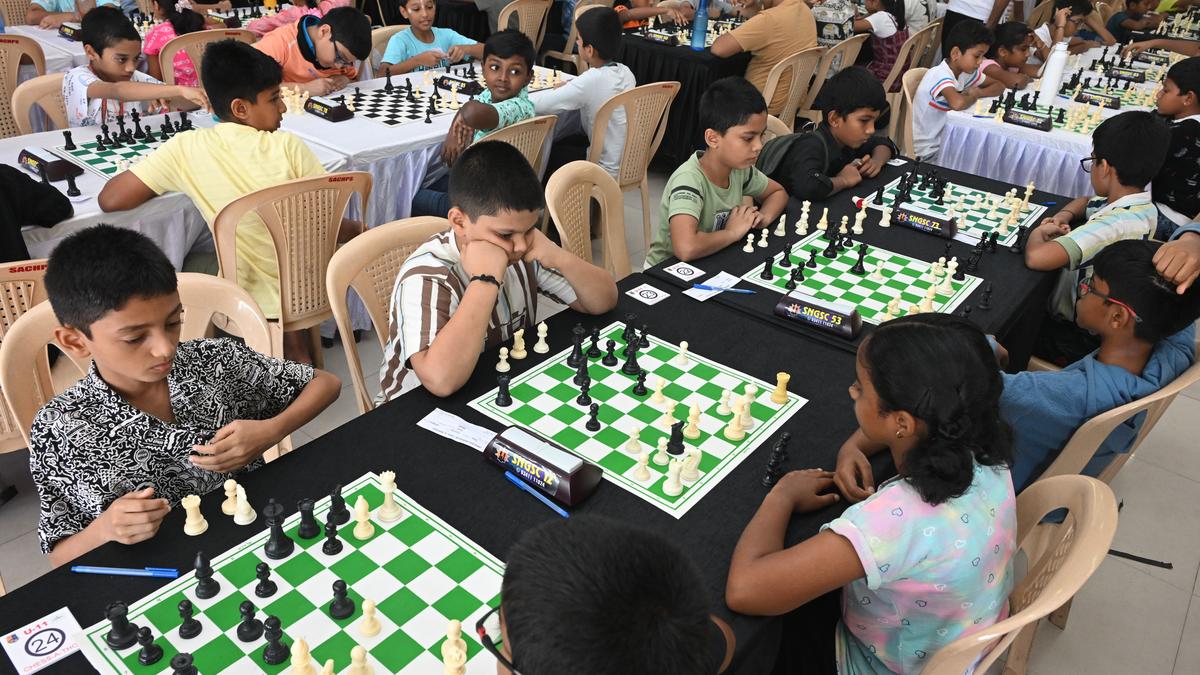
Those who perform exceptionally well at a young age versus those who do so in adulthood are rarely the same people, according to a December 2025 study in Science.
This means “most early top performers don’t become top performers at peak age, and … most top performers at peak age weren’t early top performers,” the authors wrote in their paper.
By reviewing existing studies on top-performing athletes, chess players, scientists, and famous classical music composers, the researchers also reported to have identified factors correlated with exceptional performance.
The finding suggests a “broad-base skill set is important for people to succeed later in life,” said Ankush Gupta, associate professor at Mumbai’s Homi Bhabha Centre for Science Education (HBCSE).
This can change how competitive examinations, such as the IITs’ Joint Entrance Examination (IIT-JEE) and the Science Olympiads, identify and train top-performing students, he added.
Dr. Gupta also serves as the Academic Coordinator of India’s Chemistry Olympiad.
Levels of human performance
The authors began by reviewing the research literature to investigate the factors that determine exceptional human performance, allowing them to “examine all of the available evidence we could find,” Brooke Macnamara, one of the study’s authors and associate professor of psychological sciences at Purdue University, said.
In the review, they included 19 existing datasets of about 35,000 adult top-performing athletes, chess players, classical music composers, artists, film directors, elite university graduates, and Nobel laureates and compared the findings against those from 66 studies of young and sub-elite performers (significantly better than most in a field but fall short of making it to the top-tier).
To check whether top-performing children and adolescents went on to become top-performing adults, the team used a mathematical equation to quantify the overlap between sets of junior and senior top athletes. They found that these groups differed by about 90%. They also obtained similar results for cohorts of top-performing junior and senior chess players.
When the team asked whether top graduates of elite schools eventually go on to become top earning adults, they once again found the populations differed by 85%.
Making a top performer
The authors reviewed the selected studies for factors correlated to top-performance at younger and older ages. They found exceptionally well-performing children and adolescents started in their field early and showed higher levels of discipline-specific practice compared to sub-elite performers in the same age group.
How could multidisciplinary practice help? The authors had three hypotheses: (i) engaging with multiple disciplines early on increases performers’ chances of finding one that is best suited for them. (ii) Early multidisciplinary training equips performers with the skills they need for later discipline-specific learning, including the ability to think flexibly and integrate different ways to explore solutions. (iii) Early discipline-specific practice can increase the chances of performers burning out, ceasing to enjoy that discipline, or — in case of sports — getting injuries that hinder their progress later.
Sindhu Mathai, a science education professor at Azim Premji University, Bengaluru, who wasn’t involved in the study cautioned that the study only points to a correlation between early multidisciplinary training and later exceptional performance. It does not propose a causal link.
Seeing value
Dr. Gupta said he sees value in training well-performing school students in multiple disciplines.
By way of example, he said success in the IIT-JEE is often seen as an indicator of being a top-performing student. However, this examination uses multiple-choice questions to test “a limited skill set” in sciences and mathematics, according to him.
“You are assuming that these students will do exceptionally good in engineering and science problem solving, without acknowledging that problem solving often requires observing real life phenomena, making inferences from them, and troubleshooting abilities,” he said. Exposing students to multidisciplinary training enhances these skills, he believes.
The authors agreed. “Admission and training policies of many elite training institutions … typically aim to select the top-early performers and then seek to further accelerate their performance through intensified discipline-specific training,” they write.
While such training fosters “young high-achievers,” this often comes at the “expense of long-term acquisition of the most exceptional human achievements,” they added.
Words of caution
There is one caveat, however. In Dr. Gupta’s experience, multidisciplinary training would fail without the students getting “some support in how to synthesise” their knowledge.
For example, he said, it is easier for top-performing chemistry students to see why they need to study computer science and physics to be better at chemistry. However, he added, it’s not clear even to top-performing chemistry or computer science students how studying chemistry can help them be better at computer science. The task of explaining that would fall on the students’ teachers and mentors.
Dr. Macnamara also echoed Dr. Mathai’s caution, saying “There is no ‘if you do X, Y will follow’.”
To establish such a causal relationship, future research will have to investigate whether aspects other than training, like a student’s family background and individual characteristics, also played roles in their exceptional performance, Dr. Mathai added.
Two scientists have challenged the correlation itself. According to University of California Berkeley professor Alexandro Dimakis and University of Bristol professor Michel Nivard, the study doesn’t adequately account for the base-rate fallacy and Berkson’s paradox.

Researchers commit base-rate fallacy when they ignore the general prevalence of a trend in favour of specific cases. This means Macnamara et al.’s main finding, that top-performing children and adults are different groups, can be attributed to there being “many many more non-elite young candidates,” Dr. Dimakis wrote on X.com. The claims the study makes aren’t false, but they are presented without respective base rates, Dr. Nivard added in his comment, which he posted as a preprint paper.
That said, Dr. Dimakis conceded the authors do address base rates, just later in the paper.
Berkson’s paradox, a.k.a. collider bias, is a statistical fallacy that arises because a study observed one kind of event more than others. Both Dr. Dimakis and Dr. Nivard referred to one sentence in the paper: “Across the highest adult performance levels, peak performance is negatively correlated with early performance.”
The paradox says this negative correlation would disappear if one included the general population in the sample.
Dr. Macnamara said the criticism doesn’t hold.
“We are not extrapolating to the general population or young and sub-elite performers,” she said (emphasis in the original).
In an email exchange with this reporter, Dr. Dimakis agreed “the authors do not extrapolate”. However, “they also do not discuss how this negative correlation could be due to Berkson’s paradox. The terms ‘Berkson’ or ‘collider’ do not appear in the paper.”
Dr. Dimakis agreed “completely” with the study’s “proposed lessons”, that “students should be able to try different sports and different programs at later ages, that early specialisation can be a bad idea and that many students will benefit from trying more activities”.
However, he cautioned journalists and people at large against making inferences like “early specialisation does not help reach elite status at adult age” or “let kids be mediocre at multiple things instead of great at one thing”.
Such extrapolation would be a classic example of collider bias, he said. “I think the authors should have emphasised these limitations more in their paper to prevent the general public from making incorrect causal conclusions.”
Dr. Macnamara clarified the study’s conclusions as follows: “We do not say that to be a world-class performer you should practice as little as possible or be as bad as possible early on. Rather, we explicitly state world-class performers engaged in large amounts of discipline-specific practice.”
However, “world-class performers usually had accumulated less discipline-specific practice compared with those performing just below this level,” she added.
And even though world-class performers usually performed “above average early on”, their performance when they were younger was not as good as those who would “eventually perform just below world-class,” she said.
Sayantan Datta is a faculty member at Krea University and an independent science journalist.