





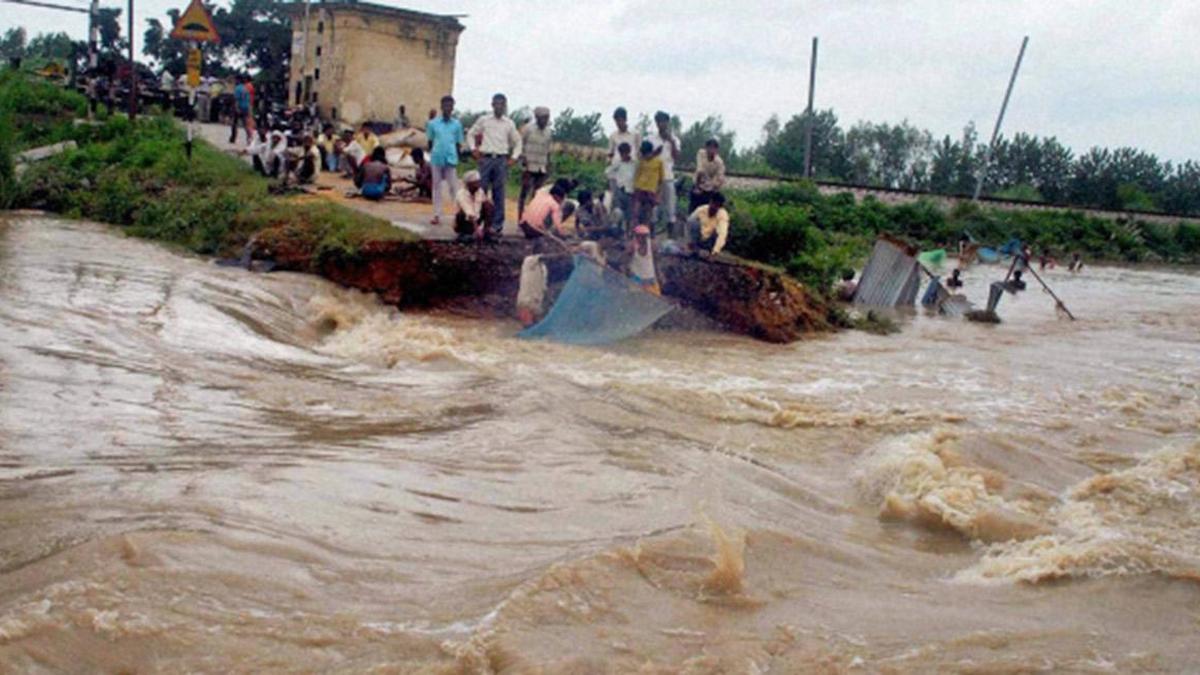
In August 2008, Bihar experienced one of the worst floods in nearly five decades when the Kosi River breached its embankment at Kusaha in Sunsari district of Nepal, killing more than 400 people and displacing thousands. A staggering 33 lakh people were affected at the peak of the flood in Bihar.
Indeed, the Kosi River breaches the walls of its embankment every few years, imperilling lives and livelihoods, and earning it the name ‘river of sorrow.’
In the eastern Gangetic plains and the adjoining floodplains, rivers have overflowed during the monsoons for centuries, causing catastrophic floods. The Kosi originates in Tibet and Nepal and later joins the Ganga in Bihar. Often called “sapta Kosi” because of its seven tributaries, it is a fragile and dynamic river that naturally carries large quantities of sediment. Over the years, the river has shifted its course by several kilometres, subsequently triggering floods.
Committee report
According to a report of the People’s Commission on the Kosi basin, an independent commission, the river has moved 120 km westwards in the last 250 years due to a heavy natural sedimentation process. Experts suggest the construction of a barrage in Nepal in the 1950s, followed by an embankment in Bihar, has significantly altered the river’s natural flow.
Embankments are artificial structures made of earth, stone or concrete, designed to control water flow in flood-prone areas. These structures are made to endure the effects of gravity, water pressure, and other external forces and are expected to remain stable over time. While they are often promoted as an ideal solution to protect settlements and enhance agriculture, experts have long warned of their limitations.
In 1951, the G.R. Garg Committee report of the Central Waterways, Irrigation and Navigation Commission warned against such projects. It was appointed after Assam decided to build an embankment, hoping to prevent floods during the monsoon. The report observed that the two main functions of a river, providing land (by eroding and depositing) and draining its basin, are disrupted by embankments. It further cautioned that these structures are useful only when the river carries less silt; otherwise they could do more harm than good.
Rather than pay heed to these warnings, however, the Assam government proceeded with building embankments along the Brahmaputra River. While the idea was simple — to prevent floods — its effects were counterproductive. In Assam, particularly, coarse silt and sand were deposited by rivers on the banks, affecting agriculture. Local communities lived in constant fear of a breach. Siltation reduced the river’s depth and made navigation more difficult.
Flood control
“The northern rivers carry a lot of silt. So if you embank them, the river keeps getting higher because of the accumulation of silt,” said E. Somanathan, head of the Centre for Research on the Economics of Climate Change, Food, Energy and Environment. “And because every monsoon the silt adds up, an embanked river after a few years turns dangerous, even though initially it provided some protection.”
This is why such incidents related to the Kosi aren’t isolated: the river breached its embankment in 1963, 1968, 1971, 1980, 1984, 1987, and in 1991, before it breached again in 2008 and 2024.
Almost exactly a year ago, when the Mahuli tributary of the Kosi River entered India and hit the Kosi barrage, the quantity of the silt in the river increased, causing devastating floods. Every year, the amount of silt threatens locals and submerges vast tracts of agricultural land.
The repeated breaches raise an important question: should embankments be considered flood-control structures at all?

Influent and affluent rivers
“Whether embankments are necessary depends on the aim,” Rahul Yaduka, a postdoctoral scholar working on the WATCON Project at The School of Oriental and African Studies, London, said. “If development is the aim, then embankments will serve the purpose because you tame the river. But people have always been living with floods for centuries.”
When the British noticed that the Kosi River was shifting its course, they found it difficult to control it, and decided to build an embankment to control the flow. But the result of this exercise was water-logging outside the embankment, causing floods for those who live between the embankment,” Dr. Yaduka added.
On the other hand, Bindhy W. Pandey, director of the Centre for Himalayan Studies at the University of Delhi, argued that embankments can play an important role in rivers in the western Himalayan region as they are less flood-prone and geologically more stable. He, however, cautioned against constructing embankments on the rivers in the eastern Himalayan region as they were vulnerable to breaches, geologically weaker and more prone to landslides.
“Rivers draining in the west are influent, meaning that as the river flows through different States, the precipitation decreases. Whereas the east-flowing rivers are affluent, that is, the amount of precipitation increases in the course of time,” said Prof. Pandey. He added that construction in such geologically weak regions must be paired with constant monitoring and a transparent rehabilitation process for the displaced people.
His argument circled back to Dr. Somanathan’s warning: that embankments may offer short-term protection but often open the door for long-term vulnerability.
‘Not a viable option’
“The US has dismantled embankments and allowed the flood to happen. When we build more infrastructure that alters the river’s course, the river bed keeps increasing silt, but floods without embankments are much milder. If an embankment is built, then we need to keep raising its height. But that requires finances,” Dr. Somanathan said.
The alternative that he proposed is to ‘learn to live with floods’.
“When we do that, we are allowing the river to act as a natural drainage system,” Dr. Somanathan said. Mahendra Yadav, member of the Kosi Nav Nirman Manch Movement, also stands by the concept of ‘living with floods’ but believes this can happen only if people between the Kosi embankment are trained with early warning systems and provided rehabilitation outside. “The solution that can be offered to people is to rehabilitate them outside the embankment because if the embankment is blocking them, they cannot get out, even with early warning systems.”
“For India, an embankment is not a viable option because we don’t have the infrastructure to maintain it,” Dr. Somanathan said. But as the embankments are a reality for many rivers in northern India, Dr. Yaduka suggested that one has to “identify ways to make them better and stable. Along with that, paleochannels (abandoned ancient river or stream channels) should be revived so that water is distributed.”
Mr. Yadav also suggests the improvement of palaeochannels, which contain the water well within their basins, preventing floods.
Tall promises
Ahead of the Bihar election this year, the National Democratic Alliance (NDA) promised “flood to fortune” in their election manifesto for the people of Bihar. The coalition assured residents that if elected to power, the newly formed government will initiate the river-linking project, embankments and canals under the “flood to fortune” model to promote agriculture and fisheries, according to the ‘Sankalp Patra’ released jointly by the BJP and NDA.
Though this promise carries with it a tone of political optimism, the State’s geography is complex and requires a deeper understanding of the long-standing ecological realities, including sedimentation and siltation. The river-linking project in question is the Kosi-Mechi project, which aims to extend the EKMC (Eastern Kosi Main Canal) up to the river Mechi, a tributary of the river Mahananda, mainly to provide irrigation to the water-scarce region along the Mahananda basin during the kharif season. However, in reality, if it rains near the Kosi catchment area, the monsoon reaches Mahananda in a day or two and there is barely any need for water during the monsoon.
“But if the issue [flooding] was to be solved by an embankment, then there should have been no floods at all, but that is not the case. If the river-linking project is completed, 5,247 cusecs of extra water will be diverted towards the Mechi River. But in the floods last year, Kosi river carried nearly 6 lakh cusecs of water. So, we are not reducing the flood water by building embankments or by linking the rivers,” Mr. Yadav explained.
Every year, Moreover money has to be spent on raising the embankment, but that is not a sustainable solution, he added. “In fact, it is a luxurious choice. Even though money is spent, does it actually sustain? And more importantly, who is benefiting from it? The locals stuck [with] the embankment face the wrath without any rehabilitation facilities.”
“With the embankment, the flood has increased nearly four times,” Mr. Yadav said. He added that desilting should be done according to scientific methods.
Dr. Somanathan strongly argued that embankments disturb the ecological integrity, groundwater, and biodiversity, and expressed hope that the discourse would change from flood-control to flood-resistance.
For the families that lose their homes every year when a river swells, the embankment is both a threat and a promise, a line drawn against nature that never seems to hold for long. But as the Kosi’s story illustrates, every time an embankment is raised, the river is quick to reclaim its domain.